Irezumi Was an Art Before It Was a Warning
· 10 min read
Long before it became the sign bathhouses warn about, irezumi was one of Japan's most demanding art forms, carved into skin by hand over months and years. A look at the craft, the woodblock heroes who inspired it, and the masters who still practice it.
Most visitors to Japan first meet irezumi on a sign. It is the small notice beside the bathhouse door, the one that says tattooed guests cannot come in, and for many people that warning is the whole story. It should not be. Long before irezumi became something a business turns away at the door, it was one of the most ambitious art forms in the country, a painting that covered a whole body and took years of hand work to finish.
The word itself is modest. Irezumi simply means inserting ink. Around that plain phrase, though, Japan built an entire craft culture: masters who train for the better part of a decade, designs borrowed from famous woodblock prints, and clients who commit their backs, arms and legs to a single composition. The warning at the door is a late chapter. The craft of irezumi is the book.
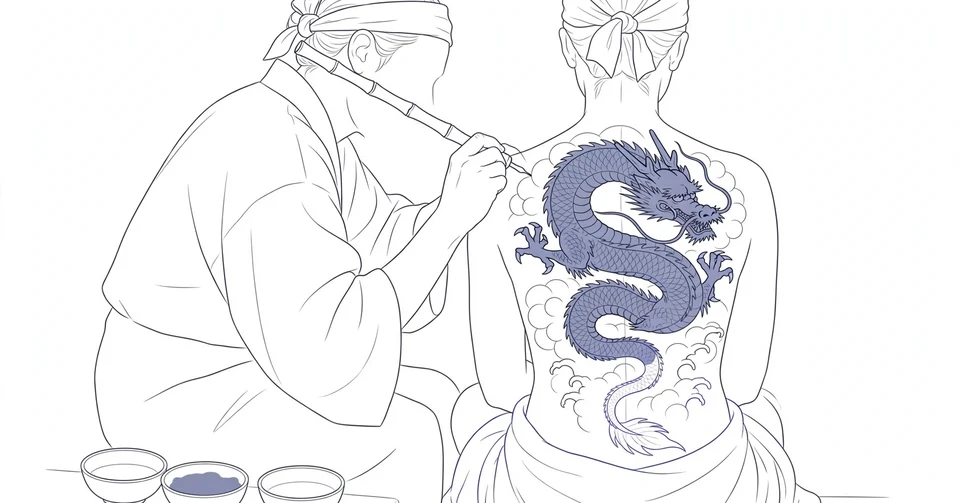
What surprises most people is how little of a traditional piece belongs to the customer. In traditional irezumi, the master decides the design, its placement and its pace, and the client mostly decides to endure it. That arrangement sounds strange now, but it explains the results. A back finished by a single horishi over several years has a unity that a shelf of separate tattoos, however good each one is, rarely achieves.
What irezumi means, and what it is not
The literal translation, inserting ink, is only the start. Japanese has a second word that practitioners often prefer, horimono, which means a carved thing. The verb at its root, hori, is the same one used for the craftsmen who carved the wooden blocks for prints, and that is no accident. Traditional tattooing in Japan grew out of the woodblock world, and its artists have always described their work as carving rather than drawing.
Understood that way, irezumi in its classic form is not a small picture placed on the skin. It is one continuous composition that treats the body as a single canvas. The back carries the central scene, and the design flows outward over the shoulders, arms, chest and thighs, usually leaving a strip of bare skin down the middle of the chest so the piece opens like a garment. Backgrounds of waves, clouds and wind bars hold the main figures together, so the whole body reads as one image instead of a gallery of separate ones.
This is also what separates traditional irezumi from the modern tattoo scene around it. Most tattooing in Japan today is done by machine, in the Western manner, with the customer bringing a design and leaving the same afternoon. That world is real and growing, but it is a different craft with different rules. The hand tradition behind irezumi is slower, more formal, and far more demanding of everyone involved, which is exactly why it produced work that museums now photograph.
Carved by hand, the tebori way
The technique behind irezumi is called tebori, which translates as carving by hand, and the description is literal. The horishi, the tattoo master, works with a bundle of needles fixed to the end of a long handle, traditionally of bamboo or wood, sometimes metal, with the needles bound in place by silk thread. There is no motor. The handle is pushed and rocked so the needles enter the skin in a steady rhythm, and the soft clicking sound the needles make even has its own name, shakki.
The ink is part of the tradition too. The classic black, often called Nara ink, settles under the skin with a blue-green cast that old photographs show clearly. Shading and color are built up gradually, because hand work lays pigment down differently from a machine. Nothing about irezumi is built for speed.
A large piece follows a set order. After a first consultation, the outline is drawn and tattooed, often freehand, in one long sitting. Shading and color then proceed in weekly visits, or whenever the client can return, until the work is done. When the tattoo is finished, the artist signs his name in a small space reserved for that purpose, most often somewhere on the back. A full body suit, covering the back, arms, chest and thighs, can take up to five years of weekly visits to complete, and cost in excess of US$30,000.
Behind every such piece stands a long apprenticeship. A student horishi may train for years under one master, sometimes living in the master's house, and the early years are spent cleaning the studio, watching, practicing on his own skin, making needles, mixing ink and copying the master's designs before he is allowed to touch a client. On finishing his training he receives a tattoo name built from the word hori and a syllable taken from his master's name, which is why the great lineages of irezumi are numbered, the second and third of a name, like generations of one house.
My own feeling, after reading about this training, is that the patience is not a side effect of the art. It is the art. The calendar is one of the materials, alongside ink and skin, and an irezumi piece that took five years carries that time visibly in a way no faster method can fake.
The heroes who stepped off the page
Decorative irezumi flowered in the Edo period, and its spark was a book. Suikoden, the Chinese tale of 108 rebel heroes, reached Japanese readers in a popular edition in 1757 and became a sensation. Its woodblock illustrations showed heroes whose bodies carried dragons, tigers, flowers and mythical beasts. A generation later, the print artist Utagawa Kuniyoshi produced his famous series of the Suikoden heroes, and the images fixed the look of irezumi in the public mind: a brave man, a bare back, a dragon moving across it.
Readers wanted what the heroes wore. The deep connection between ukiyo-e prints and horimono went further than pictures. Woodblock carvers, who already owned the skills and some of the very tools, began tattooing themselves, working with the chisels, gouges and Nara ink they knew from printing. The shared verb, hori, became a shared profession.
Who actually wore the full pieces is still debated by scholars. It is certain that irezumi became closely associated with Edo's firemen, the hikeshi, who treated their tattoos as a form of spiritual protection in a job that sent them onto burning roofs. Craftsmen, carpenters and laborers took irezumi up as a mark of bravery and belonging. Some scholars add wealthy merchants to the list, men forbidden by law from displaying their riches, who are said to have worn expensive work hidden under their clothes like a private kimono. The honest summary is that the art belonged mostly to people whose work was physical and whose status was low, and that it let them carry, on their own skin, the heroism the official world denied them.
The classic motifs settled early and have barely changed: dragons and koi, tigers and peonies, cherry blossom on the wind, heroes and Buddhist guardians, all of it stitched together by waves and clouds. If you have seen traditional irezumi in a photograph, a dragon crossing a back under drifting blossom, you have seen Kuniyoshi's imagination at one remove.
The same ink once served as a sentence
The warning at the bathhouse door has its own long history, and it begins with a darker use of the same needles. From the Kofun period onward, Japanese authorities tattooed criminals as punishment, a practice that continued into the Edo period under the name irezumi kei. The mark announced the crime, thieves tattooed on the arm, murderers on the head, so a stranger's skin could be read like a record. Ink, in other words, carried two opposite meanings in the same city: on one man's back, a masterpiece; on another man's arm, a sentence.
When Japan opened to the world at the start of the Meiji period, the new government, anxious to appear civilized to Western eyes, outlawed tattooing in 1872. Irezumi did not die. It went underground, and in one of history's small ironies, foreign sailors and travelers became some of its keenest customers, seeking out Japanese masters and carrying the work home on their own bodies. The ban stayed in place until 1948, when the occupation authorities lifted it.
That long illegality did the lasting damage. In the decades when irezumi could not be an open trade, its full body suit became associated above all with the yakuza, Japan's organized crime groups, whose members adopted it as a uniform of commitment. Bathhouses, pools and gyms responded with blanket bans, not because ink is unhygienic, but because a simple rule at the door was easier than judging each guest. The neighborhood sento, Japan's everyday public bathhouse is where most ordinary people still meet that rule today, and the related question of how onsen tattoo rules actually work, bath by bath, deserves its own telling.
It is worth adding, because it complicates the stereotype, that many gang members themselves now avoid tattoos, precisely because the association has become a liability. The sign at the door is aimed at a picture of the past as much as at anyone standing in front of it.
Irezumi today lives in two different worlds
Modern Japan has two tattoo cultures sharing one word. The first is the contemporary scene: machine work, small personal designs, fashion driven and increasingly ordinary among the young. Industry estimates put the number of working tattoo artists in Japan at around 3,000, and surveys suggest roughly 1.4 million adults in the country have tattoos. In 2020, the Supreme Court ruled that tattooing is not a medical procedure, settling a long legal argument and freeing artists from the threat of prosecution for working without a medical license.
The second world is the traditional one, and it is small. Masters of hand irezumi are few, most of them outside the Tokyo area, and many still take clients mainly through word of mouth introductions. Their work remains admired abroad, sometimes more than at home, and collectors of irezumi travel across the world for a place in their books.
Between these worlds stands a useful reminder that the art was never only a gang uniform. The Choyukai, an association of full body tattoo wearers formed more than a century ago, keeps a strict rule that its members must have no involvement in organized crime. Once a year its members climb Mount Oyama in Kanagawa to present their horimono at the shrine there: ordinary workers and craftsmen whose backs carry some of the finest traditional work in the country, shown to the gods rather than hidden from the neighbors.
A finished back, in the irezumi tradition, is not really a decoration. It is closer to a biography written by two people, the one who wore it and the one who carved it, across years of appointments neither of them could hurry. The warning sign at the bathhouse door records something true about Japan's recent century, and it should be read honestly. But it is the final chapter of the story, and it seems a shame to meet irezumi only there, at the end, when the beginning was so much more interesting.
More in Culture & Society
- When the Gara-Gara Starts, the Puppets Drop the Plot
- Forty Pounds of Cowbells, and the Mamuthones Say Nothing
- The Oarfish Still Answers to a Name From the Dragon Palace
- The Oshi Kept Fuji's Pilgrims Fed, Housed, and Devout
- Japan's Population Decline and the Villages It Leaves Behind
- Half the Old Springs in Japan Thank Kobo Daishi
Latest posts
- A Donko Never Got the Chance to Open
- The Milpa Is a Garden That Thinks Like a Forest
- The Kitamaebune Came Home Loaded With Kelp
- Nobody Just Watches a Panigyria, Everybody Dances
- Ponzu Began With a Fruit Too Bitter to Eat
- Kombu Is the Quiet Half of Dashi
- Manza Onsen Bathes at 1,800 Metres
- Every Prefecture Argues About What Goes in Ozoni
- KRL Commuterline and the Trains That Move Jakarta
- Kecap Manis and the Sweet Soy Sauce of Indonesia
- In Mamoiada, Two Hundred Families Still Make Wine at Home
- Shochu and the Quiet Spirit of Japan
- A Dried Shiitake Is Louder Than a Fresh One
- Loma Linda's Long Lives Run on Saturdays
- Maruten Numazu and the Towering Kakiage Bowl of the Port