Every Prefecture Argues About What Goes in Ozoni
· 9 min read
Ozoni is the mochi soup Japan eats to open the New Year, but almost no two prefectures build it the same way. Clear broth or white miso, square mochi or round, and one famous bowl of ozoni with a sweet filling inside.
Ask a room full of Japanese people how to make ozoni and you will not get a recipe. You will get an argument. Ozoni is the soup of pounded rice cakes eaten at New Year, and while the whole country sits down to some version of it every January, almost no two prefectures agree on what belongs in the bowl.
The disagreements are not minor garnish questions. They go down to the foundations: whether the broth should be clear or thick with miso, whether the mochi should be square or round, and whether that mochi should be grilled crisp at the edges or boiled soft. For many families, the version they grew up with is simply the correct one, and every other version is a well meaning mistake.
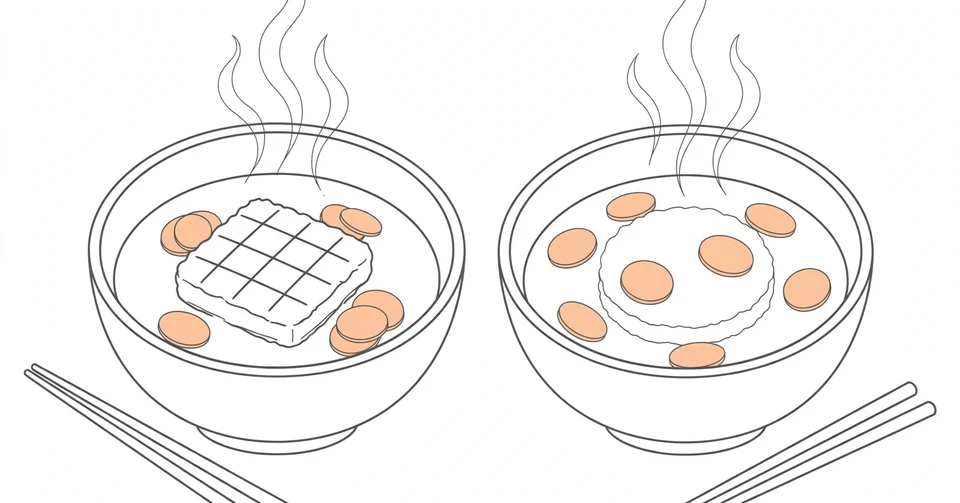
What makes the argument so durable is that ozoni is not restaurant food. It is home food, cooked once a year, usually by the same hands, from a recipe that was never written down. A bowl of ozoni carries a family's geography inside it, and people defend their geography.
What ozoni is
The name gives the dish away. Written in Japanese, ozoni combines the characters for "miscellaneous" and "simmer", and that is exactly what it is: a mixed simmer of mochi, vegetables, and whatever else the household puts in the pot.
Ozoni is generally traced back to the food of samurai society, a practical meal cooked in the field during campaigns, when mochi, vegetables, and dried provisions could be boiled together in one pot. From those beginnings it moved into formal banquet cooking, and the custom of eating it at New Year is dated to the end of the Muromachi period, when the dish was offered to the gods on New Year's Eve. Even the encyclopedia entry on zoni starts by warning that the preparation varies by household and by region, which might be the most honest first line any recipe ever had.
Today ozoni is part of the osechi spread of New Year foods. It is eaten on the morning of January 1 and through the first days of the year, hot, filling, and auspicious, a soft and stretchy symbol of a long life, eaten slowly and, every year, with a little care, because mochi waits for no one.
The timing matters to the taste. Most of osechi is cooked in advance, sweet and salty and vinegared, made to keep for days so that nobody has to work in the kitchen over the holiday. Ozoni is the exception, the one dish made fresh each morning, and in plenty of households it appears at breakfast on all three days of sanganichi, the first three days of the year. By the third morning the cook is often working from memory and leftovers, and the bowl still has to be right.
The great divide between Kanto and Kansai
Almost every map of ozoni styles starts with one long fault line running across the middle of Japan. On one side is Kanto, the region around Tokyo. On the other is Kansai, the region around Kyoto and Osaka. The two bowls barely resemble each other.
Kanto ozoni is a clear soup, called sumashi-jiru. The base is dashi, built from dried bonito flakes and kombu kelp, seasoned with soy sauce until it is savoury and transparent. You can see everything in it: pieces of chicken, leafy komatsuna greens, slices of kamaboko fish cake, carrot cut for colour, and a small curl of yuzu peel on top. The mochi is square, and it is grilled before it goes into the soup, so its surface puffs and chars in spots while the inside turns molten. That toasted skin holding its shape in a clear broth is, to an eastern palate, the whole point.
Kansai ozoni could not look more different. The broth is white miso dissolved into dashi, often kombu based, and in Kyoto it is the local Saikyo miso, which is pale and noticeably sweet. The soup comes to the table opaque and milky. The mochi is round, shaped by hand, and it is boiled rather than grilled, arriving soft and pillowy. Into the bowl go taro, daikon radish, and carrot, traditionally cut into rounds, with a drift of bonito flakes over the top.
Neither side is being difficult. The square mochi of the east is a practical shape, cut from a flat slab of pounded rice. The round mochi of the west is the older form, rolled by hand, in the region where court culture held on longest. Two histories settled into two shapes, and both shapes now taste like childhood to the people who grew up with them. I have eaten both styles in friends' homes, and the grilled square, with its charred corner slowly softening in clear broth, is the one I would ask for again. But I have learned to say that quietly in Kyoto.
Between the two capitals, the map stops being tidy. Travel west from Tokyo and the broth clouds over gradually, household by household, until somewhere in the middle of the country a family is dissolving white miso under a square mochi, or grilling a round one for a clear soup, and sees no contradiction at all. The prefecture is a rough guide. The real border of ozoni runs through individual kitchens.
The outliers that start the loudest arguments
If the Kanto and Kansai styles are the two main parties of ozoni, the regional outliers are the independents, and some of them sound like jokes until you see how seriously they are defended.
The most famous is the ozoni of Kagawa Prefecture, on Shikoku. There, the round mochi in the miso soup is filled with sweet red bean paste. Japan's agriculture ministry keeps the recipe in its archive of regional cuisines, and it is a real bowl of soup, not a dessert in disguise: a stock made from dried sardines, white miso stirred in at the end, daikon and the local kintoki carrots cut into rounds, tofu, and a sprinkle of aonori seaweed. The vegetables are sliced round on purpose, as a wish that the family will live in harmony and the year will run smoothly. The sweet centre of the mochi is not a modern stunt. The style is dated to the late Edo period, around 1800, when the Takamatsu domain was famous for fine wasanbon sugar that ordinary people could rarely afford. The story still told in Kagawa is that common folk hid their one sweet taste of the year inside the mochi, where it would not be seen. Sweet and salty in the same spoonful sounds wrong, and by most accounts it works completely.
The filling surprises people in a specific way. The mochi looks innocent, the soup tastes properly savoury, and then the centre gives and the bowl turns into something between dinner and dessert for exactly one mouthful. Kagawa is so unembarrassed about it that a few restaurants in Takamatsu serve anmochi zoni all year, long after the New Year decorations come down, which tells you the locals never thought of it as a seasonal gimmick in the first place.
Kagawa is not even the sweetest entry in the catalogue. In parts of Tottori and the Izumo area of Shimane, ozoni is made with a sweet red bean soup, closer to a dessert than a broth, with round mochi floating in it. In Fukui, the miso in the bowl is red miso, deeper and saltier than the white miso of Kyoto. In snowy Niigata, the bowl turns hearty with salmon. Coastal districts put the sea in their ozoni, oysters in Hiroshima, while mountain districts rely on stored vegetables and mushrooms. A few islands and high valleys where rice barely grows make ozoni with taro or tofu in place of mochi at all, which settles the square versus round debate by refusing to take part in it.
What all of these bowls have in common is that they are made from what the place itself provides. Ozoni maps Japan more honestly than most maps do: sardine coasts, miso towns, salmon rivers, sugar domains. The soup is local because January is local, cooked from the stores a household actually has.
Ozoni comes back in the middle of January
The ozoni season does not quite end when the New Year holidays do. Standing in homes through the first days of January is the kagami mochi, the pair of stacked mirror rice cakes offered to the New Year gods. What that decoration means, and why it is never cut with a knife, is a story of its own.
Around January 11, in the ceremony of kagami biraki, the hardened mirror mochi is finally broken open by hand or mallet, and the pieces have to go somewhere. As our article on kagami biraki, the ceremony of breaking things open, puts it: "The broken mochi goes into ozoni, the soup eaten through the New Year holidays." The rest goes into sweet red bean soup or is dried into crackers. So ozoni quietly bookends the season, fresh mochi on the first morning of the year, and the god's own mochi, tough as wood by then, softening in the same pot a week and a half later.
Why nobody will ever win this argument
Surveys of ozoni styles can draw the border between square and round mochi with great precision, and it changes nothing, because ozoni is not really decided by prefecture. It is decided by grandmothers. Marriages mix the styles, families move from Osaka to Tokyo and carry their white miso with them, and a child who grows up over a mixed bowl grows up loyal to the mixture. That is why two houses on the same street can serve two different soups on the same morning, each of them certain.
I find that more reassuring than any single correct recipe would be. A country that argued this hard about one soup would be a country that had stopped cooking it. Instead, every January, the pots come out, the mochi goes in, square or round, clear or white, sweet at the centre or plain, and the argument begins again, exactly as it should.
More in Food & Travel
Latest posts
- Manza Onsen Bathes at 1,800 Metres
- Irezumi Was an Art Before It Was a Warning
- The Oshi Kept Fuji's Pilgrims Fed, Housed, and Devout
- Japan's Population Decline and the Villages It Leaves Behind
- KRL Commuterline and the Trains That Move Jakarta
- Loma Linda's Long Lives Run on Saturdays
- The Three Sisters Grow Better Together
- Half the Old Springs in Japan Thank Kobo Daishi
- Tatamiishi Terraces Filter a River Through Stone
- Wasabi-Zuke Puts the Whole Plant in Sake Lees
- Konyoku Is Still Out There, Past the Last Train Station
- Karo Is the Tengger's Other Great Gathering
- Dry January Lasts a Month on Purpose
- Urashima's Dragon Palace Had a Name, Ryugu
- Petruk's Nose Arrives Before He Does