Wasabi-Zuke Puts the Whole Plant in Sake Lees
· 10 min read
The rhizome gets grated fresh and the rest of the plant could have been a problem, until wasabi-zuke turned the stems, leaves and trimmings into a pickle. This is how Shizuoka salts chopped wasabi into sake lees, and why the heat comes out rounder.
Ask a sushi chef about wasabi and he will reach for the rhizome, the pale green stem that is grated to order and loses its fire within minutes. Ask a farmer in the wasabi valleys of Shizuoka what happens to the rest of the plant and the answer is wasabi-zuke: the leaf stalks, the leaves and the trimmings, chopped fine, salted, and packed into sake lees until almost nothing of the harvest is left over.
Wasabi-zuke comes out of the crock as a pale, creamy paste flecked with green, and it tastes like the plant remembering itself at a lower volume. The heat is still there, unmistakably wasabi, but the lees have rounded it, adding a mild sweetness and the deep, faintly alcoholic smell of the brewery. Shizuoka, where cultivated wasabi began, counts wasabi-zuke among its signature foods, and by local accounts it is a decidedly grown up one.
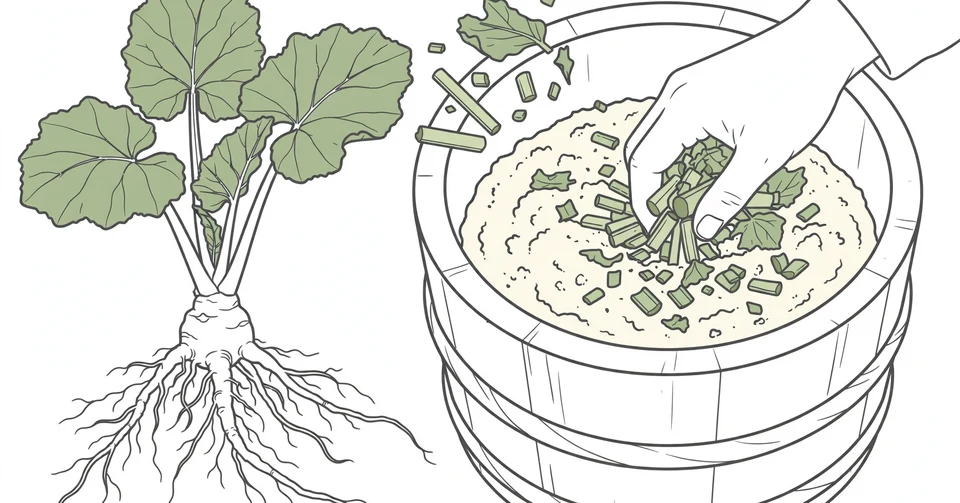
There is an arithmetic behind it. A wasabi rhizome spends a year and a half to two years standing in cold running water before it is worth grating, and no farm working that slowly can afford to throw half of each plant away. The lees, for their part, are what a sake brewery has left on its hands once the pressing is done. Wasabi-zuke is where the two leftovers meet, and each solves the other's problem.
What goes into wasabi-zuke
The rhizome is the part with the price tag. As I have written before, real wasabi refuses to grow almost anywhere, and the big, handsome rhizomes of the stream terraces are sold whole, to be grated at the table in the minutes before they fade. But a harvested plant is mostly not rhizome. It carries a sheaf of long leaf stalks, broad heart shaped leaves, and smaller or crooked pieces of rhizome that no chef would present on a wooden board.
All of that is raw material for wasabi-zuke. The official recipes, including the one published by Shizuoka Prefecture, describe the pickle in one line: chopped wasabi leaves, stems and roots, pickled in sake lees. Roots here means the humbler end of the rhizome harvest. At a hands on workshop in Shizuoka City, the roots set aside for wasabi-zuke were described as good quality but cheaper because of their inferior shape, which tells you most of what you need to know about the economics. What cannot be sold as a showpiece gets chopped, and chopping is no loss, because the pickle wants pieces anyway.
The chopping matters more than it might seem. Wasabi keeps its fire locked inside intact cells, and the pungent compounds only form when the cells are broken open. That is why the rhizome is grated slowly and why the stalks for wasabi-zuke are cut by hand, finely, rather than sent through a machine. Workshop accounts from Shizuoka describe a room full of adults quietly weeping over their chopping boards, which is the surest sign the chemistry is working. A machine would be faster. It would also be blunter, in every sense.
What goes into the crock, then, is the plant at its least presentable and most pungent: stalks for crunch, leaves for colour and a milder green flavour, and the odd shaped rhizome pieces for depth of heat. Nothing about it is a garnish. It is the harvest, audited honestly.
Salt, squeeze, and into the lees
Wasabi-zuke is not complicated, but it is done in the right order. First the chopped wasabi is salted. The recipe in the agriculture ministry's regional cuisine archive uses about two percent salt, works it through the chopped stems and roots, cut to pieces of roughly three millimetres, and leaves the mixture overnight, or at least six hours. The salt pulls water out of the plant, and water is the enemy here, because a wet pickle would dilute the lees and soften into mush.
Then the salted wasabi is squeezed, hard, through a cloth, until it gives up as much liquid as it will. While that is happening, the bed is prepared. The bed is sake kasu, the sake lees Japan cooks with instead of throwing away, loosened with sugar and a little sake, sometimes mirin, and kneaded until it turns from stiff slabs into a smooth, workable paste. The squeezed wasabi is folded through it, sealed in an airtight container, and left alone.
Two to three days later, the wasabi-zuke is ready, in the words of the prefectural recipe, when the spiciness comes out. The proportions shift from kitchen to kitchen. The ministry's home recipe uses more wasabi than lees by weight, while a Shizuoka workshop recipe runs the other way, with the lees in the majority. The ministry notes, reasonably, that recipes vary depending on the region and home. What does not vary is the sequence: salt, squeeze, bury, wait.
There is a small mercy built into the method for anyone who overshoots. If the finished wasabi-zuke is too fierce, the same ministry recipe advises leaving the lid open a little, and the spiciness will soften as the volatile compounds drift away. The pickle, in other words, can be tuned after the fact, which is more than can be said for a mound of freshly grated rhizome at a sushi counter. I find that forgiving quality part of the appeal. This is slow food that still leaves room for adjustment.
Formally, wasabi-zuke belongs to the kasuzuke family, the broad clan of Japanese foods pickled in sake lees, but it is very much its own member of that family. Most lees pickles are built around something sturdy, a fish fillet or a cucumber. This one is built around a flavour that evaporates, and the whole technique reads like a way of catching it before it goes.
The heat, rounded by the lees
Freshly grated wasabi is an event measured in minutes. The heat rises cleanly into the nose, blooms, and is gone, and an uncovered mound left on the counter for a quarter of an hour is mostly aroma and regret. Wasabi-zuke deals with the same chemistry from the opposite direction. Instead of freeing all the pungency at once and racing to eat it, the pickle frees it slowly, inside a paste that holds it in suspension.
The result is a different shape of heat. It arrives more slowly than the grated rhizome, stays longer, and finishes with the flavour of the brewery rather than the flavour of the stream. The sugar in the bed takes the raw edge off, the lees contribute a savoury depth of their own, and the alcohol that the kasu still carries keeps a faint warmth running underneath the spice. People sometimes describe wasabi-zuke as milder than fresh wasabi, and in peak intensity it is. But it is not weaker. It is the same fire with the windows closed.
That combination of sharp spiciness and sake lees flavour is exactly why Shizuoka's own food writers call it a dish mainly popular among adults. It is not a pickle for children, and not really a pickle for beginners either. The first spoonful tends to divide a table. Half the people reach for more rice. The other half reach for more of the pickle, and then, usually, for a drink to go with it.
My own view, after eating it in the prefecture where it was invented, is that wasabi-zuke is the more honest of the two preparations. Grated rhizome is a performance, beautiful and brief. The pickle is the flavour as the farming families themselves kept it: preserved, portable, and strong enough to survive the trip from a mountain valley to a city table.
On rice, with tea, beside the sake cup
The classic way to eat wasabi-zuke needs no recipe at all. A spoonful goes on top of warm rice, and the heat of the rice lifts the aroma out of the paste while the grains give the salt and spice somewhere to land. It is breakfast food in Shizuoka homes, the kind of thing that makes a plain bowl of rice feel deliberate.
From there it is a short step to ochazuke, the bowl of rice with hot tea poured over it. Salty pickles are a classic topping for ochazuke, and few pickles are better built for the job than wasabi-zuke. The tea loosens the paste through the rice, the wasabi heat blooms gently in the steam, and the lees turn the simple green tea broth faintly savoury. Eaten at the end of a meal, or at the end of an evening, it closes things quietly.
The third seat at the table is the sake cup. Shizuoka's food information center lists wasabi-zuke as a snack with alcohol, and there is a pleasing circularity in it: the lees of a finished sake, wrapped around the wasabi, served beside the next glass. The brewery's leftovers become the brewery's companion. A Shizuoka workshop account also puts the pickle alongside baked poultry and sausages, and even hot on toast, which sounds like heresy until you remember that the paste is, at heart, a savoury spread with a kick. The rice bowl is its home, but it travels well.
However wasabi-zuke is served, it is used sparingly, a small mound rather than a heap. This is a condiment with a farm's whole patience inside it, and a little carries the flavour of a lot of plant.
The souvenir from Shizuoka Station
For a pickle made of trimmings, wasabi-zuke has had a remarkably public career. According to Shizuoka's official food information center, wasabi-zuke was first sold inside Shizuoka Station, and it remains a popular Shizuoka souvenir today. Travellers carried it home on the train, and a farmhouse method of saving the leaves became one of the tastes by which the rest of Japan knew the prefecture.
That still holds. The farm shops in the wasabi growing districts of Izu and along the Abe River sell their own versions, some of them made only with stems and lees and sold only at the source, because spring water wasabi cannot be mass produced. Supermarket versions exist too, cheaper and usually paler, with less of the plant in them. The difference between a farm shop tub and a factory tub is mostly a question of how much actual wasabi the maker was willing to chop. The agriculture ministry's wasabi zuke page keeps the home method on record for anyone who wants to find out firsthand, and home cooks in Shizuoka still make it the way the workshop does, by hand and in tears.
It is worth pausing on how the whole thing is arranged. The rhizome gets the ceremony, the sharkskin grater, the chef's full attention, and a life of about fifteen minutes. The stalks and leaves get a cloth, a crock and three quiet days, and they keep for the journey home. Wasabi-zuke began as a refusal to waste a slow and difficult plant, and it ends as the form in which that plant reaches the most people. There are worse fates for a leftover, and few better uses for one.
More in Food & Travel
Latest posts
- Manza Onsen Bathes at 1,800 Metres
- Irezumi Was an Art Before It Was a Warning
- The Oshi Kept Fuji's Pilgrims Fed, Housed, and Devout
- Japan's Population Decline and the Villages It Leaves Behind
- KRL Commuterline and the Trains That Move Jakarta
- Loma Linda's Long Lives Run on Saturdays
- Maruten Numazu and the Towering Kakiage Bowl of the Port
- The Three Sisters Grow Better Together
- Half the Old Springs in Japan Thank Kobo Daishi
- Tatamiishi Terraces Filter a River Through Stone
- Konyoku Is Still Out There, Past the Last Train Station
- Karo Is the Tengger's Other Great Gathering
- Dry January Lasts a Month on Purpose
- Urashima's Dragon Palace Had a Name, Ryugu
- Petruk's Nose Arrives Before He Does