Blue Zones, the Five Places Where People Live the Longest
· 9 min read
The blue zones are five places, Okinawa, Sardinia, Nicoya, Ikaria, and Loma Linda, where Dan Buettner and a team of demographers say people live unusually long lives. Here is where the idea came from, what the five zones are said to share, and why scientists now argue about the paperwork behind the claim.
Blue zones are five places where, by one well travelled account, people live longer than almost anywhere else on earth. The list runs: Okinawa in Japan, the mountain country of Sardinia in Italy, the Nicoya Peninsula in Costa Rica, the Greek island of Ikaria, and Loma Linda, a city in California shaped by its Seventh-day Adventist community.
The name came from a pen. Before the blue zones were a book, a brand, and a television series, they were circles drawn on a map. And the honest summary, before anything else, is this: the head counts behind those circles are now disputed, sometimes sharply, while the way of life they point at is mostly ordinary common sense.
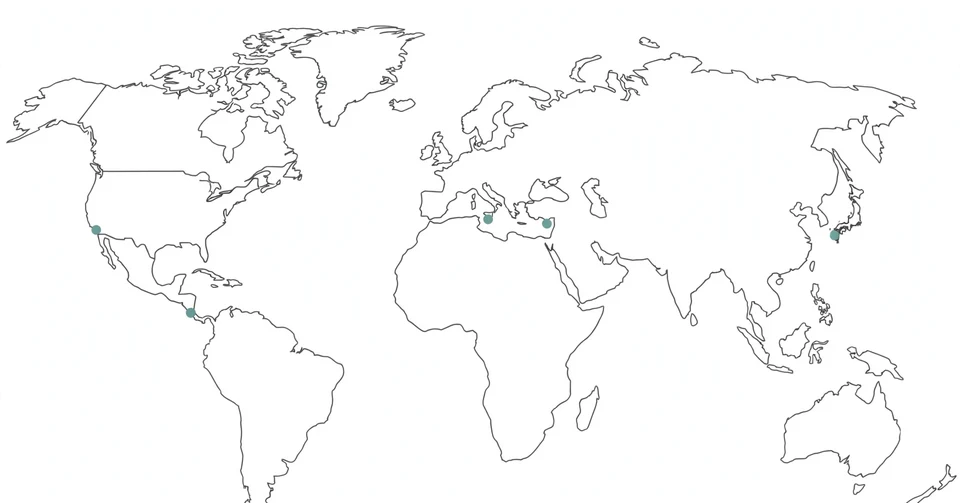
This site arrived at the blue zones from Okinawa. Its circles of lifelong friends, the moai, are one of the habits researchers keep returning to, and they sit inside a bigger claim: that Okinawa is one of the world's blue zones, places where people live unusually long lives, and that the moai are among the contributing reasons. This article is about that bigger claim, where it came from, and how much of it you should believe.
Where the name came from
The story starts in Sardinia. Around the turn of the century, the medical statistician Gianni Pes and the demographer Michel Poulain studied villages in the island's Nuoro Province, where men seemed to reach extreme old age far more often than chance would allow. Their 2004 study marked the area of highest concentration by circling villages on a map in blue ink. The circles gave the blue zones their name.
Dan Buettner, an American journalist and National Geographic fellow, picked the idea up and took it worldwide. Working with National Geographic and the National Institute on Aging, he assembled demographers, anthropologists, and epidemiologists to look for other places that passed similar demographic screens. A National Geographic cover story followed in 2005, and a bestselling book in 2008. The list of blue zones settled at five, and it has stayed there ever since.
The five blue zones, one by one
Each zone earned its place the same way, at least in the team's telling: records suggested far more people reaching 90 and 100 than statistics would predict. What the researchers found on the ground differs in flavour from place to place.
Okinawa is the Japanese entry, and by Buettner's account its women are the longest lived in the world. The habits his team emphasised there are social as much as dietary: the moai, and hara hachi bu, the old saying recited before meals that reminds people to stop eating when they are about 80 percent full. Purpose has its own local name in Okinawa, ikigai, a reason to live, and it recurs in every account of old age on the islands.
Sardinia was where the blue zones began, and its fame rests on men: shepherds in steep mountain villages who, by the team's account, walked five miles or more a day over rough ground well into old age. The classic diet there is plant heavy, whole grain bread, beans, garden vegetables, and fruit, with meat kept largely for Sundays and special occasions, and the local Cannonau wine taken moderately.
Ikaria is a small island in the Aegean where, by the team's figures, people live years longer than Americans and show remarkably little dementia. The pattern described is a Mediterranean table of vegetables, whole grains, beans, potatoes, and olive oil, long afternoons, regular naps, and a famously loose relationship with the clock.
Nicoya is a dry peninsula in Costa Rica. Its elders often do physical work into old age, keep faith and family close, and describe a plan de vida, a reason to live, in terms very like ikigai. Buettner's team also pointed to the local water, rich in calcium and magnesium, and noted that Nicoyans reach a healthy 90 at more than twice the American rate while their country spends a small fraction of what the United States spends on health care.
Loma Linda is the odd one out: not an island or a mountain range but an American suburb. Its place among the blue zones is a community of Seventh-day Adventists whose habits are set by faith, a largely vegetarian diet of leafy greens, nuts, and legumes, no alcohol or tobacco, and a complete day of rest every Sabbath. Buettner's team says these Adventists outlive the average American by about a decade.
The Power 9, the patterns Buettner lists
Comparing the five blue zones, Buettner's team distilled nine shared habits, which it calls the Power 9. Read the list as the team's summary of what it saw, not as a set of measurements:
- Move naturally. Daily life that keeps people walking, gardening, and working by hand, rather than scheduled workouts.
- Purpose. A reason to get up in the morning, ikigai in Okinawa, plan de vida in Nicoya.
- Downshift. A routine for shedding stress: prayer for the Adventists, naps in Ikaria, remembering ancestors in Okinawa.
- The 80 percent rule. Stop eating before you are full, as hara hachi bu prescribes.
- Plant slant. Beans at the centre of the table, meat in small servings a few times a month.
- Wine at five. Moderate drinking with friends and food, everywhere except teetotal Loma Linda.
- Belong. Regular attendance at some faith based community.
- Loved ones first. Ageing parents and grandparents kept nearby or in the home, family given time.
- Right tribe. Social circles, like the moai, that make the healthy habits the normal ones.
The team attaches numbers to some of these, such as up to seven extra years of life for having a clear purpose. Numbers like that are best treated as the brand's arithmetic rather than settled findings. The habits themselves are far less controversial than the figures pinned to them.
From magazine story to lifestyle brand
The idea did not stay in the magazine. The Blue Zones organisation became a company in 2008, publishing books and running a project that helps towns, mostly in the United States, redesign themselves around the nine habits, with connected sidewalks, grocery store pledges, and school rules meant to make the healthy choice the easy one. In 2023 the blue zones reached their widest audience yet, as a four part Netflix documentary series, Live to 100: Secrets of the Blue Zones, with Buettner travelling between the five communities as host.
Success on that scale was bound to attract auditors, and it did.
The argument about the paperwork
The sharpest criticism of the blue zones is not about vegetables. It is about birthdays. Saul Newman, a demographer at University College London, has argued for years that extreme age records around the world are riddled with clerical error and, in places, pension fraud. His work on the subject won the 2024 Ig Nobel Prize in demography, the award for research that makes people laugh and then think. A fair overview of the evidence and the argument gives both sides their say.
Newman's findings are uncomfortable reading for the blue zones. Across countries, he found that only about 18 percent of the people recorded at the most extreme ages hold a birth certificate. The birthdays of supercentenarians, people said to be 110 or older, cluster oddly on dates divisible by five, which is how guessed dates behave and real ones do not. And the regions most famous for extreme age tend, in his analysis, to be poorer, with patchier records and shorter average lifespans than their countries overall, the opposite profile from the one the lifestyle story would predict. Fairness requires one caveat: his central paper on this has circulated as a preprint since 2019 without completing peer review, which matters when weighing it.
The researchers behind the blue zones answer that their ages were never taken on trust. Poulain, Pes, and their colleagues say the original zones were validated by cross checking civil records against church and family archives, in places going back to the 1800s, and that Newman judges whole provinces when the zones were always small, specific communities. In 2025, senior figures in the field published a formal defence of the zones' demography along exactly those lines.
Okinawa carries a problem of its own. Its family registers were largely destroyed in the Battle of Okinawa in 1945 and reconstructed afterwards, which leaves room for error in the oldest records. And whatever the historical registers show, researchers note that Okinawans born after 1945 show no exceptional longevity at all. The advantage, if it was ever real, belonged to a generation that has now mostly gone.
What survives the argument
Strip away the disputed counts and something sturdier remains. Walter Willett, a Harvard professor of epidemiology and nutrition with no stake in the brand, has said that the blue zones theory by itself is not regarded as strong science, while the behaviours in the Power 9 are still broadly consistent with what research links to a longer, healthier life. That is, in the end, the level at which the blue zones earn their keep.
The magic was never in the map coordinates. A shepherd's working day in the Sardinian hills, an Okinawan grandmother's circle of friends, an Adventist's protected day of rest: none of it needs a blue circle to be worth borrowing, and none of it can be bought in supplement form. If some of the centenarian counts in one or two valleys turn out to rest partly on clerical error, the walking, the beans, the naps, and the friends lose nothing at all.
The blue zones are best read as a good story built on contested arithmetic, pointing at unglamorous truths. Hold the story at arm's length and the truths close: eat mostly plants, let movement be part of the day rather than an appointment, keep your people near, and have a reason to get up in the morning. Whether or not anyone in Ikaria is really 105, that is a decent way to spend the years you get.
More in Life & Style
- A Rotenburo Is a Bath With Weather
- Gensen Kakenagashi, the Onsen Water That Never Circles Back
- Sumadori, Japan's Smart Drinking for People Who Do Not Drink
- Capsule Hotels and Sleeping in a Pod in Japan
- Kashikiri, the Private Onsen Bath You Book by the Hour
- Hara Hachi Bu, Okinawa's Rule of Stopping Before You Are Full
Latest posts
- The Tengger Carry Their Dead Out of the Village in Entas-Entas
- Urashima Opened the Tamatebako and Time Came to Collect
- How Supersemar Borrowed the Authority of a God
- Katsuobushi Is a Fish You Shave Like a Block of Wood
- Bali Has Its Own Semar, and His Name Is Twalen
- White Silk Means You Made It as a Sekitori
- The Dohyo-Iri Gives a Yokozuna Three Minutes to Own the Ring
- Nobody Commutes to a Heya
- Why Kagami Mochi Is Never Cut With a Knife
- Narazuke Pickles Spend Years Asleep in Sake Lees
- Tokyo Keeps a Hundred Tiny Fujis Called Fujizuka
- Tomozuri Sends a Living Fish to Do the Fishing
- One Thousand Three Hundred Years of Ukai Nights on the Nagara River
- Fuji Ko, the Pilgrim Societies That Climbed Mount Fuji Together
- Dashi, the Quiet Stock Under Almost Everything Japan Cooks