Tatamiishi Terraces Filter a River Through Stone
· 10 min read
A tatamiishi bed is a wasabi field built like a filter, with large rocks at the bottom and sand on top, so spring water reaches the roots clean, cold and full of air. The terraced method was worked out in Nakaizu around 1892 and still climbs the valleys of Izu in green stairs.
Stand in a wasabi valley in the Amagi mountains and the first surprise is that the field is not made of soil. It is made of stone, stacked in shallow stairs up the slope, with clear water sliding over every step and green leaves standing in the flow. This is a tatamiishi bed, the terraced growing bed that Shizuoka farmers have built for well over a century, and it exists for one reason. Wasabi will only live in water that is cold, clean and always moving.
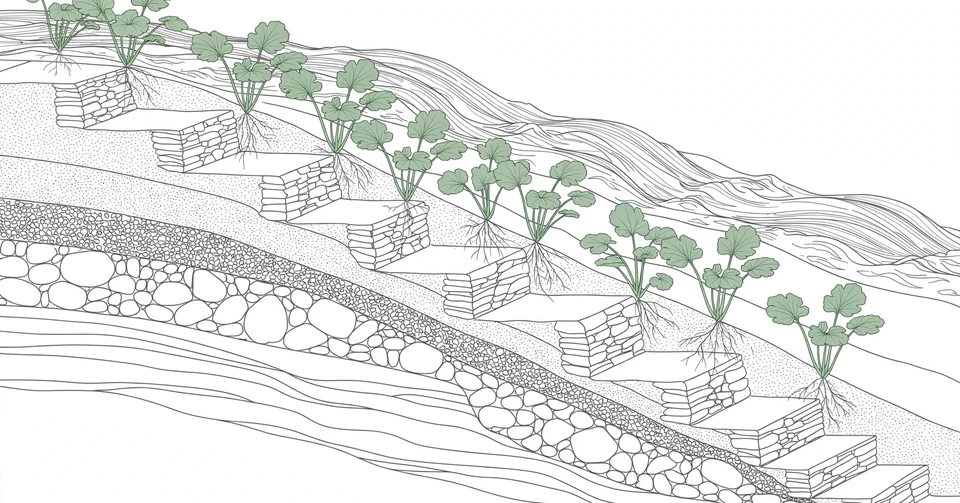
The trick of tatamiishi is that the bed is a filter you can plant in. Large rocks form the bottom layer, smaller stones and pebbles sit above them, and a thin skin of sand covers the top. Spring water is led in at the highest terrace and leaves at the lowest, and on the way down it passes through all that stone, so by the time it reaches the roots of the lowest plants it has been cleaned, cooled and loaded with oxygen.
That is a great deal of masonry for a condiment, and farmers are the first to admit it. But as I found when writing about how real wasabi refuses to grow almost anywhere, the plant leaves them no choice. Muddy water rots the roots. Still water starves them of air. Warm water slows the growth and invites disease. The layered stone bed is simply the price of the crop, paid in rock.
A staircase built like a sieve
The name describes the construction. Ishi is the Japanese word for stone, and in a tatamiishi bed the stones are graded and laid across each terrace the way flat paving stones, or tatami mats, cover a floor. Each tatamiishi terrace is a shallow tray of rock sorted by size. The biggest boulders go at the bottom. Above them come stones, then pebbles and gravel, each layer finer than the one below, until the surface is a bed of sand and fine gravel just deep enough to hold a seedling.
Growers plant the young wasabi only a centimetre or two into that sandy skin. Everything below that thin planting layer is plumbing. The water does not just run across the surface of a tatamiishi bed. Part of it sinks, percolates slowly through the graded stone, and rejoins the flow further down, so the whole bed works like the gravel filter of a fish tank, scaled up to a mountainside.
Building one is slow, heavy work, closer to dry stone walling than to gardening. The stones have to be gathered, sorted and set by hand, terrace by terrace, on slopes steep enough that the water will keep moving but gentle enough that a heavy rain will not tear the beds apart. I find something deeply satisfying in the fact that the entire system can be read off a single cross section. There are no hidden parts. If you can see the layers, you understand the field.
A stonemason's answer in 1892
Wasabi farming in Shizuoka is about four centuries old. It began at Utogi, in what is now Shizuoka City, where villagers set wild plants into spring water in the early 1600s, and it reached the Izu Peninsula in 1744, when seedlings were carried into the Amagi mountains to Yugashima. Izu turned out to be wasabi country of the first rank, soaked by rain and drained by cold, clear rivers, but the early fields were built the obvious way, in and beside the streams themselves.
The tatamiishi method was the refinement, and by local account it came from a craftsman rather than a farmer. Around 1892, in Nakaizu, a stonemason worked out the layered stone bed: graded rock instead of streambed mud, terraces instead of a single flooded plot. It makes sense that a mason solved it. The problem was never really botanical. The plant was known, the water was known. What was missing was a structure that could hold the two together on a slope, and structure was a stonemason's trade.
From Nakaizu the tatamiishi style spread through Izu and then across the prefecture, and versions of it travelled further still. Most older style beds have since been rebuilt in the newer manner, because the stone terraces are simply more productive. A farmer with a tatamiishi field can plant more densely, harvest more evenly through the year, and worry less about what the river is carrying after a storm.
How a tatamiishi bed cleans its own water
The water in these valleys is spring water, and it is the other half of the design. Around Mount Amagi the rain falls on old volcanic ground full of pumice, a stone so porous it works like a sponge. Water can spend years moving through that lava before it emerges in a stream, which is why the springs run so clear and why their temperature barely changes. The FAO puts the spring water of the region at a stable 13 degrees Celsius or so all year, right in the narrow band wasabi likes.
A tatamiishi bed is built to protect those qualities rather than use them up. The flow across the surface keeps the roots washed in fresh, oxygen rich water. The flow through the stone layers filters out the silt and debris that would cloud the water and rot the plants. The mass of wet rock holds the temperature steady against a hot afternoon or a cold night, buffering the bed the way a stone wall buffers a garden. And because the layers slow the water down, the surplus drains away instead of pooling. Nothing stagnates.
Farmers add one more layer of management above the stones. From spring to autumn, East Asian alder trees are planted in and around the fields to shade the plants from direct sun, since a bed can be ruined by heat even when the water is cold. Almost no fertiliser or pesticide is used, for a practical reason as much as an ecological one. Anything spread on a tatamiishi field goes straight into the water, and the water belongs to everyone downstream.
That downstream is not an abstraction. The water that leaves the lowest terrace of a tatamiishi field runs on to rice paddies and to streams where freshwater fish are raised, and the same terraces that slow the water for wasabi also hold back floodwater after heavy rain. The field is part of the valley's plumbing, not an interruption of it.
The older beds sat in the stream
It helps to picture what tatamiishi replaced. The older method, called the jizawa style, dates from the very beginning of wasabi cultivation, and it took the valley floor as it found it. Beds were laid in the marshy ground beside a stream, or in the shallow edges of the stream itself, and the plants stood in whatever water the season provided. It worked, after a fashion, for centuries, and a few jizawa beds survive. But the farmer was a passenger. A flood rearranged the field. A dry spell shrank it. Silt arrived uninvited.
Tatamiishi moved the field a few metres uphill and changed the relationship completely. On the slope, the grower decides how much water enters, how fast it moves and where it leaves. The stream is no longer the field. It is the field's water supply, and the stones do the rest. That, more than any single harvest, is why tatamiishi lasted. It turned a fortunate location into a repeatable design, one that could be built in any valley with a spring and a supply of rock.
Ikadaba, a valley of green stairs
The place everyone photographs is Ikadaba, in Izu City, where the terraces climb the valley in long green tiers and the water moves quietly from bed to bed. Ikadaba sits at the end of an ancient lava flow from an eruption roughly 3,200 years ago, and the pumice under the fields is part of the story, storing the mountain's rain and releasing it as the springs that feed the beds. The prefecture's own gastronomy guide describes Ikadaba and the layered fields of the Amagi valleys in loving detail, and it is worth remembering its warning too. These are private, working farms, not a tourist attraction. You admire them from the road. From there you can still read the construction in any bed lying fallow: boulders at the base, gravel above, sand on top, the tatamiishi recipe unchanged in more than a century.
The scale is easy to underestimate from a photograph. Across the designated heritage area, traditional wasabi cultivation covers about 114 hectares, and the FAO credits the region with roughly 40 percent of Japan's wasabi production. Most of that grows the tatamiishi way, in family fields, each one maintained by hand, each one somebody's stairway of stone.
These same mountains hold the hot spring town of Shuzenji, the oldest hot spring town in Izu, and the pairing is not a coincidence. It is all one water system. Rain that fell on Amagi years ago comes out cold in a wasabi terrace and hot in a bathhouse a few valleys away, and the people of Izu have built their two most characteristic industries, the fiery green crop and the evening soak, on different temperatures of the same gift.
Built to survive the river
A tatamiishi field is also a piece of flood engineering, a fact the valley learned the hard way. In 1958 the Kanogawa Typhoon tore through Izu, and the FAO records that only about five percent of the wasabi crop survived undamaged. The fields were rebuilt afterwards with stronger waterways and a new respect for what a swollen river can do, and the terraced tatamiishi beds, which slow water and hold it in their layers, turned out to be part of the defence, for the fields themselves and for the villages below them.
Recognition arrived much later. Japan named the tradition a Japanese Agricultural Heritage System in 2017, and in 2018 the FAO designated Traditional Wasabi Cultivation in Shizuoka as a Globally Important Agricultural Heritage System. The FAO's account of a spicy agricultural heritage follows farming families like the Shioyas, who have grown wasabi in these valleys for four generations, and it is honest about the pressures: hotter summers that stress a cold water plant, and the familiar rural problem of finding young people willing to take over heavy, wet, patient work.
A crop that takes about a year and a half to mature does not forgive impatience, and a tatamiishi bed does not forgive neglect either. Left alone, the terraces silt up, the layers clog, and the filter stops filtering. The system only works because somebody keeps tending it, season after season, the way somebody has tended it since a stonemason in Nakaizu first stacked stone on stone in 1892.
That is the thought I keep coming back to in these valleys. A tatamiishi terrace is an argument made in masonry: that the way to handle a river is not to fight it or dam it, but to slow it down, spread it thin and let it clean itself on the way through. The wasabi, in the end, is almost a byproduct. The real crop is the clear water, running cold over green leaves, exactly as it needs to be.
More in Food & Travel
Latest posts
- Manza Onsen Bathes at 1,800 Metres
- Irezumi Was an Art Before It Was a Warning
- The Oshi Kept Fuji's Pilgrims Fed, Housed, and Devout
- Japan's Population Decline and the Villages It Leaves Behind
- KRL Commuterline and the Trains That Move Jakarta
- Loma Linda's Long Lives Run on Saturdays
- Maruten Numazu and the Towering Kakiage Bowl of the Port
- The Three Sisters Grow Better Together
- Half the Old Springs in Japan Thank Kobo Daishi
- Wasabi-Zuke Puts the Whole Plant in Sake Lees
- Konyoku Is Still Out There, Past the Last Train Station
- Karo Is the Tengger's Other Great Gathering
- Dry January Lasts a Month on Purpose
- Urashima's Dragon Palace Had a Name, Ryugu
- Petruk's Nose Arrives Before He Does