Kombu Is the Quiet Half of Dashi
· 9 min read
Dried kombu is the kelp half of dashi, a cold water plant harvested in Hokkaido and carried by ship to kitchens across Japan and beyond. A look at its grades, its old trade routes, and the quiet chemistry it brings to the pot.
Of the two ingredients that make dashi, one of them gets all the attention. Katsuobushi is smoked, fermented and shaved in pale clouds over the pot, and it smells like a bonfire at the seaside. The other half of the flavour comes from something far plainer: a strip of dried kombu, dark and stiff as old leather, that goes into the water first and comes out before anyone thinks to thank it.
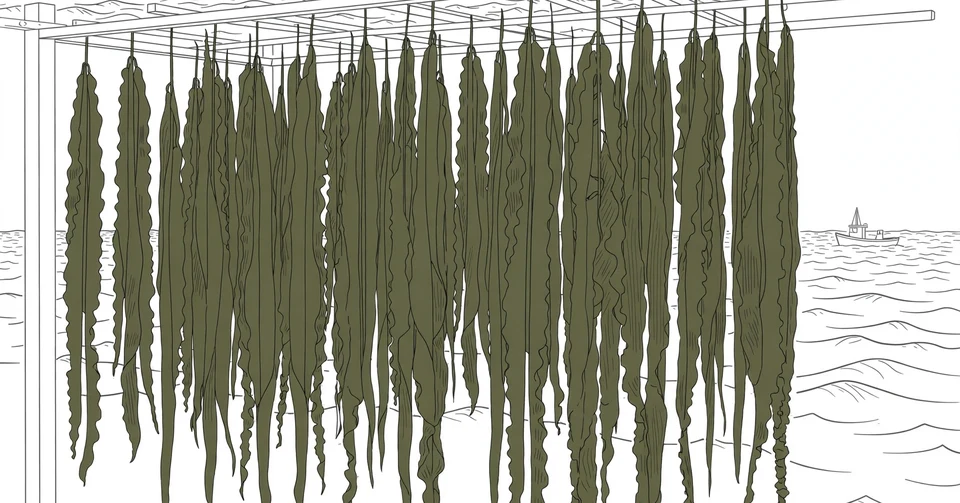
Kombu is kelp. It is harvested in cold northern seas, dried in the open air, and sold in folded ribbons that look more like building material than food. Nothing about it suggests delicacy. Yet the broth it gives up is the most delicate thing in Japanese cooking, and without it the famous stock is only halfway there.
I have written before about dashi, the quiet stock under almost everything Japan cooks, and about how its two pillars work together. This piece stays with the quieter pillar, and follows it from a cold Hokkaido shore to kitchens that have never seen the sea it grew in.
A plant that refuses warm water
Kombu is not a single species. It is a family of kelps, mostly from the Laminariaceae, and around eighteen edible species in that family answer to the name. The one that matters most is Saccharina japonica, a broad bladed kelp that grows slowly in water that stays cold all year. It needs roughly two years in the sea before it is worth harvesting, which is part of why good kombu has never been cheap.
That need for cold settles the geography. About 90 percent of Japan's harvest comes from Hokkaido, and nearly all the rest from the cold Pacific coast of northern Honshu. South of there the water is simply too warm. The plant that flavours the cooking of Kyoto, Osaka and Tokyo grows nowhere near any of them, and everything interesting in its story follows from that distance.
The harvest is a summer job. The kelp is cut or pulled from boats working close to shore, then spread on shingle beaches and racks to dry in sun and wind. Drying sounds like a small detail, but it changed kombu from a local food into a trade good. A drying method developed in the Muromachi period let the kelp keep for far longer, and a dried ribbon of it is light, flat and nearly indestructible. It could travel. Eventually, it travelled everywhere.
What kombu gives the pot
What the dried blade carries is glutamic acid, the compound behind the savoury taste called umami. Much of it sits in the pale powder that dusts the surface of a good blade, which is why cooks wipe it with a damp cloth and never wash it. Rinse a piece under the tap and you are pouring a good part of your stock down the drain.
The science here has a pleasingly exact date. In 1908 the Tokyo chemistry professor Kikunae Ikeda, puzzled by the depth of the kelp broth at his own table, worked through a large quantity of kombu and isolated the crystals responsible. The standard reference entry on kombu recounts how he identified glutamic acid as the source of the broth's palatability and named the taste umami, a word built from umai, delicious. A fifth basic taste had been sitting in a soup pot all along.
On its own, kombu dashi is remarkably quiet: clear, faintly mineral, almost sweet. Its real power appears when it meets the other pillar, katsuobushi, the fish you shave like a block of wood. Katsuobushi is rich in inosinate, a different savoury compound, and when glutamate and inosinate share a pot they do not add together, they multiply, reaching several times the savoury intensity of either one alone. I find something satisfying in the division of labour. The kelp brings the depth, the fish brings the spark, and neither of them tastes like much of the finished stock at all.
Four names worth knowing before you buy kombu
A kombu label is really a map reference. The four names that dominate the market each come from a different stretch of northern coast, and each makes a noticeably different broth.
Ma-kombu, true kombu, grows around Hakodate in southern Hokkaido and is the benchmark the others are judged against. It is thick and wide, the most produced of the fine grades, and it gives a clear broth with a gentle natural sweetness under the savouriness. If a recipe simply says kombu, this is roughly what it imagines.
Rishiri kombu comes from Rishiri Island, off Hokkaido's northern tip, and it is the aristocrat of the family. The blades are harder and the price is higher, and in return it makes the clearest, most refined dashi of all, light and clean and unwilling to colour the broth. Kaiseki chefs prize it, and Kyoto built its famously transparent soups on it.
Rausu kombu, from a short stretch of coast near the Shiretoko Peninsula, is the opposite temperament. It goes through a long and careful curing process, sometimes counted at more than twenty steps, and it produces a rich, amber broth with the strongest flavour of the four. Where Rishiri whispers, Rausu speaks up, and cooks reach for it when a stock has to stand up to miso, fat or spice.
Hidaka kombu, also sold as Mitsuishi kombu, is the everyday member of the family. Its ribbons run long, seven or eight metres in the water, and it is thinner, softer and cheaper than the others. Its dashi is mild and perfectly serviceable, and it has a second virtue the premium grades lack: it softens quickly enough to be eaten, so it ends up simmered into dishes, rolled around fish, or tucked into a pot of oden.
My own cupboard in Shizuoka holds Hidaka most of the year, and I do not feel short changed. The premium grades earn their price in a clear soup, where the stock is the dish. In a Tuesday miso soup, the difference between good kombu and great kombu is mostly a matter of pride.
The ships that carried a northern kelp south
The kelp reached the Japanese court early. Records from the year 797 describe it arriving as tribute from the far north, and a legal code of 927 lists it among the goods sent up from Mutsu province. For centuries it was a northern product that travelled in small, precious quantities. What turned it into a national ingredient was a fleet.
The kitamaebune, the northern bound ships, were cargo vessels that worked a great circuit from Osaka through the Seto Inland Sea and the Kanmon Straits, then up the Sea of Japan coast to the ports of Hokuriku and, in time, all the way to Hokkaido. A round trip could take most of a sailing season. The ships carried rice, salt, sake and cotton north, and came back loaded with the produce of the cold sea: herring, salmon, and bale after bale of dried kombu.
Osaka, the merchant city at the end of the route, built its everyday cooking on the heavier ma-kombu. Kyoto, supplied over the mountains from the Sea of Japan ports, settled on thin, clear Rishiri. Two great food cultures, a short distance apart, standardised on different kelps because different ships and different roads fed them. The route faded in the Meiji period, when steamships, the telegraph and the railways flattened the price gaps the old sailing ships had lived on. By then the taste it created was permanent.
The island that grows none and eats the most
The strangest stop on the kombu road is Okinawa. The water around those subtropical islands is far too warm for kelp, and not a single blade of kombu grows there. Yet Okinawa uses more kombu per household than any other prefecture in Japan, a habit that took hold in the Edo period and never let go.
The kelp arrived by trade, moving south through the hands of Satsuma merchants and the Ryukyu court, and some of it travelled onward from there toward China. In Okinawa it stopped being a luxury and became a staple, simmered with pork, stir fried in dishes like kubu irichi, folded into the everyday cooking of a place that had received it entirely as an import. I know of no better proof that a cuisine is shaped by its trade routes as much as by its soil. Okinawa did not adopt it because it was local. It took to the kelp because the ships kept coming.
Treating it properly
For all its travelling, kombu asks for very little in the kitchen. Warm it slowly in water and take it out before the pot boils, because boiled kombu turns bitter and slick and clouds the broth it was meant to clarify. A cold steep overnight in the fridge works too, and some cooks swear it gives the cleanest flavour of all. The method matters less than the restraint.
Nor does the blade retire after the stock is drawn. Simmered down in soy sauce it becomes tsukudani, rolled around a piece of herring it becomes kobumaki, salted and shredded it seasons rice. In a well run Japanese kitchen the blade is used twice at least, and the premium price of the best grades makes more sense once you see the whole blade as two or three ingredients in one.
That, in the end, is why this plain dried ribbon deserves its own story. Dashi is usually praised as a pair, and fairly, but the pair had to be assembled across a thousand kilometres of cold sea and slow sailing ships before it could meet in a pot. The bonito half of the story is smoke and fermentation and craft. The kombu half is geography and patience: a slow plant, in cold water, that waited two years to be cut, dried on a beach, and carried south to flavour the soups of cities it would never see.
More in Food & Travel
Latest posts
- Toji Meant Moving to a Hot Spring Until You Got Better
- Sodoran Treats an Heirloom Like an Honoured Guest
- You Can Read a Pecalang From Across the Street
- Nyuto Onsen Hides Seven Inns at the End of a Snow Road
- Nobody Just Watches a Panigyria, Everybody Dances
- When the Gara-Gara Starts, the Puppets Drop the Plot
- Forty Pounds of Cowbells, and the Mamuthones Say Nothing
- The Oarfish Still Answers to a Name From the Dragon Palace
- Manza Onsen Bathes at 1,800 Metres
- Irezumi Was an Art Before It Was a Warning
- The Oshi Kept Fuji's Pilgrims Fed, Housed, and Devout
- Japan's Population Decline and the Villages It Leaves Behind
- KRL Commuterline and the Trains That Move Jakarta
- In Mamoiada, Two Hundred Families Still Make Wine at Home
- Shochu and the Quiet Spirit of Japan