A Dried Shiitake Is Louder Than a Fresh One
· 10 min read
Drying turns a mild fresh shiitake into one of the strongest natural sources of umami, creating guanylate that fresh mushrooms barely have and giving vegetarian dashi its depth.
A fresh shiitake is a polite mushroom. It tastes of damp wood and autumn leaves, it gives a stir fry some chew and a little perfume, and then it politely steps aside for whatever else is in the pan. Nobody builds a broth on a fresh shiitake and expects the room to go quiet.
Dry that same shiitake and it comes back with a voice. Soaked overnight and simmered, a dried shiitake produces a stock so deep and insistent that Japanese cooks have leaned on it for centuries, and it anchors the vegetarian cooking of Buddhist temples, where no fish or meat is allowed to help. The mushroom did not just lose water in the drying shed. It changed its chemistry, and it came back louder.
I used to assume drying was a compromise, a way to keep a perishable mushroom through the winter at the cost of some freshness. In the shiitake's case that gets the story backwards. Drying is not what you do to a shiitake when you cannot eat it fresh. Drying is what turns a shiitake into a different and, for a cook, more useful ingredient.
What drying does to a shiitake
Part of the change is simple concentration. A fresh shiitake is about ninety percent water, so removing that water packs everything else into a much smaller space. But concentration is the smaller half of the story, and on its own it would only give you a stronger version of the same mild mushroom.
The bigger half is a compound that a fresh shiitake barely contains. Guanylate, also called guanylic acid, is one of the three substances behind umami, the fifth taste. Fresh mushrooms hold almost none of it in active form. According to the dried shiitake FAQ published by Sugimoto, a Kyushu producer, drying breaks down the cell structures inside the mushroom, and when the dried shiitake is soaked again, the RNA in those broken cells reacts with enzymes to create guanylate. The flavour is not merely preserved by drying. A large part of it is manufactured by drying, and finished off in the soaking bowl.
That is why dried shiitake is regularly described as one of the richest natural sources of umami in any kitchen. Guanylate turns up in only a limited number of foods, and dried shiitake carries more of it than almost anything else a home cook can buy. A fresh shiitake has the raw material locked away. The dried one has had it unlocked.
Drying leaves one more gift behind. Like all mushrooms, these carry ergosterol in their flesh, and when ultraviolet light reaches it during drying, some of it converts into vitamin D2. It is a side effect rather than the point of the process, but it means the dried version is not just the fresh one with the water removed. On paper, gram for gram, it is the more concentrated food in almost every respect a cook or a nutrition label cares about.
There is a practical consequence that Japanese cooks treat as basic knowledge. Because the guanylate forms while the mushroom soaks, the soaking itself matters. A slow soak in cold water, ideally overnight in the refrigerator, draws out more of the savoury compounds than a rushed soak in hot water. The mushroom swells to roughly five times its dried weight, and the soaking liquid, strained, is already a stock in its own right. Throwing that liquid away is throwing away the loudest part.
An amplifier, not a soloist
Guanylate's real talent is what it does to other ingredients. In 1957, the researcher Akira Kuninaka identified guanylate in shiitake mushrooms, and he realised something larger in the process. Nucleotides like guanylate multiply the effect of glutamate, the umami substance Kikunae Ikeda had found in kombu kelp almost fifty years earlier. Put the two together and the savouriness is far stronger than the two tastes added up. The science of umami still treats Kuninaka's discovery of this synergy as one of its founding moments.
Anyone who has read my piece on dashi, the quiet stock under almost everything Japan cooks has met this multiplication before. Classic dashi pairs kombu, rich in glutamate, with bonito flakes, rich in inosinate, a cousin of guanylate. The mushroom version simply swaps the partner. Kombu meets dried shiitake instead of fish, glutamate meets guanylate, and a pot of water, kelp and mushrooms becomes a stock with genuine depth and no animal in it at all.
That pairing is the historic backbone of shojin ryori, the vegetarian cooking developed in Buddhist temples. Temple cooks had to build satisfying food without meat, fish or even strong smelling vegetables, and the kombu and shiitake combination was their answer. It is still the answer in most Japanese vegetarian kitchens today, which tells you how complete the trick feels on the tongue.
Fermentation performs a similar rescue from another direction. Koji mold, the fungus behind miso and soy sauce, uses enzymes to break proteins down into amino acids, glutamate among them. This is why a spoonful of miso stirred into shiitake dashi tastes so finished. The mushroom brings the amplifier, the paste brings the signal, and the soup needs nothing else.
Eight centuries of practice
None of this is a recent discovery dressed up as tradition. The earliest written record of cultivating this mushroom dates to 1209, in a county gazetteer from Song dynasty China, and growers in Japan took the craft up with characteristic thoroughness. By 1796 the horticulturist Sato Churyo had written the first Japanese book devoted to growing it. The early method was patient and indirect. Growers felled shii trees, cut the trunks into logs, and laid those logs beside trees that were already fruiting, trusting drifting spores to do the inoculation.
Read that timeline against the science and the story reverses itself. Cooks were not applying chemistry they understood. They were following results they could taste, refining a process across centuries of harvests, and the chemistry, when it finally arrived in the twentieth century, mostly explained why the old process worked. The drying sheds of Kyushu were running a sound experiment long before anyone had named guanylate.
Donko, koshin, and the grades in between
Not every dried shiitake shouts at the same volume, and Japanese labelling law sorts them mainly by how open the cap was when the mushroom was picked. The two names worth knowing are donko and koshin, and between them they cover most of what is sold.
Donko are picked young, before the cap has fully opened, while the mushroom is still a thick, rounded bud. The name comes from a Chinese word for a winter mushroom, and winter is the point. Slow growth in cold weather is what packs the flesh dense and chewy, and the best donko come from the cold end of the season. At the very top sits hana donko, a donko whose cap has cracked into a pale pattern like a flower as it grew, prized for a texture that fans compare to abalone.
Koshin are the same mushroom left to open. The cap spreads wide and thin, the flavour turns more aromatic than meaty, and the slices rehydrate quickly and cut easily, while a thick donko needs the longest soak of any grade before it softens through. Koshin is the everyday grade, the one that gets chopped into soups, simmered dishes and mixed rice, and for most cooking it is honestly enough. I keep both in the house, donko for the days a mushroom is the main event, koshin for the days it is part of the crowd, and the price difference between the two has always seemed to me a fair map of the pleasure difference.
Logs, sawdust, and a race against the clock
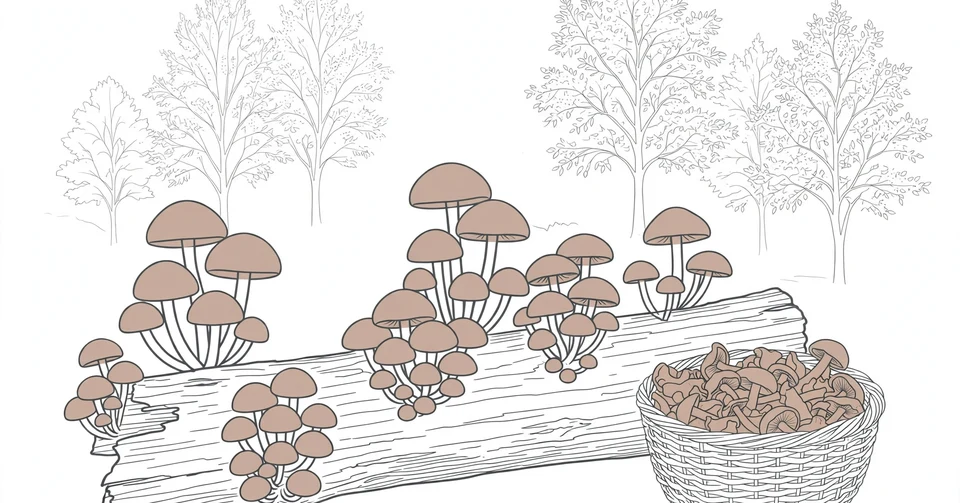
The name shiitake means the mushroom of the shii tree, a kind of chinquapin, and in the wild it grows on decaying hardwood, oak above all. Cultivation still follows that lead. In Japan, around ninety percent of dried shiitake is grown outdoors on natural logs, while most fresh shiitake comes from indoor beds of sawdust and nutrients. The two products may share a species, but they are raised almost as different crops.
Growers argue, with some self interest but also with numbers behind them, that the slow log method carries more flavour. The Sugimoto producers report that their forest grown mushrooms hold about twice the glutamate of bed grown ones and far more guanylate. Whether or not you take a seller's measurements at face value, the dried shiitake trade is built on the slower crop, and the slower crop sets the standard everyone tastes against.
Log grown mushrooms also spoil quickly, which starts a race as soon as they are picked. Producers dry the harvest within half a day, running the mushrooms through hot air for the better part of a day until they are hard and stable. That urgency is part of why a bag of dried shiitake is never uniform. Each batch is whatever the logs gave up that week, in whatever sizes the weather allowed.
Cooking with the loud ones
The dried mushrooms ask little of a pantry, too. Kept in a sealed container in a cool, dry place, away from heat and humidity, they wait for months without complaint, which is more than can be said for most ingredients with this much flavour to give.
Working with dried shiitake asks for patience in exactly one place, the soak, and rewards it everywhere else. Give the mushrooms their overnight rest in cold water. Lift them out, strain the liquid through a cloth or a paper filter to catch the grit, and keep every drop. The stems stay tough even after soaking, so most cooks slice the caps and save the stems for the stock pot, where their flavour still counts.
From there the mushroom goes where Japanese cooking has always put it. It perfumes miso soup. It simmers in nimono, the gently braised dishes of home cooking, and gives up its stock to the vegetables around it as it goes. It is steamed and simmered in temple dishes, folded into mixed rice, and sliced over noodles. In each case the dried shiitake is doing two jobs at once, ingredient and seasoning, which is something almost no fresh vegetable can claim.
My own opinion, after years of treating the fresh ones as the real thing and the dried ones as a pantry backup, is that I had the hierarchy inverted. A fresh shiitake is a texture with a pleasant smell. A dried shiitake is a flavour system, a small brown disc that carries its own stock cube inside it, made by nothing more exotic than time, air and its own enzymes.
Drying began, presumably, as housekeeping, a way to stop a fragile mushroom from rotting before it could be eaten. It survives because it turned out to be an improvement. The fresh shiitake whispers of the forest floor. The dried one speaks up, and a whole cuisine learned to cook around its voice.
More in Food & Travel
Latest posts
- Manza Onsen Bathes at 1,800 Metres
- Irezumi Was an Art Before It Was a Warning
- The Oshi Kept Fuji's Pilgrims Fed, Housed, and Devout
- Japan's Population Decline and the Villages It Leaves Behind
- KRL Commuterline and the Trains That Move Jakarta
- Loma Linda's Long Lives Run on Saturdays
- The Three Sisters Grow Better Together
- Half the Old Springs in Japan Thank Kobo Daishi
- Tatamiishi Terraces Filter a River Through Stone
- Wasabi-Zuke Puts the Whole Plant in Sake Lees
- Konyoku Is Still Out There, Past the Last Train Station
- Karo Is the Tengger's Other Great Gathering
- Dry January Lasts a Month on Purpose
- Urashima's Dragon Palace Had a Name, Ryugu
- Petruk's Nose Arrives Before He Does