Hakkeyoi Is the Word That Starts a Sumo Bout
· 20 min read
Hakkeyoi is the single word a sumo referee shouts to start a bout and to restart one that has stalled, and this guide explains what it means, when it is called, and why it carries so much weight.
Hakkeyoi is the word that starts a sumo bout. There is no whistle, no bell, and no starting gun in professional sumo. Two wrestlers crouch behind two short white lines, the referee leans in between them, and a single shouted word tells them to move. When you hear hakkeyoi, the waiting is over and the fight has begun.
The word does more than start the bout. The same call brings wrestlers back to life when a bout stalls, and it restarts a bout that had to be paused to retie a belt. It is a command, an encouragement, and a signal all at once, and it is one of the few sounds in the arena that comes from a person rather than a drum. To understand hakkeyoi is to understand how sumo is run: by voice, by ritual, and by trust.
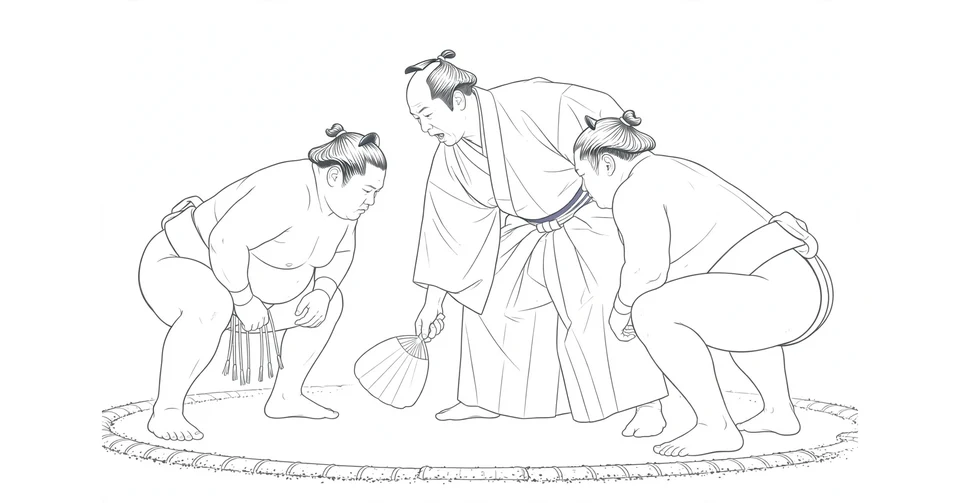
This guide explains what hakkeyoi means, when the gyoji calls it, how it works together with the other calls of a bout, and what happens in the pauses when the word is needed most. The word itself is short. The job it does is not.
What hakkeyoi means
Hakkeyoi is a shout, not a sentence, and it is not the kind of word you will find in an everyday Japanese dictionary. It belongs to the ring. Only the gyoji, the referee inside the ring, may call it, and he calls it at the moments when a bout needs to begin or to begin again. The Glossary of sumo terms on Wikipedia defines hakkeyoi as the phrase shouted by a gyoji during a bout, specifically when the action has stalled and the wrestlers have reached a stand-off, and it notes that there are numerous theories as to its meaning but that "Put some spirit into it!" is widely cited.
That translation is worth sitting with for a moment, because it tells you what kind of command hakkeyoi is. It is not "go" and it is not "fight". It is closer to an order to put your whole spirit into what you are about to do. The word carries effort inside it. When the gyoji calls hakkeyoi, he is not only telling two men to move. He is telling them to move with everything they have, and to do it now.
Hakkeyoi is one of the kakegoe, the codified calls a gyoji uses to officiate a match. These calls are fixed by tradition, and a gyoji does not invent new ones on the spot. Every call has its place, and every wrestler knows them all by heart, because a wrestler who misreads a call can lose a bout before he understands what happened. Hakkeyoi sits at the centre of that system. It is the call that opens the bout, the call that revives it, and the call that restarts it, which makes it the most heard and the most important of all the gyoji's words.
The spelling of the word varies, and that is the first thing a newcomer should know. You will most often see it written as hakkeyoi, in Japanese as はっけよい, and you will also see the form hakkiyoi. The sound is the same either way, a sharp four beat shout that carries across a silent arena. The variation is a reminder that hakkeyoi comes from spoken tradition rather than from a book, and that the ring has kept the word alive by saying it, not by spelling it.
The word that confirms the charge
A sumo bout does not start when the wrestlers feel like starting. It starts after a long preparation called shikiri, in which the two men throw salt, stamp their feet, and stare at each other across the ring. The gyoji watches all of it, and when the time judge decides the moment has come, the gyoji guides the wrestlers into position with a series of short calls. He may say kamaete, meaning get ready, or miatte, meaning look at each other, or yudannaku, meaning be on the alert. Then he says jikan desu, meaning it is time, and matta nashi, meaning no false starts, and te wo tsuite, meaning touch down with your hands.
The two wrestlers crouch behind the shikiri-sen, the two short white lines in the middle of the ring. Those lines are 90 centimetres long and 6 centimetres wide, placed 70 centimetres apart, and they have been part of the ring since the spring tournament of 1928. The wrestlers put their fists down behind them, and the whole arena holds still. If one man jumps early, the gyoji calls matta and raises his left hand, sometimes repeating mada-mada-mada, meaning not yet, not yet, not yet, and both men return to their lines to try again.
When both fists are down together and both men are still, the gyoji shouts hakkeyoi, and the tachiai, the initial charge, begins. That is the moment this whole article is about, and it is more subtle than it looks. The wrestlers do not charge because a clock ran out. They charge because the referee told them to, with a word they trust. Experienced wrestlers listen for hakkeyoi the way a sprinter listens for a gun, and if they are unsure whether a start was real or a false start, the sound of hakkeyoi is the confirmation they wait for. Without it, they hold back. With it, they go.
I find that arrangement quietly admirable. In most sports the start is a mechanical thing, a whistle or a light or a buzzer, and the athletes react to a device. In sumo the start is a human voice, and the wrestlers react to a person. That puts a different kind of responsibility on the referee, because his timing and his judgment are part of the contest, and it puts a different kind of trust in the wrestlers, because they have agreed to move when one man speaks. Hakkeyoi is the sound of that agreement working.
Hakkeyoi and nokotta, the two voices of a bout
Once the bout is under way, the gyoji does not fall silent. He keeps talking, and his calls become a running voice over the action. The two words you will hear most are hakkeyoi and nokotta, and they work as a pair. Nokotta means "remained", as in "remained in, not lost yet", and the gyoji calls it while the wrestlers are moving, to tell them the bout is still alive and they can fight on. Hakkeyoi is the call for the moments when the movement stops.
The distinction matters because the wrestlers cannot watch the referee while they fight. Their eyes are on each other, on the belt, on the edge of the ring. They cannot look at the gunbai, the wooden fan the gyoji points at the winner, so the calls are their guide. As long as they hear nokotta, they know the bout continues. When they hear hakkeyoi, they know they are being told to move again. The voice replaces the eyes, and the bout is run by sound as much as by sight.
The gyoji himself never stands still while he calls. He moves around the ring constantly, so that he does not block the view of the crowd or the judges for more than a moment, and his voice follows him. The calls come in a rhythm that follows the bout: a burst of nokotta while the men push and grapple, then hakkeyoi when they lock up and stop, then nokotta again when they break free. A listener who knows the pattern can follow a bout with closed eyes, which is a strange and lovely thing to say about a sport that looks so physical. The words are doing real work, telling two men who cannot see the referee exactly where they stand.
There is a lesson in that pairing that goes beyond sumo. Hakkeyoi and nokotta are not orders barked at athletes by an official who stands apart from them. They are a conversation in two words, one that says "keep going" and one that says "go again", and the referee is inside the ring, moving with the wrestlers, close enough to touch them. The gyoji is not a distant judge. He is a participant in the bout, and his voice is part of the bout itself.
When the action stalls
Not every bout moves at speed. A pushing bout, in which the wrestlers drive at each other with open hands, usually resolves quickly, one way or the other. But a yotsu bout, in which both men take a grip on the belt and wrestle chest to chest, can settle into a stand-off. Two strong men lock together, neither can move the other, and the bout freezes into a contest of strength and patience. The crowd waits. The wrestlers wait. And then the gyoji speaks.
When the action stalls, the gyoji stops calling nokotta and shouts hakkeyoi again, often in the pattern "yoi, hakkeyoi, yoi". He pauses a little, and then he says it again, and he keeps saying it until the wrestlers start moving. The call is an instruction to renew the action, and it is repeated as often as needed. When the men break free and the bout moves again, the gyoji switches back to nokotta, and the rhythm resumes.
This is the use of hakkeyoi that most people hear first, because a stalled bout is the moment when the referee's voice is most noticeable. A bout that flows needs little from the gyoji. A bout that sticks needs him to intervene, and hakkeyoi is the tool he uses. It is not a warning and it is not a punishment. No wrestler is penalised for stalling. The call simply says that the bout must go on, and that standing still is not an option.
I think there is something fair about that. A stalemate in sumo is not a failure of the wrestlers, it is a natural result of two evenly matched men meeting at full strength, and the sport could have chosen to let them stand there until one of them gave way. Instead it gives the referee a word, a short sharp nudge, and the bout moves again. Hakkeyoi respects the wrestlers by refusing to let the bout die of stillness, and it respects the crowd by refusing to let the contest turn into a statue.
Matta, hikimasuyo, hakkeyoi
The most dramatic use of hakkeyoi comes after a pause, when a bout has been stopped and must be restarted from exactly the place it stopped. There are two occasions when the gyoji has to halt a bout in this way, and both of them end with the same three words: matta, hikimasuyo, hakkeyoi.
The first occasion is the mawashi-matta, the pause to fix a loose belt. Our guide to the mawashi explains the belt in full, and the pause is one of the most distinctive moments in the sport. If the knot at the back of a wrestler's mawashi works loose, the gyoji alone can halt the bout, because a loose belt is dangerous and because the belt is the wrestler's only clothing. The gyoji waits for a dead moment in the bout, when neither man is attacking, and then he calls out "matta, matta", meaning wait, wait, and lays his hands on the backs of the two wrestlers to stop them from moving.
Both wrestlers must freeze in their positions, exactly as they are, while the gyoji reties the belt himself, the cord of his fan held between his teeth while he works. He checks the other knot too, and he confirms with the judges that neither wrestler has shifted from his position. Then he places his hands on the backs of both men, calls out "hikimasuyo", meaning get ready, and restarts the bout by lightly tapping their backs and calling "hakkeyoi", meaning get moving. The bout resumes from exactly the same position, as if the pause had never happened, and the wrestlers pick up the fight from the grip they held when it stopped.
The rules for the pause are precise, and they are precise for a reason. The gyoji must not order the halt during an offensive move, so a wrestler cannot use a loose belt to escape an attack. A wrestler who tries to shift his grip while the gyoji works is breaking the spirit of the pause, though many try a small adjustment, and the gyoji watches for it. The pause is treated as an interruption, not as a fresh start, and that is the whole point of the ritual. Neither man is allowed to gain from the fact that the bout stopped.
In practice the exact words vary a little, and that variation is worth knowing about. Some gyoji ask "iika, iika", meaning "OK, OK", as they put the wrestlers back into position, and the question comes out muffled because the gyoji is biting the cord of his fan. One gyoji, in a bout from the spring tournament of 2016, was heard calling "hora, ugokuna", meaning "hey, do not move", which is not in the script at all. The calls are fixed by tradition, but the man making them is human, and the tradition gives him room to speak plainly when the moment needs it. Hakkeyoi itself, though, never changes. Whatever words come before it, the restart always ends with the same call.
There is a harder rule behind the pause, and it is worth stating plainly. If a wrestler's mawashi comes completely off during a bout, he is disqualified. That is extremely rare. It happened in May 2000, when the sandanme wrestler Asanokiri was disqualified in a match with Chiyohakuhou, and it is remembered precisely because it almost never happens. The rule exists because the belt is the bout, and a bout without a belt is not a bout at all. The mawashi-matta exists to make sure that rule is almost never needed, and hakkeyoi is the word that closes the pause and lets the fight continue safely.
The water break and the restart
The second occasion for a pause is the mizu-iri, the water break. When a bout goes on for around four minutes, the gyoji stops it so the wrestlers can drink and recover, because a bout that long is exhausting and the risk of injury rises. Before he sends them to the side, he records the exact position of each wrestler's hands and feet, sometimes marking the clay, so that the bout can resume from the same spot. Then the wrestlers drink, catch their breath, and return.
In the two sekitori divisions, juryo and makuuchi, the wrestlers are placed back in exactly the same position, and the gyoji puts them there himself, watching the marks he made like a hawk so as not to confuse them with other marks in the clay. In the lower divisions the bout is restarted from the tachiai instead, with a fresh charge. Either way, the restart ends the same way the start did, with the gyoji calling hakkeyoi, and the wrestlers moving again from the place the bout had reached.
A bout with two water breaks is rare enough to be remembered. In the summer tournament of 2001, on day six, Kotomitsuki and Musoyama fought a bout so long that it needed two mizu-iri, the first at about five minutes and the second at about twelve and a half minutes. The judges held a conference, and because a second water break is so unusual, they ordered a rematch after one intervening bout rather than a second restart from the same position. The story is a good reminder of how seriously sumo takes the business of stopping and starting. Even the pauses have rules, and even the rules have exceptions, and the gyoji is the man who carries them all in his head while the crowd watches the wrestlers.
Our guide to the gyoji describes the full range of that job, from calling the bouts to writing the ranking sheet by hand, and the water break shows why the job needs a patient man. The gyoji must remember where two exhausted men were standing, put them back there exactly, and then say one word and let them fight. Hakkeyoi does not erase the pause. It honours it, by picking the bout up where it left off rather than starting over.
Where the word comes from
The meaning of hakkeyoi is not entirely clear, and the uncertainty is part of what makes the word interesting. The official documentation says it comes from 発気揚々, read hakki yoyo, which means something like "spirit bursting with vigor". That fits the way the word is used, as a call to put spirit into the fight, and it is the explanation most often given by the Japan Sumo Association.
But there are other claims as well. One theory traces the word to 八卦良い, which would mean "good omens". Another traces it to 早競へ, which would mean "compete fast". Both are plausible, and neither can be proven, because the word is old and its first uses were spoken, not written. A detailed walkthrough of the referee's calls at Tachiai sets out these theories side by side and notes that the origin is genuinely debated, which is the honest position. Nobody knows for certain where hakkeyoi comes from, and the sport has gone on using it anyway.
I like that the word keeps its mystery. Sumo is full of things that are explained by tradition rather than by history, and the calls are among the oldest of them. A word that has been shouted in the ring for centuries does not need a proven etymology to do its job, and the fact that scholars argue about it while wrestlers simply obey it says something about how tradition works. The meaning lives in the use, not in the dictionary, and every bout that starts with hakkeyoi adds one more use to the long chain.
There is one more thing to say about the origin, and it is a caution. You may come across the claim that the call "hakkeyoi, nokotta" comes from Hebrew, a theory that has been repeated in books and on the internet. It does not. The combination is Japanese, built from Japanese words and Japanese ritual, and the Hebrew theory is a curiosity rather than a serious claim. The real story is simpler and better: a word whose exact birth is lost, kept alive by the people who say it every day.
Why one word is enough
It is worth asking why sumo runs its bouts on a single word when other sports need a whistle, a buzzer, a flag, and a clock. Part of the answer is practical. A shout is immediate, it needs no equipment, and it can be heard by everyone in the arena at once, wrestlers, judges, and crowd alike. A whistle can be confused with a whistle from the crowd. A word cannot be confused with anything else, because nobody else in the arena is allowed to say it.
But the deeper answer is about authority. Hakkeyoi works because everyone in the ring has agreed, in advance, what it means and who may say it. The wrestlers have agreed to move when the gyoji speaks. The gyoji has agreed to speak only when the moment is right. The judges have agreed to accept his call. That agreement is what makes one word enough, and it is a kind of trust that no device can replace. A whistle is blown by whoever holds it. Hakkeyoi is spoken by a man who has spent decades earning the right to speak it.
There is also something to be said for the size of the word. Hakkeyoi is short, four beats, and it can be shouted clearly even by a small man in a large hall. It does not need to be loud in the way a modern public address system is loud. It needs to be clear, and it needs to be final, and four beats are enough for both. The wrestlers are crouching a metre away from the man who says it. They do not need volume. They need certainty, and the word gives it to them.
I think modern sport could learn something from that economy. So much of sport today is run by technology, by video review and electronic timing and sensor driven decisions, and those things have their place. But there is a value in a contest that can be started by a human voice, with no machine between the official and the athletes, and sumo has kept that value alive. Hakkeyoi is a reminder that authority does not have to be complicated to be real, and that a single word, spoken at the right moment by the right person, can move two of the largest athletes on earth.
Listening for it at your first tournament
If you go to a tournament for the first time, listen for hakkeyoi before you watch for anything else. The calls come in order, and once you know the order you can follow a bout without knowing a single wrestler's name. First the preparation, with kamaete and te wo tsuite as the wrestlers crouch. Then the false start, if there is one, with matta and mada-mada-mada. Then hakkeyoi, and the charge. Then nokotta, over and over, while the men move. Then hakkeyoi again if they stall. Then shobu-ari when the bout is decided, and the winner's name as the gunbai points to his side.
Six tournaments are held each year, and each one lasts fifteen days, so there are many chances to hear the pattern and to learn it. The first time, the calls will sound like noise, a stream of syllables in a language you may not speak. The second time, you will pick out hakkeyoi, because it is the loudest and the most repeated. The third time, you will start to hear the difference between the hakkeyoi that starts a bout and the hakkeyoi that revives one, and you will realise that the referee is telling you what is happening, if you know how to listen.
Watch the gyoji as well as the wrestlers. He is the smallest man in the ring, dressed in silk, holding a wooden fan, and he is doing the hardest job in the arena, which is to be certain in public. Every call he makes is heard by thousands of people, and every mistake is seen by five judges. The wrestlers get the applause and the prizes. The gyoji gets the next bout, and the next call, and the long walk back to the side of the ring.
Hakkeyoi is a small word, and it has carried a large job for a very long time. It starts the bout, it revives the bout, and it restarts the bout, and it does all of that without ever changing. The next time you hear it, listen for what it really is: not just a shout, but a promise that the contest is fair, the wrestlers are ready, and the fight can begin. That is a lot for one word to carry, and it carries it well.
More in Culture & Society
- Tachiai Is the One Second That Decides a Sumo Bout
- A Gunbai Points at the Winner and Nobody Argues
- Dondo-Yaki Is the Fire That Closes the Japanese New Year
- A Yobidashi Calls the Wrestlers and Sweeps the Ring
- A Dohyo Is Sacred Ground Long Before the First Bout
- A Kadomatsu Guards the Door Until the New Year Fire
Latest posts
- Izakaya, the After-Work Pubs Where Japan Unwinds
- A Shikona Gives a Wrestler His Second Name
- Japanese Street Food, From Takoyaki Stalls to Festival Yatai
- Komusubi Is the Smallest Chair at Sumo's Top Table
- A Sekiwake Waits One Win From Sumo's Highest Door
- Tanabata Festival and the Star-Crossed Lovers Behind the Bamboo Wishes
- A Maegashira Climbs the Numbered Ladder One Bout at a Time
- An Ozeki Stands One Step From the Top and Cannot Afford to Slip
- An Oyakata Is the Father a Sumo Stable Cannot Replace
- A Tokoyama Spends Ten Years Learning to Dress a Topknot
- Japanese Calligraphy and the Brush That Turns Writing Into Art
- A Tegata Is Sumo's Inked Handprint Autograph
- A Rikishi Is a Man of the Sumo World Before He Wins a Single Bout
- Mawashi Carries a Wrestler's Rank Around His Waist
- Namasu Turns Daikon and Carrot Into a Red and White Wish