Japanese Street Food, From Takoyaki Stalls to Festival Yatai
· 11 min read
Japanese street food runs on small stalls and big flavours, from Osaka takoyaki to Fukuoka ramen yatai. Here is what to eat, where to find it, and how much it costs.
Japanese street food is the fastest way to understand how Japan eats. A single stall can teach you more about a city than a whole guidebook, because the food on the counter is the food the neighbourhood actually wants, cooked the way it has been cooked for decades.
The scene is different from the night markets of Bangkok or Taipei. Japan has no sprawling street food scene on every corner, and eating while walking is generally frowned upon. Instead, Japanese street food gathers in specific places: festival lanes lined with yatai, the shopping streets near old temples, the canal side in Osaka, and the riverbank in Fukuoka after dark. You go to the food, you stand beside the stall, and you eat it there, hot, before moving on.
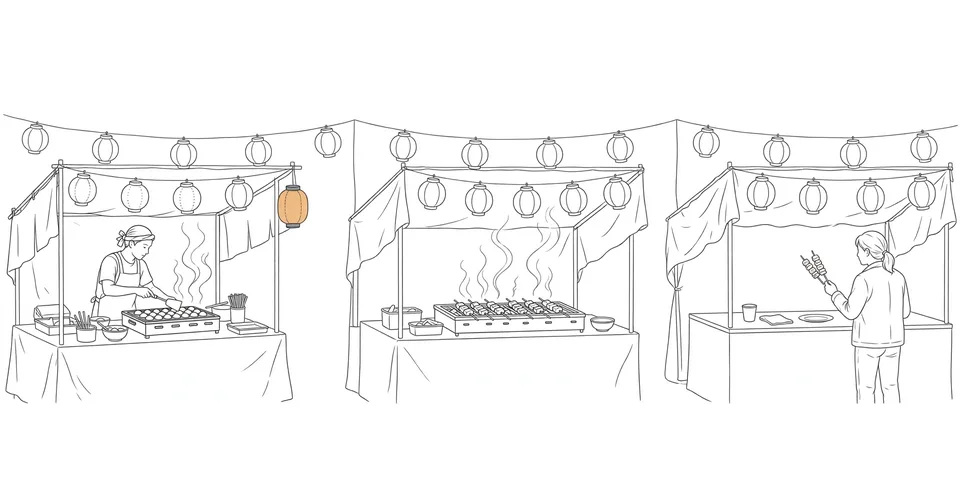
That rhythm is part of the pleasure. Japanese street food is not a meal you rush through on the way somewhere else. It is a pause, a small ceremony of smoke and steam, and a conversation with the person behind the grill. The portions are small and the prices are low, so a single evening can hold five or six different tastes. For a first time visitor, it is the cheapest and most honest food tour in the country.
What counts as Japanese street food
The heart of Japanese street food is the yatai, a portable food stall that appears at festivals, temple fairs, and seasonal markets. At a matsuri, the yatai line up in rows under paper lanterns, each one selling a single dish, and the air fills with the smell of grilled sauce and hot oil. Summer and autumn are the peak seasons, when fireworks festivals and shrine festivals bring out the full range.
But Japanese street food is not only festival food. Some of it lives in permanent spots: the takoyaki shops of Dotonbori in Osaka, the taiyaki bakeries on temple approach streets, the roasted sweet potato trucks that circle residential neighbourhoods in winter, and the ramen yatai of Fukuoka that set up along the Naka River every evening. Shopping streets, known as shotengai, are another home for it, with small stalls selling korokke, senbei, and melon pan to people doing their daily shopping.
The common thread is scale. Japanese street food is cooked in front of you, in small batches, by a vendor who often sells only one thing. That focus is why a takoyaki stall can be famous for thirty years while selling nothing else.
Takoyaki, the ball that made Osaka famous
No dish defines Japanese street food better than takoyaki. The round balls of wheat batter hide a piece of tender octopus inside, cooked in a special iron mold until golden and crisp outside and molten inside. They come topped with takoyaki sauce, Japanese mayonnaise, green seaweed powder, and bonito flakes that curl and dance in the heat.
Takoyaki was born in Osaka in the 1930s, and the city still treats it as a point of pride. A serving of six to eight pieces usually costs 500 to 800 yen. In Dotonbori, the stalls at Wanaka and Kukuru draw lines that move in ten to fifteen minutes, and the wait is part of the experience. In Tokyo, the chain Gindaco is consistent and easy to find, though a festival stall with a long queue is usually the better bet.
One warning that every first timer needs: fresh takoyaki is far hotter inside than it looks. The outside feels ready while the centre is still molten batter. Bite carefully, or you will learn the lesson the way everyone does, once.
Yakitori, yakisoba, and the smell of the grill
If takoyaki is the star, yakitori is the workhorse of Japanese street food. Skewers of chicken, thigh, meatball, skin, and leek, grilled over charcoal and seasoned with salt or sweet tare sauce, sell for 100 to 300 yen a stick. Yakitori stalls appear at almost every festival and near train stations, and the smoke from the grill is the best advertising a stall can have.
Yakisoba, fried noodles tossed on a hot plate with cabbage, pork, and sweet sauce, is the other festival classic. It is cooked in huge batches in front of the crowd, and a serving costs around 500 yen. The noodles are a reminder that Japanese street food is not delicate. It is salty, saucy, and made to be eaten standing up with chopsticks and a paper tray.
Kushikatsu, deep fried skewers of meat and vegetables from Osaka, is the third member of this group. In Dotonbori, the rule is famous: dip your skewer in the shared sauce once, and only once. Double dipping is not just bad manners, it is a local scandal.
The sweet side: taiyaki, dango, and kakigori
Japanese street food has a whole sweet half that visitors often miss. Taiyaki is the best known, a fish shaped cake filled with sweet red bean paste, custard, or chocolate, crisp outside and warm inside, usually 200 to 400 yen. The shape is a sea bream, a lucky fish in Japan, and the best taiyaki has filling that reaches all the way to the tail. Naniwaya Sohonten in Azabu Juban, Tokyo, has been making it since 1909 and is considered the original shop.
Dango, small rice dumplings on a skewer, is the quieter classic. The most common version is mitarashi dango, coated in a sweet soy glaze, sold for 100 to 300 yen a skewer at temple fairs and tea houses. It is simple, chewy, and older than almost everything else on this list.
In summer, kakigori takes over. The shaved ice, flavoured with syrup and sometimes topped with condensed milk or red bean, is the festival answer to the heat. A cup costs 300 to 500 yen, and on a humid August evening it sells faster than anything else on the lane. In winter, the sweet stalls switch to yaki imo, roasted sweet potatoes sold from trucks, and hot amazake, a sweet fermented rice drink.
Where to find it: Osaka, Fukuoka, Tokyo, and Kyoto
Osaka is the undisputed capital of Japanese street food. The city even has a word for its attitude to food, kuidaore, which means eating yourself into ruin. Dotonbori is the centre of it, a canal side strip where takoyaki, okonomiyaki, kushikatsu, and crab legs are sold from hundreds of stalls and tiny restaurants. A walking dinner of takoyaki, okonomiyaki, and kushikatsu with a drink costs around 2,000 to 3,500 yen.
Fukuoka offers a different version. Its ramen yatai, open air stalls along the Naka River in the Nakasu and Tenjin districts, open in the evening and serve tonkotsu ramen, oden, and grilled skewers to people sitting on stools under a canvas awning. A bowl of ramen costs around 800 to 1,000 yen, and the stalls are small, seating eight to ten people at most. Talking to the stranger on the next stool is part of the price.
In Tokyo, the best Japanese street food is found on the approach to Senso-ji Temple in Asakusa, where Nakamise Street is packed with stalls selling taiyaki, age-manju, and senbei, and in Ameyoko market near Ueno, where the lanes are loud and the food is cheap. In Kyoto, the place is Nishiki Market, a covered arcade known as the kitchen of Kyoto, where the stalls sell dango, pickles, and skewered fish.
Festivals are the richest hunting ground of all. If your trip overlaps with a summer matsuri, a shrine festival, or a fireworks show, the yatai rows will give you the full range of Japanese street food in a single evening. Check the local festival calendar before you travel, because the best stalls only exist for a few days a year.
The etiquette that matters
Japanese street food comes with a few rules that are easy to follow once you know them. The most important is the one about walking. Eating while walking, known as tabearuki, is considered rude in most places, so the correct move is to step aside, eat beside the stall, and throw your rubbish in the bin the vendor provides. The stall will have a small standing area, and that is where the food is meant to be eaten.
Ordering is simple. Most stalls have a menu with pictures or plastic food models, and you point and pay. Cash is still common at festival stalls, though many permanent shops take IC cards and QR payment. A little Japanese helps, but a smile and a pointed finger work everywhere.
Prices for Japanese street food are honest and low. A filling evening of Japanese street food, three or four dishes plus a drink, rarely costs more than 2,000 yen per person. That is part of why the scene survives: it is food for everyone, not a tourist performance. The vendors cook for their neighbours first and visitors second, and the quality shows it.
How much to budget
For planning a Japanese street food evening, a simple table of typical prices helps. These are the ranges you will see at most stalls in 2026, though festival prices run a little higher than everyday shops.
| Dish | Typical price | Where to find it |
|---|---|---|
| Takoyaki, 6 to 8 pieces | 500 to 800 yen | Osaka Dotonbori, festivals |
| Yakitori, per skewer | 100 to 300 yen | Festival stalls, station streets |
| Taiyaki, per piece | 200 to 400 yen | Temple streets, shopping streets |
| Okonomiyaki | 800 to 1,500 yen | Osaka, Hiroshima, festivals |
| Yakisoba | 400 to 600 yen | Festival stalls |
| Dango, per skewer | 100 to 300 yen | Temple fairs, tea houses |
| Kakigori | 300 to 500 yen | Summer festivals |
| Ramen yatai, per bowl | 800 to 1,000 yen | Fukuoka Nakasu and Tenjin |
A budget of 2,000 to 3,500 yen buys a generous evening. A budget of 1,000 yen still buys two or three good dishes. Japanese street food is one of the few parts of a Japan trip where spending less buys you more variety, because the smallest portions are often the best ones.
For context, the same money at a convenience store buys a decent meal too, and many visitors mix the two. The onigiri from a konbini is the portable snack of everyday Japan, while the yatai is the celebration version, cooked to order and eaten on the spot. Both are worth your time, and they teach different things about how Japan feeds itself.
Why it stays with you
I have eaten in fine restaurants in Tokyo and tiny ones in the countryside, and the meals I remember most clearly are the ones eaten standing up. There is something about food cooked a metre away from you, handed over still steaming, that no table service can match. The vendor watches you take the first bite. The steam fogs your glasses. The bonito flakes are still moving.
That is the real reason Japanese street food matters, and why it keeps drawing crowds even as Japan changes around it. It is not about the novelty of eating octopus balls or fish shaped cakes. It is about a food culture that stayed small, local, and human at a time when almost everything else got bigger and more anonymous. The stall has one dish, one cook, and one queue, and that is enough.
If you visit Japan, give one evening to the stalls. Go to a festival if you can, and if you cannot, go to Dotonbori, or the riverbank in Fukuoka, or the temple street in Asakusa. Follow the smoke, join the longest queue, and eat standing up like everyone else. Japanese street food will do the rest, and it will probably be the cheapest great meal of your trip. If you want to plan the evening around the festival calendar, the guides at TabiWay and Food in Japan list the dishes and the places to find them, and the Tanabata festival and the wider festival season are good starting points for timing a visit.
More in Food & Travel
- Namasu Turns Daikon and Carrot Into a Red and White Wish
- Ebi Bends Like an Old Back and Wishes You a Long Life
- Kobumaki Rolls Joy Into a Strip of Kelp
- Kurikinton Is the Golden Mash That Wishes You Wealth
- Japanese Beer and the Dry Wars That Changed How Japan Drinks
- Kamaboko Paints the New Year Red and White
Latest posts
- A Kadomatsu Guards the Door Until the New Year Fire
- A Shikona Gives a Wrestler His Second Name
- Komusubi Is the Smallest Chair at Sumo's Top Table
- A Sekiwake Waits One Win From Sumo's Highest Door
- Tanabata Festival and the Star-Crossed Lovers Behind the Bamboo Wishes
- A Maegashira Climbs the Numbered Ladder One Bout at a Time
- An Ozeki Stands One Step From the Top and Cannot Afford to Slip
- An Oyakata Is the Father a Sumo Stable Cannot Replace
- A Tokoyama Spends Ten Years Learning to Dress a Topknot
- Japanese Calligraphy and the Brush That Turns Writing Into Art
- A Tegata Is Sumo's Inked Handprint Autograph
- A Rikishi Is a Man of the Sumo World Before He Wins a Single Bout
- Mawashi Carries a Wrestler's Rank Around His Waist
- Yokai, the Strange Spirits That Haunt Japanese Folklore
- Yokozuna Is the Rank Sumo Never Takes Back