A Yobidashi Calls the Wrestlers and Sweeps the Ring
· 18 min read
A yobidashi is the voice and the workhorse of professional sumo, calling wrestlers to the ring, building the clay dohyo, and keeping every tournament day moving.
Before a single wrestler steps onto the clay, a voice fills the arena. It is high, stretched, and musical, and it carries a name across the hall in a way no loudspeaker could. That voice belongs to a yobidashi, the ring announcer and attendant of professional sumo, and without it the tournament cannot begin.
A yobidashi does far more than announce names. He builds the ring the wrestlers fight on, sweeps it between bouts, beats the drum that opens and closes the day, carries the sponsor banners, and keeps the whole programme running on time. The wrestlers are the stars of sumo, but the yobidashi is the stagehand, the usher, and the herald rolled into one person. Our guide to The Banzuke Remembers Every Basho in Calligraphy notes that the yobidashi, who call the wrestlers to the ring and sweep it between bouts, are listed on the ranking sheet too, and that small line on the sheet is the seed of this article. The men behind that line deserve a closer look.
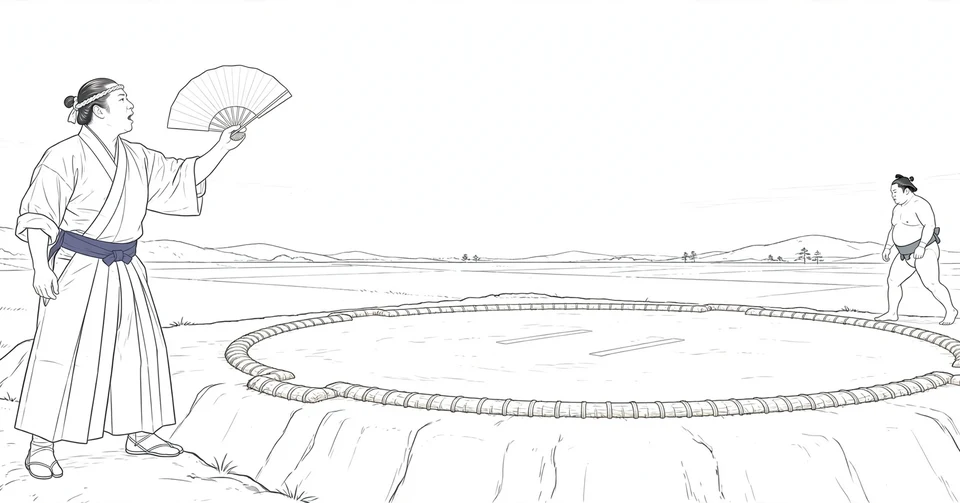
This guide explains what the caller is, how the call works, how a teenager becomes one, how the ranks are ordered, and why a tournament would fall apart without them. The role looks simple from the stands. Up close, it is a lifetime of craft.
What a yobidashi actually is
A yobidashi, written with characters that mean to call or to summon, is an employee of the Japan Sumo Association. The English translations vary, usher, ring attendant, or ring announcer, and each one captures only part of the job. The yobidashi is the person who calls a wrestler, or rikishi, to the dohyo by his ring name, or shikona, immediately before his bout. He does it standing in the ring, holding a simple white folding fan, in a high pitched and melodious voice that can be heard across a crowded arena.
The role is old. The status did not appear under that name until 1750, but earlier versions of the job go back much further. In the Heian period there was a role called fusho, who presented wrestlers to the emperor and the nobility attending matches. In the Edo period the callers were known as maegyoji, meaning preceding referees, and later as fure and nanori, both words meaning to announce something. Because early callers would sit on their heels in the middle of the ring when the wrestlers arrived and call them by name, they were also called tsubaki gyoji, or squatting referees. The name changed over the centuries. The job stayed.
There are not many of them. The maximum number of callers allowed in the Sumo Association is 45, and as of August 2025 there were 44. That small number has to cover six tournaments a year, plus tours, plus the daily work inside the stables. Every yobidashi belongs to a stable, just as the wrestlers do, and like the wrestlers he is a full member of the Association, subject to retirement at 65. Former sekiwake Takamiyama once nicknamed them sumo's workhorses, and the nickname has stuck because it fits.
He is not a wrestler, and he is not a referee. The gyoji referees the bout from inside the ring. The shimpan, the ringside judges, decide disputed results. The yobidashi does almost everything else. He is the person who makes sure the bout can happen at all.
How a yobidashi learns the call
The call is the most famous part of the job, and it is also the hardest to learn. NHK's sumo guide explains that the caller is not singing when he calls a name. He is calling it out in a long, stretched chant, using volume and intonation to give the introduction weight. One top division yobidashi, Rikinojo, told NHK that acquiring the skill takes at least three years of apprenticeship and hard work. That is three years to learn how to say a name.
The technique is physical rather than musical. A caller who was interviewed by the French sumo magazine Le Monde du Sumo said there are no singing lessons as such. The main point is to open the mouth wide and produce the sound from the stomach, from the diaphragm, so that it carries to the far side of the arena. Volume matters, but so does control. The call has to be loud enough to be heard at a distance, and it has to be clear enough that every syllable of a long ring name lands correctly. A yobidashi is known to use cheat sheets, because the divisions hold hundreds of wrestlers and a mistake in front of a full arena is not easily forgotten.
The white fan is part of the technique as well as the costume. He holds a plain white folding fan in front of his face while he calls, and the fan was originally intended to prevent droplets of saliva from soiling the sacred surface of the dohyo. The fan is blank. No name is written on it. It is not a script. It is a shield for the clay, and a reminder that the ring is treated as sacred ground. The Japan Sumo Association notes that the fan is the broad type used in Japanese dance, larger than an ordinary folding fan, and the yobidashi directs his gaze toward its upper edge while he calls.
There is a strict order to the calling. On odd numbered days of a tournament the east wrestler is called first, and on even numbered days the west wrestler is called first. The caller enters the dohyo from the south side, moves toward the centre, then turns toward the first wrestler he will announce and takes one or two steps toward him, opening his paper fan. He stops at the white line painted on the ground. Every step is set by custom, and the audience, many of whom have watched sumo for decades, notices when it is done well. I think that is the first thing to understand about the call. It is not decoration before the fight. It is a ceremony in its own right, and the yobidashi performs it several dozen times a day.
Building the ring from clay
Long before the first call of a tournament, the caller has already done his heaviest work. He builds the dohyo. Construction begins five days before the first day of the tournament, and the work takes about three days. The ring is 4.55 metres across and rises 66 centimetres above the ground, and it is made from about 40 tonnes of a special clay called Arakida, collected in the town of Kawagoe in Saitama Prefecture. The yobidashi use small trucks to transport the material, then shape it by hand into the raised circle the wrestlers will fight on.
He is also responsible for the facing of the tsuriyane, the suspended roof above the dohyo. Supervision of the construction does not necessarily fall to the most senior man present. Depending on their skills, a san'yaku ranked yobidashi may supervise the building of the ring. When a stable goes on tour, not all yobidashi are present, and it is not uncommon for local volunteers to help with the construction. When a stable's training area needs rebuilding, yobidashi from the same ichimon, or clan of stables, take charge of the work.
The ring is not only built, it is blessed. On the morning of the day before each of the six tournaments of the year, the dohyo matsuri, the ring purification ceremony, is held to purify the dohyo before any bouts are fought. Three gyoji preside over the ceremony, with the highest ranked gyoji available acting as head priest, and the ceremony begins when the most senior caller claps the hyoshigi, the wooden clappers. Offerings of rice, salt, kelp, dried squid, and chestnuts are buried in the centre of the ring, and at the end of the ceremony two taiko drum sets carried by callers walk around the ring three times counter clockwise, led by the most senior yobidashi available. The ceremony goes back to the 1790s, when the Yoshida family introduced it, and the yobidashi has been part of it ever since.
I find the building of the ring the most telling part of the job. A wrestler trains for years to spend a few seconds in the ring. He spends days building that ring, and then sweeps it, waters it, and repairs it between bouts, so that the few seconds can happen at all. The audience never applauds the clay. It should, at least once.
The drums, the banners, and the long day
On a tournament day the caller is the busiest worker in the building, staying on site from 7.30 in the morning until 6 in the evening. The day starts with sound. The first drum, the ichiban daiko, is played for 30 minutes from 8 in the morning to announce the opening of a day of matches. Before the tournament, a small group of yobidashi walks the streets of the host city with a drum to tell the locals that the tournament is about to start. During the tournament the drum moves to the top of the yagura, a bamboo tower about 16 metres tall in front of the arena, where two yobidashi play the yagura daiko. At the end of the day, immediately after the yumitori shiki bow twirling ceremony, the hane daiko is played to invite the departing spectators to come back the next day.
The drums are not the only sound a caller makes. The hyoshigi, two pieces of cherry wood tied together with a cord, is used to signal the wrestlers waiting in the changing room. Banged one against the other, the pieces of cherry wood make a very clear sound that tells the next two wrestlers it is time to come and sit at ringside. High ranking callers also accompany sekitori ranked wrestlers in their dohyo iri ring entering ceremonies by sounding the hyoshigi. The instrument has different names for different moments, such as ichiban gi and agari gi, the last of which sounds as the closing bow ceremony ends and marks the conclusion of the day's programme.
Between bouts, he sweeps the ring, provides the purification salt, and makes sure the buckets of chikara mizu, the power water at the corners of the ring, do not become a hazard during a bout. About 45 kilograms of salt are used on each day of a grand tournament, and the yobidashi supplies it. He also parades the kensho advertising banners around the ring before particular match ups between popular wrestlers. The banners belong to the companies that sponsor the prize money for those bouts, and the yobidashi carries them in a slow circuit of the ring so the whole arena can read them. He displays banners showing that a match has been decided by default, usually because of a withdrawal, or declared a draw, or subject to a rematch. He brings the thick cushions of the makuuchi ranked wrestlers to the ring, hands towels to wrestlers, and guards the ring so that no wrestler injures himself on the water bucket at its edge.
Less publicly, the caller also takes care of many small requests from Sumo Association executives on judging or guard duty, such as fetching drinks. At the stable, he runs errands for his stablemaster and keeps track of the wrestlers' progress during training sessions. When a stable goes on tour in the odd numbered months, the caller is responsible for making the travel arrangements, reserving accommodation for the masters and the wrestlers. It is also traditional for yobidashi to write folk songs called jinku, based on sumo life. The job description is long because the job is everything the wrestlers and the referees do not do.
Ranks, names, and a career of decades
Like the wrestlers, a caller climbs a ladder. The current ranking system was created in July 1993 and consists of nine ranks. From the bottom they are jonokuchi yobidashi, jonidan yobidashi, sandanme yobidashi, makushita yobidashi, juryo yobidashi, makuuchi yobidashi, san'yaku yobidashi, fuku tate yobidashi, and tate yobidashi at the top. The lower ranks mirror the wrestlers' divisions. The top two stand apart, since tate means chief and fuku tate means deputy chief. The system is identical to the one applied to the gyoji referees.
Promotion is based mainly on experience, although ability is also taken into account, particularly for promotion to the top ranks. New recruits can only begin their career under the age of 19 and must have completed compulsory education. Most enter at 15, and it is not uncommon for new recruits to be wrestlers who did not manage to break through but are keen to stay in professional sumo. Junior callers undergo six months of theoretical training in one of the Kokugikan's training rooms under the tutelage of their seniors. From there the climb is slow. It takes around 15 years for a caller to be promoted from the bottom of the hierarchy to the rank of juryo yobidashi. A makuuchi caller is promoted only after 30 years of service. A tate caller is not generally promoted until he has 45 to 50 years of experience.
The pay reflects the ladder. A young apprentice earns just 14,000 yen a month, while a tate caller earns between 360,000 and 400,000 yen a month, according to figures reported in November 2023. In the past, callers lived on tips alone. Junior callers are also forbidden to live anywhere other than in their stable and are not allowed to marry, while sekitori ranked callers are allowed these liberties and have a tsukebito assistant assigned to them. The tasks a caller is given depend on his rank, although all callers are versatile, and the highest ranks appear at the end of the day and perform the tasks that put them in the public eye.
The names are part of the tradition too. He takes a single name as his ring name, unlike both the wrestlers and the gyoji, who have a surname and a given name. This may be related to the practice of the Edo period, when only samurai class persons could hold a surname. The professional name of a caller is sometimes derived from the name of the master who taught him, borrowing a kanji character from the master's name. Since July 1993 the upper ranked callers also have their names included on the banzuke, the ranking sheet produced before each tournament. Before that, with the exception of a period around the Kansei era to the Bunsei era, only the gyoji had traditionally been included on the banzuke alongside the wrestlers and their training masters.
The top of the ladder changes slowly, and the changes are news in the sumo world. Jiro, of Kasugano stable, was promoted to tate yobidashi with the January 2024 tournament, after the post had been vacant for about four years. In October 2025 it was announced that Katsuyuki, of Shibatayama stable, would be promoted to tate yobidashi, and Shiro, of Otake stable, would be elevated to fuku tate yobidashi, effective with the January 2026 tournament. A career that takes half a century to reach the top is not a career most people would choose. That is exactly why it commands respect inside sumo.
| Rank | Position | Rough time to reach it |
|---|---|---|
| Jonokuchi yobidashi | Entry level | On joining, usually at 15 |
| Juryo yobidashi | Middle of the ladder | Around 15 years of service |
| Makuuchi yobidashi | Top division caller | After 30 years of service |
| Tate yobidashi | Chief caller | After 45 to 50 years of service |
The table is short, but the time behind it is long. A caller who joins at 15 may be close to 60 by the time he stands at the top of the ladder. The wrestlers he calls will have come and gone many times over. He will still be there, calling the next name.
The uniform of a working man
The outfit of the caller is loosely based on an old style Japanese workman's outfit, with tatsuke bakama working trousers and tabi socks. The kimono he wears often displays sponsors' names in black characters and a logo. As of October 2025 there are seven sponsors of the Sumo Association referred to as yobidashi partners, and each caller has seven different kimono, one for each sponsor, which he wears during all 15 days of each basho. The costume is the same for senior and junior ranked yobidashi. Only the kimono worn on the torso varies in colour and the names on the back, and since the kimono display the logos and names of the sponsors, it is often offered by them and the caller rarely chooses the colours himself.
The hakama colours and designs, on the other hand, are often decided within an ichimon, but they can also be presented by a rikishi who has been promoted to ozeki or yokozuna as a commemorative gift. In that case the shikona of the wrestler can be seen at the top of the back of the hakama, in place of the name of the stable to which the yobidashi belongs. It is a small detail, easy to miss from the stands, and it tells a story. A wrestler who reached the top remembered the man who called his name when he was nobody, and gave him a gift that carries the wrestler's own name.
The uniform matters because it marks the caller as a worker, not a performer. The gyoji wears elaborate robes derived from Heian court dress. The wrestler wears a ceremonial apron worth a fortune. The caller wears the clothes of a man who is about to do a job, because that is what he is about to do. The Yobidashi on Wikipedia sets out the history, the ranks, and the duties in full, and it is the best single reference for the details in this article. NHK's Sumo Q and A answers the basic questions in plain language, including the three year apprenticeship behind the call.
Why a tournament cannot run without them
It is easy to watch sumo and never think about the caller. The camera follows the wrestlers. The crowd watches the bout. The call is over in seconds, the sweeping is over in seconds, and the drum is background noise. But take the caller away and the tournament stops. Nobody builds the ring. Nobody calls the wrestlers. Nobody keeps the order of the day. The gyoji cannot referee a bout in a ring that does not exist, and the wrestlers cannot fight on schedule if nobody tells them when to enter.
The other specialists of sumo depend on the same quiet labour. The tokoyama, who dress the wrestlers' hair, need the wrestlers to arrive on time and in order, and that order is the caller's work. Our guide to A Tokoyama Spends Ten Years Learning to Dress a Topknot describes a craft that takes a decade to learn, and the caller's craft is no shorter. Three years to learn the call, fifteen years to reach the middle of the ladder, thirty years to call the top division, fifty years to reach the top. Sumo is built on people who spend decades learning jobs the audience barely notices.
There is a lesson in that which reaches beyond sumo. Modern work rewards visibility. The person on the screen gets the credit, and the person behind the screen gets forgotten. The caller is the opposite of that bargain. He spends his whole working life making sure other people can be seen, and he does it in a workman's uniform, with a plain white fan, for a salary that starts at almost nothing. He does it because the tournament needs him, and because the tradition he serves is older than he is and will outlast him.
So the next time you watch a tournament, listen for the moment before the bout. A man steps into the ring, opens a white fan, and stretches a name across the hall. The name is the wrestler's, but the voice is the caller's, and the voice is what turns two men waiting at ringside into a bout. The wrestlers will be remembered. The caller deserves to be remembered too, not as a footnote on the banzuke, but as the person who calls the wrestlers, sweeps the ring, and keeps sumo running, one name at a time.
More in Culture & Society
- A Dohyo Is Sacred Ground Long Before the First Bout
- A Kadomatsu Guards the Door Until the New Year Fire
- A Shikona Gives a Wrestler His Second Name
- Komusubi Is the Smallest Chair at Sumo's Top Table
- A Sekiwake Waits One Win From Sumo's Highest Door
- Tanabata Festival and the Star-Crossed Lovers Behind the Bamboo Wishes
Latest posts
- Japanese Street Food, From Takoyaki Stalls to Festival Yatai
- A Maegashira Climbs the Numbered Ladder One Bout at a Time
- An Ozeki Stands One Step From the Top and Cannot Afford to Slip
- An Oyakata Is the Father a Sumo Stable Cannot Replace
- A Tokoyama Spends Ten Years Learning to Dress a Topknot
- Japanese Calligraphy and the Brush That Turns Writing Into Art
- A Tegata Is Sumo's Inked Handprint Autograph
- A Rikishi Is a Man of the Sumo World Before He Wins a Single Bout
- Mawashi Carries a Wrestler's Rank Around His Waist
- Namasu Turns Daikon and Carrot Into a Red and White Wish
- Yokai, the Strange Spirits That Haunt Japanese Folklore
- Ebi Bends Like an Old Back and Wishes You a Long Life
- Yokozuna Is the Rank Sumo Never Takes Back
- Kobumaki Rolls Joy Into a Strip of Kelp
- Kurikinton Is the Golden Mash That Wishes You Wealth