A Kadomatsu Guards the Door Until the New Year Fire
· 18 min read
A kadomatsu is a pine and bamboo decoration placed in pairs at the gate for the Japanese New Year to welcome the toshigami, and this guide explains what it is made of, when it goes up, and how it ends in the fire of dondo-yaki.
A kadomatsu stands at the gate in the last days of December, and for about two weeks it turns an ordinary entrance into a doorway with a guest expected. It is a bundle of pine and cut bamboo, tied with straw rope, set in a pot or a wooden frame, and placed in a pair, one on each side of the gate. It looks like a decoration, and it is one, but it is also an invitation. The Japanese New Year deity, the toshigami, is believed to visit the home during the holiday, and a kadomatsu marks the place where the deity is welcome to enter.
That is the whole idea, and it is older than the bright bamboo suggests. The name means gate pine, from the characters for gate and pine, and the decoration is a type of yorishiro, an object into which a kami can descend. A kadomatsu is not hung for beauty alone. It is put up so that something sacred has somewhere to arrive. The pine stays green through winter, the bamboo grows straight and fast, and together they say what the household hopes for in the year ahead: long life, steady growth, and a harvest worth waiting for.
Most visitors meet a kadomatsu without knowing its name, outside a shop in late December or at the entrance of a shrine on New Year morning. It is easy to walk past it as a piece of seasonal furniture, one more green thing among the red and white of the holiday. The trick is to stop and look at it the way a host looks at a doorway before a guest arrives. A kadomatsu is a threshold made visible, and once you see it that way, every gate in Japan in the first week of January starts to look like a house that is expecting someone.
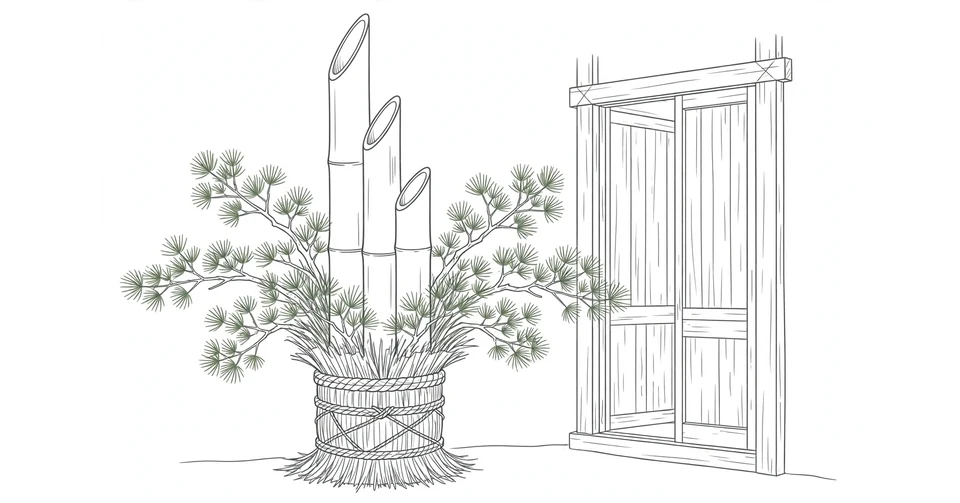
The decoration itself is larger than most people expect, usually standing about waist high, though small versions are sold for flats and shop counters. A pair flanks the entrance, and the pair matters. The two are understood as male and female, a matched set rather than two identical objects, and they stand on either side of the gate like a pair of sentries that welcome rather than warn. A single kadomatsu looks incomplete, and that is the point. The welcome is made by a pair, the way a greeting is made by two people, one arriving and one receiving.
What a kadomatsu is
A kadomatsu is a traditional Japanese decoration made for the New Year, placed in pairs in front of homes, shops, temples, and shrines, as described in the Wikipedia entry on kadomatsu. The usual description calls it a yorishiro, an object intended to welcome ancestral spirits or kami of the harvest, and the decoration serves as a temporary dwelling, a shintai, for the kami during the holiday. The central idea is simple enough to state in one sentence. The toshigami, the deity of the New Year, is honoured and received at the start of the year, and the deity then brings a bountiful harvest for farmers and the blessing of the ancestors for everyone. A kadomatsu is the sign at the gate that says the house is ready for that visit.
Historically a kadomatsu was often made with pine wood, but these days bamboo is more common, and the modern form is a mix of both. The central portion is formed from three large bamboos, cut at an angle so that their hollow tops slant upward like the mouths of flutes. Pine branches fill out the bundle, and a sprig of plum is sometimes added. After all the elements are bound together, the whole thing is tied with a straw mat and newly woven straw rope. The rope is not decoration alone. Straw rope marks sacred space in Shinto, and its presence on a kadomatsu says that the bundle is not ordinary greenery. It is a prepared place.
The materials carry their own meanings, and they are the same three plants that appear together in Japanese art under the name shochikubai, the three friends of winter: pine, bamboo, and plum. Pine stands for longevity, because it stays green when other trees are bare. Bamboo stands for prosperity, because it grows fast and straight and bends without breaking. Plum stands for steadfastness, because it flowers while the cold is still in the air. A kadomatsu that holds all three is a small essay in botany and hope at once, and the household that puts one up is making a wish in the language of plants.
Three bamboos, pine, and plum
The three bamboos at the centre of a kadomatsu are its most recognisable feature, and they are cut in a way that rewards a closer look. The stalks are of different heights, and their tops are sliced at a slant, so the arrangement rises in steps. The tallest stalk stands in the middle or to one side, and the shorter ones step down beside it. There is no single rule for the order that holds everywhere, and regional styles disagree, which is part of the charm. The cut is what matters. A flat cut is the older style, and the slanted cut, called sobogiri, is the one most people picture today, and both say the same thing in different dialects of the same craft.
Pine is the older half of the decoration, and the name gate pine remembers a time when pine did most of the work. In the older custom, a pine tree was brought to the gate and set up whole, and the bamboo was added later, from the medieval period onward. The encyclopaedias record other trees used in some places, including oak, camellia, chestnut, and sakaki, but pine is the usual New Year tree, and it has stayed at the centre of the custom even as bamboo took over the visible bulk of the arrangement. The straw mat and rope that bind the bundle are the finishing touch, and they are made fresh for the season rather than reused. A kadomatsu is built new each year, because the welcome it makes is for one year only.
A pair at the gate
A kadomatsu is almost always placed in a pair, one on each side of the gate or door, and the pairing is not a matter of symmetry alone. The two represent male and female, and they face the street together as a single welcome. A shop puts a pair outside its shutters. A shrine puts a pair at its entrance. A house with a garden gate puts a pair where visitors pass. The pair turns a boundary into a greeting, and the street side of the gate, the public side, is where the decoration does its work. The toshigami is expected from outside, so the welcome is placed where the outside meets the home.
The size of a kadomatsu varies with the building it serves. A department store or a large shrine may display a pair as tall as a person. A family home may use a pair about a metre high. Small versions, sometimes no taller than a bottle, are sold for flats, offices, and shop counters, and plastic kadomatsu are available for places where fresh pine is impractical. The small ones are real kadomatsu in miniature, not toys, and they carry the same three plants in the same arrangement, only scaled down. The tradition bends to fit the space, and the space is allowed to be small. What matters is that the pair stands at the threshold, facing outward, waiting.
When a kadomatsu goes up and comes down
In modern times a kadomatsu is placed after Christmas and kept up until 7 January, or until 15 January in the older practice of the Edo period, and the difference between those two dates is a small map of Japanese history. The period when the decorations stay up is called matsunouchi, the days of the pine, and in the Kanto region around Tokyo it traditionally ends on 7 January, while in the Kansai region around Kyoto and Osaka it often extends to 15 January, following the older lunar calendar. The two dates are not a disagreement. They are two survivals of the same custom, kept alive in different regions, and both are correct where they are observed.
The trees were traditionally cut on the 13th day of the twelfth month, and the decorations went up in the last days of the old year, after the house had been cleaned for the holiday. Putting a kadomatsu up too early was not the custom, and putting it up on the last day itself was considered unlucky in some places, so the usual window was the 28th or 29th of December. The decoration then stood through the New Year itself, through the first shrine visit of the year, and through the days when the toshigami was believed to be present in the home. It was not a Christmas decoration that lingered into January. It was a New Year decoration with a job to do, and the job had a fixed length.
Taking a kadomatsu down is as much a part of the custom as putting it up. The removal dates vary between the 4th, the 7th, and the 14th of the first month, depending on the region, and the decoration is never simply thrown away. A kadomatsu that has housed a kami is treated with respect at the end of its service, and its ending is a ceremony rather than a disposal. That ending is the fire, and the fire is the part of the story that most visitors never see.
The same care that goes into choosing and returning a small shrine charm applies to the larger decorations of the season. An omamori, the small cloth pouch carried for protection, is also returned to a shrine after about a year to be burned with respect, and the guide to the omamori and its year of protection tells that story in full, from the shrine counter to the sacred fire. A kadomatsu follows the same logic at a larger scale. It is received, it serves, and then it is returned by fire, and the year begins again with a fresh one.
The fire that ends the season
After 15 January, or in many instances the 19th, a kadomatsu is burned to appease the kami or the toshigami and release them, and the burning is one of the oldest rituals of the Japanese year. The fire is called dondo-yaki, and near Kyoto it is called sagicho, while eastern Japan uses the name saito and Kyushu uses onibi and hokkengyo, but the rite is the same under all its names. Around 15 January, during koshogatsu, the Little New Year, communities collect the pine kadomatsu, the straw decorations, and the first calligraphy of the year from their homes and burn them on one fire at a shrine, beside a roadside dosojin shrine, or on a riverbank. The fires are built from bamboo, wood, and rice straw, and mochi is grilled over the embers and eaten.
Writing in 1923, Helen Gunsaulus described the New Year festival closing with the burning of the kadomatsu pine decorations and other New Year ornaments on the 14th or 15th day of the first month, and many shrines still hold their fire rituals in mid January. The Association of Shinto Shrines notes that many shrines hold fire rites called sagicho or dondo-yaki between New Year's Eve and 15 January, the Little New Year, where New Year decorations, old talismans, and charms are burned together. The account is more than a century old, and the fire it describes is still lit every year, which says something about how little this part of the calendar has changed.
The name sagicho comes from the imperial court. Heian period documents write it with characters meaning three gicho, and the name is explained as three gicho sticks set up together. On the 15th and 18th days of the first month, three mallet-like gicho poles were set up in the garden of the Seiryoden in the palace and burned while those present sang and chanted. The court rite involved onmyoji, the court's yin and yang diviners, and the custom spread from the palace to the shrines and villages until it belonged to the whole country. A fire that began as a court ceremony became a neighbourhood bonfire, and the change is a measure of how deeply the New Year belongs to everyone in Japan.
The main fuel of the fire is the kadomatsu itself. Encyclopaedias describe the decoration as a yorishiro, an object into which the toshigami descends, and the burning sends the deity off with thanks. The fire also takes the straw decorations, the shimenawa ropes that mark off sacred space and the shimekazari made from them, which are displayed with the kadomatsu at the entrance. Kakizome, the first brush writing of the year, traditionally done on 2 January, is also burned on the fire, and the reading is a charming one. If the burning paper flies high, the writer's handwriting will improve, expressed in the phrase te ga agaru, the hand rises. Children held their sheets over the flames, and the fire was both a disposal and a small fortune telling.
The full story of the Little New Year fire is told in the account of dondo yaki and the fires that close the Japanese New Year. The article records that the Sagicho Festival of Omihachiman in Shiga Prefecture has more than 400 years of history and is designated a National Intangible Folk Cultural Property, and that its floats, built on torches of wood and rice straw about 3 metres tall, are burned at the shrine as an offering to the deities. The Nozawa Onsen Dosojin Fire Festival, held from 13 to 15 January with the fire on the night of the 15th, is one of Japan's three major fire festivals, and afterwards villagers take charred pieces of the beams home to light their hearths. A kadomatsu that ends in such a fire has had a good ending.
Regional variations of the kadomatsu
Designs for a kadomatsu vary depending on region, and the differences are visible enough that a practiced eye can tell a Kanto kadomatsu from a Kansai one at a glance. In the Kanto style of eastern Japan, the bamboo is cut at a slant and the arrangement is tall and upright, with the pine filling out the lower half. In the Kansai style of western Japan, the bamboo is often cut flat across the top, and the arrangement is broader and lower. The flat-topped kadomatsu of Shimane is a further variation, and the Kyoto style has its own proportions. The plants are the same, and the welcome is the same, but the shape of the welcome changes with the place, the way an accent changes with the region.
The dates change with the region too. In Kyushu the pine is burned in the onibi fire of the 7th, while elsewhere it usually goes to the Little New Year fire around the 15th. In some districts the fire is held on the night of the 14th or the morning of the 15th, and in others the burning happens on the 7th or as late as the 19th. The variation is not confusion. It is the custom adapting to local calendars, local shrines, and local weather, and the result is a New Year that ends on slightly different days in different parts of the country, like a wave breaking on a long shore.
A kadomatsu in modern Japan
A kadomatsu still appears across Japan every December, and its survival is worth noting because so many seasonal customs have faded. Offices order a pair for the entrance. Department stores display a pair taller than their staff. Hotels place a pair in the lobby. Temples and shrines put up the largest pairs of all, and the pairs at the great shrines are photographed by visitors who may not know the name of what they are photographing. The decoration has also gone small and synthetic, with plastic kadomatsu sold for offices and flats, and miniature versions sold outside shops for a few hundred yen, and the small ones are no less a part of the season than the grand ones at the shrine gate.
The food of the New Year sits beside the decoration in the same season, and the two belong together in the holiday table. Kamaboko, the pink and white fish cake served at New Year, is another object whose colour and shape carry a wish for the year ahead, and the story of kamaboko and the red and white of the New Year table tells how a sliced fish cake came to stand for celebration. A kadomatsu at the gate and kamaboko on the table are two parts of one holiday, the first welcoming the deity in and the second feeding the family that gathers under the same roof.
There is a temptation to treat a kadomatsu as a piece of nostalgia, a folk decoration kept alive by hotels and shrines for tourists, and the temptation should be resisted. The pairs outside offices and shops are not museum pieces. They are ordered, paid for, and put up by people who expect the New Year to arrive and want to be ready for it, and the readiness is the point. A custom survives when it is still useful, and a kadomatsu is still useful because it does a job that nothing else in the modern entrance does. It marks a threshold, and thresholds still matter, even in a country of automatic doors.
How to see a kadomatsu
The best way to see a kadomatsu is to walk a shopping street or a shrine approach in the last week of December, when the pairs are fresh and the straw rope is still pale. Look at the cut of the bamboo first, and see whether the tops are slanted or flat, and then look at the pine, and see how much of the bundle it fills. Look at the rope, and notice that it is newly woven, not reused from last year. Look at the pot or frame, and notice whether it is a simple wooden box or a ceramic planter. Each choice is a small decision made by the person who built it, and the decoration rewards the attention of someone who looks closely.
Do not touch the straw rope or move the pair, and do not take a branch as a souvenir. A kadomatsu is a prepared place for a kami, and it is treated with the same respect as any other sacred object at a shrine. Photographs are welcome, and the pairs at shrines and shops are used to being photographed, but the decoration itself is left alone. It will be taken down and burned in its own time, and the burning is part of the custom, not an afterthought.
What the gate teaches
A kadomatsu is, in the end, a small lesson in hospitality. It says that a guest worth having is a guest worth preparing for, and that preparation is not a matter of expense but of attention. Pine and bamboo and a little straw rope are not expensive materials, and a kadomatsu is not a luxury object. It is a careful object, and the care is the whole of it. The household that builds one is saying, in the language of plants, that it has thought about the year ahead and is ready to receive it, and that readiness is a form of hope.
I think there is a wider lesson here, and it is not only a Japanese one. We tend to mark the New Year with noise, with fireworks and countdowns and resolutions made in a hurry, and a kadomatsu marks it with quietness instead. It stands at a gate and waits, and the waiting is the celebration. The decoration does not announce the year. It receives it, and the difference between announcing and receiving is the difference between shouting at a guest and opening a door for one. A kadomatsu opens the door, and then it stands aside, and that is a better way to begin a year than any noise I know.
That is what a kadomatsu guards, in the end. It guards a door, and a season, and a habit of welcome that has survived centuries of change. The gate pine stands through the coldest weeks of the year, green against the grey of winter, and then it goes to the fire, and the year it welcomed is underway. The decoration is gone, but the welcome it made is not. It stays in the house it guarded, in the form of a year that began with someone taking the trouble to be ready, and that readiness is the real decoration, the one that no fire can burn.
More in Culture & Society
- A Shikona Gives a Wrestler His Second Name
- Komusubi Is the Smallest Chair at Sumo's Top Table
- A Sekiwake Waits One Win From Sumo's Highest Door
- Tanabata Festival and the Star-Crossed Lovers Behind the Bamboo Wishes
- A Maegashira Climbs the Numbered Ladder One Bout at a Time
- An Ozeki Stands One Step From the Top and Cannot Afford to Slip
Latest posts
- Japanese Street Food, From Takoyaki Stalls to Festival Yatai
- An Oyakata Is the Father a Sumo Stable Cannot Replace
- A Tokoyama Spends Ten Years Learning to Dress a Topknot
- Japanese Calligraphy and the Brush That Turns Writing Into Art
- A Tegata Is Sumo's Inked Handprint Autograph
- A Rikishi Is a Man of the Sumo World Before He Wins a Single Bout
- Mawashi Carries a Wrestler's Rank Around His Waist
- Namasu Turns Daikon and Carrot Into a Red and White Wish
- Yokai, the Strange Spirits That Haunt Japanese Folklore
- Ebi Bends Like an Old Back and Wishes You a Long Life
- Yokozuna Is the Rank Sumo Never Takes Back
- Kobumaki Rolls Joy Into a Strip of Kelp
- Kurikinton Is the Golden Mash That Wishes You Wealth
- Japanese Beer and the Dry Wars That Changed How Japan Drinks
- Kamaboko Paints the New Year Red and White