A Dohyo Is Sacred Ground Long Before the First Bout
· 18 min read
A dohyo is the clay ring where sumo happens, built by hand for every tournament and treated as sacred ground from the first handful of salt to the last bout.
A sumo bout is often over in seconds. Two huge men crouch, spring forward, and one of them is out of the dohyo or on the floor before the crowd has finished its first gasp. Yet the ground they fight on is prepared for days, consecrated in a ceremony, and treated with a reverence that no other sporting surface receives. That ground is the dohyo, a circle of clay and straw that sumo regards as sacred long before the first bout begins.
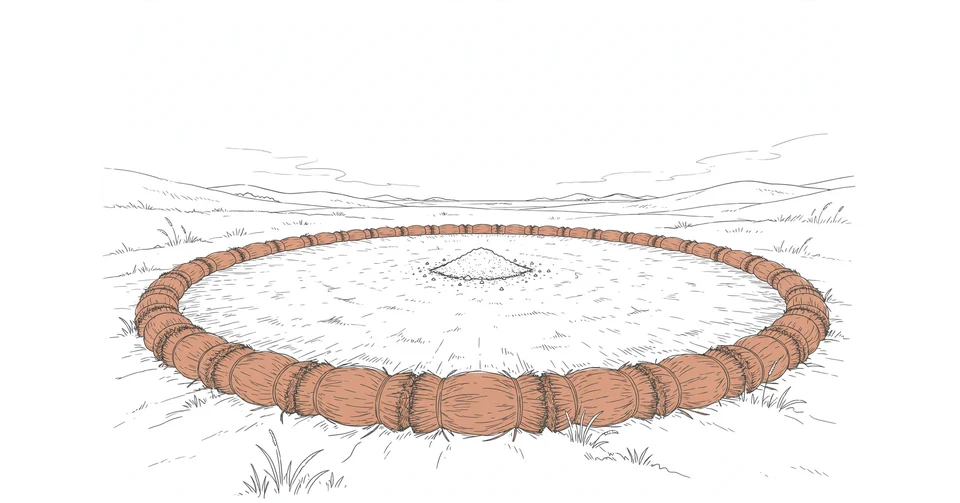
A dohyo is not a mat and it is not a stage. It is a ring 4.55 metres across, bounded by rice straw bales and raised on a square platform of clay, and every part of it has a purpose that reaches back centuries. The clay comes from a particular riverbank, the straw bales are set by hand, the surface is covered in sand, and before any wrestler steps onto it, priests in all but name invite the gods to watch. To understand sumo, you have to understand this ring first, because everything else in the sport, the ranks, the ceremonies, the rules, is built around it.
This guide explains what a dohyo is made of, how it is built, why it is purified with salt, who may and may not step onto it, and how the dohyo is rebuilt for every tournament. The facts are simple enough to list, but the feeling they add up to is harder to pin down, and that feeling is the point. A dohyo is a place where sport and ritual share the same few square metres of clay, and neither one apologises for the other.
What a dohyo is made of
A typical dohyo is a circle 4.55 metres in diameter, which is 15 shaku in the old Japanese measure, bounded by partially buried rice straw bales. In official professional tournaments, the honbasho, the circle sits on a square platform of clay 6.7 metres on each side and between 34 and 60 centimetres high. The height has been standardised at 58 centimetres for tournaments outside Tokyo, while the dohyo at the Ryogoku Kokugikan in Tokyo sits slightly lower, at 55 centimetres, because of the mechanism that lowers it into the arena floor between tournaments. The surface is covered by sand, which gives the wrestlers grip and lets the ring attendants read the marks left by a foot or a hand.
The clay itself is not ordinary dirt. It is a sticky, adhesive clay known as arakida, traditionally taken from the banks of the Arakawa River in Saitama Prefecture, and its name comes from the Arakida plain in the old Arakawa river basin. Because the riverbanks have been built over, clay from Ibaraki Prefecture has also started to be used. The point of the material is practical as much as symbolic. It packs hard, it holds its shape under the weight of two men colliding at full speed, and it can be raked smooth again between bouts. A dohyo has to survive fifteen days of punishment and still look the same on the last day as it did on the first, and the clay is what makes that possible.
The dohyo was not always this size. Until 1931 the circle measured 13 shaku, about 3.94 metres, and it was enlarged to 15 shaku that year. Sixty one centimetres may not sound like much, but in a contest decided by a single step it changes everything, giving the wrestlers more room to work and the crowd more time to watch a bout develop. The change has lasted nearly a century now, and nobody in sumo talks about going back.
There is a quiet lesson in the way the materials are chosen. Nothing about the dohyo is imported, synthetic, or new. Clay from a river, straw from a rice field, sand brushed smooth by hand. I find that stubbornly old fashioned choice moving, because it says that the sport would rather keep hauling river clay across the country than switch to something easier. The dohyo is not a backdrop for the sport. It is the sport, made solid, and sumo treats it that way.
The straw circle that decides everything
The boundary of the dohyo is made of tawara, bales of rice straw about one third of standard size, partially buried in the clay of the dohyo. They are not decoration. Step outside them, or touch the ground outside them with any part of the body except the soles of the feet, and the bout is over. The straw is the line, and the line is the law.
Four of the tawara are set slightly outside the circle at the four cardinal points, north, east, south, and west. These are the tokudawara, the privileged bales, and they were originally placed that way so that rain could run off the surface when tournaments were held outdoors. Today they serve a different purpose. A wrestler being forced to the edge will often try to work his way round to one of these points, because the slight step out gives him a little more leverage to push back against the man driving him out. The dohyo rewards the wrestler who knows its geography, not only the one with the stronger arms.
At the centre of the dohyo are two white lines, the shikiri-sen, behind which the wrestlers crouch at the start of the bout. They were first introduced in the spring tournament of 1928, and they are painted 90 centimetres long, 6 centimetres wide, and 70 centimetres apart. The yobidashi, the ring attendants, touch them up with white enamel paint at the end of each day. The painted lines are slightly slicker than the surrounding dirt, but they are narrow enough that they rarely cause a wrestler to slip.
Around the dohyo lies finely brushed sand called ja-no-me, the snake's eye, and it has a job of its own. If there is any doubt about whether a wrestler's foot touched outside the circle, the marks in the sand give the answer. The yobidashi sweep it clean of previous marks immediately before each bout, so that every contest starts with a fresh record. It is a humble tool, a patch of brushed sand, doing the work that a video replay does in other sports, and it has done that work for generations.
The dohyo is also where the ranking sheet comes to life. The banzuke lists every wrestler in order, and the dohyo is where that order is tested, bout by bout, for fifteen days. Our earlier guide to The Banzuke Remembers Every Basho in Calligraphy explains how that sheet records the fate of more than six hundred wrestlers, and every one of those fates is decided inside the same circle of straw.
Three days of building, then a ceremony
A new dohyo is built before each tournament by the yobidashi, who are responsible for this work. The process takes three days and is done with traditional tools. The clay is piled, tamped, and shaped by hand, the tawara are set in place, the surface is levelled and covered with sand, and the lines are painted. It is slow, physical work, and it is done by the same people who will sweep the sand and touch up the lines during the tournament itself. The men who build the dohyo are the men who keep it honest.
The yobidashi also build the rings used for training in the stables and for touring events, the jungyo, where the dohyo is made with a lighter core of foam blocks covered by sand so that it can travel. A training ring in a stable is not raised on a platform, but it is otherwise the same as the tournament ring, and a wrestler may spend years of mornings practising on one before he ever fights on the raised ring in front of a crowd. The dohyo in the stable is where the sport is learned, and the dohyo in the arena is where it is judged.
Once the tournament ring is built, it is consecrated in a ceremony called the dohyo matsuri, the ring ceremony, which is said to have been introduced by Yoshida Zenzaemon during the Edo period. The ceremony is led by one of the tate-gyoji, the head referees, together with two other gyoji, who take the place of Shinto priests. Its purpose is to purify and consecrate the dohyo and to invite the kami, the Shinto deities, down to watch the sumo.
The heart of the ceremony is a square hole cut in the middle of the dohyo. Into it the tate-gyoji places torreya nuts, dried chestnuts, salt, washed rice, dried squid or cuttlefish, and kombu seaweed. He pours sacred sake into the hole and around several other places on the dohyo, and then more clay is put into the hole and the yobidashi cover it up. The sacred sake is shared with everyone in attendance. Then the yobidashi begin a procession with taiko drums, the fure-daiko, circling the dohyo three times before going out into the street to announce the beginning of the tournament.
At the end of the tournament, the ceremony is closed in a way that always makes me smile. One gyoji is thrown into the air by the low ranking wrestlers, as a way of sending off the kami and officially ending the tournament. It is a joke and a ritual at the same time, and it is a reminder that the sacred and the playful have always lived side by side in sumo. The dohyo is consecrated with salt and sake, and it is farewelled with a man being tossed in the air by laughing juniors.
Salt, clapping, and the ring entering ceremony
Before each bout, a wrestler takes a handful of salt and throws it onto the clay. The salt purifies the dohyo, and the gesture is one of the most recognisable sights in Japanese sport. The wrestler then claps his hands and stamps his feet, driving away evil spirits and cleansing the ground he is about to fight on. The whole sequence is brief, and to a newcomer it can look like superstition, but it is better understood as respect. The wrestler is telling the dohyo, and the crowd, that he knows where he is standing.
The most formal version of this purification is the dohyo-iri, the ring entering ceremony, which takes place before the bouts begin each day. The top division wrestlers enter as a group, forming a circle around the dohyo in their decorated silk aprons before filing off to prepare. A yokozuna enters alone, after the others, flanked by two assistants, the dew sweeper who walks ahead and the sword bearer who follows behind carrying a katana. Inside the dohyo he performs a slow ritual dance, clapping, stamping, and raising each leg high in turn, in a sequence meant to drive away evil spirits and purify the dohyo. Our guide to Yokozuna Is the Rank Sumo Never Takes Back describes how the yokozuna wears his sacred rope during this ceremony, and how the rope marks him as something set apart, the way a sacred rope marks off a shrine.
The ceremony is slow, formal, and repeated in exactly the same way every day of a tournament, and its slowness is the point. The bouts are fast and violent and over in seconds. The ceremony is the opposite, and it gives the crowd time to settle, to watch, and to remember that what they are about to see is not only a contest. I think this is one of the wisest things about sumo. Most sports rush to the action and treat the ceremony as a delay. Sumo treats the ceremony as the action, and the bout as its conclusion.
The details of the dohyo and its ceremony are set out in full in the Dohyo article on Wikipedia, which covers the construction, the consecration ceremony, and the roof above the dohyo, and it is a reliable place to check the measurements and the history that follow in this guide.
The roof above the dohyo
Above the dohyo at the Ryogoku Kokugikan in Tokyo hangs a roof that looks like the roof of a Shinto shrine. It is called the tsuriyane, and it has been in the Shinmei-zukuri style since the May 1953 tournament. The roof weighs 6.25 tons and hangs from cables that can hold up to 30 tons. Until the September 1952 tournament it was supported by columns at the corners of the ring, but the columns were removed so that the crowd could see the ring without obstruction. In their place, coloured tassels called fusa hang from the corners.
The four tassels carry the colours of the four seasons and the four spirits of the directions. Green stands for the Azure Dragon of the East and spring. Red stands for the Vermilion Bird of the South and summer. White stands for the White Tiger of the West and autumn. Black stands for the Black Tortoise of the North and winter. A spectator who looks up sees a small map of the year and the compass hanging over the wrestlers, and the ring below becomes the centre of that map. The dohyo is not only a place to fight. In the architecture of the arena, it is the centre of the world for fifteen days.
The underside of the roof holds hidden lights, and the whole structure is usually raised to the ceiling and lowered only for the matches. It is an extraordinary piece of engineering for a building whose purpose is to hold a circle of clay, and it shows how seriously Japan takes the setting of this sport. The roof does not make the wrestling any better. It makes the wrestling matter more, by telling everyone in the room that what happens below it is worth a shrine roof and four seasons of colour.
Who may step onto the ring
The hardest question about the dohyo is who is allowed to step onto it. In professional sumo, women are not allowed to enter or touch the ring, a tradition rooted in Shinto and Buddhist ideas about ritual purity. There is no women's division in professional sumo, and the Japan Sumo Association's entry rule for new recruits is limited to men. Female sumo does exist at the amateur level, where women compete and train, but the professional ring remains closed to them.
The rule became a national debate in April 2018, when the mayor of Maizuru, Ryozo Tatami, collapsed on the ring during a speech at a regional tour event and women from the audience, among them a nurse, climbed up to give him first aid. A young referee repeatedly announced over the public address system that women should leave the ring, even as they were trying to save the mayor's life. The head of the Japan Sumo Association, Chairman Hakkaku, apologised afterwards and called the announcement an inappropriate act in a situation that involved a life. The mayor was taken to hospital, and the footage of women being ordered off the ring while giving first aid was broadcast across Japan and around the world.
On 28 April 2018, the association issued a formal statement. It apologised again to the women who had come forward to save a life, and it set out its position. The tradition of not allowing women onto the ring would continue, but emergencies were an exception, and a situation where a life is at stake is the exception of exceptions. The statement also addressed the explanation often given for the rule, that women are regarded as impure, and called that interpretation a misunderstanding, giving instead three reasons for keeping the tradition: sumo's origins in Shinto ritual, the wish to preserve the traditional culture of professional sumo, and the character of the ring as a sacred place of combat and training for the wrestlers. The account of the incident and the apology is reported by RNZ, and it remains the clearest record of what happened that day.
Two days after the Maizuru incident, the female mayor of Takarazuka, Tomoko Nakagawa, asked to give her welcome speech from the ring at a tour event in her city, and she was refused. She lodged a formal protest with the association, calling the rule discrimination and vowing to petition every six months until it was reviewed. The officials told her the rule was tradition rather than discrimination, and promised to discuss it at a meeting of executives, but the rule itself did not change.
It is worth handling this question with care, because both sides of it are sincerely held. The association sees the ring as a sacred space whose rules protect something old and fragile, and it points out that the restriction applies to the ring itself rather than to the sport as a whole, since women can watch, report, and compete as amateurs. Critics see a public institution in a modern democracy drawing a line that excludes half the population from a space that is, in the end, clay and straw, and they point to the Maizuru incident as proof that the rule can do real harm when it is applied without judgement. The association's own statement concedes the most important part of the critics' case, that a life at stake overrides the tradition. I think that concession matters more than the rest of the debate, because it shows that even the keepers of the tradition accept that the ring is not more important than a human life. A tradition that knows its own limit is a tradition that can survive, and a tradition that knows no limit is one that will eventually break.
A dohyo is rebuilt for every tournament
A tournament ring does not last. In Tokyo, the dohyo at the Ryogoku Kokugikan is retracted beneath the arena floor after the tournament and repaired before the next one. Outside Tokyo, the ring is dismantled after each tournament, and in Nagoya pieces of the clay are taken home by fans as souvenirs. Six tournaments a year means six fresh rings, or six fresh repairs, and the yobidashi begin the three day building process again each time. Nothing is left to chance and nothing is left over.
That rhythm is part of what makes the ring feel alive rather than permanent. A stadium is built once and stands for decades. A dohyo is built, consecrated, fought on for fifteen days, and then taken apart, and the next one is built from the same clay and the same straw in the same way. The sport never has to wonder whether its centre still matters, because it rebuilds its centre from scratch every couple of months. There is something honest about a sport that refuses to let its most sacred object become a monument. The ring is allowed to be temporary, and its temporariness is what keeps it sacred.
The rebuilding also means that no two tournaments share the same ring, even though every ring is built to the same measurements. Each one carries the marks of the bouts fought on it, the salt thrown, the sand brushed, the feet that stepped outside the straw, and then it is gone. The wrestlers come back, the crowd comes back, the roof comes down again, and a new circle of clay waits for them. The dohyo is rebuilt because sumo believes that sacred ground is not found, it is made, and it is made again every time the sport needs it.
What the ring teaches the rest of us
A dohyo is a small thing, a circle of clay 4.55 metres across, and it carries a weight that has very little to do with its size. It is built by hand, consecrated with salt and sake, purified before every bout, watched over by a shrine roof, and rebuilt for every tournament. It is also a place where the rules are absolute, where a single step outside the straw ends the contest, and where a centuries old argument about who may enter it is still unresolved. All of that lives in the same few square metres of clay, and sumo does not try to resolve the contradictions. It lets them stand, the way the ring itself stands, plain and unadorned, in the middle of the arena.
I think there is a lesson in that for anyone who has ever cared for a place that mattered to them. A room, a workshop, a field, a kitchen. The places that matter are not the ones with the finest materials or the grandest design. They are the ones that are prepared with care, entered with respect, and kept by rules that everyone understands, even when those rules are argued about. The dohyo is clay and straw and sand, and it is also a reminder that a place becomes sacred not because of what it is made of, but because of how people treat it. Sumo treats its ring as sacred ground long before the first bout, and that is why, when the bout finally begins, the few seconds of it feel like they matter.
More in Culture & Society
- A Yobidashi Calls the Wrestlers and Sweeps the Ring
- A Kadomatsu Guards the Door Until the New Year Fire
- A Shikona Gives a Wrestler His Second Name
- Komusubi Is the Smallest Chair at Sumo's Top Table
- A Sekiwake Waits One Win From Sumo's Highest Door
- Tanabata Festival and the Star-Crossed Lovers Behind the Bamboo Wishes
Latest posts
- Japanese Street Food, From Takoyaki Stalls to Festival Yatai
- A Maegashira Climbs the Numbered Ladder One Bout at a Time
- An Ozeki Stands One Step From the Top and Cannot Afford to Slip
- An Oyakata Is the Father a Sumo Stable Cannot Replace
- A Tokoyama Spends Ten Years Learning to Dress a Topknot
- Japanese Calligraphy and the Brush That Turns Writing Into Art
- A Tegata Is Sumo's Inked Handprint Autograph
- A Rikishi Is a Man of the Sumo World Before He Wins a Single Bout
- Mawashi Carries a Wrestler's Rank Around His Waist
- Namasu Turns Daikon and Carrot Into a Red and White Wish
- Yokai, the Strange Spirits That Haunt Japanese Folklore
- Ebi Bends Like an Old Back and Wishes You a Long Life
- Yokozuna Is the Rank Sumo Never Takes Back
- Kobumaki Rolls Joy Into a Strip of Kelp
- Kurikinton Is the Golden Mash That Wishes You Wealth