A Sekiwake Waits One Win From Sumo's Highest Door
· 18 min read
A sekiwake is sumo's third-highest rank, one step below ozeki, and the hardest place in the sport to simply stand still, because winning is not enough and one bad tournament takes the rank away.
A sekiwake is the closest thing sumo has to a man standing in a doorway. He can see the room where the ozeki live, and he can hear the yokozuna being announced, but he does not belong to either room yet. One more strong tournament, and the door may open. One bad tournament, and he is back on the stairs. That is the whole tension of the rank, and it is why the third-highest rank in sumo is often more interesting to watch than the two above it.
The rank sits in the middle of a ladder that every fan should learn once, because it explains almost everything that happens in a tournament. Our guide to the fifteen days of a basho put it in a single sentence: "The ranks inside makuuchi run from yokozuna at the top, through ozeki, sekiwake, and komusubi, down to the maegashira, who are numbered in order." A sekiwake is the third name in that line, which makes him the third-highest wrestler in the sport, and a member of the group called sanyaku, the titleholder ranks. He has climbed past every numbered maegashira and past the komusubi below him, and the only men above him are the ozeki and the yokozuna.
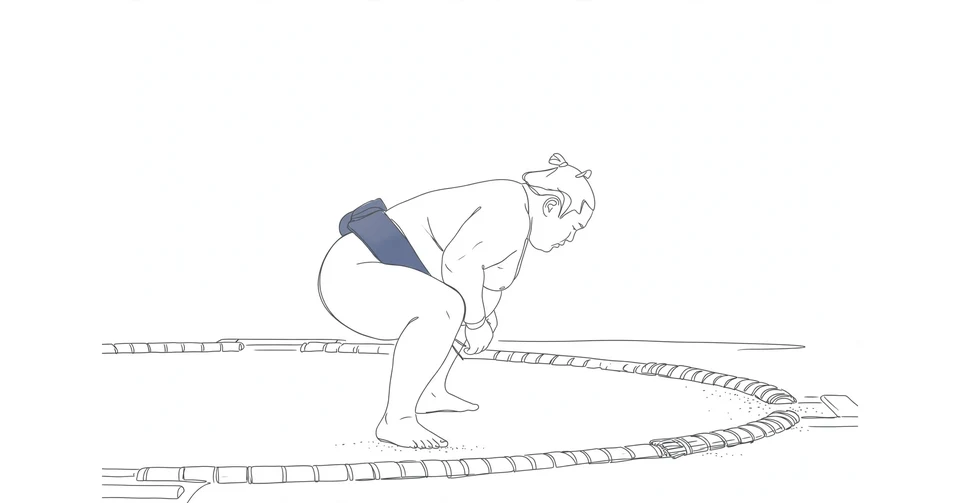
Watch him before a bout and you will see the rank in his body. He crouches at the edge of the ring with his weight forward, patient and coiled, because a sekiwake cannot afford to waste a single bout. Every tournament is a test with two questions, and the answers pull in opposite directions. Can he win enough to move up, and can he avoid losing enough to stay where he is? Most ranks ask only one of those questions at a time. A sekiwake is asked both, every day, for fifteen days.
Where a sekiwake sits on the banzuke
The banzuke is the ranking sheet that sumo publishes before every tournament, written in calligraphy, and it is the document that decides who fights whom. A sekiwake lives near the top of that sheet, in the makuuchi division, which has been fixed at 42 wrestlers since 2004. The four named ranks at the top of the division are the sanyaku, and a sekiwake is one of them, below ozeki and above komusubi. There must always be at least two men ranked as sekiwake on a banzuke, one on the east side and one on the west, and the number can rise to three or four when the results demand it, for example when both sekiwake win their tournaments and an ozeki is demoted. Our earlier guide to The Banzuke Remembers Every Basho in Calligraphy explains how that sheet is drawn up and why it never forgets a result.
The word itself tells a story. Sekiwake is believed to come from guarding the ozeki at his side, with seki meaning the barrier or the ozeki and wake meaning the side. A sekiwake stands beside the champion rank, not inside it. That picture is exact. He fights the same opponents, he appears in the same ceremonies, and he is measured against the same standard, yet the door to ozeki stays shut until he proves himself over more than one tournament. The Sekiwake entry on Wikipedia sets out the rank, its history, and its promotion rules in full, and it is the clearest single reference for the details in this article.
Being a sekiwake brings real rewards, and they are worth naming because they show how much the sport values the rank. His salary is higher than a maegashira earns. He is called to flank the chairman of the Japan Sumo Association during the speeches on the opening and closing days of a tournament. He may be asked to represent all the wrestlers at official events, especially when the number of ozeki and yokozuna is low. Like the other sanyaku wrestlers, he is entitled to buy one of the membership shares in the Association, a privilege that turns a fighting career into a future inside the sport. And unlike the ozeki and yokozuna above him, a sekiwake is still eligible for one of the three special prizes awarded at the end of a tournament, the sansho, which recognise fighting spirit, outstanding performance, and technique. A sekiwake can therefore leave a basho with a prize in his hands even when he does not leave with the championship, and that is a distinction the two ranks above him do not share.
There is also a quieter reward, and it lasts longer than any prize. If a sekiwake is the highest rank a wrestler ever reaches, even for a single tournament, he will be called "former sekiwake" for the rest of his life after he retires. That title is a mark of a successful career, and it follows him into coaching, commentary, and every introduction he ever receives. I find that detail touching. Sumo does not only remember champions. It remembers the men who stood one step below them, and it gives them a name that keeps the achievement alive long after the bouts are over.
How a wrestler reaches sekiwake
No one is handed the rank of sekiwake. A wrestler climbs to it by winning, tournament after tournament, and the climb gets steeper the higher he goes. The usual route runs through komusubi, the rank directly below, and the rule of thumb is simple to state and hard to achieve. A record of 11 wins and 4 losses as a komusubi is typically enough to earn promotion to sekiwake even when no normal space is available at the rank. A wrestler coming from a lower rank needs progressively more wins, because the committee must be convinced that his record was not a lucky fortnight. The banzuke committee reads the numbers strictly, and it reads the opponents behind the numbers too. Beating strong men counts for more than beating weak ones, and a sekiwake candidate who earned his wins against the top of the division arrives with a stronger case than one who padded his record in the lower half.
It is worth pausing on what that climb means in human terms. A wrestler who reaches sekiwake has already spent years in the lower divisions, then in juryo, then among the numbered maegashira, winning a majority of his bouts again and again. Each promotion brought harder opponents, and each harder opponent made the next winning record more difficult to earn. By the time he stands as a sekiwake, he has beaten almost everyone below him and lost, repeatedly, to the men above him, until the day his record finally forced the committee to move him up. That is a long apprenticeship, and it is why the rank commands respect in the sumo world. Nobody arrives there by accident, even if a little luck sometimes helps, as when a shortage of candidates leaves a space that a strong record can fill.
The climb also changes what a wrestler faces every day. A sekiwake meets the ozeki and the yokozuna in the first week of the tournament, when the schedule pairs the top ranks against each other. There is no gentle introduction to the rank. A man who was a komusubi last tournament was already facing those opponents, but as a sekiwake he faces them with more attention on him and more expectation in the crowd. The first week can decide his whole tournament, and the first week is the hardest part of it. I think that is fair, in the severe way sumo is fair. The rank does not protect you from the best wrestlers. It introduces you to them, every day, and asks you to prove that you belong in their company.
Why winning is not enough at sekiwake
Here is the fact that makes a sekiwake different from almost every other rank in sumo. Winning, by itself, is not enough. A wrestler at sekiwake who records a winning record, eight wins against seven losses, will normally keep his rank. That sounds like safety, but it is not progress. To move up to ozeki he needs far more than a bare winning record, and the gap between keeping the rank and earning promotion is where whole careers are spent. The standard is a guideline of 33 wins over three tournaments at the sanyaku ranks, usually as a sekiwake, including ten or more wins in the most recent tournament. A man who wins eight, eight, and eight has three winning records and has gone nowhere. A man who wins eleven, eleven, and eleven is knocking on the door of ozeki. The difference between those two men is nine wins spread over 45 bouts, and it is the difference between standing still and moving up.
That arithmetic explains why a sekiwake can look successful and still feel stuck. The crowd sees a wrestler who wins more than he loses, tournament after tournament, and wonders why he is not promoted. The answer is that the rank above him is not awarded for consistency alone. It is awarded for dominance, for a run of results that leaves the committee no room for doubt. The promotion is discretionary, and there are no hard and fast rules, so even a strong run can be judged insufficient if the quality of the sumo behind it is doubted. A sekiwake who wins by sidestepping at the charge, or who piles up wins against the lower half of the division while losing to every ozeki he faces, may find the door stays closed. The numbers open the conversation. They do not end it.
I admire that severity, even though it can feel cruel to the wrestler living through it. Most of life rewards steady competence, and a steady competent worker can expect a steady rise. Sumo at this level does not work that way. A sekiwake is asked to be not merely good, but unmistakably better than the rank he already holds, and to prove it three tournaments in a row. That is a high bar, and it is deliberately high, because the rank above it carries privileges that cannot be taken back. An ozeki who falters is given a second chance through the kadoban system, so the committee is careful about who it lets through the door in the first place. The sekiwake who waits at that door is paying the price of that caution, one tournament at a time.
The 33 win guideline from sekiwake to ozeki
The number 33 has become the shorthand of the rank, and it deserves a careful look, because it is often quoted as a rule when it is really a guideline. The Japan Sumo Association calls the figure a meyasu, a guideline or a target, not an automatic switch. A sekiwake who reaches 33 wins across his three most recent tournaments at the sanyaku ranks, with ten or more in the last of them, has made the case for promotion, but the case is still decided by people, not by arithmetic. The banzuke-forming conference and the board of directors meet after the tournament, discuss the performance, and announce the decision. The published decision is what makes the new rank official, not a fan keeping count on a spreadsheet. That distinction matters, and the guide to the sekiwake rank at Dosukoi Lab explains it well, drawing on the Association's own quizzes and announcements to show why 33 wins is a way to follow a run of results, not a promise.
History shows both sides of the guideline. Some wrestlers have reached the number and been promoted without much debate, their records so strong that the committee had little to discuss. Others have reached it and waited, or fallen just short and been told to produce one more strong tournament. And some have passed through the rank without ever coming close, even while winning more often than they lost. The number is therefore best understood as a map, not a contract. It tells a fan where the door is, and it tells a sekiwake how far he still has to walk, but it does not tell him the door will open when he arrives. He must arrive and then wait for the committee to decide that he has arrived as an ozeki, not merely as a sekiwake with a good record.
There is a second route worth knowing, because it shows how seriously the sport treats a demoted ozeki. An ozeki who loses his rank falls to sekiwake, and no lower, however badly he performed. If that former ozeki then wins ten or more bouts in his very next tournament as a sekiwake, he is restored to ozeki at once. That rule makes the sekiwake rank a landing place as well as a stepping stone, a place where a fallen champion can prove in a single tournament that he still belongs at the top. The contrast is sharp. A career sekiwake needs 33 wins over three tournaments to go up, while a demoted ozeki needs ten wins in one. The difference is not unfairness. It is the sport remembering what the man has already proved, and giving him one tournament to prove it again. Our guide to An Ozeki Stands One Step From the Top and Cannot Afford to Slip explains the kadoban system that produces those falls, and why an ozeki fights with a safety net that a sekiwake does not have.
The men who waited longest at sekiwake
The history of the rank is, in large part, a history of waiting, and two names define its limits. In the 1980s, Sakahoko stayed at sekiwake for nine consecutive tournaments without even coming close to ozeki consideration, winning enough to hold the rank and never enough to leave it. That is a year and a half of standing in the doorway, tournament after tournament, and it takes a particular kind of resilience to keep returning to the same rank without bitterness. Then came Goeido, who was stuck at the rank for fourteen consecutive tournaments, a modern-day record, between May 2012 and July 2014, before finally being promoted to ozeki in September 2014. Fourteen tournaments is more than two years. It is two years of being good enough to stay and not quite good enough, on the numbers, to rise. Goeido's eventual promotion is one of the most satisfying stories in modern sumo, precisely because the wait was so long. He did not force the door. He outlasted it.
Other names show a different kind of waiting, the kind that never ends in promotion at all. Kotonishiki held the sekiwake rank on 21 different occasions and could never gain promotion to ozeki, a record of persistence that is both admirable and melancholy. He kept winning enough to return to the rank again and again, and the committee kept deciding that his record, impressive as it was, did not add up to an ozeki. Tamagaki, from an earlier era, appeared as a sekiwake 25 times between October 1797 and November 1811, the most appearances in history, and he did eventually reach ozeki. Kotomitsuki reached the rank 22 times. Hasegawa and Kaio reached it 21 times each. The table below lists the wrestlers with the most appearances at the rank, and it is worth reading slowly, because each number is a career measured in tournaments.
| Wrestler | Sekiwake appearances | Highest rank reached |
|---|---|---|
| Tamagaki | 25 | Ozeki |
| Kotomitsuki | 22 | Ozeki |
| Hasegawa | 21 | Sekiwake |
| Kaio | 21 | Ozeki |
| Kotonishiki | 21 | Sekiwake |
Those numbers carry a lesson that the raw statistics do not spell out. A sekiwake who returns to the rank again and again is not failing. He is succeeding at something narrower and harder than promotion, which is survival at the edge of the top of the sport. Every tournament at sekiwake means facing the best wrestlers in the world, and every winning record at that level means he held his ground against them. The men in the table did that 21 times or more. Whether they eventually rose to ozeki or not, they spent years of their lives as the third-highest wrestlers in sumo, and that is a career most wrestlers would trade everything for. I think the sport understands this, which is why it gives them the title of former sekiwake for life. The title is the sport's way of saying that the waiting itself was an achievement.
What a sekiwake keeps, and what he risks
A sekiwake keeps his rank by winning, and he loses it by losing, and the line between the two is as thin as a single bout. Unlike the ozeki and yokozuna above him, a wrestler at sekiwake will nearly always lose the rank immediately after a losing record, a make-koshi tournament. There is no kadoban safety net, no second chance built into the rules. One tournament of seven wins and eight losses, and the next banzuke will usually show him as a komusubi or a maegashira. That is the pressure that shapes everything about the rank. An ozeki can survive a bad tournament and fight his way back. A sekiwake who has a bad tournament has to climb again, and the climb back is the same long road he travelled the first time.
There are rare exceptions, and they are so rare that they prove the rule. A lucky sekiwake might keep his rank even with a 7-8 record if there are no obvious candidates to replace him, as when the komusubi and the upper maegashira have also had losing records. That has happened only five times since the six-tournaments-a-year era began in 1958, most recently with Goeido in July 2013, and in each case the wrestler was merely moved from the east side of the rank to the less prestigious west side. Five times in nearly seventy years is not a safety net. It is a reminder that the committee will bend the rules only when the results leave it no alternative. A sekiwake should never plan on being the sixth.
The risk is therefore constant, and it gives the rank its particular emotional colour. A sekiwake enters every tournament knowing that eight wins will keep him where he is, that eleven or twelve might move him up, and that seven will send him down. He is fighting on three fronts at once, and the front that matters most changes from day to day. Early in the tournament, the question is survival. Late in the tournament, if his record is strong, the question becomes promotion. On the final day, a wrestler at seven wins and seven losses fights a single bout that decides whether he stays or falls, and the whole arena knows it. That is a hard way to make a living, and it is also an honest one. The record is public, the arithmetic is public, and nobody can argue with the banzuke when it appears two weeks later.
Why the rank matters even if ozeki never comes
It is tempting to treat a sekiwake as an ozeki who has not happened yet, and that is a mistake. The rank is worth watching on its own, because it is where the future of the sport is tested. A young wrestler reaching sekiwake for the first time is announcing that he can live with the best in the world. An older wrestler holding the rank for the tenth time is announcing that he refuses to fade. Both stories are worth following, and both are more human than the simple question of whether the next promotion will come. The sekiwake rank is where ambition meets arithmetic, and the meeting is public, repeated six times a year, and decided by nothing except what happens in the ring.
There is also a lesson in the rank for anyone who has ever waited for a promotion that did not come. A sekiwake who wins eight bouts and stays where he is has not failed. He has done his job, kept his place among the best, and earned the right to try again in two months. The sport gives him six chances a year, and each one is a fresh start with the same question. Can he win eleven this time, or twelve, and can he do it against the men above him rather than the men below? The answer is never guaranteed, and the asking is the point. I have come to think that the men who spend years at sekiwake understand something the rest of us forget, which is that holding a hard position is itself an achievement, even when the next step stays out of reach.
So when the next basho begins, do not look only at the yokozuna and the ozeki. Find the sekiwake on the banzuke, watch his record day by day, and count his wins across the three-tournament line. He is one win from the highest door in sumo, and one loss from the stairs. That narrow space, between rising and falling, is where the sport is at its most honest, and it is where a wrestler shows who he really is.
More in Culture & Society
- Komusubi Is the Smallest Chair at Sumo's Top Table
- Tanabata Festival and the Star-Crossed Lovers Behind the Bamboo Wishes
- A Maegashira Climbs the Numbered Ladder One Bout at a Time
- An Ozeki Stands One Step From the Top and Cannot Afford to Slip
- An Oyakata Is the Father a Sumo Stable Cannot Replace
- A Tokoyama Spends Ten Years Learning to Dress a Topknot
Latest posts
- Japanese Calligraphy and the Brush That Turns Writing Into Art
- A Tegata Is Sumo's Inked Handprint Autograph
- A Rikishi Is a Man of the Sumo World Before He Wins a Single Bout
- Mawashi Carries a Wrestler's Rank Around His Waist
- Namasu Turns Daikon and Carrot Into a Red and White Wish
- Yokai, the Strange Spirits That Haunt Japanese Folklore
- Ebi Bends Like an Old Back and Wishes You a Long Life
- Yokozuna Is the Rank Sumo Never Takes Back
- Kobumaki Rolls Joy Into a Strip of Kelp
- Kurikinton Is the Golden Mash That Wishes You Wealth
- Japanese Beer and the Dry Wars That Changed How Japan Drinks
- Kamaboko Paints the New Year Red and White
- Datemaki Rolls Sweet Eggs Into a Spiral of Good Luck
- Japanese Bento and the Lunch Box That Became an Art Form
- Tazukuri Turns Tiny Sardines Into a Wish for a Good Harvest