Komusubi Is the Smallest Chair at Sumo's Top Table
· 19 min read
Komusubi is the fourth highest rank in professional sumo and the lowest of the titled sanyaku ranks, a small chair at the top table that comes with the hardest schedule in the sport.
There is a chair at sumo's top table so small that it barely looks like a seat at all. It is called komusubi, and it is the fourth highest rank in professional sumo. A wrestler who sits in it has climbed out of the numbered ranks and into the titled elite, yet he sits at the very bottom of that elite, looking up at everyone above him. That contradiction is the whole story of the rank, and it is why the smallest chair is also one of the hardest to hold.
Our guide to the basho put the ladder in a single sentence: "The ranks inside makuuchi run from yokozuna at the top, through ozeki, sekiwake, and komusubi, down to the maegashira, who are numbered in order." That sentence is the seed of this article. It lists five ranks in one breath, and the fourth name in the list is the one that changes a wrestler's life the most for the least reward. Reaching komusubi means a man has finally arrived among the titled wrestlers, and it also means he must now fight all of them, starting immediately.
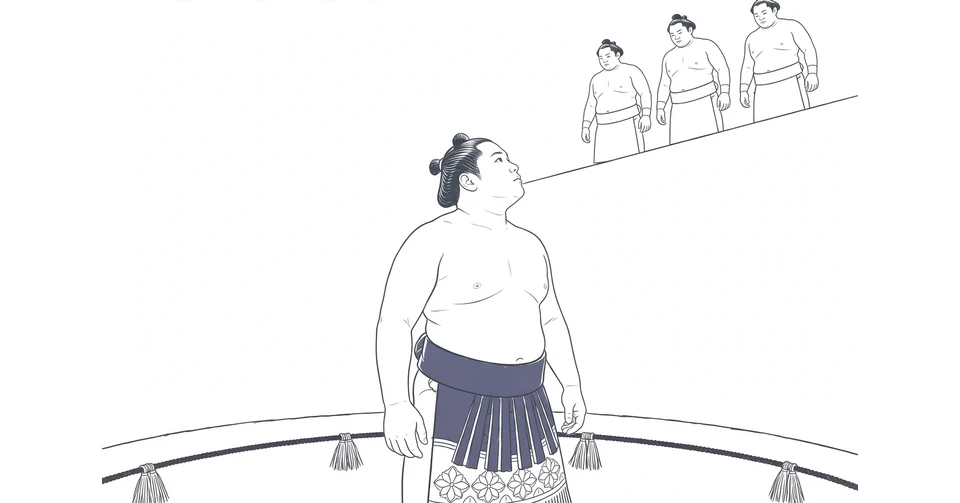
A new komusubi does not get a gentle introduction. In his first week at the rank he faces the ozeki and the yokozuna, the strongest men in the sport, and he usually meets a yokozuna on the opening day. If he survives that week, the second week brings the maegashira he used to fight as an equal, except now he meets them tired and bruised. That is the bargain of the rank. The rank is an honour and an ordeal in the same fortnight, and the men who hold it learn quickly whether they belong at the top table or were only visiting.
What komusubi means
Komusubi is written with two characters, small and knot, and it literally means "the little knot". The knot in the name refers to the match-up between two wrestlers, the pairing that ties two men together in a bout. It is a modest name for a high rank, and the modesty is part of the point. A knot is small, but it is what holds things together, and a komusubi holds the bottom of the titled ranks together. The Komusubi section of Wikipedia gives the plain definition: the fourth highest rank in sumo wrestling and the lowest of the titleholder ranks, or sanyaku.
Sanyaku itself is a small puzzle. The word literally means "the three ranks", yet it has contained four ranks since 1909: yokozuna, ozeki, sekiwake, and komusubi. The reason is history. A yokozuna was traditionally regarded as an ozeki who held a special licence to wear the ceremonial rope and perform his own ring entering ceremony, so the old count of three did not include him as a separate rank. The name stayed even after the counting changed, and sumo is full of names like that, old words kept long after the facts behind them moved on. I find that stubbornness reassuring. A sport that keeps a name for more than a century after it stopped adding up is a sport that knows what it values, and it values continuity more than neatness.
Within sanyaku there is a clear split. The senior ranks, yokozuna and ozeki, carry special promotion rules, higher salaries, and extra duties. The junior ranks, sekiwake and komusubi, are treated together for many purposes, and records of how many tournaments a wrestler spent in junior sanyaku are often counted as one figure. That pairing matters, because it tells you where komusubi belongs in the sport's mind. A man at this rank is not a senior figure. He is a junior titleholder, a man who has earned a title and is still expected to prove he deserves it, tournament after tournament.
Where komusubi sits on the banzuke
The banzuke is the ranking sheet, a large sheet of calligraphy published about two weeks before each tournament, and it lists every professional wrestler in rank order. The top division is makuuchi, fixed at 42 wrestlers since 2004. Everyone in makuuchi holds one of five ranks, and the table below shows them from the top down, with komusubi sitting fourth, directly above the numbered maegashira.
| Rank | Place in makuuchi | What it means |
|---|---|---|
| Yokozuna | 1st | Grand champion, cannot be demoted |
| Ozeki | 2nd | Champion rank, one step below the top |
| Sekiwake | 3rd | Junior titleholder, one step above komusubi |
| Komusubi | 4th | Lowest titleholder rank, the smallest chair |
| Maegashira | 5th | Numbered ranks, from 1 down |
The table looks simple, but the numbers behind it are not fixed. The size of makuuchi never changes, yet the number of sanyaku wrestlers does. There are typically between eight and twelve of them, with the rest ranked as maegashira. Every banzuke must have at least one sekiwake and one komusubi on each side, east and west, and normally there are two of each rank. The number of komusubi can rise to three or four when both men at the rank finish with winning records and an upper maegashira produces a score so good that he cannot reasonably be denied promotion. That is relatively rare, and it is worth pausing on, because it shows that komusubi is not a fixed number of chairs. It is a minimum of two, and the sport adds chairs only when the results demand it.
East outranks west at the same rank, so the east man sits a fraction higher than the west man. The difference is small, but in a sport built on hierarchy, small differences are the whole game. A wrestler can spend a career chasing fractions like that, one half step at a time, and the banzuke records every one of them.
How a maegashira earns komusubi
A maegashira earns komusubi the way every promotion in sumo is earned: by winning more bouts than he loses in a tournament, and by doing it near the top of the division. The banzuke committee reads the previous tournament strictly. A winning record, called kachi-koshi, normally means promotion, and a losing record, called make-koshi, normally means demotion. In the top division, where a wrestler fights fifteen bouts, eight wins against seven losses is the smallest winning record. That single extra win can move a man up the ladder, and a strong record near the top can move him a long way.
The most dramatic route to the rank is the championship leap. A maegashira ranked 14 who wins the division championship can be promoted as high as komusubi in one jump, and that is exactly what happened in March 2000, when Takatoriki won the title with thirteen wins and two losses and went straight to the rank. The lesson of that story is not that komusubi is easy to reach. It is that the rank is the ceiling for a single great tournament. No matter how spectacular the run, a maegashira cannot jump past komusubi. The titled ranks are entered through the smallest door, and everyone comes through the same one. The climb itself is a long one, and our guide to the numbered ladder of the maegashira follows the men who work their way up it one bout at a time.
Most promotions to the rank are quieter than a championship. A wrestler at maegashira 1 or 2 puts together a strong winning record, often ten or eleven wins, and the committee has no choice but to lift him into the lowest titled rank. There is also an element of luck at the door. Because every banzuke must have at least two komusubi, a shortage of obvious candidates can lift a wrestler into the rank on a record that would not normally be enough. The sport is honest about this, and the honesty is useful. Luck can open the door to the rank, but nothing about the rank itself is lucky. The schedule that waits on the other side is the same for everyone, and it does not care how a man got there.
Why eight wins are not enough
Here is the first hard truth about the rank. Winning eight bouts and losing seven at the rank is not enough to guarantee promotion to sekiwake, the next rank up. A komusubi who goes eight and seven has done his job, he has kept his rank, but keeping a rank and climbing from it are two different things. Promotion to sekiwake depends on a space being available, which is quite common, or on winning at least eleven bouts when no normal sekiwake slot is free. Eleven wins against the hardest schedule in the sport is a serious demand, and it is the reason so many wrestlers spend their careers knocking on the door above komusubi without ever stepping through it.
The numbers tell the story plainly. Tochiozan was promoted to a third sekiwake slot in March 2014 with eleven wins, when the other two sekiwake had winning records and there was no normal opening. Tochinoshin, in a similar situation, was not promoted with ten wins in November 2015. One win was the difference between a promotion and another tournament at komusubi, and that is how fine the margins are at the top of the sport. A wrestler can do almost everything right and still stay exactly where he is, because the rank above him is full.
The longer road runs through sekiwake to ozeki. A wrestler is typically considered for promotion to ozeki when he has at least 33 wins over the three most recent tournaments at sekiwake or komusubi, including ten or more wins as a sekiwake in the last completed tournament. That is a three tournament test, not a one tournament flash, and it is deliberately hard. Our guide to the ozeki rank explains what waits at the end of that road, and why the step from sekiwake to ozeki is the most scrutinised promotion in the sport. Before the Second World War, there were several instances of a komusubi advancing straight to ozeki after nearly winning a tournament, but there have been no instances of this since then. Today, being ranked at sekiwake is a necessary condition for any further promotion, and the rank is the place where a wrestler proves he is ready to take that step, or learns that he is not.
The hardest fortnight in sumo
Komusubi is widely regarded as a difficult rank to maintain, and the schedule explains why. A komusubi is likely to face all the ozeki and yokozuna in the first week of a tournament, with a yokozuna normally scheduled for the opening day. There is no warm-up bout, no gentle start, no chance to find form against weaker opposition. The first week is a test against the best, and it begins on day one.
The second week is different but not easier. He faces mainly maegashira, the men he used to fight as an equal, but by then he is often exhausted and demoralised from the first week, and he loses bouts he would normally win. Few men making their komusubi debut return a winning record in their first tournament at the rank, and those who do are likely to promote even higher. That sentence, read carefully, contains the whole psychology of the rank. Surviving the debut is itself a sign of quality. A man who goes eight and seven in his first tournament as a komusubi has beaten the hardest schedule in sumo and stayed standing, and the sport notices.
I think there is something fair about this cruelty, even if fairness is not the first word that comes to mind. Most sports protect their newcomers. Sumo does the opposite at this rank. It throws the new titleholder at the champions first and asks him to prove, in public, that his promotion was not a mistake. The audience understands this, which is why a debuting komusubi who wins early in a tournament gets some of the loudest cheers in the arena. The crowd is not only cheering a win. It is cheering a man who refused to be overwhelmed by his own promotion.
NHK World's sumo questions and answers page sets out the structure behind all of this in plain language: six tournaments a year, fifteen days each, five ranks in the top division, and promotion that depends on finishing with more wins than losses. It also explains that a candidate for ozeki must score double digit winning records for at least three consecutive tournaments, and that reaching yokozuna generally takes two consecutive tournament championships or something equally impressive. The NHK World sumo Q and A is a useful companion to the detail in this article, because it shows how the small facts about komusubi fit into the larger shape of the sport.
Komusubi and the gold star that is not his
There is a famous prize in sumo called the kinboshi, the gold star. When a maegashira defeats a yokozuna, he earns a kinboshi, and he is rewarded with extra money for the victory for the remainder of his career. The bout itself is one of the great spectacles of the sport. The arena erupts, and in the past it was common for members of the audience to throw their seat cushions into the ring, a tradition that is now discouraged but still remembered fondly.
Here is the twist that makes komusubi strange. A komusubi who beats a yokozuna does not earn a kinboshi. The gold star belongs only to a maegashira, a wrestler from the numbered ranks below the titled elite. The moment a man is promoted to komusubi, he loses the right to win the sport's most famous upset prize, even though he is now far more likely to actually face a yokozuna. He can beat the grand champion on the opening day of a tournament, and the win will count toward his record, and the crowd will roar, but no gold star will be added to his name.
That sounds unfair, and in one sense it is. But I think the rule is honest about what a kinboshi means. The gold star is not a prize for beating a yokozuna. It is a prize for beating a yokozuna from below, from outside the titled ranks, as an outsider. A man at this rank is no longer an outsider. He sits at the top table, and the sport expects him to beat the men at that table. It does not reward him with a star for doing what his rank already demands of him. The win still matters enormously, and it can decide a championship race, but the reward for a man at this rank is different: a better record, a better chance at the special prizes, and a step closer to sekiwake.
The special prizes, called sansho, are the consolation that the rules do offer. They have been awarded since 1947 for fighting spirit, outstanding performance, and technique, and they go to wrestlers below the top two ranks. That means a man at this rank, unlike an ozeki or a yokozuna, is still eligible for them. A wrestler at this rank who beats a yokozuna and finishes with a strong record can leave the tournament with a prize and a reputation, even if he did not win the title. The prizes are decided by people who watched every bout, not by the win column alone, and that judgement matters to a wrestler whose record alone might not show how hard his tournament was.
What the rank gives back
For all its hardship, the rank pays. A wrestler who reaches the rank gets a salary increase, and the money is only the beginning. He is called to flank the chairman of the Sumo Association during the speeches on the opening and closing days of the official tournaments, standing in his mawashi beside the most senior figure in the sport while the arena watches. He may also be called on to represent all the wrestlers on behalf of the Association at other events, especially when the number of ozeki and yokozuna is low. These are ceremonial duties, but ceremonies are how sumo says who matters, and a man at this rank is told, in public, that he matters.
The rank also stays with a man after he leaves it. If this rank is the highest a wrestler reaches, even if it is only for one tournament, he will always be referred to as "former komusubi" after his retirement. That title is an indicator of a successful sumo career, even if the wrestler never reached the exceptional standards of the two highest ranks. It is a small thing, a word kept in front of a name, but in a world that measures men by rank, it is a permanent mark of having arrived. One tournament is enough. The sport does not ask how long you sat at the top table, only whether you sat there at all.
There is a practical benefit too, and it matters for life after wrestling. Only a limited number of men can become stablemasters, and the routes are narrow. Ozeki and yokozuna are eligible, as are wrestlers who fought at least one tournament at sanyaku, which means sekiwake or komusubi. Competing in at least twenty tournaments in the top division is another route. A single tournament as a komusubi can therefore open a door that stays open for the rest of a man's life in sumo, a door to coaching, to running a stable, to staying inside the world that shaped him. That is a large return for a rank that is often described as the smallest chair in the room.
The wrestlers who made komusubi their home
Some wrestlers pass through the rank on their way up. Others make it their home, and the record books remember them for it. The wrestler with the most komusubi appearances in history is Miyagino, who held the rank twenty three times between October 1818 and January 1834, and whose highest rank was sekiwake. Twenty three tournaments at the same rank, across sixteen years, is a career built on the smallest chair. He never reached ozeki, yet his name sits at the top of a list that the sport still keeps, two centuries later.
The second name on the list is Takamiyama, who held komusubi nineteen times between November 1969 and January 1979. He is remembered for more than the number. He was the first foreign born wrestler to reach the top division, and in July 1972 he became the first wrestler from outside Japan to win a top division championship. He came from Hawaii, and his success opened a door that wrestlers from Mongolia, Eastern Europe, and many other places have walked through since. His nineteen tournaments at the rank are part of that story. He was not a man who flashed through the rank. He lived in it, learned it, and used it as the base for a career that changed the sport.
Akinoshima is third, with fifteen appearances between November 1988 and September 2000, and his highest rank was also sekiwake. Three men, three eras, one pattern: the rank rewards the wrestler who can return to it again and again, who can survive the first week, recover in the second, and come back two months later to do it all over. There is a dignity in that kind of career that the championship lists do not capture. The champions are remembered for their peaks. The long serving men at this rank are remembered for their refusal to fall, and in a sport that tests a man fifteen days at a time, six times a year, refusal is a skill of its own.
Why the smallest chair matters
Komusubi matters because it is where sumo is most honest about itself. The higher ranks are protected. A yokozuna cannot be demoted, and an ozeki gets a second chance after one losing tournament. The lower ranks are numbered and patient, and a maegashira can climb slowly without facing the champions every day. This rank has neither protection. It is the only rank that is both titled and exposed, both an honour and a trial, and it asks a wrestler to defend his place against the best in the sport from the very first day.
I have come to think that every field has a komusubi, a smallest chair at the top table. It is the first promotion that changes how people see you, and the last one that still lets you fail in public without disgrace. The people above you are stronger and better paid, the people below you are hungry for your seat, and the only way to keep it is to do the work in front of everyone, day after day. There is no comfort in that position, but there is a clarity that comfort never gives. You know exactly where you stand, because the results are published, the schedule is fixed, and the next test arrives in two months whether you are ready or not.
That is why I admire the wrestlers who hold the rank, and especially the ones who hold it for years. They are not the grand champions, and they are not the young hopefuls. They are the men who arrived at the top table, found the smallest chair, and sat in it as if it belonged to them. In the end, it did. A chair is only small until someone sits in it long enough to make it theirs, and sumo, which remembers everything, remembers the men who did.
More in Culture & Society
- A Sekiwake Waits One Win From Sumo's Highest Door
- Tanabata Festival and the Star-Crossed Lovers Behind the Bamboo Wishes
- A Maegashira Climbs the Numbered Ladder One Bout at a Time
- An Ozeki Stands One Step From the Top and Cannot Afford to Slip
- An Oyakata Is the Father a Sumo Stable Cannot Replace
- A Tokoyama Spends Ten Years Learning to Dress a Topknot
Latest posts
- Japanese Calligraphy and the Brush That Turns Writing Into Art
- A Tegata Is Sumo's Inked Handprint Autograph
- A Rikishi Is a Man of the Sumo World Before He Wins a Single Bout
- Mawashi Carries a Wrestler's Rank Around His Waist
- Namasu Turns Daikon and Carrot Into a Red and White Wish
- Yokai, the Strange Spirits That Haunt Japanese Folklore
- Ebi Bends Like an Old Back and Wishes You a Long Life
- Yokozuna Is the Rank Sumo Never Takes Back
- Kobumaki Rolls Joy Into a Strip of Kelp
- Kurikinton Is the Golden Mash That Wishes You Wealth
- Japanese Beer and the Dry Wars That Changed How Japan Drinks
- Kamaboko Paints the New Year Red and White
- Datemaki Rolls Sweet Eggs Into a Spiral of Good Luck
- Japanese Bento and the Lunch Box That Became an Art Form
- Tazukuri Turns Tiny Sardines Into a Wish for a Good Harvest