A Shikona Gives a Wrestler His Second Name
· 18 min read
A shikona is the ring name a sumo wrestler carries through his career, given by his stablemaster and shaped by the traditions of his stable.
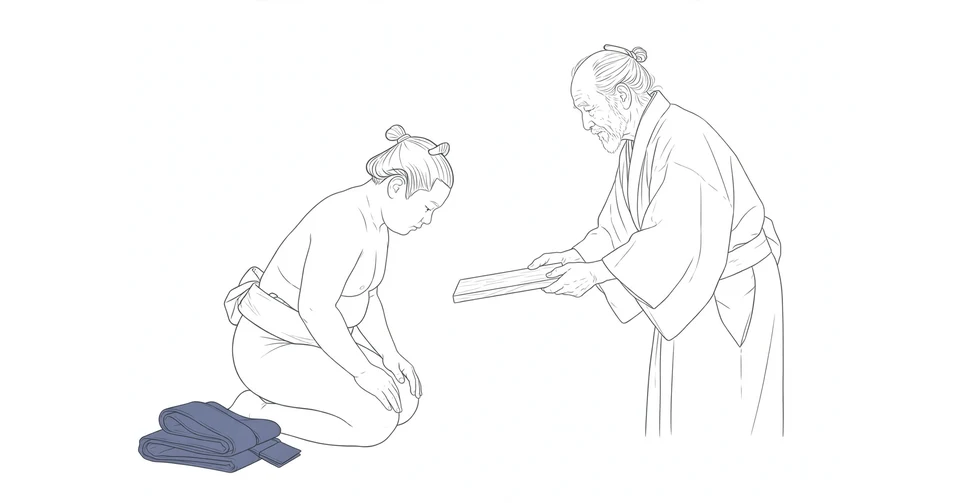
A boy of fifteen walks into a sumo stable with a small bag and his birth name, the name his parents gave him and his teachers called him by. Within days, the stablemaster gives him a second name. From that moment, the crowd, the newspapers, and the ranking sheet will know him by the new name, and his old name will retreat into private life. That second name is his shikona, and in professional sumo it matters almost as much as the wrestler himself.
A shikona is not a nickname chosen on a whim, and it is not a stage name picked for marketing. It is a formal ring name, built from kanji characters that carry meaning, history, and belonging. It tells the audience where the wrestler comes from, which stable raised him, and sometimes which great wrestler of the past he is expected to follow. A fan who learns to read a shikona can tell a great deal about a wrestler before he has thrown a single opponent.
This article explains what a shikona is, how a wrestler receives one, what its characters usually mean, when it changes, and what happens to it when the wrestler retires. The name looks like a small detail of the sport, a label on a ranking sheet, but it holds the whole structure of sumo inside it: the stable, the master, the lineage, and the idea that a wrestler belongs to something larger than himself.
What a shikona actually is
At its simplest, a shikona is a sumo wrestler's ring name. Every active professional wrestler must have one, and the Japan Sumo Association expects the general public to refer to a wrestler by it. If a wrestler fights under his birth name, that name counts as his shikona, so the rule is less about inventing a name than about fixing one name for the public to use. The full article on the term traces its history from the Edo period to the present day, and the history is longer and stranger than most fans expect.
Like a standard Japanese name, a shikona is made of a family name followed by a given name, with the family name coming first. In practice, the given name is rarely used outside formal or ceremonial occasions. The great yokozuna Kitanoumi was born Toshimitsu Obata, and his full ring name was Kitanoumi Toshimitsu, but almost everyone called him simply Kitanoumi. The surname does the work. It is the part the crowd chants, the part painted on the ranking sheet, and the part that carries the stable's tradition.
There is a proverb in professional sumo that a wrestler has three names: his birth name, his ring name, and the name he takes when he retires and trains younger wrestlers. The shikona sits in the middle of that life, between the boy he was and the elder he may become. In private, either the ring name or the birth name can be used. Masters often call their wrestlers by their birth names during training, and relatives keep using the birth name at home. But the moment the wrestler steps into public life, the shikona takes over, and the birth name waits quietly in the background.
That split is worth pausing over, because it tells you what the name is for. A birth name belongs to a family. A shikona belongs to the sport. When a boy receives his ring name, he is being told that he now has a public self, and that the public self answers to the stable, the Association, and the audience. I think there is something fair in that arrangement, and something demanding. The wrestler is not asked to erase who he was. He is asked to carry a second identity alongside the first, and to live up to both. A boy of fifteen can understand that bargain even before he understands the sport.
As the story of the rikishi explains, a wrestler does not compete under his own name. Each is given a shikona, a ring name, usually built by his stablemaster from a syllable of the stable's own tradition. The name can change mid career, and it rarely resembles the name on his passport. The shikona is a second identity, and receiving one is one of the first signs that the young rikishi now belongs to the stable rather than to his old life.
Where a shikona comes from
Traditionally, a wrestler's shikona is given to him by his master, the oyakata who runs his stable. The wrestler may influence the decision, and a wise master listens, but the choice itself is the master's to make. The selection can also be made by the master's wife, the okamisan, or even by a sponsor, and the name is then communicated to the wrestler by his master. It is a gift handed down, not a name a young man picks for himself, and that difference shapes everything about it.
The inspiration for a shikona is usually drawn from characters linked to the wrestler's family, his stable, or his master. Other common sources include place names, mythology, and natural phenomena. Typically, a name is made by combining the name of a wrestler's hometown or region with kanji characters for natural formations such as mountains, rivers, or seas. Some wrestlers use kanji that have a connection to their stable name, and the result is a name that reads like a short poem about where the man comes from and who raised him.
The stable traditions are the easiest to spot. Anyone with the prefix Koto belongs to Sadogatake stable or its spinoff, Naruto stable, and the character for the koto, a Japanese stringed instrument, has been passed down through generations of that stable's wrestlers. The Japan Times notes the same pattern in its guide to sumo nicknames, pointing out that the Oki in Okinoumi's name comes from the Oki Islands, where he grew up. Kasugano stable reuses the character for Japanese horse chestnut, Isegahama stable reuses the characters for Mount Fuji, and the now defunct Miyagino stable reused the character for peng, a mythical bird, a tradition inspired by its stablemaster Hakuho.
Wrestlers often incorporate a character from their master's name into their own name, and sometimes a master proposes that a wrestler inherit his own ring name. In 2023, the then sekiwake Kiribayama changed his name to Kirishima when he was promoted to the rank of ozeki, so that his name would evoke his master. The change was announced with the promotion, and it told the audience something the ranking sheet alone could not: this wrestler now carries his master's name into the ring with him.
The characters themselves are chosen with care, and certain kanji appear again and again: mountain, river, sea, dragon, flower, wave, morning, north, island, power, rising sun, cherry blossom, abundance, heaven, great, youth, noble, country, wisteria, brocade, field, and rice field. A shikona built from these characters has no literal sentence meaning, and the full name usually does not translate into a phrase. What it does is create a feeling, strength, nature, brightness, or good fortune, and the audience reads that feeling before the bout begins.
Foreign wrestlers show how flexible the system is. The Bulgarian Kotooshu combined the Koto of Sadogatake with characters meaning Europe, while the Estonian Baruto chose characters that evoke the Baltic Sea beside his homeland. These names are not Japanese birth names dressed up for the ring. They are new Japanese names, built for men who were not born in Japan, and they work because the shikona system cares about belonging, not about blood. A wrestler from Sofia or Tallinn receives the same kind of name as a boy from Aomori, and the crowd learns it the same way.
I find this part of the tradition quietly generous. A name that ties a man to his hometown and his stable at the same time is a name that says he has two homes, and both of them claim him. The stable does not ask a foreign wrestler to pretend he is Japanese. It asks him to bring his own geography into the Japanese naming system and let the two sit side by side. That seems to me a better model of belonging than most institutions manage, because it adds an identity instead of replacing one.
The history hidden inside a shikona
The use of ring names in sumo dates back to the Muromachi period, and it developed further in the Edo period, when ring names were used to hide the identities of early rikishi, many of whom were masterless samurai called ronin. The long peace under the Tokugawa shogunate had reduced the demand for samurai, and many masterless swordsmen earned their living in street sumo, wrestling on street corners for the entertainment of passers by. The shame of lost status led these men to adopt a shikona to hide their true identities, and the ring name began as a mask before it became an honor.
The word itself carries that history in its spelling. The archaic spelling of the term used the kanji for ugliness, and it had a meaning associated with humility, the wrestler presenting himself as lowly before the crowd. During the Edo period, the spelling changed to incorporate the kanji for shiko, the leg stomping ritual, which sounded similar to the kanji for ugliness. In that period, shikona came to refer exclusively to the ring names of sumo wrestlers, and the humble mask became a professional title.
The authorities of the day did not always welcome the sport. Restrictions on public sumo culminated in 1661 with a total prohibition, and the practice continued illegally until 1684, when a ronin named Ikazuchi Gondaiyu obtained permission from the Edo authorities to hold an official tournament, making sumo and its customs legal again under a new organization. The ring name survived the ban, and it survived because it had already become part of what sumo was. A wrestler without a shikona was not yet a professional, and the name marked the boundary between street wrestling and the organized sport.
By the Horeki era, wrestlers who retired and established themselves as coaches began to inherit and assume the names of their predecessors, and the ring name became something that could be passed down like a house or a trade. That idea has never left the sport. A shikona can still be inherited today, and the inheritance is treated as a serious matter, as we will see. The name is not only the wrestler's. It is also the stable's, and the stable keeps it after the wrestler is gone.
There is something touching about a name that began as a disguise for ashamed samurai and became the proudest thing a wrestler owns. The men who first took these names wanted to hide. Their descendants in the sport want to be known by them, and the same syllables that once covered a face now announce one. I think that is how traditions usually work. They begin as a practical answer to a problem, and if they last long enough, they become the thing people love most about the institution that kept them.
When a wrestler gets a new shikona
Not every wrestler receives his shikona on the day he joins. It is common to see new recruits fighting under their birth name before later choosing a pseudonym, while others adopt a new name from their professional debut. Wrestlers who start their career using their birth name typically change their ring name by the time they achieve promotion to the juryo or makuuchi divisions, the two salaried ranks. The timing depends on the naming traditions of individual stables. Wrestlers at Kokonoe stable often adopt a new shikona upon entering the lower sandanme division, while wrestlers at Sadogatake stable generally adopt a new one on joining as trainees, even if the new name is simply the character Koto attached to the beginning of their original family name.
Some wrestlers never change at all. While unusual, some choose to wrestle their entire career under their real name, and this has become more common in the twenty first century. Sekitori who made this choice include Takayasu, Shodai, Endo, Ura, and Dejima, and Wajima remains the only yokozuna to have used his real name throughout his career. There is no rule that forces a man to invent a new name, and the sport seems comfortable with the exception. A birth name can be a shikona if the wrestler and his master decide it should be.
The most common occasion for adopting a new shikona is a promotion. In 2023, Kiribayama became Kirishima when he rose to ozeki, and the new name honored his master. A similar story played out in January 2021, when the wrestler formerly known as Naya was billed under his new ring name of Oho in the list of wrestlers promoted to juryo. Oho is the grandson of Taiho, considered the greatest yokozuna of the Showa period, and his stablemaster built the new name by replacing the character for big in his grandfather's name with the character for king. The promotion gave him a new rank, and the new name told the audience he was ready for it.
A master may also change a wrestler's name to inspire him to progress through the ranks, or to change his luck. In 2023, Oshoma changed the first name of his shikona, keeping the same pronunciation but swapping the kanji for the characters meaning energy, to ward off the risk of injury after a series of setbacks. Another wrestler, Hattorizakura, debuted in 2015 and went on to post just three wins against 209 losses, then changed his name to Shonanzakura. The new name partly refers to his birthplace, the city of Chigasaki in the Shonan region, but the first character is written with the kanji meaning victory, in the hope it will help him win more bouts. The name becomes a small prayer, written in characters the whole audience can read.
There are almost no written rules about what a shikona can be. Wrestlers can even use the katakana characters usually reserved for foreign and loanwords, and Hawaiian born former sekiwake Takamiyama made his first appearances under his real name, Jesse. Unusual ring names have included Hifumiyama Yogoroku, Inoshishi Nabekichi, Dekoboko Takichi, and Hero Ichimatsu. The only real limit seems to be taste and the master's judgment. A shikona can be grand, playful, or strange, but it cannot be careless, because the wrestler will answer to it for years.
A shikona can be inherited, and a yokozuna keeps his forever
It is common for a wrestler to inherit the shikona of a family member who had previously been a wrestler. Kotozakura II began his career under his father's shikona before inheriting his grandfather's upon promotion to ozeki, carrying three generations of his family into the ring under one name. If a wrestler from outside the family wishes to inherit the shikona of a former wrestler, it is traditionally required that the master ask permission from the family of the wrestler in question. The name is treated like an heirloom, and the family decides who may wear it next.
Stable lineage names work the same way. Kashiwado is a lineage name within Isenoumi stable that dates from the mid Edo era, and it was only given to wrestlers seen as future champions, so receiving it was itself a prediction. Takamiyama was the original name of the founder of Takasago stable, and it has been inherited by wrestlers of that stable ever since. When a young wrestler receives one of these names, he is not only being named. He is being told what the stable expects of him, and the expectation is written into the name he must answer to every day.
The names of yokozuna are protected most strictly of all. For yokozuna, these names are referred to as tomena, stopped names, which are not to be inherited, with the exception of direct disciples of the last holder. Taiho, who won 32 championships, ascended to the rank of elder as a special ichidai toshiyori, a single generation elder who retains his ring name, and his grandson could not take the name Taiho even as a tribute. The stopped name is the sport's way of saying that some achievements close the book. The name retires with the man, and the next generation must write its own.
That system of single generation elders lasted from 1941 to 2021, when it ended after Hakuho, the wrestler with the most top division championships, was denied the privilege on his retirement. The decision closed a door that had stood open for eighty years, and it showed that even the grandest names in the sport answer to rules larger than themselves. A shikona can be inherited, lent, or stopped, but it is never owned outright, and that is part of its dignity.
What happens to a shikona after retirement
Retired wrestlers who become toshiyori, elders of the Association, give up their shikona and adopt the name associated with their elder share, and the ring name passes out of daily use. Some retired wrestlers find official roles within the Association as wakaimonogashira or sewanin, and those men retain their shikona as their professional name even though they are no longer active. Other retired wrestlers simply give up their ring names and are subsequently referred to by their birth names, returning to the name they were given before the sport renamed them.
There is a quiet symmetry in that return. A man enters the sport with a birth name, receives a shikona, lives under it for a career, and then, unless he stays on as an elder or an official, hands it back and becomes his birth name again. The ring name was never really his property. It was a loan from the stable and the sport, and the retirement is the day the loan is repaid. I find that honest, and a little sad, because the name the crowd loved belongs to the crowd more than to the man who wore it. But it is also the reason the names keep their power. They are not spent on one man. They are kept, protected, and passed on, and the sport stays larger than any single wrestler.
Why a second name matters beyond sumo
The shikona is a small part of sumo, a few characters on a ranking sheet, but it carries the whole idea of the sport inside it. It says that a wrestler is not only an athlete but a member of a house, a student of a master, and a link in a line that reaches back to the Edo period. The banzuke records that name in calligraphy before every tournament, and the sheet is rebuilt six times a year, yet the name on it can last for decades, carried by one wrestler and then another.
Most of us will never receive a ring name, but most of us know what it feels like to be given a name by an institution: a job title, a team name, a nickname from a teacher or a coach. Those names do the same work as a shikona. They tell us we belong somewhere, and they ask us to live up to a standard we did not set ourselves. The difference in sumo is that the sport is honest about the exchange. The name is a gift, and the gift has a price, which is obedience, effort, and years of mornings that start before dawn. The wrestler pays it gladly, because the name gives him something his birth name cannot: a place in a story that began before he was born and will continue after he retires.
A shikona gives a wrestler his second name, and the second name gives him his second life. The first life is the one his parents gave him, and it stays with him in private, in the stable, and at home. The second life is the one the sport gives him, and it is the life the crowd sees, the life the ranking sheet records, and the life history will remember. When the bout ends and the wrestler bows, it is the second name the announcer calls, and that is as it should be. The man goes home to his first name. The wrestler belongs to the second.
More in Culture & Society
- A Kadomatsu Guards the Door Until the New Year Fire
- Komusubi Is the Smallest Chair at Sumo's Top Table
- A Sekiwake Waits One Win From Sumo's Highest Door
- Tanabata Festival and the Star-Crossed Lovers Behind the Bamboo Wishes
- A Maegashira Climbs the Numbered Ladder One Bout at a Time
- An Ozeki Stands One Step From the Top and Cannot Afford to Slip
Latest posts
- Japanese Street Food, From Takoyaki Stalls to Festival Yatai
- An Oyakata Is the Father a Sumo Stable Cannot Replace
- A Tokoyama Spends Ten Years Learning to Dress a Topknot
- Japanese Calligraphy and the Brush That Turns Writing Into Art
- A Tegata Is Sumo's Inked Handprint Autograph
- A Rikishi Is a Man of the Sumo World Before He Wins a Single Bout
- Mawashi Carries a Wrestler's Rank Around His Waist
- Namasu Turns Daikon and Carrot Into a Red and White Wish
- Yokai, the Strange Spirits That Haunt Japanese Folklore
- Ebi Bends Like an Old Back and Wishes You a Long Life
- Yokozuna Is the Rank Sumo Never Takes Back
- Kobumaki Rolls Joy Into a Strip of Kelp
- Kurikinton Is the Golden Mash That Wishes You Wealth
- Japanese Beer and the Dry Wars That Changed How Japan Drinks
- Kamaboko Paints the New Year Red and White