Kotatsu, Japan's Heated Table That Warms Winter
· 10 min read
A kotatsu is a low table with a heater underneath and a thick blanket over it, and it has warmed Japanese winters for 600 years. This is how the kotatsu works, where it came from, and why families still gather around one.
On a cold night in Japan, the warmest place in the house is often not a room. It is a table. You slide your legs under a thick blanket, settle onto a floor cushion, and feel the heat rise around your knees while the rest of the room stays cold enough to see your breath. That table is a kotatsu, and for about 600 years it has been the way Japanese families get through winter.
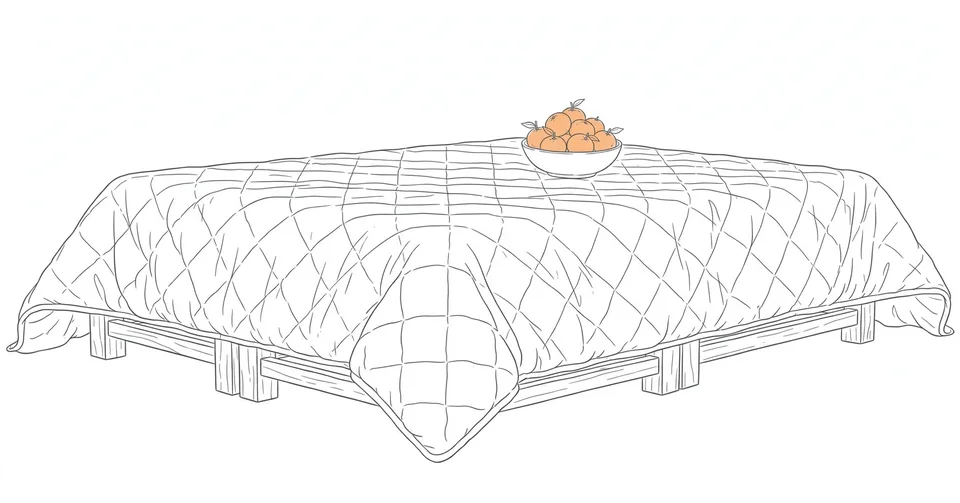
The short version is simple. A kotatsu is a low wooden table with a heat source fixed underneath it and a heavy blanket, called a kotatsu futon, draped over the frame. The tabletop sits on top of the blanket, sealing the warm air inside. You sit on the floor, put your legs under the blanket, and the heat warms your lower body while your hands stay free for tea, a book, or a bowl of mandarins. The Wikipedia entry on the kotatsu describes it the same way, a table frame covered by a futon, with a heat source underneath that used to be charcoal and is now almost always electric.
What I like about it is that it solves the wrong problem on purpose. Japanese houses are famously cold in winter. Traditional construction was built to survive hot, humid summers, with thin walls and poor insulation, and even modern apartments often heat one room at a time rather than the whole flat. It does not fight that. It gives up on warming the room and warms the people instead, and it does it with a heater that draws only 200 to 600 watts, less than a hair dryer. It is the most honest piece of furniture I know, a small warm pocket in a cold house, and it turns winter into a season people gather for rather than endure.
What a kotatsu actually is
A modern one has four parts, and each one does a simple job. The frame is a low wooden table, short enough to sit at on the floor. Under the tabletop, fixed to its underside, sits the heater, a flat electric element with a temperature dial. Over the frame goes the kotatsu futon, a thick quilted blanket that hangs down to the floor on all four sides. On top of the blanket sits the tabletop itself, a flat board that holds your tea and your dinner. The blanket is the whole trick. Without it, the heat would rise straight into the room and vanish. With it, the warm air stays trapped under the table, around your legs, exactly where you need it.
There are two classic forms. The older one is the hori-gotatsu, the dug kind, built around a pit in the floor where the heat source sat below floor level. The one almost everyone knows today is the oki-gotatsu, the placed kind, a free-standing table you can put anywhere in a room and move when spring comes. The electric version, the denki kotatsu, is the only kind found in modern Japanese homes, and it is the one you will meet in apartments, in some inns, and in the living rooms of anyone who grew up with one.
Sitting at one has its own posture. You sit on a zabuton cushion on the floor, or you stretch your legs out straight under the blanket, or you fold them to one side. There is no correct position. The blanket decides. Once your legs are under it, moving takes effort, and that is part of the design. It is a place you settle into, not a place you pass through.
How the kotatsu grew out of a cooking hearth
It began in the 14th century, during the Muromachi period, and it began as a cooking fire. At the center of a traditional Japanese house sat the irori, a sunken hearth cut into the floor, where charcoal burned for cooking and heating. On cold days the family sat around the irori, and at some point someone put a wooden frame over the fire, draped a quilt over the frame, and tucked their feet underneath. The heat that used to warm the whole room now warmed the people sitting closest to it, and the first one was born.
The idea spread, and by the Edo period, which ran from 1603 to 1868, it had become a portable piece of furniture. Instead of a pit in the floor, people used a hibachi, a small charcoal brazier, placed under a low table. Charcoal stayed the heat source for centuries. It worked, but it carried risks, smoke, ash, and the danger of carbon monoxide in a closed room, and it needed constant attention.
Electricity changed everything. Electric heaters had existed since the Taisho era, but they were rare and expensive. In 1957, Tokyo Shibaura Electric, the company now known as Toshiba, manufactured an electric yagura model, and the device spread quickly. Within a decade the charcoal version had almost disappeared. By 1997, about 81 percent of Japanese homes had one, according to the figures cited on Wikipedia, and it had become a standard part of winter in Japan, as ordinary as a heater and far more loved. A detailed guide to the kotatsu traces the same path, from the 14th century hearth to the electric table in the living room.
Why the kotatsu still wins in winter
It survives for a practical reason and a social one, and the practical reason comes first. Heating a whole room in a poorly insulated house is expensive and slow. One heats a space about the size of a table, and it heats it fast. You switch it on, slide your legs under the blanket, and you are warm in minutes. The heater draws a few hundred watts, and because the blanket traps the heat, almost none of it is wasted. Compared with an air conditioner running all evening, one is cheap to run, and in a country where electricity bills climb every winter, that matters.
The social reason is the one people remember. In Japanese, the word for a family gathering around the table is danran, and it is the place where danran happens in winter. Homework gets done there. Television gets watched from it. Board games, phone calls, long conversations, and naps all happen there, because everyone in the room ends up with their legs under the same blanket. It turns a cold evening into a shared one, and that is a harder thing to replace than a heater. Air conditioning warms a room. It gathers a family.
The food of the kotatsu is the mikan, the small Japanese mandarin orange that peaks in December and January. A bowl of mikan sits on the tabletop, and people peel one after another while they watch television or talk. It is a small ritual, and it is so tied to it that the two are almost always pictured together. The oranges are sweet, easy to peel with cold hands, and they do not need a plate, which is exactly the kind of food it asks for.
The rules of kotatsu life
It has rules, and most Japanese people learn them young. The first is about falling asleep under one. It is famously easy to do. The warmth creeps up your body, your eyes close, and the next thing you know it is morning and you have slept half under the table. It feels wonderful, and doctors warn against it anyway. Sleeping under one for hours can dehydrate you, and the heater can cause low temperature burns, slow burns that happen when skin stays pressed against gentle heat for a long time. The advice is simple, enjoy the warmth, then get up and go to bed.
The second rule is about the blanket. A kotatsu futon is thick and heavy, and it needs airing and washing like any bedding. In spring, when the season ends, families fold the blanket away, store the tabletop, and the frame often becomes an ordinary low table for the summer. In autumn, it comes back out, and putting it together again is one of the small seasonal markers of the year, the same way the first mikan in the shops is.
The third rule is about sharing. A kotatsu has four sides, and the best seat is the one closest to the heater controls, which is also the seat everyone argues about. In a family, the person who sits at the kotatsu first claims the warmest corner, and the others fill in around them. It is a small domestic negotiation, repeated every winter, and it is part of why the kotatsu feels like home rather than furniture.
| Kotatsu type | Heat source | Where it sits | Still used today |
|---|---|---|---|
| Hori-gotatsu | Charcoal in a floor pit | Built into the floor | Rare, mostly in old inns |
| Oki-gotatsu | Charcoal brazier | Free-standing table | No, replaced by electric |
| Denki kotatsu | Electric heater | Free-standing table | Yes, the standard today |
For visitors, the kotatsu is also a good way to read a Japanese winter. If you stay at a traditional inn, a ryokan, in the cold months, you may find a kotatsu waiting in your room, and sitting at it after a bath is one of the quiet pleasures of the trip. The bath itself is the other half of the ritual. After warming up outside in an onsen, the hot spring bath that Japan treats as a way of life, or at a neighborhood sento, the everyday public bathhouse, you come back to a room that is cold and a kotatsu that is warm, and the contrast is the whole point. Even the snow monkeys of Nagano understand the idea, though they use a hot spring instead of a table.
Where to try a kotatsu
You do not need to buy a house in Japan to try a kotatsu. Some ryokan set one up in guest rooms from late autumn to early spring, and a few cafes and restaurants in colder regions put kotatsu seating out in winter, sometimes on a terrace, so customers can sit outside in the cold with their legs warm. Rental apartments sometimes come with one, left behind by the previous tenant. If you live in Japan for a winter, buying a kotatsu is a rite of passage, and a basic set, table, heater, and blanket, costs less than a month of running an air conditioner every night.
Buying one outside Japan is harder but not impossible. Kotatsu sets are sold online by Japanese retailers that ship overseas, and the heater runs on Japan's 100 volt supply, so buyers abroad need a step-down transformer or a heater made for their own voltage. Some sellers now offer heaters built for 220 volt markets, which removes the problem. If you are only visiting, the simpler plan is to look for one where you sleep. Ask the inn. The answer is often yes, and the memory of it lasts longer than the warmth.
The kotatsu is not the most advanced heating in the world. It is a table with a blanket and a heater, and it has barely changed in 600 years. That is the point. Japan has spent centuries building faster trains, taller towers, and cleverer gadgets, and through all of it, the kotatsu stayed the same, because nobody found a better way to spend a winter evening. A warm table, a bowl of mandarins, and the people you live with sitting close enough that your knees touch under the blanket. That is what a kotatsu is for, and it is enough.
More in Life & Style
- The History of the Bicycle From Wooden Wheels to Japanese City Bikes
- A Shukubo Lets You Sleep Inside a Working Temple
- Kaburiyu Is How You Talk Your Body Into the Bath
- Ganbanyoku Is Bathing Without Water
- The Obuki Throws Out Nine Thousand Litres a Minute
- Sainokawara Is a Bath You Share With a Hundred Strangers
Latest posts
- Japanese Festivals, From Snow Sculptures to Summer Fireworks
- The Daruma Doll, Japan's Round Symbol of Perseverance
- Kakiage and the Tempura Bowl That Towers Over Rice
- the-javanese-of-suriname-and-the-language-they-kept-alive
- Kanban and the Japanese System That Organized Work
- Shichi-Go-San and the Day Japan Dresses Its Children in Kimono
- Desa Pakraman Is the Name the Law Gave the Old Village
- A Primbon Reads Your Life From the Day You Were Born
- Pasaran Is the Five-Day Week Java Never Gave Up
- A Ceper Folds a Coconut Leaf Into a Crescent Moon
- Your Neptu Is the Number Hidden Inside Your Birthday
- Tilem Is the Dark Moon Bali Counts Its Year By
- The Saka Calendar Sets Nyepi on a Different Date Every Year
- On Tumpek Kuningan Bali Feeds Its Ancestors
- Garuda Carried a Mountain to the Middle of the Ocean