The History of the Bicycle From Wooden Wheels to Japanese City Bikes
· 11 min read
The history of the bicycle runs from a wooden running machine in 1817 to the mamachari parked outside every Japanese supermarket. This is how two wheels changed the world, and Japan.
The bicycle is the most successful machine most of us never think about. It needs no fuel, no license, and almost no maintenance, yet it has carried people to work, to school, and around the world for more than two hundred years. The history of the bicycle is not really a story about a machine. It is a story about how a simple idea, two wheels in a line, kept being reinvented until it fit ordinary life.
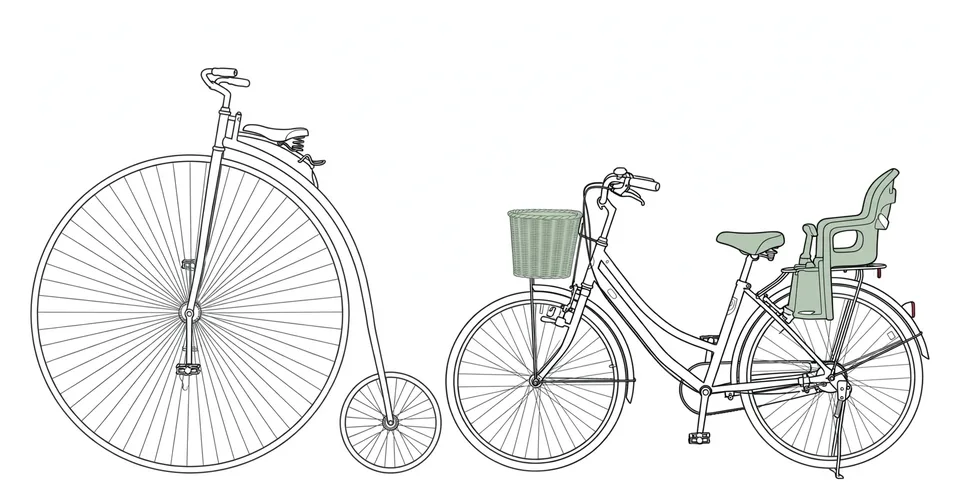
The short version runs like this. A German baron built a wooden running machine in 1817. French inventors added pedals in the 1860s. A British engineer built the tall, dangerous penny-farthing in the 1870s. Then, in 1885, the safety bicycle arrived with two equal wheels and a chain, and the modern bicycle was born. The 1890s brought a cycling boom that changed how women dressed and moved. And in Japan, the story took one more turn, into the mamachari, the humble city bike that still carries groceries, children, and commuters across the country. The history of the bicycle ends, for now, outside a Japanese supermarket, where a row of baskets waits in the rain.
What I like about this story is that nobody planned it. No government launched the bicycle. No company owned it. Each improvement came from someone solving a small, practical problem, and the result outlasted every grand transport scheme of its century. The bicycle won by being simple enough to fix, cheap enough to own, and useful enough to keep.
The running machine that started it all
The history of the bicycle begins in 1817 with a German inventor named Karl von Drais. He created a two-wheeled, human-powered vehicle called the draisine, also known as the running machine or hobby horse. It had no pedals. The rider sat on a saddle and pushed along the ground with their feet, steering with a handlebar. It looked strange, and it worked.
Drais was trying to solve a real problem. A volcanic eruption in Indonesia, Mount Tambora in 1815, had cooled the climate across the northern hemisphere and ruined harvests. Horses were expensive to feed, and many had been slaughtered for food. A vehicle that needed no horse was worth trying. It is a reminder that the history of the bicycle starts with scarcity, not with sport. Drais patented his machine in 1818, and it spread quickly through Europe and to America.
It did not spread without trouble. Riders on sidewalks collided with pedestrians, and several cities banned the machines from footpaths. The draisine was also hard work on anything but smooth ground, and the novelty wore off within a few years. But the idea survived, and the history of the bicycle continued from there: two wheels in a line, steered by a bar, balanced by the rider. Every bicycle since is a refinement of that idea.
Pedals arrive, then a very tall wheel
The next big leap came in the 1860s, when French inventors Pierre Michaux and Pierre Lallement attached pedals directly to the front wheel of a two-wheeled machine. The history of the bicycle moved fast in that decade. The result was the velocipede, a heavy machine with a wooden frame and iron tires that riders nicknamed the boneshaker, because that is what it felt like on cobblestones. It was uncomfortable, but it was faster than walking, and it sold. The velocipede was the first time the history of the bicycle became a business, with factories, clubs, and races forming around it. The full timeline of these early machines is well told in History.com's account of the bicycle's bumpy history.
Then came the machine most people picture when they think of early bicycles. In the 1870s, the British engineer James Starley introduced a design with a huge front wheel and a tiny rear wheel, the penny-farthing, named after two coins of very different sizes. The big wheel covered more ground with each turn of the pedals, so the machine was fast. It was also tall, unstable, and dangerous. Getting on required a step and a leap, and a sudden stop could throw the rider headfirst over the handlebars, a fall riders called taking a header.
The penny-farthing still had its moment. Bicycle clubs formed across Europe and America, the first races were held, and in 1884 an Englishman named Thomas Stevens set off around the world on a high-wheeler, finishing the journey in 1887. For most of the history of the bicycle up to that point, the machine belonged mostly to young men with money and nerve. For everyone else, the bicycle was still a spectacle, not transport.
The safety bicycle changes everything
That changed in 1885, when the English inventor John Kemp Starley, the nephew of James Starley, perfected the safety bicycle. His Rover Safety Bicycle had two wheels of equal size, a chain driving the rear wheel, and a low frame that let the rider sit close to the ground and put a foot down at any moment. It was slower than a penny-farthing at first, but it was safe, and anyone could ride it.
Three years later, the Scottish veterinarian John Boyd Dunlop added the pneumatic tire, a rubber tube filled with air, and the ride became smooth. From here, the history of the bicycle accelerated. The safety bicycle sparked a massive cycling boom in the United States and Europe during the 1890s. Factories could not build them fast enough. Prices fell as production grew, and the bicycle moved from a rich young man's toy to a working person's tool.
The boom changed more than transport. For women, the bicycle was a quiet revolution. Riding a penny-farthing in a long skirt was impossible, but the safety bicycle, ridden in shorter skirts or the bloomers named after the reformer Amelia Bloomer, gave women a way to travel alone, without a chaperone and without a horse. A New York Times article from 1896 gushed that the bicycle promised a splendid extension of personal power and freedom, scarcely inferior to what wings would give. This is the moment the history of the bicycle stops being a story about machines and becomes a story about people. The history of the bicycle is full of engineering, but this is the part that mattered most to the people riding it. The machine gave ordinary people a little more freedom, and they noticed.
The history of the bicycle reaches Japan
Bicycles were introduced to Japan in the late Edo period, but for a long time they were large, heavy, and expensive machines built for men. It was not socially acceptable for women to ride them, and the market stayed small. The history of the bicycle in Japan only really begins after the Second World War, when the country was rebuilding around dense cities where few people owned cars, and a cheap, practical bicycle was exactly what daily life needed. That is why the history of the bicycle in Japan reads differently from the European version. In Europe, the bicycle was a sport and a pastime before it was transport. In Japan, it was transport from the start.
The turning point came in 1956, with a model called the Smart Lady. Before it, women's bicycles in Japan were lumbering machines weighing 22 to 24 kilograms, with a high center of gravity, and mostly ridden by the young. The Smart Lady was lighter, lower, and more stable, with a step-through frame that let women in skirts hop on and ride without ceremony. It even had a removable front basket. It became an instant bestseller, and every Japanese city bike since is its descendant. The history of the bicycle in Japan turns on this one model.
The timing was perfect. Post-war Japan was urbanizing fast, and the bicycle quietly became the glue between home, shop, and train station. By the 1970s, cycling in Japan was not a movement or a hobby. It was simply how people got around, the same way the first bullet train had become how people crossed the country, and the same way Japanese trains had become the most reliable way to move between cities.
The mamachari, Japan's city bike
The Smart Lady's descendant is the mamachari, short for mama's bike, from mama and charinko, a colloquial word for bicycle. It is a heavy, upright, step-through bicycle with a basket on the front, a dynamo light, mudguards, a built-in wheel lock, and very often a child seat, sometimes two. Prices start at under 10,000 yen, which is closer to a kettle than to a carbon race machine. The mamachari's story is told in detail in this account of Japan's everyday masterpiece.
By the 1970s and 1980s, the mamachari had become a ubiquitous sight in Japanese cities, with millions of bikes on the roads and in the parking lots outside stations and supermarkets. The numbers tell the next chapter of the history of the bicycle in Japan, and they are still striking today. Around 16 percent of all trips in Japan are made by bicycle, and a 2021 study of 17 countries found that Japanese cities have the highest proportion of female cyclists in the world. In Tokyo, 57 percent of people on bikes are women. In Osaka, it is 64 percent.
The design fits the life it serves. The low step-through frame makes it easy to get on and off in a skirt or with shopping bags. The basket carries the groceries. The rear rack carries a child, or a second child in a front seat. The built-in lock means there is nothing extra to carry. It is not fast, it is not light, and it is not fashionable. It is useful, which is a harder thing to be.
There is a detail here that I think matters. The mamachari is not a bike for cyclists. It is a bike for everyone else, for people who never think of themselves as cyclists at all. That is the same quality that made the safety bicycle win in the 1890s, and it is the lesson the history of the bicycle teaches in every century. The bicycle succeeds when it stops being a statement and starts being a habit.
Electric assist and the modern mamachari
The mamachari went electric before the rest of the world caught on. Yamaha built the world's first electric-assist bicycle in 1993, and Panasonic followed with the first electric mamachari in 1998. The electric chapter of the history of the bicycle began in Japan, not in Europe. The motor does not replace pedaling, it assists it, which matters on hills and with a child on board, and it turned the city bike into something an older rider or a tired parent could use all day.
Owning one comes with a small set of Japanese rules that visitors should know. Bicycles are supposed to be registered against theft, and owners are expected to park in designated areas, not on the sidewalk outside the station. Riding on the sidewalk is allowed in many places, a historical quirk of Japanese traffic law, but pedestrians always have priority. And the rules keep tightening. Since April 2026, riders aged 16 and older can be fined on the spot for certain traffic violations, under a system known as the blue ticket. The mamachari is a relaxed machine, but Japan is serious about how it is ridden.
None of this has slowed the bike down. Electric-assist models are now the default choice for parents, and the old steel mamachari still does the daily work in every neighborhood. The history of the bicycle, two hundred years after Drais, is still being written by the same kind of rider: someone going to the shops, someone taking a child to school, someone getting to the station on time.
Two wheels, still going
The history of the bicycle began as a wooden toy for a German baron and became the most common vehicle on earth, with more than a billion in use. It survived the penny-farthing, the motor car, and the prediction that it would be replaced. It survived because it does one thing, moving a person from here to there, with less fuss than anything else ever invented.
Japan gave the history of the bicycle its most honest ending. The mamachari is not the fastest bicycle, or the lightest, or the most beautiful. It is the one that fits a whole life: the shopping, the children, the station, the rain. Two hundred years after the running machine, the bicycle still wins the same way it always has, by being the simplest answer to an ordinary day.
More in Life & Style
Latest posts
- Kakiage and the Tempura Bowl That Towers Over Rice
- the-javanese-of-suriname-and-the-language-they-kept-alive
- Kanban and the Japanese System That Organized Work
- Shichi-Go-San and the Day Japan Dresses Its Children in Kimono
- Desa Pakraman Is the Name the Law Gave the Old Village
- A Primbon Reads Your Life From the Day You Were Born
- Pasaran Is the Five-Day Week Java Never Gave Up
- A Ceper Folds a Coconut Leaf Into a Crescent Moon
- Your Neptu Is the Number Hidden Inside Your Birthday
- Tilem Is the Dark Moon Bali Counts Its Year By
- The Saka Calendar Sets Nyepi on a Different Date Every Year
- On Tumpek Kuningan Bali Feeds Its Ancestors
- Garuda Carried a Mountain to the Middle of the Ocean
- Vasuki Was the Rope That Churned the Ocean of Milk
- En No Gyoja, the Mystic Shugendo Calls Its Patriarch