Bonsho Is the Bell That Wakes a Japanese Temple
· 13 min read
A bonsho is the great bronze bell of a Japanese Buddhist temple, struck from outside with a wooden beam, and its low note has opened temple days and marked the hours for more than a thousand years.
Before the chanting starts, before the monks file into the hall, a single note rolls out over the temple roofs. It is low, slow, and long, and it seems to come from everywhere at once. That note is the voice of a bonsho, the great bronze bell of a Japanese Buddhist temple, and it has been waking temple towns for more than a thousand years.
A bonsho is not a church bell, and it does not work like one. It has no clapper swinging inside it. It hangs still in its own tower, and a monk strikes it from the outside with a heavy wooden beam hung on ropes. One slow swing, one deep note, and the whole neighborhood knows the temple day has begun.
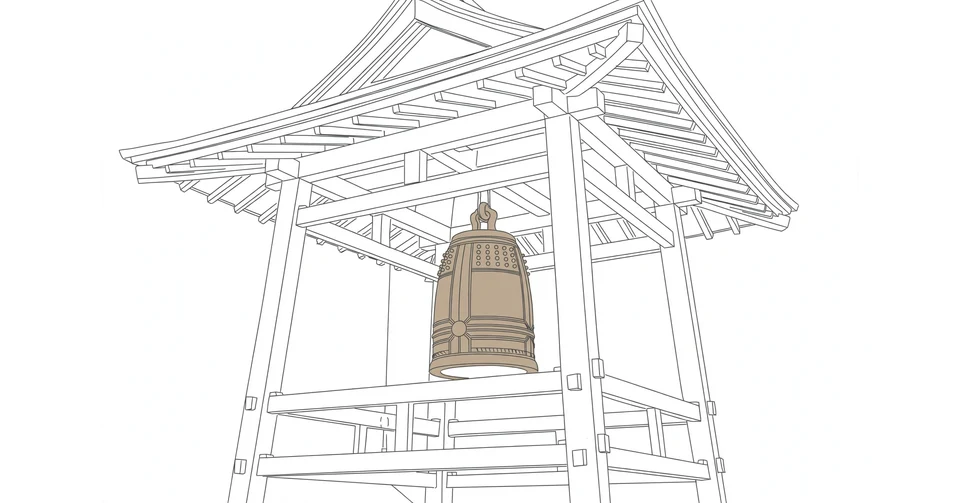
I first understood what a bonsho was for on a cold morning near a temple in Kyoto, when the bell sounded once and the street seemed to pause with it. Nobody hurried. Nobody looked up in surprise. People simply went on with their morning, a little more slowly, as if the note had reminded them that the day had a shape. That is the quiet job of a bonsho. It does not demand attention. It gives the day a beginning.
What a bonsho is
A bonsho, written with the characters for Buddhist bell, is the large bell found in Buddhist temples across Japan. It is also called a tsurigane, which means hanging bell, or an ogane, which means great bell. The names all point to the same thing, a bell too large to carry, hung in place, and rung from outside.
The bell hangs in a small building of its own, called a shoro, or bell tower, open on the sides so the sound can escape. The bonsho is given a home apart from the main hall, because its sound belongs to the whole temple grounds and to the streets beyond them, not to one room.
The earliest of these bells in Japan date to around 600 CE, and the design came from China, where large bells had been cast for centuries before. According to the Nihon Shoki, one of the oldest chronicles of Japan, a general named Otomo no Satehiko brought three bronze bells back from the Korean Peninsula in 562. The bonsho arrived in Japan along the same routes as Buddhism itself, and it grew into something distinctly Japanese in the centuries that followed. A full account of the bell, its history, and its parts can be found in the detailed article on the bonsho at Wikipedia.
How a bonsho is made
Making a bonsho is a slow and risky craft, and the method has barely changed since the Nara period, which ran from 710 to 794. Each bell is cast in a single piece, using two moulds, a core and a shell. The core is built from a dome of stacked bricks made from hardened sand. The shell is shaped with a strickle board, a large flat wooden board cut to the cross section of the bell and rotated around a vertical axis to shape the clay. Inscriptions and decorations are carved or pressed into the clay before the two moulds are fitted together.
Molten bronze is poured into the narrow gap between the core and the shell at a temperature of more than 1,050 degrees Celsius. The alloy is usually around 17 parts copper to 3 parts tin, though the exact mixture, and the speed at which the metal cools, can change the tone of the finished bell. When the metal has cooled and hardened, the mould is broken away, which means a new mould must be built for every single bell. There is no reuse, and no shortcut.
The process has a high failure rate. Only around half of all castings succeed on the first attempt without cracks or flaws, and a difference of a single hertz in the fundamental pitch can be enough to send a bell back to be recast from scratch. The casting itself is traditionally accompanied by the chanting of Buddhist sutras, and prayer papers and sprigs of sacred mulberry are added to the molten bronze while the work is done. The bell is treated as a sacred object from the moment it is poured.
A finished bonsho has parts with names of their own. At the top is the ryuzu, a dragon shaped handle by which the bell is carried or hung. Around the upper body are the chi, small raised bosses that help the bell resonate. The tsuki-za is the striking panel, a reinforced spot on the side of the bell, often decorated with a lotus or chrysanthemum motif, and it is the one place the beam is meant to land. The shu-moku is the hanging wooden beam itself, suspended on ropes, that strikes the tsuki-za. Some bells still show faint lines where the joints of the mould met, and the makers leave them there, as part of the bell's beauty.
The sound of a bonsho and how far it travels
The sound of a bonsho has three parts, and knowing them helps to explain why a single strike feels so long. First comes the atari, the impact of the strike itself, which a well made bell delivers as a clean and clear tone. Then comes the oshi, the reverberation that follows the strike. It is higher in pitch, a low rumble rich in harmonics, and it can last for up to ten seconds. Finally comes the okuri, the decay, the resonance that is heard as the vibration of the bell dies away, which can last up to a minute. All through the tolling, continuous harmonic overtones sound as well, which is why the note of a bonsho feels more complex than a single pitch.
The low tone and deep resonance allow the sound to travel a long way. A large bonsho can be heard up to 32 kilometres away on a clear day. That range is the reason the bell became so much more than a temple instrument. Across Japanese history, the sound of a bonsho has been used as a signal, a timekeeper, and an alarm. It warned of coming typhoons, and during the Genpei War, which ran from 1180 to 1185, temple bells were used for military communication.
There is also a quiet belief attached to the sound. The bell's note is thought to be calming, and to create a fitting atmosphere for meditation, and tradition holds that it can be heard even in the underworld. That is why the bell is treated with such respect. Its shape, with sloped shoulders and a flat base, is seen as a representation of the sitting Buddha, and those who strike the bell first make three bows toward it, just as they would before a statue of the Buddha.
I think this respect is the part most worth keeping. We live surrounded by sounds that want something from us, alarms, notifications, and ringtones that all mean hurry. The bonsho asks for the opposite. It asks the listener to stop, for one minute, and to hear a note finish. A culture that keeps a bell like that is a culture that has decided some sounds are worth protecting.
What the bonsho does in a temple day
In the daily life of a temple, the bonsho is a clock that everyone can hear. It marks the passage of time, and it calls the monks to their services. Its most familiar job is the morning strike, the note that opens the day before the chanting begins. Many temples ring the bonsho early in the morning, and by the time the monks gather in the hall, the bell has already told the neighborhood that the day has started. That is the same sound described in the account of a gongyo starts the temple day before sunrise, where the bell rings before the voices rise in chant.
The bell also marks the evening, and in some temples it is rung at set hours through the day, so that the rhythm of the temple becomes the rhythm of the town around it. Before mechanical clocks were common, this was how a whole community knew the time. A farmer in the fields, a shopkeeper in the street, and a monk in the hall all heard the same note at the same moment. The bonsho was, in effect, the public clock of premodern Japan.
Joya no Kane and the 108 strokes of New Year
The most famous night in the life of a bonsho is New Year's Eve. Across Japan, people queue at temples to ring the bell 108 times in a ceremony called Joya no Kane, the New Year bells. The 108 peals are meant to purge humanity of the 108 earthly temptations, and the ringing carries on past midnight, from the old year into the new one. Each person who steps forward takes a turn at letting the old year go.
The night is one of the most atmospheric moments in the Japanese calendar. Temples stay open late, the grounds fill with people, and the bell sounds again and again through the dark. A guide to visiting Japan at New Year describes the scene well: the most atmospheric visit is to a temple around midnight on New Year's Eve, when the temple's bell is rung repeatedly, and crowds gather for hatsumode, the first visit of the year, in the days that follow. You can read that account in this guide to visiting Japan during New Year.
There is something honest about a ritual that ends the year with a sound instead of a speech. A speech would argue about what the year meant. A bell simply marks that it is over, and that a new one has begun. I like that the Japanese New Year starts this way, not with fireworks or a countdown, but with 108 slow notes in the dark, each one a small act of letting go.
Three famous bonsho to know
Japan has thousands of temple bells, but a few are famous enough to be known by name, and each one tells a different part of the story.
| Bell | Temple and place | What is known about it |
|---|---|---|
| The bell of Chion-in | Chion-in, Kyoto | The largest bonsho in Japan, cast in 1636, weighing 70 metric tons, and rung by a team of 17 people |
| The bell of Todaiji | Todaiji, Nara | Cast in 752, 3.85 metres high, 2.71 metres across the mouth, weighing 26.3 tons, a National Treasure and one of the three famous bells of Japan |
| The bell of Kenchoji | Kenchoji, Kamakura | Cast in 1255, 2.1 metres tall, weighing 2.7 tons, a National Treasure bearing an inscription by the founding abbot Lanxi Daolong |
The largest bonsho in Japan hangs at Chion-in in Kyoto. It was cast in 1636 and weighs 70 metric tons, and it takes a team of 17 people to sound it. On New Year's Eve, the monks of Chion-in ring it 108 times, and the ceremony is broadcast across the country.
The bell of Todaiji in Nara is older and, in some ways, more remarkable. It was cast in 752, the year the Great Buddha's eyes were opened, and it stands 3.85 metres high and 2.71 metres across the mouth, weighing 26.3 tons. It is a National Treasure and is counted as one of the three famous bells of Japan, and it is rung every evening at 8 o'clock.
The bell of Kenchoji in Kamakura is smaller but older than the Chion-in bell by nearly four centuries. It was cast in 1255, stands 2.1 metres tall, and weighs 2.7 tons. It is also a National Treasure, and it carries an inscription by Kenchoji's founding abbot, Lanxi Daolong, a Zen monk who had come from China. The bell survived the fires of the fourteenth and fifteenth centuries that destroyed most of the temple, and it was one of the few temple bells that was not requisitioned and melted down by the government during the Second World War.
Why the bonsho still matters
The bonsho matters because it does something that almost nothing else in modern life does. It marks time without selling anything, without asking for attention, and without hurrying. A temple bell is rung, the note fades, and the day goes on. There is no advertisement attached to it, no message to decode, and no reason to look at a screen. It is one of the few public sounds left that exists only to be heard.
That is also why it is worth protecting. Bells are expensive to cast, and the craft of casting them is held by a small number of foundries. The knowledge of how to shape the mould, how to mix the bronze, and how to judge the tone by ear is passed from one generation to the next, and it is the kind of knowledge that can be lost in a single generation if nobody is there to receive it.
The bonsho also carries a lesson that fits easily into a life far from any temple. A day that begins with a single deliberate act begins better than a day that begins by accident. The monks ring the bell because the day needs a beginning, and a bell is a good way to give it one. One quiet act, done on purpose, before the noise starts, is enough to set the tone for everything that follows.
On Koyasan, the mountain where the monk Kukai founded his monastery in 816, the morning service is still the heart of a temple stay, and the founder is said to be still meditating in the forest cemetery a short walk from the hall. The bell that opens those mornings is not famous, and it does not need to be. It does the same work as the great bells of Kyoto and Nara, on a smaller scale, for the same reason. It tells the mountain that the day has begun.
If you ever stand near a temple tower at dawn and hear the note roll out, do not hurry past it. Stand still for the minute it takes to fade. That is what the bell is for. It is not asking you to believe anything. It is only asking you to listen, once, before the day begins, and to let a single low note remind you that time is passing, and that it is passing well.
More in Culture & Society
Latest posts
- Sambal Matah Wakes Up Every Balinese Plate Raw
- The Javanese of Suriname and the Language They Kept Alive
- Nembutsu Is the Name Japan Calls Out to Amida
- Sate Lilit Wraps Bali's Feast Around a Lemongrass Stick
- Babi Guling Turns a Whole Pig Into a Balinese Feast
- Konpon Daito Towers Over Koyasan in Vermilion and Gold
- Lawar Is the Dish Bali Serves When the Whole Village Eats
- Goma Dofu Is the Forty Minute Tofu Ground by Hand
- Garuda Wisnu Kencana Rises Above Bali's Southern Cliffs
- Wuku Gives Every Week in Bali a Name
- A Penjor Turns a Whole Street Into an Offering
- A Mokugyo Keeps the Beat of the Chant
- Soba, the Buckwheat Noodles Japan Slurps on the Last Night of the Year
- Udon in Kagawa, Where Noodles Are a Way of Life
- Garuda Pancasila Carries Five Principles on One Bird