A Lamak Turns a Coconut Leaf into a Hanging Prayer
· 14 min read
A lamak is the long woven palm leaf hanging Bali pins to the front of its shrines, a decorated base for offerings that works as a ladder between the seen and unseen worlds.
Stand in front of a Balinese shrine during a festival and you will notice something easy to miss. Beneath the baskets of flowers and rice, beneath the small daily offerings stacked in careful piles, a long sheet of woven palm leaf hangs down the front of the shrine like a tapestry. That sheet is a lamak, and it is doing more work than anything piled on top of it.
A lamak is a rectangular mat woven from palm leaves, made to hang vertically as the decorated face of an altar or shrine. Its top end is left plain and tucked under the offerings themselves, so the patterned face falls in full view down the front. It is a base for the gifts, a sign that new offerings have been laid, and, in the Balinese understanding, a pathway that invites deities and ancestors to come and find them.
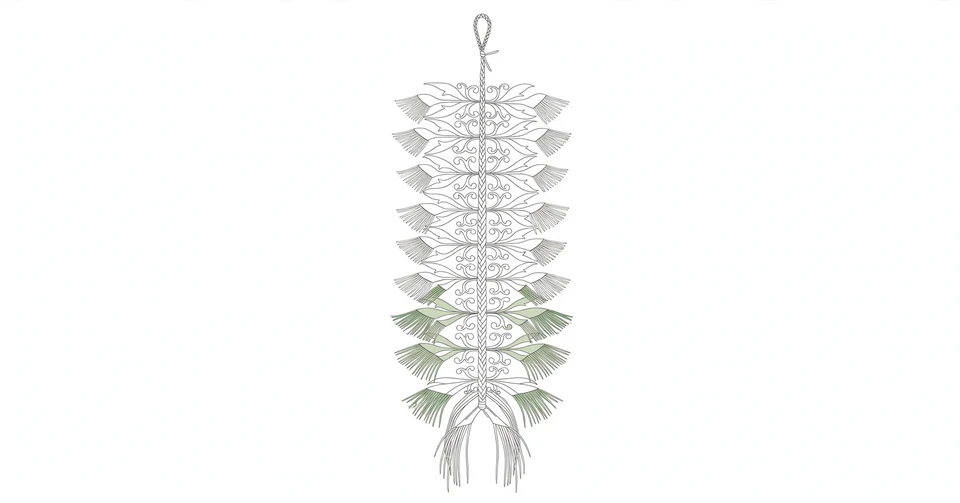
It is also one of the most quietly beautiful objects in Bali, and one of the most overlooked. The penjor gets the photographs. The offerings get the attention. It hangs underneath it all, doing the humble job of holding the prayer together, and it deserves a closer look.
What a lamak actually is
The simplest definition comes from the scholars who have studied the object most closely. A lamak is a ritual object in Balinese Hinduism, a rectangular mat woven from palm leaves that serves as a decoration for altars and shrines. That plain description hides a great deal of art. The mats are narrow and elongated, and they are made predominantly from young and old palm leaves, with one face decorated in intricate motifs built from coloured leaves that are cut, shaped, and pinned into place.
The leaves themselves are not all the same. It may be woven from the leaves of the coconut palm, the sugar palm, or the palmyra palm, and the choice of leaf is part of the design. Often the yellow leaves of the coconut or sugar palm are combined with the light, older leaves of the palmyra palm, so that the motifs stand out in contrast against a paler ground. The result is a sheet that reads at a distance as a single hanging, and up close as a piece of embroidery done entirely in leaf.
Size is part of the wonder. The hanging varies heavily in length, because it is made to fit the shrine it dresses. The smallest ones may be no longer than 30 centimetres, pinned to the makeshift shrine at the foot of a penjor during Galungan. The largest may sprawl over 10 metres down from the very top of a padmasana shrine in a temple, a single sheet of leaf work falling the height of a three storey building. Between those two extremes lies every size a household altar or a village temple could need, each one cut and woven to its place.
The word itself gives away the function. It is not a picture hung for its own sake. It is a foundation, a base on which offerings rest. The plain top is tucked under the offering baskets or the piles of canang sari, and the decorated face hangs down the front of the shrine for everyone to see. Where there is no basket to tuck it under, it is pinned directly to the front of the altar, still hanging, still showing its motif.
How a lamak is made
It begins the way so much of Balinese ceremonial art begins, with janur, the young coconut leaf Bali folds into everything. The leaves are cut while they are still young and pale, then shaped by hand into the flat sheet that forms the body of the hanging. The motifs of the lamak are built up on that sheet from pieces of coloured leaf, cut into shape and pinned in place with tiny pins made from the leaf ribs themselves, so that nothing foreign holds the work together.
The making is slow, skilled, and mostly done by hand. For days before a festival, the women and girls of a household sit together cutting janur and folding ornaments, and this hanging is among the finest pieces they produce. The work is social as much as it is technical, done in company, with the patterns learned by watching and corrected by the older women in the room. Nobody in Bali attends a course in making one. You learn it the way you learn everything else in the ceremonial calendar, by being handed a leaf and told to try.
The most elaborate examples are the work of specialist craftsmen and women, and they can take days. Francine Brinkgreve, a curator at the National Museum of World Cultures in the Netherlands who spent years studying the object, published the first full study of it in 2016, a book called Lamak: Ritual Objects in Bali. Her account describes how the motifs, the materials, and the techniques vary by region and by use, and how the finest examples are made by makers whose whole reputation rests on this one craft. That a whole book could be written about a hanging made of leaves tells you how much meaning is folded into it.
The lamak on a penjor
Most visitors meet a lamak for the first time without knowing it, on the side of the road at Galungan. The penjor, the tall curved bamboo pole Bali raises in front of every home for the festival, carries a small shrine at its base, the sanggah penjor, where the family's daily offerings for the pole are placed. Pinned to that little shrine is a lamak, usually a short one, about 30 centimetres long, its decorated face turned toward the street.
It is a small detail on a very large object, which is probably why it goes unnoticed. The pole itself can be ten metres tall, hung with fruit, rice, sugar cane, and cloth, and the eye goes to the curve of the bamboo against the sky. But it is there at the foot of it, doing the same job it does on a temple altar, marking the place where offerings have been laid and inviting the honoured guests to find them. A penjor turns a whole street into an offering, and it is the small hanging that tells you exactly where the offering begins.
There is a special case worth knowing about. During Galungan, a house where a wedding took place in the previous year sets up an elaborately decorated lamak nganten, a wedding hanging, in front of the house. It is sometimes a metre long, far grander than the small shrine hanging, and it announces to the whole street that this household has a new marriage to celebrate. The hanging, in other words, is not only a religious object. It is also a public notice, written in leaf, that something joyful has happened behind that gate.
The penjor stays standing for 35 days after Galungan, through Kuningan and on to the closing day of the festive season, and it hangs on its shrine for the whole of that time, drying slowly in the sun with everything else on the pole. When the pole finally comes down, the leaves and fruit are burned and the ashes buried in the family courtyard. It goes with them. It was never meant to survive the festival it served.
What the pictures on a lamak mean
Look closely at the decorated face of a lamak and you will find it is not random pattern. The imagery commonly includes a mountain, vegetation and trees, and a female figure known as cili, who symbolises fertility and prosperity. The tree that appears most often is the kalpataru, the tree of life. These are not decorations chosen for prettiness alone. They are pictures of the sources of life, arranged in order.
That order matters. According to Brinkgreve's study, the decorative motifs on one are arranged according to Balinese concepts of the vertical structure of the cosmos, with the sources of life set out from top to bottom in their proper places. The mountain sits where a mountain should sit. The tree grows where a tree should grow. The cili, the best known of all the motifs, stands for human fertility and regeneration, and she is placed where she belongs in that order. To read one is to read a small map of the universe, drawn in leaf.
The mountain motif is the one that connects the hanging most directly to the rest of Balinese belief. The sacred mountain, Agung, is the home of the gods and the ancestors, and the penjor itself is often read as a small Agung planted at the gate. The hanging on that pole carries the mountain in miniature on its face, a reminder that the offering at the foot of the pole is addressed to the residents of the mountain above. It is a picture inside a picture, a mountain on a mountain, and nobody in Bali seems to find that strange.
There is a second great reading of the penjor that belongs to the pole rather than the hanging, but it is worth knowing because the lamak hangs on the same bamboo. Some say the pole is a dragon, one of the great cosmic nagas, with its head at the base above the little shrine and its tail in the slender tip that curves down at the top. The hanging does not picture the dragon. It hangs beneath it, on the shrine where the dragon's head rests, dressing the place where the offerings are laid. The two readings sit together without arguing, the way so much in Bali does. A pole can be a mountain and a dragon in the same breath, and a lamak can hang on both.
A ladder between two worlds
The most interesting thing about it is not what it looks like. It is what it is believed to do. Though these hangings are considered offerings themselves, they function as an invitation, a sign, and even a pathway, a lantaran, to visiting deities, spirits, and ancestors, directing them toward the offerings that have been laid out. They indicate, through decoration, which shrines and altars have new gifts. They also serve as a separation between the offerings and the profane materials they might otherwise rest on, like a holy table mat set between the sacred and the ordinary.
Some consider the sacred decoration to be a ladder or a bridge, not only for the essence of the offerings to be given to the unseen world, the niskala, but also so that blessings may be directed back down into the seen world, the sekala. That is a precise and beautiful idea, and it changes how the object looks once you know it. It is not hanging there to be admired. It is hanging there to be climbed, in both directions, by gifts going up and blessings coming down.
The same idea explains a use that surprises first time visitors. In some dances and ceremonies, one may be placed on the chest of a dancer, or on the chest of someone taking part in a manusa yadnya ceremony, the rituals that mark the stages of a human life. Worn on the body, it acts as the same guide and bridge it acts as on a shrine, a pathway between the two worlds for the person wearing it. The hanging leaves the altar and becomes clothing, and the prayer goes with it.
I keep coming back to that image of the ladder, because it explains why the lamak is long and narrow and why it hangs down. A ladder has to reach from one place to another. A bridge has to span a gap. The lamak is built in the shape of its job, a long strip of leaf that joins the place where people stand to the place where the gods are invited to come.
Sacred lamak, decorative lamak
Not every one is a sacred object, and the Balinese distinction is worth understanding. The same split that divides the penjor into the sacred penjor suci and the ornamental penjor hias runs through the whole world of leaf work. A sacred one is made for a religious occasion, under inherited rules, and hung on a shrine where offerings are actually laid. A decorative lamak answers to no priest. It goes up for weddings, for temple anniversaries, for shop openings and celebrations, and its maker is free to invent.
The distinction is spelled out in detail in this guide to penjor and janur kuning, which notes that the two kinds of penjor consist of different equipment, because the sacred one is more complete, and that some of the sacred fittings are not allowed to appear on a merely decorative pole. The same instinct governs the hanging. What is sacred is made to rule. What is decorative is made to delight. Both are made of leaf, and both are made by hand, but they are not the same object.
There is also a practical form of the distinction. Permanent forms exist, made of cloth or of coins, and they can hang on a shrine for years without rotting. But the ephemeral palm leaf form must still be present, even where a permanent one exists. The leaf one is the one that counts, because it is the one that is made fresh, offered, and allowed to die. A cloth one can be beautiful, and a coin one can be impressive, but neither of them is the prayer. The prayer is the one that rots.
Why a lamak is allowed to die
The short life of a lamak is not a flaw in the design. It is the design. It is made usually of palm leaves, and it is by nature ephemeral, made time and again. The leaf dries, the colours fade, the pins loosen, and within weeks the beautiful hanging is a dry husk. That is expected. The maker knew it when she cut the first leaf, and she made it anyway.
There is a lesson in that which goes beyond Bali, and it is the reason I keep thinking about this object long after I finished reading about it. So much of what we make now is built to last, and built to be kept, and we measure the value of a thing by how long it survives. It measures value the other way round. It is valuable because it is made with care and then given away, to the gods, to the ancestors, and finally to the fire. The care is the point. The survival is not.
The same is true of the whole festival the lamak serves. Galungan returns every 210 days in the pawukon calendar, and every time it returns, the poles go up again and the leaf work is made again, by the same hands, in the same sitting circles, with the same patterns learned from grandmothers. The tradition survives not because any single lamak survives, but because the making survives. Each new one is proof that someone still knows how, and still thinks it is worth doing.
Stand in front of a shrine in Bali and look past the baskets for a moment, down the long decorated face of the hanging beneath them. That is the lamak, a coconut leaf folded into a prayer, hung where the seen world meets the unseen one, and left there to dry in the sun until its work is done. It asks for nothing except to be noticed, and then, having been noticed, to be allowed to go.
More in Culture & Society
Latest posts
- Sambal Matah Wakes Up Every Balinese Plate Raw
- The Javanese of Suriname and the Language They Kept Alive
- Nembutsu Is the Name Japan Calls Out to Amida
- Sate Lilit Wraps Bali's Feast Around a Lemongrass Stick
- Babi Guling Turns a Whole Pig Into a Balinese Feast
- Konpon Daito Towers Over Koyasan in Vermilion and Gold
- Lawar Is the Dish Bali Serves When the Whole Village Eats
- Goma Dofu Is the Forty Minute Tofu Ground by Hand
- Garuda Wisnu Kencana Rises Above Bali's Southern Cliffs
- Wuku Gives Every Week in Bali a Name
- A Penjor Turns a Whole Street Into an Offering
- A Mokugyo Keeps the Beat of the Chant
- Soba, the Buckwheat Noodles Japan Slurps on the Last Night of the Year
- Udon in Kagawa, Where Noodles Are a Way of Life
- Garuda Pancasila Carries Five Principles on One Bird