Tanabata Festival and the Star-Crossed Lovers Behind the Bamboo Wishes
· 11 min read
The Tanabata festival is Japan's star festival, held on 7 July, when two lovers separated by the Milky Way meet for one night and people tie handwritten wishes to bamboo.
Once a year, on the night of 7 July, Japan looks up. The Tanabata festival marks the one night when Orihime, the weaver star, and Hikoboshi, the cowherd star, are allowed to meet across the Milky Way. All year they are kept apart by a river of stars, and all year people wait for this single evening.
The festival itself is quiet compared with Japan's louder summer events. There are no portable shrines crashing through the streets and no drums shaking the ground. Instead there is bamboo, paper, and handwriting. People write a wish on a narrow strip of coloured paper called a tanzaku and tie it to a bamboo branch, then watch it flutter in the warm evening air.
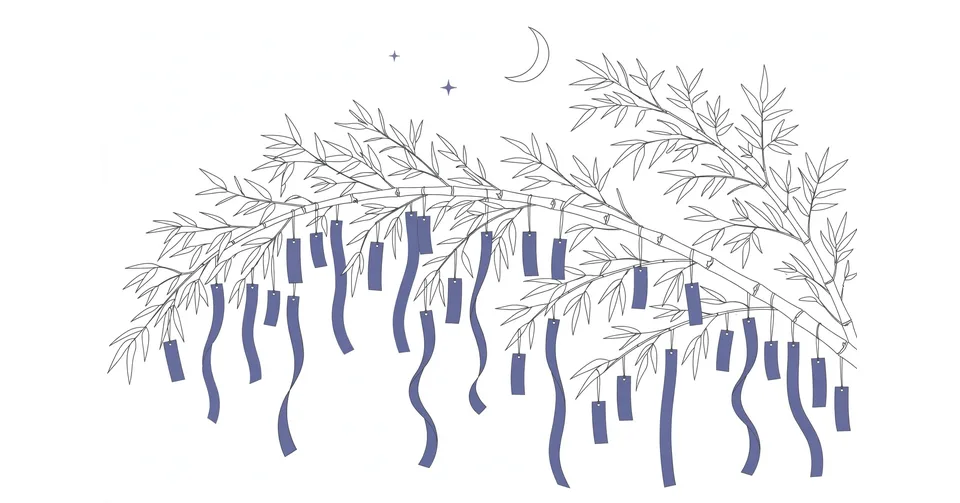
That simplicity is the point, and it is why the Tanabata festival has survived for more than a thousand years. A wish written by hand feels more honest than one typed into a phone, and a bamboo branch in a schoolyard or a shopping street costs nothing at all. The festival asks for very little and gives back a small, stubborn kind of hope.
The lovers behind the festival
The story at the heart of the Tanabata festival comes from China, and it is older than the festival itself. Orihime was the daughter of Tentei, the emperor of heaven, and she wove cloth for the gods at her loom beside the river of heaven. She worked so hard that she had no time for anything else, so her father introduced her to Hikoboshi, a cowherd who grazed his cattle on the far bank of the same river.
The two fell in love at once, and then they fell into the oldest trap in the story. They loved each other so much that they stopped working. Orihime left her loom untouched and Hikoboshi let his cattle wander. Angry, Tentei separated them to opposite banks of the river and forbade them to meet. When they wept and could not work at all, he relented a little. If they worked hard all year, he said, they could meet for one night, on the seventh night of the seventh month.
That river is the Milky Way, called Amanogawa in Japanese, the river of heaven. The two lovers are real stars. Orihime is Vega, the brightest star in the constellation Lyra. Hikoboshi is Altair, the brightest star in Aquila. On a clear night in July you can find both of them high in the summer sky, with the pale band of the Milky Way running between them. Legend adds one more detail. On the night they meet, magpies are said to spread their wings and form a bridge across the river so Orihime can cross. And if it rains on the night of the Tanabata festival, people say the rain is the lovers' tears, because the magpies could not come and the meeting had to wait another year.
How a Chinese festival became Japanese
The Tanabata festival reached Japan from China during the Nara period, in the eighth century, together with a court ritual called Kikkoden, in which women prayed for skill in weaving and sewing. Over the centuries it merged with older Japanese customs around weaving and the summer season, and by the Heian period it had become one of the five seasonal festivals, the gosekku, that marked the turning of the year. The other four were New Year, the Doll Festival, Children's Day, and Chrysanthemum Day. Of the five, Tanabata is the one that has kept its old magic most visibly, perhaps because its story is so easy to love.
For most of its history the date followed the old lunar calendar, which put the seventh day of the seventh month somewhere around August. When Japan adopted the Gregorian calendar in the Meiji period, most of the country moved the Tanabata festival to 7 July. Some places kept the older seasonal timing, holding it around early August instead. That is why the most famous Tanabata festival of all, in Sendai, takes place in August rather than July, and why the date still varies a little from town to town.
One thing the Tanabata festival is not, and this surprises many visitors, is a national holiday. Shops stay open, offices stay open, and trains run as usual. The festival happens in the margins of an ordinary working day, in schoolyards after class and in shopping streets after dinner. That ordinariness is part of its charm. It does not stop the country. It simply gives the country something to look up at.
What people actually do on the night
The centre of the Tanabata festival is the wish. You take a tanzaku, a narrow strip of paper, write your wish on it, and tie it to a bamboo branch. The branches stand in schools, in shrines, in shopping arcades, and in front of houses, and by the evening of 7 July they are heavy with paper. The wishes are usually small and concrete. Pass the exam. Let grandmother get better. Find a good job. Win the tournament. The festival has never asked for grand wishes, and I think that is a large part of why it still works. A small wish, written by hand, is a promise you make to yourself as much as to the stars.
The paper comes in five colours, blue or green, red, yellow, white, and black or purple, and tradition links the colours to the five elements of wood, fire, earth, metal, and water. Most people simply pick the colour they like, and that is fine. What matters is the act of writing, not the colour of the paper.
Bamboo is not the only decoration. Alongside the wish strips you will see folded paper cranes, paper kimonos, small paper purses, woven nets, and long flowing streamers that catch the evening breeze. Sendai is famous for seven traditional decorations, each carrying its own wish. The wish strips ask for better study and handwriting. The paper kimono asks for skill with needle and thread. The crane asks for a long life, the purse for honest savings, the net for a good catch and a good harvest, and the streamers, the most beautiful of the seven, ask for skill in weaving and the arts. Walk under them in a Sendai shopping arcade in August and you understand why people travel across the country to see them.
Children make most of the decorations in the weeks before the festival, which is why the Tanabata festival feels like a school festival as much as a folk tradition. Kindergartens and primary schools all over Japan put up bamboo in late June, and the branches fill up a little more every day. By the night of the Tanabata festival the whole country seems to be carrying a small, private hope on a strip of paper.
The three festivals worth travelling for
Most of Japan celebrates the Tanabata festival quietly, at home or at school. Three cities turn the Tanabata festival into a full public festival, and each has a different character.
| Festival | Where | When |
|---|---|---|
| Sendai Tanabata Matsuri | Sendai, Miyagi | 6 to 8 August every year |
| Shonan Hiratsuka Tanabata Festival | Hiratsuka, Kanagawa | Early July every year |
| Asagaya Tanabata Matsuri | Suginami, Tokyo | Early August every year |
Sendai is the largest Tanabata festival in Japan, and it is not close. The shopping arcades of central Sendai fill with thousands of giant handmade streamers, some several metres long, each one made by a local shop, school, or neighbourhood group. The tradition goes back to the time of Date Masamune, the lord who founded the city in the early seventeenth century, and the merchants of the city centre revived it as a public festival in 1928. Fireworks open the festival on the evening of 5 August. If you go, arrive before dark, because the streamers look best in daylight, and the arcades get crowded fast after sunset.
Hiratsuka, on the coast of Kanagawa, is the showman of the three. Its festival is known for large decorated displays and a parade atmosphere, and it draws crowds from across the Tokyo area. Asagaya, in western Tokyo, is the most local of the three. Its shopping street fills with handmade decorations, street food, and a neighbourhood crowd, and it is the easiest of the three to reach if you are staying in Tokyo. All three are free to walk through, and all three are best visited in the early evening, when the paper catches the light and the day's heat finally breaks.
When to go and what to expect
If you want the night itself, mark 7 July. In 2027 that falls on a Wednesday. If you want the biggest festival, go to Sendai from 6 to 8 August 2027, which falls on a Friday to Sunday. Either way, check the sky after sunset. Vega and Altair are bright enough to find even from a city, and the moment you spot them with the Milky Way between them, the old story stops being a story and starts being something you can see.
Rain is the Tanabata festival's running joke. A shower on 7 July is called the lovers' tears, and it does not cancel anything. The bamboo stays up, the wishes stay tied, and people simply read the rain as part of the story. If the night is clear, so much the better. Bring nothing special. The festival provides the bamboo and the paper at most public displays, and a pen is usually all you need.
For a quieter version of the Tanabata festival, skip the big cities altogether. Small shrines and neighbourhood shopping streets put up a single bamboo branch and a basket of paper strips, and that is often the best place to write a wish. There is no queue, no crowd, and no one watching. The festival was never really about spectacle. It was about one person, one strip of paper, and one honest sentence.
What I would write on a tanzaku
If I had a strip of paper in my hand tonight, I would not write anything grand. I would write something small enough to be true. That is the lesson the Tanabata festival has kept alive for more than a thousand years, and it is a better lesson than most festivals teach. Big wishes are easy to make and easy to forget. A small wish, tied to bamboo in front of other people, is a promise with witnesses.
I also like that the festival does not promise results. The stars do not guarantee anything. Orihime and Hikoboshi meet for one night and then go back to work for another year, and the festival is honest about that. It does not say your wish will come true. It says that wanting something, writing it down, and working for it is a decent way to spend a year. For a festival built on a love story, that is a surprisingly practical message.
The Tanabata festival also reminds me why Japan's seasonal festivals survive while louder events fade. Cherry blossom season works the same way, a short season, a simple act of looking, and a whole country doing it together for a few days. Autumn leaves do the same in November, and even Christmas in Japan keeps its charm because it stays small and personal instead of turning into a shopping event. Tanabata belongs in that family. It is a festival that trusts people to bring their own meaning.
One night, two stars, and a paper wish
The Tanabata festival endures because it asks so little and means so much. Two stars, a river of light, a bamboo branch, and a strip of paper. The lovers meet for one night, the wishes flutter in the summer air, and in the morning the bamboo comes down and the year begins again. If you are in Japan on 7 July, find a branch, borrow a pen, and write one true sentence. The stars have kept their appointment for more than a thousand years. The least we can do is keep ours.
For the full story and the festival dates, see the Tanabata article on Wikipedia and the Tanabata star festival guide on Japan Nakama.
More in Culture & Society
- Komusubi Is the Smallest Chair at Sumo's Top Table
- A Sekiwake Waits One Win From Sumo's Highest Door
- A Maegashira Climbs the Numbered Ladder One Bout at a Time
- An Ozeki Stands One Step From the Top and Cannot Afford to Slip
- An Oyakata Is the Father a Sumo Stable Cannot Replace
- A Tokoyama Spends Ten Years Learning to Dress a Topknot
Latest posts
- Japanese Calligraphy and the Brush That Turns Writing Into Art
- A Tegata Is Sumo's Inked Handprint Autograph
- A Rikishi Is a Man of the Sumo World Before He Wins a Single Bout
- Mawashi Carries a Wrestler's Rank Around His Waist
- Namasu Turns Daikon and Carrot Into a Red and White Wish
- Yokai, the Strange Spirits That Haunt Japanese Folklore
- Ebi Bends Like an Old Back and Wishes You a Long Life
- Yokozuna Is the Rank Sumo Never Takes Back
- Kobumaki Rolls Joy Into a Strip of Kelp
- Kurikinton Is the Golden Mash That Wishes You Wealth
- Japanese Beer and the Dry Wars That Changed How Japan Drinks
- Kamaboko Paints the New Year Red and White
- Datemaki Rolls Sweet Eggs Into a Spiral of Good Luck
- Japanese Bento and the Lunch Box That Became an Art Form
- Tazukuri Turns Tiny Sardines Into a Wish for a Good Harvest