Hello Kitty and the Cat Who Conquered the World
· 10 min read
Hello Kitty began as a small drawing on a vinyl coin purse in 1975. Fifty years later, the mouthless cat from Sanrio is one of the most recognisable faces on the planet.
Hello Kitty has no mouth, no visible age, and no fixed address in the country that created her. She is, officially, a British schoolgirl who lives in the suburbs of London, stands five apples tall, and weighs three apples. She has still managed to become one of the most recognisable faces on Earth, printed on everything from lunch boxes to airplanes. The strange part is not that a cartoon cat became famous. The strange part is that she did it by saying nothing at all.
That silence is the whole trick, and it was there from the beginning. Hello Kitty was designed in 1974 by Yuko Shimizu, a young artist at the Japanese company Sanrio, and she first appeared on a small vinyl coin purse in March 1975. The purse sold for less than a dollar. It became the best selling item of the year. Nobody at Sanrio had planned a global empire. They had planned a cute product for a gift shop, and the gift shop customers had other ideas.
Hello Kitty started on a coin purse
Sanrio itself started far from the world of cute characters. Its founder, Shintaro Tsuji, set up a silk company called Yamanashi Silk in 1960, and soon moved into rubber sandals decorated with small flower patterns. He noticed something simple: the same sandal sold better when it had a pretty picture on it. The company, renamed Sanrio in 1973, built its business on that observation, designing small gifts for birthdays and thank you notes. Characters were the decoration, and the decoration was the product.
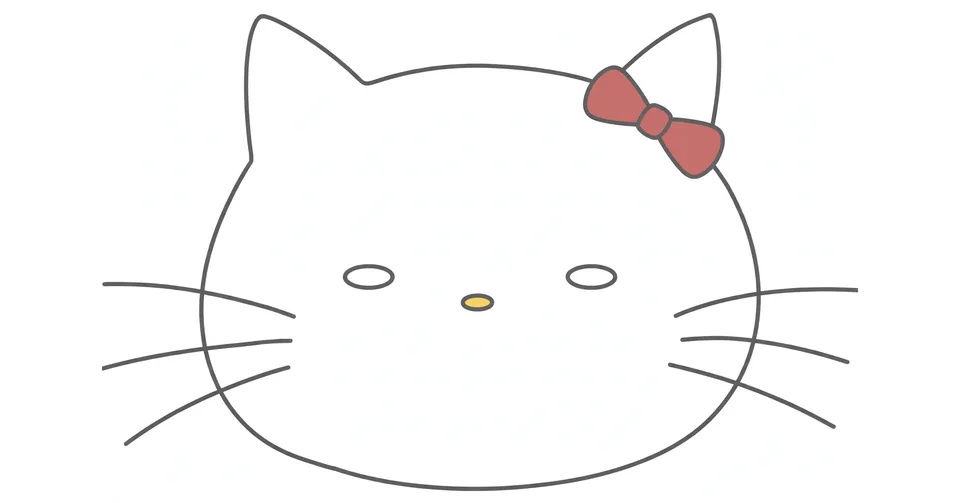
Hello Kitty joined the Sanrio lineup on 1 November 1974. Shimizu drew a white kitten sitting between a bottle of milk and a goldfish bowl, wearing blue overalls and a red bow on her left ear. She had two oval eyes, a small yellow nose, six whiskers, and no mouth. The name came from Lewis Carroll, whose Alice plays with a pet cat called Kitty in Through the Looking-Glass. Sanrio gave her a full name, Kitty White, a twin sister called Mimmy, who wears her bow on the opposite ear, and a home in suburban London, because Britain was fashionable in Japan at the time and Sanrio already had plenty of characters set in America.
The coin purse arrived in shops in March 1975, and it sold out. Sanrio sales multiplied seven times in the years that followed. Shimizu herself left the company in 1976, only two years after creating the character, and never became wealthy from her work, because Sanrio owned the rights. Setsuko Yonekubo took over the design briefly, and in 1980 Yuko Yamaguchi became the lead designer, a role she held for more than four decades. The face barely changed in all that time, which is exactly the point. A face that never ages never goes out of fashion.
The girl who is not a cat
In 2014, ahead of Hello Kitty's 40th anniversary, Sanrio corrected the world in a way that made headlines everywhere. Hello Kitty is not a cat. She is a girl, a cartoon character, a personification of a cat, what the Japanese call a gijinka. The company also confirmed the details of her official profile: she is a third grade student, her birthday is 1 November, she lives with her parents George and Mary, her favourite food is her mother's apple pie, and she is five apples tall and three apples heavy.
People laughed at the correction, but it revealed something real about how Hello Kitty works. She is deliberately unfinished. She has no mouth, so she cannot smile or frown, and anyone looking at her can project their own feelings onto her face. Sanrio has said she is not bound to any particular language, and the design proves it. A child in Jakarta, a teenager in Los Angeles, and an office worker in Osaka can all see something different in the same two dots for eyes. That is not an accident. It is the design.
There is a useful comparison close to home. Studio Ghibli built its reputation on richly detailed worlds and long, emotional stories. Hello Kitty went the opposite way. She has almost no story at all, and that emptiness is what lets her travel. A character with a detailed backstory belongs to one culture. A character with a blank face belongs to everyone.
| Fact | Detail |
|---|---|
| Created | 1974, by Yuko Shimizu |
| First product | Vinyl coin purse, March 1975 |
| Full name | Kitty White |
| Birthday | 1 November |
| Home | Suburbs of London |
| Height and weight | Five apples tall, three apples heavy |
| Lead designer since 1980 | Yuko Yamaguchi |
The table above looks simple, and that is the point. Everything about Hello Kitty fits on a small card, and everything about her fits on a small product. She was designed to be printed, stitched, moulded, and stuck onto things, and the simplicity of the drawing is what makes that possible at any size, from a pencil eraser to the side of a building.
From Tokyo to the world
Hello Kitty reached the United States in 1976, only a year after the coin purse. By the 1980s she was a fixture of American childhood, on lunch boxes, bedding, and birthday cards, and by the 1990s she had spread across Europe and Asia. The brand grew into one of the most valuable character licences in history, estimated at around 8 billion dollars a year in retail sales when she turned 40 in 2014. For comparison, that put a mouthless cat ahead of many of the world's most famous cartoon characters in sheer commercial weight.
Japan's own relationship with Hello Kitty is different from the rest of the world's. In Japan she is not only a children's character. She appears on Japanese stationery, on train passes, on police safety posters, on hospital signs, and on the uniforms of regional mascots. She has fronted campaigns for the Japanese government, appeared on a bullet train wrapped head to toe in pink, and even served as a goodwill ambassador for tourism. Adults buy her without embarrassment, which is the part that surprises visitors most. In Japan, cute is not a phase you grow out of. It is a design language that runs through everyday life, from the convenience store shelf to the prefectural office.
That is also why Hello Kitty never really had a slump the way other characters do. Her popularity dips and rises, but the floor is high, because she is not tied to one film, one television show, or one generation. When the 1970s children grew up, they kept buying her for their own children, and then for themselves. Nostalgia did the work that new content usually has to do.
Sanrio Puroland and the theme park years
Sanrio opened its own theme park, Sanrio Puroland, in Tama, western Tokyo, on 7 December 1990. It was the company's flagship park, an indoor world of parades, live shows, boat rides, and character restaurants, built entirely under one roof. The park drew more than a million visitors in its first seven months, and it still draws over 1.5 million people a year. It celebrated its 35th anniversary in December 2025, which means it has now been open for longer than Hello Kitty had existed when it first opened its doors.
Puroland matters because it shows what Hello Kitty became: not just a picture on a product, but a place. Visitors do not go there for roller coasters. They go to meet the characters, watch the parades, eat in the themed restaurants, and buy the limited edition goods that exist only inside the park. The park is also where Hello Kitty's birthday is celebrated every 1 November, with fans queuing for a glimpse of the character herself. For a character with no voice, she is remarkably good at filling a room.
The park's success also explains the second wave of Hello Kitty's career. Sanrio learned to sell experiences, not just objects, and Hello Kitty became the face of that strategy. The same logic now runs through the character cafes, the pop up shops, and the collaborations with fashion houses that appear every season. The face stays the same. The context changes, and that keeps it fresh.
The 50th anniversary and the kidult boom
Hello Kitty turned 50 in 2024, and the anniversary arrived at the perfect moment. The character had already been riding a new wave of popularity among adults, driven by a trend the industry calls kidult, grown ups buying toys, plushies, and character goods for themselves. Sanrio reported a 45 percent rise in sales and a 92 percent rise in operating income in the nine months to December 2024, reaching record highs. The 50th anniversary events ran from November 2023 to the end of 2024, and they pulled in fans who had grown up with the character alongside children meeting her for the first time.
Social media did the rest. The Hello Kitty aesthetic spread across TikTok and Instagram, where a generation that never watched a Hello Kitty cartoon still recognised the bow instantly. Fashion brands lined up for collaborations, from streetwear to luxury handbags, and limited edition products sold out in hours. Google search interest for Hello Kitty products stayed strong through 2025, with backpacks, clothing, and plush toys leading the demand, and seasonal peaks around the holidays and the back to school season. A character designed in 1974 was, improbably, one of the defining aesthetics of the mid 2020s.
My own view is that this is not really about nostalgia. Nostalgia explains why people remember Hello Kitty, but it does not explain why teenagers who were born decades after the coin purse want her on their phone case. The real reason is that the design still works. In a feed full of noise, a white face with a red bow is instantly readable at any size, on any screen, in any country. That is a rare thing, and it is worth more than any marketing budget.
What Hello Kitty says about Japan
Hello Kitty is often described as the face of kawaii, Japan's culture of cute, and that is true as far as it goes. But she is also the face of something more practical: Japan's ability to turn a drawing into an industry. Sanrio's business was never really about cartoons. It was about understanding that people do not buy products, they buy feelings, and a small gift with a friendly face on it carries a feeling that a plain product does not. The Japanese word for that idea is hard to translate, but the coin purse proved it in 1975, and the 8 billion dollars a year proved it again in 2014.
There is also a quieter lesson in her story, and it is the one I keep coming back to. Hello Kitty's creator left the company two years after drawing her, and the character outlived every plan Sanrio made for her. The designers who followed kept her face almost exactly the same for fifty years, resisting the temptation to modernise her, give her a voice, or explain her. Restraint is not usually what people praise in popular culture, but here it is the whole achievement. A character who never speaks never says the wrong thing, and a face that never changes never looks dated.
Japan's love of cats probably helped too. The country that built an island where cats outnumber people was always going to take a white kitten to its heart, even one that turned out not to be a cat at all. And in the end, that may be the most Japanese thing about Hello Kitty. She is a contradiction that nobody minds: a British schoolgirl from Japan, a cat who is not a cat, a silent character who has been talking to the world for fifty years. She says nothing, and somehow, everyone hears her.
More in Music & Entertainment
Latest posts
- Umeboshi Is the Sour Plum Japan Puts in Every Bento
- Baikasai Serves Tea Under the Plum Blossom at Kitano Tenmangu
- Plum Blossom Opens Japan's Year Before the Cherry Trees Wake
- Tenjin Engi Emaki Paints a Storm God Into a Saint of Learning
- The Flying Plum Tree That Followed a Scholar Into Exile
- Kitano Tenmangu Turns Plum Blossom Into a Prayer for Exams
- Japanese Geisha and the World Behind the Painted Face
- Tenjin Is the Storm God Who Became Japan's Patron of Learning
- Queen Is the Crown Japan Gives Its Best Woman Karuta Player
- Japanese Pottery and the Six Kilns That Turned Clay into Culture
- Meijin Is the Title Every Karuta Player Dreams of Wearing
- Dazaifu Tenmangu Is Where Japan Still Prays to a Scholar God
- Sugawara No Michizane Became the God Students Still Pray To
- Wakamizu Is the First Water Japan Draws for Good Luck
- Kakizome Turns the First Brushstroke of the Year Into a Wish