Japanese Kabuki and the Theatre That Paints Its Actors
· 13 min read
Japanese kabuki is four centuries of painted faces, frozen poses, and music that still fills the Kabukiza in Tokyo. Here is how it began, how to read it, and how to see it for yourself.
The first thing you notice about Japanese kabuki is not the story. It is the face. A hero strides on stage with bold red lines sweeping across a white-painted face, and before he says a word you already know who he is. A villain answers him in cold blue. That is the whole point. Japanese kabuki is theatre that paints its meaning where everyone can see it, and it has been doing that for more than four hundred years.
If you have never seen Japanese kabuki, the easiest way to think of it is as a mix of drama, dance, and music, performed in a style so bold that it reads clearly even from the back row. The actors wear elaborate costumes and heavy makeup, they freeze in dramatic poses at the climax of a scene, and musicians and narrators sit in plain view on the stage, playing shamisen and chanting the story while the action unfolds. It is not quiet theatre, and it was never meant to be. It began as popular entertainment for townspeople, and it still behaves like it.
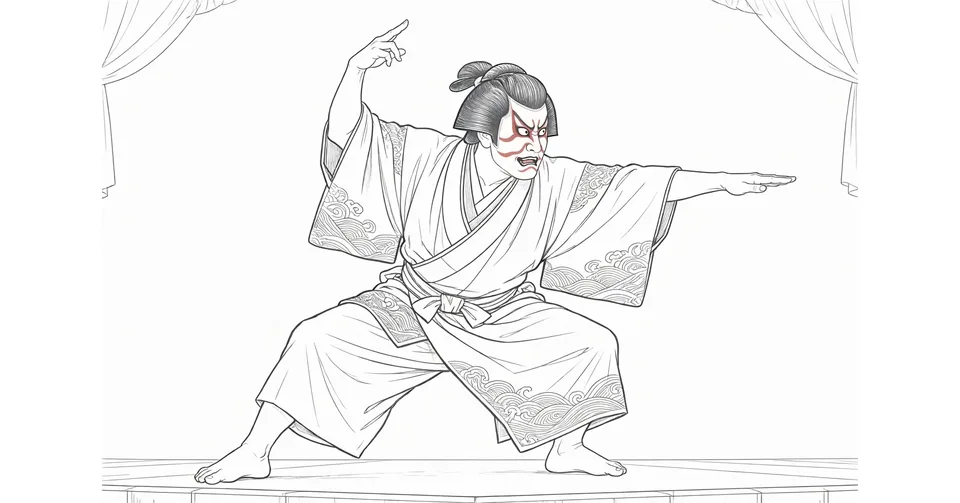
A first visit to Japanese kabuki can feel overwhelming, and that is normal. A full program can run for hours, the dialogue is in old-fashioned Japanese, and the conventions are nothing like a modern play. But the form is more forgiving than it looks. The makeup tells you who is good and who is not, the music tells you how to feel, and the famous poses tell you when to applaud. You do not need to understand every word. You need to know what to watch for, and that is a smaller list than most visitors expect.
A Woman Invented It, Then Men Took the Stage
Japanese kabuki began in Kyoto in 1603, when a dancer named Izumo no Okuni performed a new style of dance drama on a makeshift stage in the dry bed of the Kamo River. Okuni is said to have been a shrine maiden from Izumo Taisha, one of the oldest shrines in Japan, and her performances mixed dance, song, and comic sketches in a way Kyoto had not seen before. The word kabuki itself comes from kabuku, to lean or to behave outrageously, which fits. Okuni and her troupe dressed in strange costumes, imitated fashionable eccentrics, and drew crowds that the authorities soon found hard to ignore.
The early years belonged to women. Female troupes performed kabuki across Kyoto and then in Edo, the city we now call Tokyo, and the form grew fast. But in 1629 the shogunate banned women from the stage, on the grounds that the performances harmed public morals. Young male troupes took over, and they were banned in turn. What survived was yarō kabuki, kabuki performed entirely by adult men, and that is the form that has continued to this day. The ban is the reason Japanese kabuki has one of its most famous features: the onnagata, male actors who specialise in playing women, and who over centuries built a stylised idea of femininity out of movement, voice, and costume rather than imitation.
The bans did not kill Japanese kabuki. They pushed it toward the townspeople of Edo, who became its true audience. Much like the crowds who filled the stands for sumo, merchants and craftsmen who were shut out of the samurai world found their own stories on the kabuki stage: love affairs, debts, revenge, and loyalty tested to breaking point. The great playwright Chikamatsu Monzaemon, who lived from 1653 to 1724, wrote domestic tragedies about ordinary people driven to desperate choices, and his plays gave Japanese kabuki a literary weight it had not had before. The form reached its height in the middle of the 18th century, and the plays written then are still the ones most often performed today.
How to Read a Painted Face
The painted faces are the signature of Japanese kabuki, and they work like a code. The white base, called oshiroi, is made with rice powder, and over it the actor paints kumadori, bold coloured lines that exaggerate the muscles and veins of the face. Each colour means something, and regular audiences read them at a glance. Red lines mark passion, heroism, and righteousness. They belong to the brave hero. Blue or black lines mark villainy, jealousy, and coldness. Green marks the supernatural, a ghost or a demon. Purple marks nobility. When a hero and a villain face each other across the stage, the audience can tell who will win the moral argument before either of them speaks.
Kumadori belongs mostly to aragoto, the rough style of superhuman heroes. The brushwork of the painted face has something in common with Japanese calligraphy: a single line, made with confidence, carries the whole meaning. Aragoto was created in Edo in the late 17th century by the actor Ichikawa Danjuro I, and perfected by his son. The aragoto hero is larger than life: he shouts, he stamps, he wears a costume padded out to impossible width, and his face is a map of red lines. The opposite style is wagoto, the soft style, which grew up in the merchant city of Osaka and favours graceful, realistic lovers over swaggering warriors. The two styles are the twin poles of Japanese kabuki, and most plays lean toward one or the other.
The makeup is only half of the visual language. The costumes are famously heavy and layered, and they change in front of the audience. An actor can pull a string and shed an outer robe in a second, a trick called bukkaeri, revealing a different character underneath. Wigs are enormous and sculpted, and a single costume can weigh many kilograms. Stagehands dressed in black, called kuroko, move props and help with costume changes in plain sight, and the audience is expected to pretend they are not there. It is a theatre that shows its machinery and asks you to enjoy the show anyway, which is part of its charm.
The Frozen Pose and the Walkway Through the Crowd
If kumadori is the face of Japanese kabuki, the mie is its punctuation. A mie is a pose the actor strikes at the climax of a scene, freezing in place with eyes crossed and body twisted into a shape that holds the emotion of the moment. The audience responds with shouts of the actor's house name, a practice called kakegoe, and the pose can last several seconds while the applause builds. The mie is not a pause in the action. It is the action, distilled into a single image, and it is the moment most first-time visitors remember best. There is a discipline to holding one image still that it shares with ikebana, where a single arrangement is asked to carry a whole feeling.
The other great invention of Japanese kabuki is the hanamichi, the flower path. It is a runway that runs from the back of the auditorium, through the audience, to the stage, at about the height of the spectators' heads. Actors enter and exit along it, so a hero can appear from behind you and walk past your seat on his way to the fight. The hanamichi turns the audience into part of the scenery, and it makes the theatre feel far more intimate than its size suggests. When an actor makes a slow, formal exit down the hanamichi at the end of a scene, walking away from the stage while the music plays, it is one of the most moving sights in Japanese theatre.
Music is the third pillar. The shamisen, a three-stringed instrument, and the chanting narrator sit on a platform at the side of the stage, visible throughout. The music does not hide in a pit the way it does in Western theatre. It comments on the action, sets the pace of a fight, and tells the audience how to feel about a scene, much like a film score that you can watch being played. Offstage, wooden clappers called hyoshigi mark the start of the performance, and the sound of them is the signal for the whole theatre to settle.
Three Plays to Start With
The repertoire of Japanese kabuki is large, but three plays come up again and again, and knowing them in advance makes a first visit much easier. The most famous is Kanadehon Chushingura, first performed in 1748, which tells the story of the 47 ronin, the masterless samurai who avenged their lord and then accepted death for it. It is a story about loyalty, and it is so central to Japanese culture that it has been retold in almost every medium. On the kabuki stage it is performed as a series of episodes, and even a single act of it is enough to understand why the story matters.
The second is Yoshitsune Senbon Zakura, a spectacular play about Minamoto no Yoshitsune, the 12th-century general whose life ended in tragedy. It mixes history with fantasy: a fox disguised as a retainer, a magic drum, and a hero who cannot escape his fate. It is the kind of play where the staging itself is the attraction, with flying, quick costume changes, and a famous scene in which a character turns into a fox before the audience's eyes.
The third is Shibaraku, a short, swaggering piece built entirely around the aragoto hero. The hero, Kamakura Gongoro, strides onto the stage through the hanamichi in red kumadori and a huge costume, shouts down the villains, and saves the day in a matter of minutes. There is almost no plot, and that is the point. Shibaraku is a showcase for a great actor's presence, and it is often the first taste of Japanese kabuki that a new audience gets. If your program includes it, you are lucky.
The stories of Japanese kabuki are not always easy to follow, and that is worth saying honestly. Plots borrow from history, legend, and older plays, and characters sometimes have two names or a secret identity. That is why the Kabukiza, the main theatre in Tokyo, rents earphone guides in English that explain the story as it unfolds. Use one. There is no prize for struggling through a play in silence, and the guide turns a confusing evening into a good one.
How to See Japanese Kabuki Without Feeling Lost
The Kabukiza in the Ginza district of Tokyo is the home of Japanese kabuki. The first theatre on the site opened in 1889, and the current building, the fifth, reopened on 2 April 2013, designed by the architect Kengo Kuma as part of a tower development. It is the place most visitors go first, and it is set up for them. Performances are usually split into a matinee and an evening program, and each program is made up of several short plays rather than one long one. You can also buy a single-act ticket, called hitomaku-mi, which lets you watch just one act from a seat on the fourth floor, from around 1,600 yen. It is the cheapest way to try Japanese kabuki, and for a first visit it is the smartest. A practical guide to kabuki explains the seating and the single-act system in detail.
Kyoto has the Minami-za, the other great kabuki theatre, and regional tours take the form to cities across Japan. Outside Japan, touring companies perform in London, Paris, and New York, and the form has found audiences far from home. Japanese kabuki was proclaimed a masterpiece of oral and intangible heritage by UNESCO in 2005 and inscribed on the Representative List of the Intangible Cultural Heritage of Humanity in 2008, which is the official way of saying that the world considers it worth protecting. The history of kabuki on Wikipedia gives the full timeline, from Okuni's riverbed stage to the present day.
A few practical points make the evening easier. Arrive early enough to read the program notes and rent the earphone guide. The audience is expected to applaud the mie and to shout the actor's name at the right moments, but nobody minds if you simply applaud. Food is part of the experience: bento boxes are sold in the theatre, and eating quietly in your seat during the interval is normal. And do not worry about the length. A single act is about an hour, and you can leave at the interval without anyone thinking badly of you.
I think the best advice for a first visit is the simplest one: pick one act, not a full day. Japanese kabuki rewards attention, and an hour of close watching teaches you more than four hours of drifting. Watch the makeup, listen for the moment the shamisen quickens, and wait for the mie. When the actor freezes and the theatre erupts, you will understand what the form is for, and you will not need anyone to explain it to you.
Why Japanese Kabuki Still Fills Seats
Four centuries after Okuni danced on a riverbed, Japanese kabuki still fills the Kabukiza, and the reason is not nostalgia. The form survived because it kept changing while looking the same. Actors inherit stage names from their fathers and grandfathers in ceremonies called shumei, so a name like Danjuro carries centuries of expectation, but each generation reinterprets the great roles. New plays are written, old plays are restaged with modern staging, and star actors appear in films and television, bringing new audiences back to the theatre. Tradition and show business have always lived together in Japanese kabuki, and that is what keeps it alive.
There is also something about the form that fits the way we watch things now. Japanese kabuki is visual before it is verbal. The makeup, the costume, the frozen pose, and the walkway through the crowd all work without translation, and they work just as well for a visitor from abroad as for a regular in the front row. It is theatre that trusts the eye, and the eye rarely needs subtitles.
If you are planning a trip to Japan and you like theatre, or music, or even just spectacle, put Japanese kabuki on the list. Not because it is a duty, and not because it is old, but because it is the most theatrical thing Japan ever made. A painted hero walks down a runway through the crowd, freezes in a pose that stops the room, and for a few seconds the whole theatre agrees on what it is seeing. Four hundred years of audiences have felt that moment, and it still works.
More in Music & Entertainment
Latest posts
- Japanese Pottery and the Six Kilns That Turned Clay into Culture
- Meijin Is the Title Every Karuta Player Dreams of Wearing
- Dazaifu Tenmangu Is Where Japan Still Prays to a Scholar God
- Sugawara No Michizane Became the God Students Still Pray To
- Wakamizu Is the First Water Japan Draws for Good Luck
- Kakizome Turns the First Brushstroke of the Year Into a Wish
- Ujigami Is the Guardian God Who Watches Over One Neighbourhood
- Omi Jingu Is Where Karuta Crowns Its Champions
- Hagoita-ichi Turns Asakusa Into a Forest of Paddles
- The Two Lives of Japanese Coffee
- Oshi-e Hagoita Turns Silk Into a Picture You Can Touch
- Hyakunin Isshu Gave Karuta Its Hundred Poems
- Hagoita Is the Paddle Japan Turns Into New Year Art
- Takoage Sends New Year Wishes Up on a Paper Kite
- Hanetsuki Keeps New Year in the Air With a Wooden Paddle