Tamahagane Is the Jewel Steel Behind Every Katana
· 22 min read
Tamahagane is the jewel steel smelted from iron sand in a clay tatara furnace, and no true Japanese sword can exist without it. This is the story of the steel itself, from sand to folded blade.
Every katana begins long before the smith picks up a hammer. It begins on a riverbank in western Japan, where black sand glitters in the shallows, and in a clay furnace that must be built from scratch and then broken open to give up its treasure. That treasure is tamahagane, and it is the reason a Japanese sword looks and behaves the way it does. Without it, there is no katana, only a sword shaped like one.
The name itself tells you how the Japanese regard it. Tamahagane means jewel steel, and the word is not marketing. It is a statement of value. A single smelting run consumes tons of iron sand and charcoal, takes three days and nights of unbroken labour, and yields less than a ton of usable tamahagane. That tamahagane is then folded, welded, and quenched by hand into a blade that can take an edge sharp enough to cut silk and still bend without breaking. The whole craft exists because this one material demanded it.
It is worth pausing on that point, because it turns the usual story of the katana upside down. We tend to imagine a great smith imposing his will on passive metal, the way a sculptor imposes form on stone. With tamahagane, the relationship runs the other way. Tamahagane arrives flawed, uneven, and full of slag, and the smith spends weeks correcting it. The folding, the layering, the clay coating, and the quench are all answers to problems that tamahagane itself creates. The sword is not a triumph over tamahagane. It is a conversation with it, and tamahagane sets the terms.
What tamahagane actually is
Tamahagane is an iron carbon alloy made by smelting iron sand, called satetsu, with charcoal in a clay furnace called a tatara. The sand is collected from riverbeds and mountain streams, mostly in the Chugoku mountains of western Japan, where weathered granite sheds iron rich grains into the water. Two kinds of sand are used. Masa satetsu, from weathered granite, gives cleaner steel with fewer impurities. Akome satetsu carries more impurities and adds variety to the mix. The fuel is pine charcoal, which does two jobs at once: it burns hot enough to reduce the iron oxides in the sand to metallic iron, and it feeds carbon into that iron as it sinks through the furnace.
The carbon content of tamahagane is where honest sources start to disagree, and the disagreement is worth stating plainly. The Art Research Center at Ritsumeikan University puts the carbon content of sword grade tamahagane at around 0.3 to 1.5 percent. A detailed guide from Swords of Japan gives a narrower range of 1 to 1.5 percent. Other specialists discuss a window of roughly 0.6 to 1.5 percent. The wide range in the Ritsumeikan figure is the safer one to use, because it reflects what the furnace actually produces: not one uniform steel, but a spread of material from soft iron to high carbon steel, all in a single bloom. That unevenness is not a defect to be hidden. It is the defining character of tamahagane, and the entire craft of the Japanese sword is built around sorting it and putting each grade where it belongs.
That is the first thing to understand about tamahagane. A modern steel mill is designed to produce uniformity, ton after ton of identical alloy, and it is very good at it. A tatara is designed to produce variety, and the smith is the sorting machine. The furnace gives him a range of carbon contents in one lump, and his job is to read that range the way a cook reads a market stall, choosing this piece for the edge and that piece for the core. No industrial process can replicate the result, which is why the tatara survives in an age of electric arc furnaces. It survives because it makes something industry cannot make: tamahagane that is already, before any forging begins, a kit of parts.
The name jewel steel also carries a second meaning that is easy to miss. Tamahagane is precious because it is scarce, and it is scarce by design. Japan has no rich iron ore deposits of the kind that fed the furnaces of Europe and China. What it has is sand, and sand is a poor starting point for steel. The Japanese answer was not to find better ore. It was to build a better process around poor ore, and to accept the cost of that process: enormous inputs, tiny outputs, and a furnace that is destroyed every time it is used. I find that stubbornness admirable. It is the same stubbornness that runs through the whole history of the katana, a craft that kept choosing the hard way because the hard way produced something worth having.
Three days and nights inside the tatara
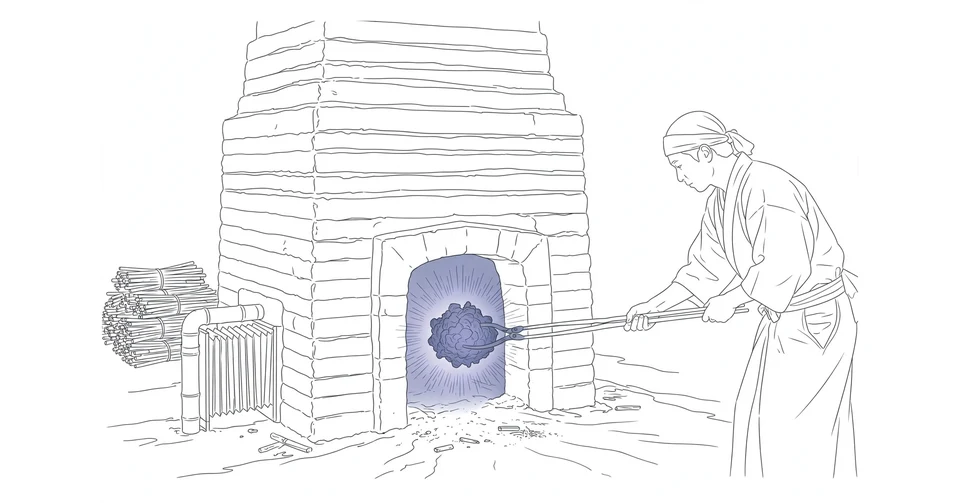
The tatara itself is a humble object for something so important. It is a rectangular clay structure, roughly 1.2 metres high, 3 metres long, and 1 metre wide, built fresh before each smelting run because the heat and the chemistry of the process destroy the clay from the inside. Bellows called fukisashi pump air into the furnace continuously, and a team of masters and workers tends it in shifts around the clock. The furnace is first preheated with charcoal for several hours to drive out moisture, and once the temperature reaches 900 to 1,000 degrees Celsius, the iron sand is introduced.
Then the long work begins. Every 10 to 15 minutes, workers add alternating layers of iron sand and charcoal in carefully measured amounts, and the layering continues for three days and nights without stopping. The temperature inside climbs to between 1,300 and 1,500 degrees Celsius, hot enough to reduce the iron oxides in the sand to metallic iron, which absorbs carbon from the charcoal as it descends. The work never pauses. Someone must always be feeding the furnace, watching the colour of the fire, and judging the airflow, because a tatara left untended for an hour can ruin three days of labour. It is the kind of work that can only be done by a team that trusts each other completely, and that trust is part of the craft as surely as the clay and the charcoal.
The numbers tell the scale of the effort. A single operation consumes about 9.1 tonnes of iron sand and 11 tonnes of charcoal, and at the end of it the masters break the furnace apart to reveal the kera, a bloom of solidified steel weighing about 2.3 tonnes. From that bloom, less than one tonne of usable tamahagane can be selected. The rest is lower grade iron, slag, and waste. Put simply, eleven tonnes of charcoal and nine tonnes of sand go in, and less than a tonne of sword steel comes out. No commercial steelmaker would accept that ratio. It only makes sense if the product is irreplaceable, and for the Japanese sword it is.
The history of the tatara is as old as Japanese steelmaking itself. The method of smelting iron sand in a low box shaped clay furnace began in Kibi Province in the sixth century and spread across Japan, distinct from the taller furnaces of China and Korea. For more than a thousand years it supplied the iron for tools, nails, and swords across the country. Then, in the early twentieth century, it nearly died. Western steelmaking displaced it, the old furnaces fell silent, and the knowledge of how to run one survived only in memory and in a few written records. The revival came in 1977, when the Society for the Preservation of Japanese Art Swords, together with the Agency for Cultural Affairs and the Yasugi works of Hitachi, rebuilt a working tatara at Yokota in Shimane Prefecture. That furnace, the Nittoho Tatara, is now the only active traditional tatara in Japan. It runs only three or four times a year, in winter, and every gram of tamahagane it produces is collected by the society and distributed to licensed swordsmiths. There is no other source. Every genuine Japanese sword made today begins in that one furnace.
I think there is something quietly radical about that arrangement. In a country famous for industrial scale, the most revered steel in its culture is made in a single clay box, a few times a year, by a small team, and handed out like a ration. The scarcity is not an accident of history. It is a choice, renewed every winter, to keep tamahagane rare so that the craft stays serious. A smith who receives his year's supply of tamahagane knows exactly what it cost to make, because he can count the tonnes of sand and charcoal and the three sleepless nights behind every piece. That knowledge sits in his hands when he starts to forge.
Sorting the bloom
When the furnace is broken open and the kera is revealed, the work is only half done. The bloom is a lump of tamahagane with wildly uneven carbon content, ranging from soft wrought iron to pig iron, and it is shot through with slag. It cannot be forged as it is. It must be broken apart, examined piece by piece, and sorted by hardness, and this sorting is one of the most skilled jobs in the whole chain. The smith strikes each fragment and listens to it. He looks at the fracture, feels the weight, and judges the carbon by the colour and the grain. A lifetime of practice goes into that judgement, and a mistake at this stage follows the blade all the way to the quench.
The best pieces of the bloom become tamahagane of the first grade, the high carbon steel used for the cutting edge. The grades below it serve other purposes. Hocho tetsu, the lower carbon steel from the bloom, goes into the soft core of the blade. Zuku, the impure iron at the bottom of the range, is discarded or used for other metalwork. Nothing is wasted carelessly, but nothing is used above its station either. The discipline of the sorting is the discipline of the craft: use the best material where the blade needs it most, and never pretend a lesser piece is something it is not.
This is also where the romance of tamahagane meets its reality. Tamahagane is called jewel steel, and the finest pieces are beautiful, with a fine grain and a bright fracture. But most of the bloom is ordinary, and some of it is poor. The craft does not begin with perfect material and keep it perfect. It begins with mixed tamahagane and makes it better, piece by piece, by selection and by labour. That is a useful corrective to the way we talk about traditional crafts, as if they were effortless expressions of ancient wisdom. They were not effortless. They were systems for getting excellent results from difficult materials, and the difficulty was the point. A craft that only works with perfect inputs is not a craft. It is a factory with better branding.
The sorting also explains why a katana is never the work of one person, even though we remember the smith's name. Before the smith begins, the tatara masters have already made the tamahagane. After the sorting, the smith forges, and then a polisher spends weeks bringing out the grain and the temper line, and makers of fittings build the guard, the handle, and the scabbard. The full story of how a katana is made, from the furnace to the finished sword, is told in the article on how the katana became the soul of the samurai, and the chain of hands in that story starts here, with the sorting of the bloom.
Fifteen folds and tens of thousands of layers
The sorted pieces of tamahagane are still not ready to become a sword. Each piece is flattened to a thickness of about 3 millimetres, stacked with other pieces, and forge welded by heating to around 1,300 degrees Celsius. Then comes the famous folding. A chisel is set into the middle of the heated tamahagane, the block is folded in two, and the fold is welded shut. The work of flattening and folding is repeated about fifteen times, both horizontally and vertically, and each cycle drives out impurities and evens out the carbon. Some guides give the usual range as ten to fifteen folds, which agrees with the Ritsumeikan figure of about fifteen, and the conservative way to state it is that a smith folds tamahagane on the order of fifteen times.
The arithmetic of folding is what makes the numbers in sword books sound almost unbelievable. Each fold doubles the layers, so a block folded fifteen times contains tens of thousands of layers. Those layers are not decoration. They are the record of the refining process, and after polishing they appear on the surface of the blade as hada, a fine wood grain pattern that collectors study the way art lovers study brushwork. A blade with tight, even hada tells you that the smith folded patiently and welded cleanly. A blade with coarse or broken grain tells you where the work was rushed. The surface of a katana is, in this sense, an honest document. It cannot hide how it was made.
It is important to say plainly what folding does not do. It does not make tamahagane harder, and it does not add carbon. What it does is remove slag and inclusions, and spread the carbon more evenly through the block, so that the finished blade is cleaner and more uniform than the raw tamahagane the smith started with. A modern mill achieves the same uniformity by melting and refining in a furnace. The Japanese smith achieves it by hand, with heat and a hammer, over days of repetitive labour. The result is comparable in quality and utterly different in character. One is the product of a process designed to be invisible. The other carries the evidence of its making on its surface, in every layer of the grain.
I have always thought the folding is the part of the story that best explains why people love these swords. It is not the sharpness, which any good steel can achieve, and it is not the curve, which other cultures also produced. It is the visible proof of patience. When you look at the hada of a well made blade, you are looking at fifteen rounds of heating, hammering, cutting, and folding, each one done by a person who could have stopped sooner and chosen not to. That is a kind of beauty that has nothing to do with decoration. It is the beauty of work done properly, and it is there in the tamahagane whether or not anyone is looking.
Two steels in one blade
Most katana combine two grades of tamahagane in a single blade, and the pairing is the solution to a problem that every sword faces. A blade that is hard all the way through will hold an edge but snap under shock. A blade that is soft all the way through will bend instead of breaking, but it will not cut. The Japanese answer is to put both steels in one body. A harder, higher carbon jacket called kawagane wraps around a softer, lower carbon core called shingane. The hard jacket takes and holds the edge. The soft core absorbs shock and keeps the blade from snapping. The skill of the smith is in joining them so cleanly that the join disappears.
The pairing is possible only because tamahagane arrives as a range of carbon contents rather than a single grade. The tatara gives the smith high carbon steel and low carbon steel from the same bloom, and the sorting described earlier is what separates them. In a modern steelworks, a smith who wanted this combination would order two different alloys from two different suppliers. The Japanese smith gets both from one furnace, and the furnace does not ask which one he needs more of. He takes what the bloom gives him and plans the blade around it. That constraint is part of the craft, and it is why the sorting matters so much. A smith who misjudges a piece of tamahagane does not just waste material. He unbalances the blade.
There is a quiet lesson in that pairing, and it is one that reaches beyond swords. The katana is often described as a perfect weapon, but its perfection is not the perfection of a single quality pushed to an extreme. It is the perfection of a compromise held in balance: hard and soft, sharp and tough, beautiful and functional, all in one piece of tamahagane. The two grades of tamahagane do not compete. They cooperate, and the blade is better for the tension between them. I think that is a wiser model of excellence than the one we usually celebrate, which is a single strength taken as far as it will go. The katana suggests that the best things are made by holding opposites together without letting either one win.
Clay, water, and the line that proves the quench
The final transformation of tamahagane happens in the quench, and it is the most dramatic moment in the whole process. The smith coats the shaped blade with a paste of clay, charcoal, and stone powder, thick on the spine and thin on the edge. The blade is heated until it glows the right colour, judged by eye in a darkened forge, and plunged into water. The thinly coated edge cools very fast and becomes martensite, a very hard crystal structure. The thickly coated spine cools more slowly and stays tougher. Martensite takes up slightly more volume than the softer steel, so the edge expands and the blade bends backward, and much of the blade's curve is born in that sudden cooling.
The boundary between the hard edge and the tough spine appears as a visible line, the hamon, and each smith shapes it with the clay into patterns that are straight, wavy, like clove buds, or like rolling waves. The hamon is both a fingerprint and a proof of the quench, because it can only form when the clay coating and the cooling are done correctly. No two are exactly alike. If you want to understand what that line means and how to read it, the article on the hamon, the wavy line that proves a katana is real follows the temper line from the forge to the finished blade.
The quench is also the moment when everything can go wrong. A blade that cools unevenly can crack, warp, or lose its curve, and a crack in the quench means the loss of weeks of work. The smith cannot undo it. He can only start again with a new piece of tamahagane, and the new piece will behave slightly differently from the last, because no two pieces of tamahagane are identical. That risk is part of why a genuine katana is expensive and why a licensed smith makes only a small number of blades each year. Tamahagane is scarce, the process is slow, and the final step can destroy everything that came before it. A craft that carries that much risk in its last step is not a craft for the impatient, and the smiths who practise it are not impatient people.
What strikes me about the quench is how much of it depends on judgement that cannot be written down. The colour of the heated blade, the thickness of the clay, the temperature of the water, the angle of the plunge: all of these are learned by doing, over years, under a master who corrects by demonstration rather than by instruction. The Ritsumeikan story on Japanese swords, with photographs from a working smithy, shows this part of the craft clearly: the Japanese swords story from the Art Research Center at Ritsumeikan University follows a modern smith through the forge, and the images of the clay coating and the tempering make the abstract description concrete. A detailed guide to tamahagane itself, from the furnace to the folding, is the tamahagane essay from Swords of Japan, which sets out the tatara process step by step.
The living craft
Tamahagane is not a museum material. It is still made, still forged, and still judged by standards set seven centuries ago, and the people who keep it alive are few. After the Second World War, the occupation banned sword manufacture between 1945 and 1953, and many swords were confiscated and destroyed. Since 1953, smiths have been allowed to work again, but under strict rules: a swordsmith must be licensed and serve a five year apprenticeship, and each licensed smith may produce only two long swords per month, or 24 per year. The limit is deliberate. It keeps the craft small, slow, and serious, and it means that a new katana is still a rare object made by a named person, not a product rolling off a line.
The living craft is carried by a small number of masters, and a few have been recognised as Living National Treasures for keeping the tradition alive. One of the most remarkable stories in recent decades belongs to Kunihira Kawachi, who was born in 1941 and keeps a workshop in Higashiyoshino in Nara. In 2014, Kawachi succeeded in reproducing midare utsuri, a misty pattern in tamahagane from the Kamakura period that no one had been able to recreate, and won the Masamune Prize, the highest honour for a swordsmith. No one had won the prize in the tachi and katana section for 18 years before him. His pupil, Takami Kuniichi, born in 1973 in Sayo in Hyogo Prefecture, set out on his own at 26 and now works in the region where tatara iron forging has flourished since ancient times, with the stated goal of reproducing the old swords of the Kamakura period.
What these smiths are doing is not nostalgia. They are not preserving a dead technique in a glass case. They are making new swords from new tamahagane, and they are judged against blades made seven hundred years ago, and sometimes they meet that standard. That is an extraordinary thing to attempt, and it only makes sense if you believe that a craft is a living conversation with the past rather than a performance of it. Kawachi did not copy a Kamakura blade. He recovered a lost effect in tamahagane itself, which means he understood the material well enough to make it do something it had not done for centuries. That is not imitation. It is mastery, and it is the reason the Masamune Prize had waited 18 years for a winner.
The craft also survives in the hands that come after the smith. A polisher grinds and refines the surface over many stages, bringing out the grain and the hamon, and a single polish can take weeks. Then the fittings are made: the guard, the handle, the scabbard, the small ornaments tucked into the handle. A blade like this is never the work of one person. It is the work of a chain of craftsmen, and a weakness in any link shows in the finished sword. The tamahagane is the first link in that chain, and everything after it depends on the quality of the tamahagane the tatara produced.
Why jewel steel still matters
It is fair to ask why any of this matters now. Modern steel is cheaper, stronger, more uniform, and available in any quantity. A factory can stamp out a blade in minutes that will cut as well as a katana, and a laboratory can produce an alloy that outperforms tamahagane on every measurable property. If the goal is a sharp piece of metal, the tatara is an absurd way to get one. Three days of labour, eleven tonnes of charcoal, and less than a tonne of tamahagane, all to produce a material that a mill could improve on by lunchtime. The case for tamahagane cannot be made on efficiency, and it should not be attempted.
The case for it is different. Tamahagane matters because it is the material that a particular culture chose to build its most revered object from, and because the object cannot be understood without the material. The folding exists because tamahagane is uneven. The two steel construction exists because the bloom gives a range of carbon. The clay quench exists because tamahagane needs a hard edge and a tough spine in one body. Take away the tamahagane and the whole chain of techniques loses its reason. The techniques are not ornaments added to a sword. They are answers to tamahagane, and tamahagane is the question.
There is also a simpler reason, and it is the one I keep returning to. Tamahagane is proof that a society can choose to keep doing something the slow way, at great cost, because the slow way produces something the fast way cannot. The tatara runs three or four times a year in a single furnace in Shimane, and every piece of tamahagane it makes is rationed to licensed smiths, and every sword those smiths make is limited to 24 a year. That is not a production system. It is a promise, renewed every winter, that some things are worth doing properly even when doing them properly makes no economic sense. A thousand years from now, when the factories are gone and the alloys are forgotten, the promise may be the most durable thing the tatara ever produced.
A katana is a beautiful object, and it is easy to love it for its beauty. But the beauty is the last thing about it, not the first. First there is sand in a river, then three days of fire, then a broken furnace and a lump of uneven steel, then weeks of sorting and folding, then a plunge into cold water. Tamahagane is the thread that runs through all of it, from the riverbank to the finished blade, and it is the reason the finished blade is what it is. The jewel steel is not the decoration of the katana. It is the katana, in its first and truest form, waiting to be folded into the shape we recognise.
More in Culture & Society
- Tatara Is the Clay Furnace Where Tamahagane Begins
- Tsuka Is the Wrapped Grip That Lets a Katana Speak
- The Tanto Was the Small Blade a Samurai Trusted With His Life
- Seppuku Was the Ritual a Samurai Chose Over Disgrace
- Saya Is the Lacquered Sheath That Guards the Katana
- Daisho Was the Pair of Swords That Marked a Samurai
Latest posts
- Hamon Is the Wavy Line That Proves a Katana Is Real
- Ikebana and the Quiet Discipline Behind Japan's Flower Art
- The Wakizashi Was the Short Sword a Samurai Never Left Behind
- The Tsuba Turned a Sword Guard Into a Small Work of Art
- Omiyage and the Japanese Art of Bringing Something Back
- How the Katana Became the Soul of the Samurai
- The Menpo Gave the Samurai a Face Worth Fearing
- Japan Goes Maple Hunting Every Autumn and Calls It Momijigari
- Kabuto Gave the Samurai a Helmet Worthy of His Sword
- Christmas in Japan and the Fried Chicken Dinner That Started It All
- Kiso Yoshinaka Rode Out of the Mountains and Nearly Took Japan
- Sakayaki Gave the Samurai His Signature Hairline
- The Archer on the Tower Was Hangaku Gozen
- Koyo Turns Japan Into a Country That Forecasts Leaves
- Inside Japan's 100 Yen Shops, Where Everything Costs a Coin