The Tanto Was the Small Blade a Samurai Trusted With His Life
· 21 min read
The tanto was the short dagger a samurai carried beside his long swords, a blade of about fifteen to thirty centimetres that served in close combat, in ritual, and as a work of art.
The katana gets the films, the posters, and the museum banners. The tanto, the small blade, gets almost nothing, and that is a strange fate for the blade a samurai trusted with his life. It was the shortest sword in his kit, a dagger with a blade of about fifteen to thirty centimetres, and it was the one he reached for when everything else had failed. It was also the blade laid on the tray at the most solemn moment of his life, and the blade a samurai bride carried in her sash on her wedding day.
A tanto is easy to overlook because it looks simple. It has no sweeping curve, no long handle, no dramatic silhouette. Yet the simplicity is the point. It was forged with the same care as a katana, from the same folded steel, and the best of them are counted among the great works of Japanese swordsmithing. To understand the samurai, you have to understand why a man who carried a long sword everywhere also carried a dagger he hoped never to use.
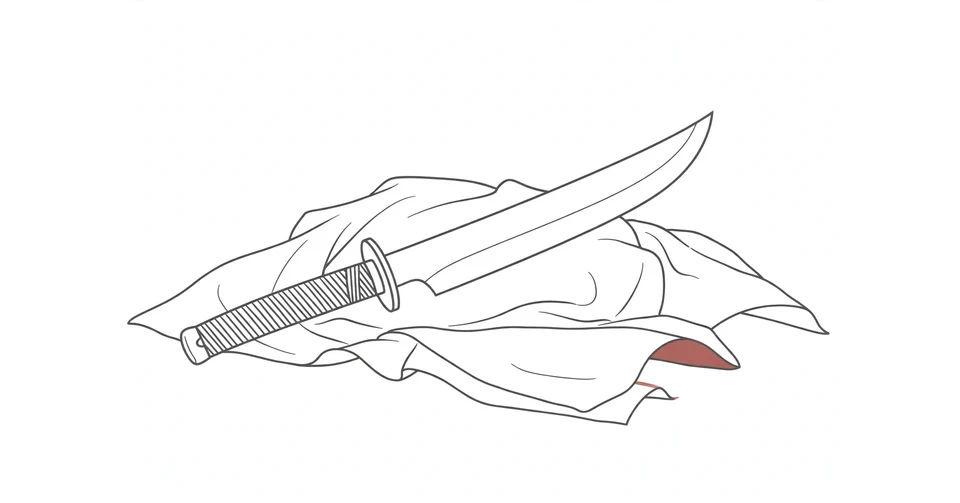
The word itself gives the definition away. Tanto means short sword, from tan, short, and to, sword. In the usual classification a tanto is a single edged dagger with a blade between fifteen and thirty centimetres long, which is one Japanese shaku. Anything shorter is classed as a small knife, and anything longer becomes a wakizashi. The Samurai Museum Berlin puts the range plainly, and the standard reference works agree, so fifteen to thirty centimetres is the safe figure to carry in mind. Some blades from the chaotic fourteenth century stretched to about forty centimetres, but those were the exception, not the rule.
What a tanto actually is
A tanto is not a small katana. That is the first mistake people make, and it matters, because the two blades were built for different jobs. A katana is a cutting weapon, designed to be drawn and swung. It is a thrusting weapon, designed for the moment when there is no room to swing at all. Its most common form is hira-zukuri, a flat blade with no ridge line, which makes it easy to sharpen and strong for its size. The flat sides also leave the smith nowhere to hide. Every flaw in the steel shows, which is one reason connoisseurs say this is the format in which differences of workmanship show most plainly.
Most tanto are single edged, but a few rare forms are sharpened on both sides. The moroha-zukuri is ground on both edges along its whole length, a form borrowed from continental dagger traditions and found mostly on religious blades. The kissaki-moroha-zukuri sharpens only the point on both sides, giving the blade a symmetrical tip. Both were always exceptions in Japan, and that is telling. The Japanese sword tradition was built around the single edged blade, and the blade stayed inside that tradition even when a double edge would have made it a better dagger.
The size of a tanto is also the reason it survived so many changes of fashion. A blade under thirty centimetres can be hidden in a sleeve, tucked into a sash, or carried inside the breast of a kimono. A katana cannot be hidden, and a wakizashi is still too long to disappear. That concealability made it useful in every period of Japanese history, from the battlefield to the peaceful streets of Edo, and it is why the blade outlived the world that made it.
A blade beside the daisho, not part of it
The samurai carried his status on his hip. Under the Tokugawa shogunate, only a samurai was permitted to wear the daisho, the matched pair of a katana and a wakizashi. The tanto was not part of that pair, and that fact shaped its whole career. It fell into a grey area of the law. It was small enough to pass as a tool, and deadly enough to be a weapon, so merchants, craftsmen, and even women carried them in Edo period Japan, officially for self defence and unofficially as a concealed weapon in a society that strictly regulated violence.
Before the daisho became the standard pairing, the usual combination was different. In the earlier centuries a samurai commonly carried a tachi, the older long sword, with the short blade as his second, rather than a katana and a wakizashi. The wakizashi eventually won the place of companion sword, and one historian, Kanzan Sato, suggested the reason was practical: the wakizashi was better suited to fighting indoors, where a fight happens at arm's length and a longer blade is a hindrance. It did not disappear when it lost that place. It simply moved to a different role, worn as a third blade, carried in the breast, or kept close at hand where the long swords could not go.
That third place is worth pausing over. The katana was the public blade, the one other people saw. The wakizashi was the constant companion, the blade that stayed on indoors when the katana was left at the door. The tanto was the private blade, the one carried closest to the body. There is something honest about that arrangement. A man can show the world his long sword, but the blade he keeps nearest himself is the one that says what he is really prepared for. The full story of the companion sword is told in the article on the wakizashi, the short sword a samurai never left behind.
From tool to weapon of last resort
The earliest tanto date from the Heian period, which ran from 794 to 1185, and at first they were tools more than weapons. They repaired armour, cut cords, and sealed letters. In the Kamakura period, from 1185 to 1333, that changed. Warfare in this era was based on mounted archers, and the military historian Karl Friday has emphasised that the sword was always the weapon of last resort. Arrows were shot first, then spears, and only when both were exhausted did warriors close to grapple with swords and daggers. In those desperate moments a compact stabbing weapon was exactly what a warrior needed, and the dagger became part of the standard equipment of a samurai.
The fourteenth century pushed the blade to its limits. As warfare changed from mounted single combat to battles of mass infantry, the blades grew longer and wider. Some from the Nanboku-cho period, 1336 to 1392, reached about forty centimetres, which is technically short sword length. The blades also grew thinner and broader, a fashion that prized reach over the stout strength of the earlier daggers. It was a period when conventions broke down on the battlefield just as they did in the political system, and the blade grew with the disorder.
The Sengoku period, from 1467 to 1615, produced the most functional blades of all. Constant warfare demanded mass production, and smiths specialised in the yoroi-doshi, the armour piercer, a heavy blade with a reinforced back designed to thrust through the gaps in lamellar armour. Quality suffered as workshops produced for the mass demand of the armies, but the design itself was brutally honest. These weapons had no elegant curves. They were pure killing tools, built for a single purpose.
Then came peace, and the tanto changed again. After the founding of the Tokugawa shogunate in 1603, open combat became a rare exception, and the blade lost its military function and gained an aesthetic one. Craftsmen poured their art into elaborate mountings, gold lacquer decoration, ray skin coverings, and small accessories such as the utility knife and the sword needle. It became a status symbol, a wedding gift, and a family heirloom. I find that transformation more interesting than the battlefield history, because it shows how an object can keep its form while its meaning turns completely around. The blade that once opened a gap in armour ended up as a gift between families, and nobody in Edo thought that strange.
The armour piercer and the forms of the blade
Not all of these daggers look alike, and the differences are not decoration. They are answers to different problems, and each form has a name that tells you what it was for.
The most common form is hira-zukuri, the flat blade already described, with no ridge line and no separate point section. These were the workhorses of the samurai, not spectacular but reliable, easy to make and easy to sharpen. A hira-zukuri blade with a straight temper line, known as suguha, is the classic image of the blade, and a fourteenth century example forged by the smith Kinju survives in the Samurai Museum Berlin.
The shobu-zukuri takes its name from the iris leaf, whose shape the blade imitates. It has a central rib near the back that gives structural strength, but it does without the distinct ridge transition to the point that a katana has. This form became popular in the Edo period, when these blades were increasingly made for duels and rituals rather than for battles, and elegance mattered more than brute strength.
For military purposes, smiths preferred kanmuri-otoshi, a form with a reinforced back whose cross section recalls a helmet. These blades were thicker, heavier, and triangular in profile, optimised to penetrate metal plates and mail. A yoroi-doshi in kanmuri-otoshi form could penetrate the gap between the cuirass and the helmet neck guard, and the smiths of the Soshu tradition in particular, known for their robust combat blades, perfected this type in the Kamakura period. A frontal attack on a breastplate was impossible even for a yoroi-doshi. The key was never brute force. It was precise knowledge of the weak points, under the arms, at the neck, on the inside of the thighs, where armour was protected by fabric or leather rather than metal.
Two rarer forms are worth knowing because they show the range of the tradition. Unokubi-zukuri, the cormorant's neck, has a narrow, waisted blade back that abruptly becomes thicker, a form that saves weight and shifts the centre of gravity towards the point. Osoraku-zukuri has an extremely long point, over half the blade's length, and owes its unusual name, which means probably, to the legend that a smith commented on his own creation only with that single word. Both forms are rare and particularly sought after by collectors.
The temper line, the hamon, is where the art of the small blade shows most clearly. Like a katana, a tanto is hardened by selective quenching, with parts of the blade covered in clay slurry before it is hardened in water. A straight hamon, suguha, was the classic choice for this blade, simple and functional. An undulating hamon, midare, required more skill and was regarded as a sign of high smithing art. The fine particle structures along the hamon, the visible crystals called nie and the milky mist called nioi, determine the aesthetic value of a blade, and to experts they are as individual as a fingerprint.
The kaiken and the women who carried a tanto
This blade was not only a man's weapon. Women of the samurai class often carried a special short dagger called a kaiken, a bosom dagger, hidden in the obi, the sash of the kimono. A kaiken was typically a compact blade in aikuchi style, often with a blade under twenty centimetres, and it served two purposes: defence against attackers, and, if capture threatened, an honourable death by cutting the throat, a practice known as jigai. Women of the samurai class received systematic combat training, including the naginata and the tanto, and the kaiken was presented at weddings as part of the dowry, a sign that the bride could protect herself.
I think the kaiken deserves more attention than it usually gets, because it changes the story of the blade. When we picture a Japanese dagger we picture a warrior, but for centuries this blade was also carried by women who were expected to defend a household when the men were away at war. The kaiken was not a miniature or a toy. It was a real blade, carried in a mounting with no guard, so that it would sit flat and hidden against the body. Its existence is a reminder that the samurai household was a military household, and that the women in it were part of that world, not spectators of it.
The kaiken also shows how much of a blade's meaning came from its mounting rather than its blade. In aikuchi mounting, the hilt meets the scabbard directly, with no guard in between. This minimalist construction made the blade more compact and easier to conceal, and it was considered the more refined choice. The hamidashi mounting offers a middle way, a tiny, often barely visible guard that gives minimal hand protection without changing the silhouette of the dagger. The choice between the two was less functional than social. The aikuchi was considered more refined, the hamidashi more pragmatic, and a person chose according to the impression they wanted to give.
The blade of seppuku
No account of this blade is complete without seppuku, because the ritual is what most people outside Japan associate with the blade. The short blade used in seppuku was usually a tanto, a dagger of about twenty to twenty five centimetres, though the wakizashi could also serve. It had the perfect length for the purpose: short enough to be handled in the kneeling position, long enough to reach the internal organs. A katana was too long, and a knife was too small. The blade laid on the ceremonial tray was often a family heirloom, passed down through generations, and it was the last object a samurai consciously touched.
The ritual itself, in the form most people picture, was a codification of the Edo period, not a medieval practice. The historian Andrew Rankin has put it plainly: what we call classical seppuku, the white kimono, the death poem, the ritual dagger, is an Edo period codification, and earlier seppuku varied wildly in form and setting. The idealised version ran as follows. The condemned man sat kneeling on white mats. A ceremonial tray was presented, and on it lay the dagger, wrapped in white paper. He wrote a farewell poem, bared his upper body, and made the cut from left to right, and then the kaishakunin, the second who stood by, ended his suffering with a precise stroke of the long sword.
Reality was often less tidy. Towards the end of the Edo period, many samurai had never fought and had hardly any sword skills, and numerous forced seppuku ended with the condemned man merely reaching symbolically for the blade, sometimes even for a paper fan, whereupon the second immediately beheaded him. The gesture had become the point. The blade was there to be touched, to show readiness and composure, and the actual cutting was no longer required. The history of that ritual, and of the men who carried it out, is told in the article on seppuku, the ritual a samurai chose over disgrace.
Yamamoto Tsunetomo, the author of the Hagakure, written in 1716 and one of the most influential texts on the later reception of the samurai mentality, explicitly lists this dagger as a seppuku knife among the essential items of a warrior, alongside armour, sword, and bow. That listing is revealing. The tanto sat beside the great weapons of the samurai, not below them, because in the world the Hagakure describes, the blade a man used to take responsibility for his own failure mattered as much as the blade he used against an enemy.
How a tanto was worn and carried
A tanto was worn in several ways, and each way tells you something about the person carrying it. The most common was at the waist, tucked through the obi with the edge facing up, in the same manner as the longer swords. A tanto worn this way was called a koshigatana, a waist sword. Another way was concealed under clothing, close to the chest, where it was called a futokoro-gatana, a bosom sword. The kaiken of a samurai woman was carried in exactly this hidden way, tucked into the folds of the kimono where it could be reached in an instant and seen by no one.
The manner of wearing also changed with the form of the blade. The yoroi-doshi, the armour piercer, was worn differently from other tanto, with the handle facing inward and the scabbard facing forward, a design intended to prevent an opponent from drawing the blade and using it during a grapple. It is a small detail, but it shows how seriously the samurai took the problem of close fighting. The blade was not only a weapon. It was a weapon that had to be kept out of the enemy's hands at the exact moment when the two men were close enough to grab it.
On the battlefield, the tanto also served a grim practical purpose beyond the fight itself. It was the blade used for taking the head of a fallen enemy, and it appears in equipment lists under names such as koshigatana and metezashi. After the fighting, a warrior needed a short, stiff blade for that work, and the tanto was the tool at hand. This is the part of the blade's history that museum displays tend to pass over, and it should not be passed over. A tanto was not only an art object. It was a tool of war, and the beauty of its shape was a byproduct rather than the aim.
Steel, hamon and the art of the small blade
The great age of the tanto was the Kamakura period, and its great smiths worked chiefly in this size. Awataguchi Yoshimitsu, whose dagger Atsushi Toshiro is a National Treasure held in the Tokyo National Museum, and Shintogo Kunimitsu, whose tanto is an Important Cultural Property, are the names that appear again and again in the history of the blade. Their work shows what the tanto could be at its best: a short blade in which every quality of the swordsmith's art, the grain of the steel, the temper line, the shape of the point, is concentrated into twenty five centimetres.
Later masters kept the tradition alive long after the blade had lost its military purpose. Gassan Sadakazu, who lived from 1836 to 1918 and held the title of imperially authorised master craftsman, the predecessor of today's Living National Treasure, created tanto that combined tradition with technical perfection, and one of them is held in the Samurai Museum Berlin. His kissaki-moroha-zukuri tanto, sharpened on both sides at the point in the style of the Nara period, is a good example of how a master could reach back a thousand years for a form and make it new.
The three masterpieces known as the Nihon Santo, the Three Blades of Japan, include a tanto, the Horaisan Kotetsu, forged by Nagasone Kotetsu. It sits beside the other two celebrated blades as an equal, which is remarkable for a dagger in a tradition that worships the long sword. The fact that a tanto is counted among the three greatest blades in Japan says everything about how seriously the culture took this small weapon.
There is also a humbler side to the craft. Many tanto mountings included a small utility knife, the kogatana, that sat in a pocket on the scabbard, and a sword needle, the kogai, used for arranging the hair or as a chopstick. Together with the fittings they formed the mitokoro-mono, the three pieces, made together by one master and documenting the cultural aspirations of the owner. A tanto was therefore not only a blade. It was a small collection of objects, each made with care, that a samurai carried on his person every day.
The tanto after the samurai
The Meiji Restoration of 1868 and the sword ban of 1876, the Haitorei Edict, ended the samurai era and forbade the public carrying of swords. The art of tanto smithing survived as cultural heritage. Organisations such as the NBTHK, the Society for the Preservation of the Japanese Art Sword, classify and certify historical blades to this day, and a tanto with its papers, a certificate of authenticity from the society, is the standard of the collecting world. The Tokugawa peace had already turned the tanto into an art object. The Meiji ban completed the change, and the blade moved from the waist to the display case.
Many tanto were forged before the Second World War, when members of the Imperial Court began wearing the set of tachi and tanto once more and the number of tanto in existence increased dramatically. After the war, restrictions on sword forging caused tanto manufacture to fall drastically, and the blades that survived became rarer and more valuable. In the twentieth century the tanto also remained in use among yakuza, since it could be carried as a concealed weapon more easily than a katana, and it is traditionally used in the yubitsume ritual, the cutting off of part of a finger as an act of submission or atonement. That is the darker afterlife of the blade, and it is worth naming honestly rather than leaving it out of the story.
Outside Japan, the tanto found a second life in the martial arts and in the knife world. Blunt wooden or plastic tanto are used to practise aikido, aikijutsu, jujutsu, and other arts, and versions with a blunt metal blade are used in more advanced training and in demonstrations. The blade's shape also travelled into Western knife design. Since the 1980s, as the Wikipedia article on the tanto records, the term tanto has been used in the West for a style of modern tactical knife with an angular, chisel-like point, a design that is not present on any traditional tanto. The German army is among the few militaries that issues a tanto style military knife in significant numbers, designated the KM2000. The American tanto, as it is called, is a tribute to the Japanese blade's reputation for piercing strength, even if the shape itself is an invention of the modern knife industry.
The modern collecting market has its own numbers, and they show how the small blade holds its value. Specialist dealers list authentic tanto at a median price of a few thousand dollars, with certified examples commanding several times more, and at equal period and papers a tanto lists at roughly six tenths the price of a katana. Those figures come from dealer asking prices, not final sales, so they should be read as a guide rather than a fact, but they confirm what collectors have long known. A tanto is not a cheap entry into Japanese swords. It is a serious object, priced like one.
Why the smallest blade still matters
The tanto is the least famous of the Japanese swords, and that is exactly why it is worth a closer look. The katana tells the story of the samurai as the world likes to imagine him, sweeping and dramatic. The tanto tells the story as it actually was, close, practical, and personal. It was the blade a samurai carried when his bow was empty and his spear was broken. It was the blade he laid on the tray when his life was over. It was the blade a bride carried on her wedding day, and the blade a master smith used to show everything he knew in twenty five centimetres of steel.
I think there is a lesson in that smallness. We tend to judge objects, and people, by how much space they take up, and the tanto refuses that measure. It did the hardest work of any blade in the samurai's kit, in the grapple, in the ritual, in the quiet moments when no one was watching, and it did it without ceremony. The katana was the soul of the samurai, as the saying goes, but the tanto was the blade he trusted with his life, and trust is the quieter and more demanding of the two honours.
Today the tanto sits in museums, in Tokyo, in Berlin, in private collections around the world, and its story is mostly told in the language of art history. That is fair, because the blades are beautiful. But the beauty is only half the story. The other half is the hand that reached for the blade when everything else had failed, and the history that made such a small piece of steel necessary. The tanto was never the grandest weapon in Japan. It was the most personal, and that is why it is still worth remembering.
More in Culture & Society
- Tatara Is the Clay Furnace Where Tamahagane Begins
- Tsuka Is the Wrapped Grip That Lets a Katana Speak
- Tamahagane Is the Jewel Steel Behind Every Katana
- Seppuku Was the Ritual a Samurai Chose Over Disgrace
- Saya Is the Lacquered Sheath That Guards the Katana
- Daisho Was the Pair of Swords That Marked a Samurai
Latest posts
- Hamon Is the Wavy Line That Proves a Katana Is Real
- Ikebana and the Quiet Discipline Behind Japan's Flower Art
- The Wakizashi Was the Short Sword a Samurai Never Left Behind
- The Tsuba Turned a Sword Guard Into a Small Work of Art
- Omiyage and the Japanese Art of Bringing Something Back
- How the Katana Became the Soul of the Samurai
- The Menpo Gave the Samurai a Face Worth Fearing
- Japan Goes Maple Hunting Every Autumn and Calls It Momijigari
- Kabuto Gave the Samurai a Helmet Worthy of His Sword
- Christmas in Japan and the Fried Chicken Dinner That Started It All
- Kiso Yoshinaka Rode Out of the Mountains and Nearly Took Japan
- Sakayaki Gave the Samurai His Signature Hairline
- The Archer on the Tower Was Hangaku Gozen
- Koyo Turns Japan Into a Country That Forecasts Leaves
- Inside Japan's 100 Yen Shops, Where Everything Costs a Coin