Tsuka Is the Wrapped Grip That Lets a Katana Speak
· 16 min read
A tsuka is the wrapped handle of a katana, and it is the only part of the sword you ever truly touch. This is the story of its wood, ray skin, cord, and craft.
Pick up a katana and your eyes go to the blade. That is natural. The steel is polished, curved, and beautiful, and it holds the light. But your hands go somewhere else entirely. They close around the tsuka, the long wrapped handle, and from that moment the sword stops being an object on a wall and becomes something you hold. Everything you learn about a katana, its balance, its weight, its temper, reaches you through this one part.
A tsuka is not a handle in the simple sense of a stick you grab. It is a small assembly of wood, ray skin, cord, metal ornaments, and a single bamboo pin, fitted to one blade and no other. It is made to be taken apart, cleaned, and put back together. It is the only part of the sword that wears out from honest use, and it is the part that tells an expert, at a glance, whether the sword in front of them was made by craftsmen who understood their work or by a factory that only copied the shape.
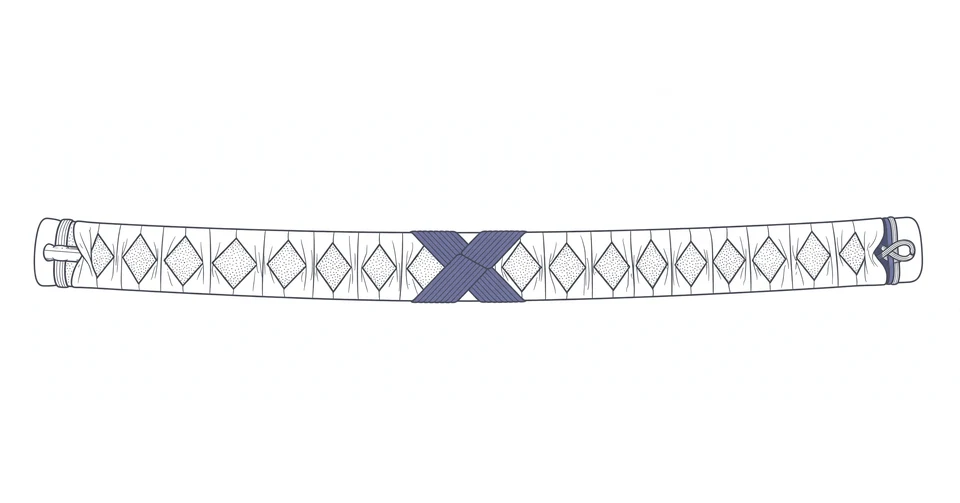
That is the quiet truth at the heart of this story. The blade gets the poetry and the museum glass. The tsuka gets the sweat, the friction, and the daily work of turning a piece of steel into a tool a human being can use safely. If the blade is the voice of the sword, the tsuka is the mouth that lets it speak, and a sword that cannot be held properly cannot say anything at all.
What a tsuka is
A tsuka is the handle of a Japanese sword. The word covers the whole assembly, not just the wrapping you see. At its heart is a wooden core called the tsuka-gaki, traditionally carved from magnolia wood, the same ho no ki used for the scabbard. The core is made from two halves, hollowed to fit the tang of one specific blade, then glued together with rice paste. That fit matters more than it sounds. A genuine tsuka is shaped for one blade alone, and when the blade is seated properly there is no wobble, no rattle, and no play of any kind. The handle should feel like a single piece of material with the blade, not like a sleeve slipped over it.
Over the wooden core goes samegawa, the skin of a ray. Genuine samegawa is white or cream coloured, covered in small rounded nodes that you can see and feel. Those nodes are not decoration. They give the cord something to bite into, and they give the hand a texture that holds even when the palm is wet with sweat. When the skin dries it shrinks and hardens, forming a rigid shell that strengthens the wooden core and helps stop it splitting around the peg holes. A factory handle often replaces it with plastic, synthetic leather, or painted wood, and the difference is visible the moment you look through one of the diamond openings in the wrap.
Over the ray skin goes the ito, the cord that makes the pattern everyone recognises. It is usually silk or cotton, sometimes leather, and it is wound under very tight tension in a pattern of crossing diagonals. Between the crossings, diamond shaped openings reveal the pale ray skin beneath. Under the cord sit the menuki, small metal ornaments that press gently against the palm and fingers, and at each end of the handle sit the fuchi and the kashira, the metal collar and the end cap. A single bamboo pin called the mekugi passes through the handle and the tang of the blade and holds the whole assembly together. Nothing is glued shut or nailed fast. The tsuka is made to come apart, and that reversibility is part of its genius.
The shape of a tsuka is worth noticing too. It is not round. A proper handle has an oval cross section, slightly flattened, so the hand knows at once which way the edge is pointing without looking. It also carries a gentle curve that follows the curve of the blade. Hold a well made tsuka with your eyes closed and you can feel the direction of the cut. That is not an accident. It is the result of centuries of fitting a tool to the human hand, and it is why the handle feels so different from the round grip of a Western sword.
The parts inside a tsuka
Each part of the tsuka does a job, and learning the names changes how you look at a sword, because suddenly the wrapped handle has a structure instead of a surface. The wooden core is the foundation. The samegawa is the grip beneath the grip. The ito is the binding that holds everything together. The menuki are the small points of pressure that help the hands find their place. The fuchi and kashira are the metal ends that stop the wood splitting. The mekugi is the one pin that keeps the blade from flying out of the handle.
| Part | Japanese name | What it does |
|---|---|---|
| Wooden core | Tsuka-gaki | Hollowed to fit one tang, gives the handle its shape |
| Ray skin | Samegawa | Rough noduled surface that grips the cord and the hand |
| Wrapping cord | Tsuka-ito | Binds the handle together and forms the diamond pattern |
| Ornaments | Menuki | Small metal pieces under the cord that guide the grip |
| Collar | Fuchi | Reinforces the front of the handle beside the guard |
| End cap | Kashira | Reinforces the end of the handle and balances the sword |
| Retaining pin | Mekugi | Bamboo peg that locks the blade into the handle |
How the wrapping is done
The wrapping of a tsuka has its own name, tsukamaki, and its own specialists, the tsukamaki-shi. It is a craft that takes years to learn, and the reason is simple: the cord must be kept at even, very tight tension from the first crossing to the last knot, and a single lapse shows in the finished pattern. The work begins with the centre of a long length of ito placed flat on the front face of the handle, just behind the fuchi. From there the two halves of the cord cross back and forth down the length of the handle, twisting at each crossing, until the whole tsuka is covered. The ends are finished with a knot that locks the wrap and often holds the kashira in place.
The twist at each crossing is the detail that separates real craft from imitation. In the classic style, the cord alternates its twist at every fold, turning first one way and then the other, in strict alternation. This technique is called moroneri, and it has a practical purpose that goes beyond looks. Because each section of the wrap is locked independently, a cut to the cord in one place loosens only that section. Without the alternating twist, a single cut could let the whole wrapping unravel. On a battlefield, where a sword used to block a blow might take a cut to its handle, that difference could decide whether the swordsman kept fighting or lost his grip entirely.
Small folded paper wedges called hishigami are often placed under the cord at the crossings. They help shape the diamond openings, keep them even, and build the handle up to a comfortable shape for the hand. The menuki are set in place during the wrapping, held by the tension of the cord itself. The whole process is done with the handle alone clamped on a stand, never with the blade attached, because the wrapper needs both hands free and a steady, controlled working position. A factory line that wraps handles with the blade already fitted is doing it the wrong way round, and the result usually shows.
Why the diamond pattern matters for grip
The diamonds are the first thing anyone notices about a tsuka, and it is easy to treat them as decoration. They are not. They are the visible result of a grip designed to work when conditions are at their worst. The raised crossings of the cord give the fingers ridges to hold, the open diamonds let the rough ray skin show through, and the combination holds the hand even when it is wet, tired, or shaking. A smooth handle slips. A diamond wrapped handle talks back to the palm, and that feedback is what lets a swordsman know, without looking, exactly where the blade is pointing.
The pattern also cushions the hand. The cord and the skin beneath it absorb a little of the shock of a cut, protecting the wrists during long practice. The wrap distributes stress evenly across the wooden core, so no single point takes all the force. And because the cord is wound so tightly, it binds the whole assembly into one solid piece, stopping the parts from shifting or rattling. A loose wrap is not a cosmetic flaw. It is a warning that the handle is coming apart, and a handle that comes apart in use is dangerous.
I find something quietly honest in this. A katana is often described as a work of art, and it is. But the diamond pattern is art that exists because it works, not art pasted onto a tool after the fact. The beauty of a well wrapped tsuka is the beauty of a problem solved properly, and it is a reminder that the best decoration is often the shape that a function takes when it is done with care.
Length and shape across schools and hands
A katana tsuka is made for two hands, and its length is part of the sword's character. On a properly made katana the handle is about 24 centimetres long, roughly 8.5 sun in the old Japanese measure, though the exact length varies with the blade it serves and the person who will use it. A wakizashi has a shorter handle, and a tanto shorter still, because each sword is built around the way it will be used. A handle too short for its blade crowds the hands and spoils the balance. A handle too long shifts the balance point and makes the sword feel clumsy. The proportion matters, and it is judged by feel as much as by measurement.
Different schools and different eras favoured different shapes. A handle made for formal wear in the peaceful Edo period might be slimmer and more elegant, with fine silk cord and elaborate metal fittings, because it would be seen more than used. A handle made for the warring states era might be sturdier, with a thicker wrap and a rougher finish, because it would be used hard and repaired in the field. The wrapping style itself could signal a school or a clan, and the colour of the cord could mark a formal mounting: the formal sword prescribed for a samurai visiting a castle, for example, was wrapped in white ray skin and black cord, a uniform rather than a choice. A good wrapper also fits the tsuka to the hands that will hold it, building the core up slightly fuller for a larger hand or keeping it slimmer for a smaller one, so the same length of handle can feel quite different from one sword to the next.
How to tell a real tsuka from a cheap replica
Most katana shaped objects sold around the world today are not Japanese swords, and their handles are the easiest place to see it. The checks are simple, they take less than two minutes, and they need no specialist tools. The first is the simplest: grip the handle firmly and try to move the cord with your thumb. On a properly wrapped tsuka the ito does not move at all. It feels like part of the wood. If the cord lifts, shifts, or gives under light pressure, the tension was wrong or the wrap has loosened, and the handle needs attention.
The second check is the alternating twist. Look at three consecutive diamond folds and watch the direction of the cord at each crossing. On a correctly wrapped handle the twist alternates, left, right, left. If every fold faces the same way, the moroneri is missing, and the wrap will unravel from any cut instead of holding. This is the detail that factory handles almost never get right, and it is the single most revealing test of all. A full guide to reading a handle this way, including photographs of correct and incorrect wrapping, is given in this guide to telling a genuine tsuka from a factory imitation.
The third check is the ray skin. Look through a diamond opening. Genuine samegawa is white or cream, with rounded nodes of irregular size, slightly rough to the touch. A substitute is often black, grey, or painted, with a surface too smooth or too regular, sometimes with a slight sheen that real ray skin never has. Painted wood and moulded plastic are common on cheap replicas, and once you have seen real samegawa, the difference is hard to miss.
Then look at the menuki. They should be in the correct orientation, with a clear top and bottom, and the pair on the two faces should be offset, not directly opposite. Menuki that are identical on both faces, or mounted upside down, are a fundamental error. Check the fit as well: hold the blade and the handle and try to move them against each other. There should be no wobble at all. A factory handle is made to fit a range of tang sizes, so the fit is approximate. A genuine one is made for one tang, and it shows in the solidity of the join. Finally, look at the geometry. The cross section should be oval, not round, and the length should suit the blade. A handle that is far too short or too long for its sword is a sign that the parts were bought separately and put together without care.
Care and re-wrapping
A tsuka is a working object, and it needs care like any other part of the sword. The first rule is to keep it dry and keep it steady. Silk and cotton cord absorb moisture and oils from the hands, and over time the wrap loosens, darkens, and loses its grip. A handle that has become slack should not be used for cutting practice, because a loose wrap can shift under load and a shifting handle is unsafe. The cord can be cleaned gently, but once the tension is gone, cleaning will not bring it back.
Re-wrapping is a normal part of a sword's life, not a failure. A tsuka that has served for years in regular practice will eventually need new ito, and a good wrapper can strip the old cord, check the core and the ray skin beneath it, and wrap it again. The wooden core and the samegawa often survive several re-wrappings, and each one is a chance to check the mekugi, the peg that holds the blade, and the fit of the tang. The mekugi itself should be inspected regularly and replaced when it shows wear, because it is a small bamboo peg carrying a large responsibility. Bamboo is chosen deliberately: under extreme shock it deforms or cracks gradually, giving a warning, where a metal peg might fail all at once. For a fuller account of the wrapping itself, its styles, its materials, and its maintenance, this essential guide to tsukamaki is the best place to start.
The tsuka in iaido and kenjutsu
The tsuka comes alive in the martial arts, and it is there that its design makes the most sense. Iaido is the art of drawing the sword in one smooth motion, and every kata begins and ends with the sword sheathed. The draw starts with the left thumb pushing the guard forward to break the grip of the scabbard, the right hand closing around the tsuka, and the blade leaving its sheath in a single arc. In that first fraction of a second, the hands must find the handle, settle into the correct grip, and begin the cut, all without looking down. A handle that fits the hands makes that possible. A handle that does not makes it a struggle.
The grip itself is part of the teaching. The right hand sits close to the guard, the left hand at the end of the handle, and the two hands work together to guide the blade rather than wrestling with it. The menuki press against the palms in the same place every time, the diamonds give the fingers their reference points, and the oval shape keeps the edge aligned with the cut. In kenjutsu, the older art of fencing with a partner, the handle takes harder use: the shock of blade meeting blade travels straight down the steel and into the hands, and the cushioning of the cord and ray skin is what keeps the wrists safe through long sessions.
The story of the blade it guards is told in How the Katana Became the Soul of the Samurai, and the sheath that holds the blade when it rests is the subject of Saya Is the Lacquered Sheath That Guards the Katana. Together the three parts make one object: a blade that cuts, a sheath that protects, and a handle that connects the two to the person holding them.
A tsuka is easy to overlook, and most people do. It is the part of the sword that never appears in the museum photograph, the part that wears out, the part that gets replaced. But it is also the part that decides whether a katana is a weapon, a tool, or a decoration. A sword with a well made handle is ready to be used, and a sword with a poor one is ready only to be looked at. The difference is in the wood, the skin, the cord, and the hands that wrapped it, and it is a difference you can feel the moment you pick the sword up. That is why the tsuka matters, and why it deserves its place in the story of the katana: it is the wrapped grip that lets the blade speak, and it speaks most clearly through the hands of the person holding it.
More in Culture & Society
- Tatara Is the Clay Furnace Where Tamahagane Begins
- The Tanto Was the Small Blade a Samurai Trusted With His Life
- Tamahagane Is the Jewel Steel Behind Every Katana
- Seppuku Was the Ritual a Samurai Chose Over Disgrace
- Saya Is the Lacquered Sheath That Guards the Katana
- Daisho Was the Pair of Swords That Marked a Samurai
Latest posts
- Hamon Is the Wavy Line That Proves a Katana Is Real
- Ikebana and the Quiet Discipline Behind Japan's Flower Art
- The Wakizashi Was the Short Sword a Samurai Never Left Behind
- The Tsuba Turned a Sword Guard Into a Small Work of Art
- Omiyage and the Japanese Art of Bringing Something Back
- How the Katana Became the Soul of the Samurai
- The Menpo Gave the Samurai a Face Worth Fearing
- Japan Goes Maple Hunting Every Autumn and Calls It Momijigari
- Kabuto Gave the Samurai a Helmet Worthy of His Sword
- Christmas in Japan and the Fried Chicken Dinner That Started It All
- Kiso Yoshinaka Rode Out of the Mountains and Nearly Took Japan
- Sakayaki Gave the Samurai His Signature Hairline
- The Archer on the Tower Was Hangaku Gozen
- Koyo Turns Japan Into a Country That Forecasts Leaves
- Inside Japan's 100 Yen Shops, Where Everything Costs a Coin