Tatara Is the Clay Furnace Where Tamahagane Begins
· 16 min read
A tatara is a clay furnace built fresh for every smelt and broken open to release its steel, and it is the only furnace that can make true tamahagane. This is the story of the furnace itself.
Every Japanese sword begins in a furnace that is built to be destroyed. The tatara is a clay furnace, roughly three metres long and a little over a metre high, and it is made fresh before each smelting run. For three days and nights it is fed with iron sand and pine charcoal, tended without pause, and then its walls are torn down so the steel inside can be taken out. There is no other way to make tamahagane, the jewel steel of the Japanese sword, and everything that follows depends on what happens inside those clay walls.
It is a strange object to revere. A modern steel mill runs for years without stopping and turns out identical steel by the tonne. A tatara runs for three days, consumes tonnes of sand and charcoal, and is then smashed to pieces, and its yield is a single lump of uneven steel, part of which is useless. Yet this wasteful, fragile, one use furnace has outlasted every attempt to replace it, and it still runs today in a single workshop in the mountains of Shimane. The reason is simple. The tatara does something no mill can do. It makes steel that arrives already sorted into grades, ready for the smith to shape into a blade.
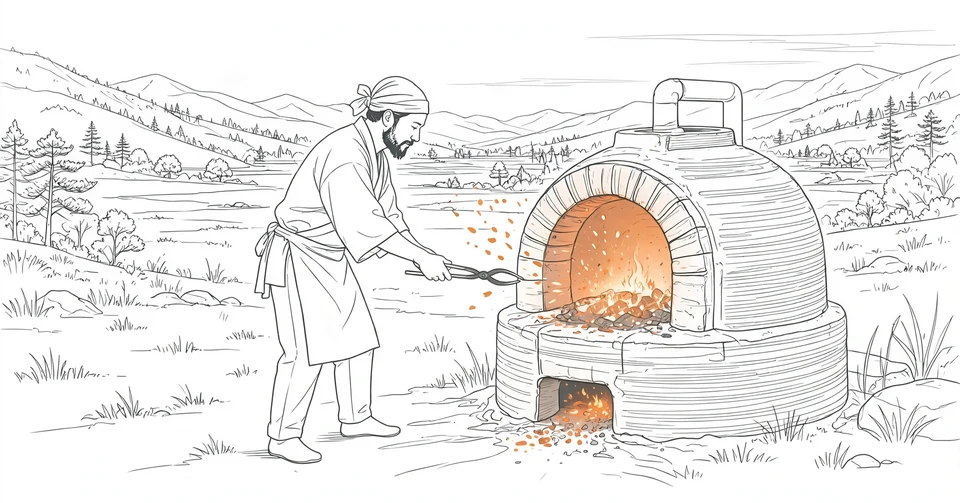
To understand the katana, you have to understand the tatara first. The famous folding, the two steel construction, and the clay quench are all answers to problems the tatara creates. The steel that comes out of it is uneven, full of slag, and mixed in carbon content from soft iron to high carbon steel. The swordsmith spends weeks correcting that unevenness, and the result is a blade no factory can copy. The story of the sword is usually told from the forge onward. This is the part before the forge, the three days of fire that decide everything that follows.
What a tatara actually is
A tatara is a rectangular clay vessel, built on the ground inside a tall workshop hall called a takadono. The word can mean the furnace itself, the bellows that feed it, or the whole worksite, and that looseness is fitting, because a tatara is really a small building with a furnace at its heart rather than a single piece of equipment. The clay tub is about 1.1 metres high, about three metres long, and about one metre wide, though one careful report from the modern furnace puts the length closer to 2.7 metres. The difference is small, and either way the shape is the same: a low, long box of clay with bellows on both sides and a deep underground structure below it.
That underground structure is one of the cleverest parts of the design. Beneath the furnace lies a space called the hondoko, where charcoal is laid, and beside it a tunnel like gap called the kobune, and together they form a system of air ducts that draws moisture out of the ground during the smelt. Moisture is the enemy of this kind of steelmaking, which is why the furnace is built on a structure some three metres deep, and why the modern runs are held in the driest weeks of winter. The clay walls start 20 to 40 centimetres thick and thin to around 10 centimetres by the end of a run, because part of the clay is absorbed into the smelt.
The air comes from bellows on both sides of the clay tub, their pipes entering through small holes in the walls, some widened during the run so the master can peer inside and check the growing bloom. In the late 1600s the craft adopted a foot operated blower called the tembin fuigo, which could push a much larger volume of air into the furnace and raise the temperature. The whole arrangement was settled by the Edo period, and the furnace that runs in Shimane today follows the same plan. The word itself is old, appearing in the Kojiki of 712 and the Nihon Shoki of 720. A good place to check the shape, the history, and the numbers of the furnace is the Tatara furnace entry on Wikipedia, which draws on the technical histories published by the Iron and Steel Institute of Japan.
Three days and nights of fire
Building a tatara takes about a week from the first clay to the finished smelt, and the firing itself lasts 72 hours without a break. The furnace is first preheated with charcoal for several hours to drive the moisture out of the clay walls, and once the temperature reaches 900 to 1,000 degrees Celsius, the workers begin adding iron sand, called satetsu, in thin layers alternating with charcoal. The layering continues hour after hour for three days and nights, and the temperature climbs to between 1,300 and 1,500 degrees Celsius, hot enough to reduce the iron oxides in the sand to metallic iron, which absorbs carbon from the charcoal as it sinks.
How often the feed is added is one of the details on which honest sources disagree: some guides give every 10 to 15 minutes, while a detailed report from the modern Nittoho furnace describes additions every 30 minutes. I am keeping both figures in view rather than picking one, because the exact rhythm depends on the size of the charge and the judgement of the master. What every source agrees on is the part that matters: the feeding never stops.
The work is hard in a way that is difficult to imagine from the outside. The master smelter does not sleep for the whole three days, watching the flames constantly, checking the molten slag that runs out of the vent holes at the ends of the furnace, and judging by colour and behaviour whether the smelt is going well. It is said that many masters lose their sight with age from staring into the brightness of the molten steel. The tatara is judged by eye, by experience, and by attention, not by instruments. The furnace has no thermostat. The master is the thermostat.
Iron sand and pine charcoal
Everything a tatara makes starts as sand. Satetsu is iron bearing sand, black grains washed out of weathered granite and carried into riverbeds and mountain streams. The Chugoku mountains of western Japan are rich in it, and the Sanin region, especially Okuizumo in Shimane Prefecture, became famous because its granite country sheds usable sand into the streams.
Two kinds of sand are used. Masa satetsu, from weathered granite, gives cleaner steel with fewer impurities, and it is the feed most often named for the sword grade runs at the modern furnace. Akome satetsu carries more impurities and adds variety to the mix. In the Middle Ages the craft adopted a new way of gathering the sand, called kanna nagashi, which used waterways to wash large amounts of sand out of the hillsides efficiently, and it is one of the reasons the tatara survived as an industry for so many centuries rather than remaining a village craft.
The other ingredient is pine charcoal, and it does two jobs at once. It burns hot enough to reduce the iron oxides in the sand to metallic iron, and it feeds carbon into that iron as it sinks through the furnace. Without the charcoal there is no heat and no carbon, and without carbon there is no steel, only iron. A single run consumes about nine to ten tonnes of iron sand and about eleven to twelve tonnes of charcoal, and no commercial steelmaker would accept that ratio. The furnace is not a machine for making steel cheaply. It is a machine for making one particular steel that cannot be made any other way, and the cost is accepted because the product is irreplaceable.
The murage and his crew
The person in charge of a tatara run is the murage, the master smelter, and his authority inside the workshop is absolute. He decides when the furnace is hot enough to begin, how fast the sand and charcoal are fed, how much air the bellows should push, and when the run is finished and the walls should come down. The crew works in shifts, but the murage does not sleep for the three days. Like an expectant father, he watches the flames constantly for 72 hours, checking the slag, listening to the bellows, and reading the colour of the fire. It is a job that takes decades to learn, because so much of it is judgement that cannot be written down.
The most famous murage of recent times was Akira Kihara, who was named a Living National Treasure for his skill in traditional tatara steelmaking and had been in charge of production at the Nittoho furnace since 2002 when Japan Forward reported on the annual smelt in 2018. The Japan Forward report on the annual sword steelmaking at Okuizumo describes the scene: the furnace like a great altar, the sacred rope marking off the workshop, and prayers offered to Kanayago-no-kami, the deity of metal production, before the work begins. The tatara is not treated as a piece of industrial equipment. It is treated as a place where something sacred happens, and the crew behaves accordingly.
That sacred framing is not decoration. When a process can be ruined by an hour of inattention, treating it as sacred is a practical discipline, and it tells everyone in the room that this work deserves their full attention.
The crew itself is small, four or five people for the whole run, and the trust between them matters as much as their skill. They work in shifts through three nights, handing the furnace from one watch to the next, and a mistake by one person becomes a problem for everyone. The tatara is often described as a furnace, but it is also a test of a team.
Breaking the furnace and judging the kera
When the murage decides the run is finished, the walls of the tatara are torn down and the bloom inside is revealed. The moment is dramatic, and every account of it uses the same word: sensational. The clay that was built up over a week is smashed apart in minutes, and there, in the bottom of the furnace, lies the kera, a lump of solidified steel about 2.7 metres long, one metre wide, and 30 centimetres deep, weighing from two to two and a half tonnes. Its outer surfaces are covered in a mix of pig iron, steel, half reduced steel, slag, and charcoal. Inside, along the two sides where the air from the bellows gave the best conditions, lie the two cores of first grade tamahagane.
The kera is dragged out into the snow and left to cool to its core, and once it is fully cold it is broken into fist sized chunks and graded by hand. This grading is one of the most skilled jobs in the whole chain, and it is the moment when the tatara hands its work over to the swordsmith. The grader strikes each fragment and listens to it. He looks at the fracture, feels the weight, and judges the carbon by the colour and the grain. A lifetime of practice goes into that judgement, and a mistake at this stage follows the blade all the way to the quench.
The grading sorts the bloom into a range of carbon contents. The first grade tamahagane, from the inner cores, has a carbon content of about 1 to 1.5 percent. The second grade tamahagane runs from about 0.5 to 1.2 percent. The zuku, the pig iron at the bottom of the range, carries more than 1.75 percent carbon. What comes out of one furnace is not one steel but a spread of material, from soft iron to high carbon steel, and the smith is the sorting machine who turns that spread into a blade.
That unevenness is the point, not a flaw. A modern mill is designed to produce uniformity, tonne after tonne of identical alloy, and it is very good at it. A tatara is designed to produce variety, and the smith sorts that variety the way a cook sorts a market stall, choosing this piece for the edge and that piece for the core. The finest pieces become the hard jacket of the blade. The softer pieces become the core. The poor pieces are set aside or used for other metalwork. Nothing is wasted carelessly, and nothing is used above its station. The full story of the steel itself, from the sorting of the bloom to the folding and the quench, is told in the article on tamahagane, the jewel steel behind every katana.
A history written in clay
The tatara is as old as Japanese steelmaking itself. The method of smelting iron sand in a low box shaped clay furnace began in Kibi Province, in what is now Okayama Prefecture, around the middle of the sixth century, and it spread from there across Japan. The low box shape was distinct from the taller furnaces of China and Korea, and it was a Japanese answer to a Japanese problem: a country with no rich iron ore deposits, but with rivers full of iron sand and mountains full of pine. For more than a thousand years the tatara supplied the iron for tools, nails, farm equipment, and swords across the country.
In the Middle Ages the furnaces grew larger and the underground structures beneath them grew more elaborate, built to keep the furnace warm and to reduce humidity. By the Edo period the design had settled into the form that survives today: the takadono hall, the hondoko and kobune below the furnace, and the tembin fuigo bellows that could push enough air to reach the temperatures the best steel required.
Then, in the early twentieth century, it nearly died. Western steelmaking displaced it, and by 1920 the old furnaces were no longer economically viable and they closed. The knowledge of how to run one survived only in memory and in a few written records. The revival came in 1977, when the Society for the Preservation of Japanese Art Swords, together with the Agency for Cultural Affairs and the Yasugi works of Hitachi, rebuilt a working tatara at Yokota in Shimane Prefecture. That furnace, the Nittoho Tatara, is now the only active traditional tatara in Japan. It runs only in the winter months, when the air is dry, and it completes about three cycles in three weeks, producing three blooms. Every gram of tamahagane it makes is collected by the society and distributed to licensed swordsmiths. There is no other source, and every genuine Japanese sword made today begins in that one furnace.
The history of the tatara is also the history of the sword. When the tatara fell silent in the early twentieth century, the craft of the sword nearly died with it, and when the furnace was rebuilt in 1977, the craft came back with it. The story of how that steel becomes a blade is the story of how the katana became the soul of the samurai, and it begins, as every katana begins, in the clay furnace.
Why the slow method survives
It is fair to ask why any of this still exists. Modern steel is cheaper, stronger, more uniform, and available in any quantity. A factory can produce in an afternoon a steel that outperforms tamahagane on every measurable property, and it can do so without anyone staying awake for three days or tearing down a furnace to get at the product. If the goal is a sharp piece of metal, the tatara is an absurd way to get one. The case for it cannot be made on efficiency, and it should not be attempted.
The case for it is different, and it is the same case that keeps any slow craft alive in a fast world. The tatara survives because it makes something industry cannot make: a steel that arrives as a kit of parts, already graded by nature into hard and soft, already carrying the variation that the smith needs to build a blade with a hard edge and a tough core. No mill can replicate that, because no mill is designed to produce unevenness on purpose.
There is also a simpler reason. The tatara is proof that a society can choose to keep doing something the slow way, at great cost, because the slow way produces something the fast way cannot. A single clay furnace runs a few times each winter in the mountains of Shimane, a small team tends it for three sleepless days, and the steel it makes is rationed to licensed smiths who are allowed to make only 24 long swords a year each. That is not a production system. It is a promise, renewed every winter, that some things are worth doing properly even when doing them properly makes no economic sense.
I think the furnace also teaches something about patience that is easy to lose in ordinary life. A tatara cannot be hurried. You cannot add the sand faster, or raise the temperature sooner, or skip the night shift, without ruining the steel. The furnace sets the pace, and the people around it have to match it, hour after hour, for three days. Most of us spend our lives dividing our attention between many things and doing none of them properly. The murage and his crew do the opposite, and the steel they make is the proof that the opposite works.
The tatara will never come back as an industry. The blast furnace won that argument a century ago, and it is not going to lose it now. But the tatara does not need to come back as an industry. It needs only to keep running, a few times each winter, in one workshop in Shimane, making the steel that no one else can make for the swords that no one else can forge. As long as it runs, the craft that depends on it stays alive, and the knowledge of how to build a furnace out of clay, fill it with sand and charcoal, and tend it for three days without sleep will not be lost. A furnace that is built to be destroyed turns out to be one of the most durable things Japan has ever made, not because the clay lasts, but because the decision to rebuild it, winter after winter, keeps lasting.
More in Culture & Society
- Tsuka Is the Wrapped Grip That Lets a Katana Speak
- The Tanto Was the Small Blade a Samurai Trusted With His Life
- Tamahagane Is the Jewel Steel Behind Every Katana
- Seppuku Was the Ritual a Samurai Chose Over Disgrace
- Saya Is the Lacquered Sheath That Guards the Katana
- Daisho Was the Pair of Swords That Marked a Samurai
Latest posts
- Hamon Is the Wavy Line That Proves a Katana Is Real
- Ikebana and the Quiet Discipline Behind Japan's Flower Art
- The Wakizashi Was the Short Sword a Samurai Never Left Behind
- The Tsuba Turned a Sword Guard Into a Small Work of Art
- Omiyage and the Japanese Art of Bringing Something Back
- How the Katana Became the Soul of the Samurai
- The Menpo Gave the Samurai a Face Worth Fearing
- Japan Goes Maple Hunting Every Autumn and Calls It Momijigari
- Kabuto Gave the Samurai a Helmet Worthy of His Sword
- Christmas in Japan and the Fried Chicken Dinner That Started It All
- Kiso Yoshinaka Rode Out of the Mountains and Nearly Took Japan
- Sakayaki Gave the Samurai His Signature Hairline
- The Archer on the Tower Was Hangaku Gozen
- Koyo Turns Japan Into a Country That Forecasts Leaves
- Inside Japan's 100 Yen Shops, Where Everything Costs a Coin