Matcha and the Green Tea of Japan
· 8 min read
Matcha went from a quiet tea ceremony powder to a global boom, and now Japan cannot grow enough of it. Here is how Uji makes it, how to tell the grades apart, and what the shortage means.
A green powder that once belonged to monks and tea masters is now in lattes, ice cream, and doughnuts on five continents. Matcha, the powdered green tea of Japan, has become one of the most recognisable flavours on earth. And in 2025, for the first time in its long history, Japan could not grow enough of it.
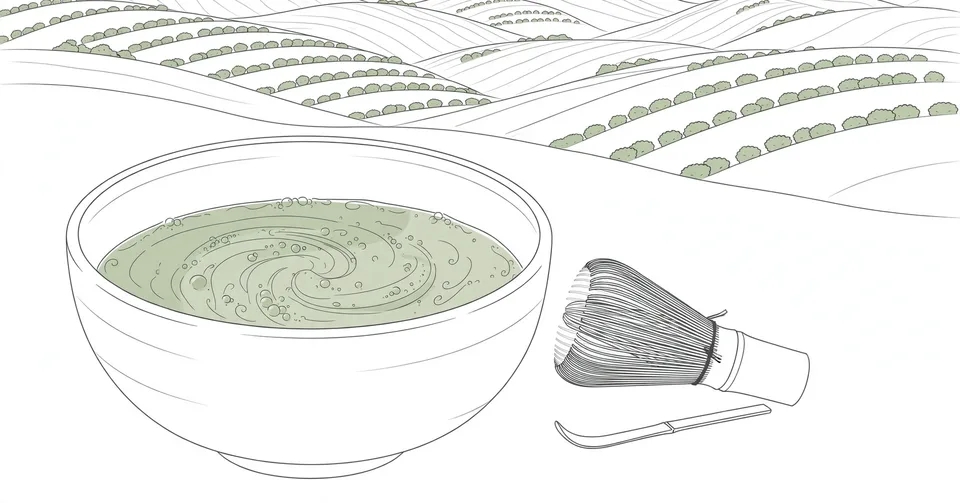
The story starts in Uji, a small city south of Kyoto where tea has been grown for more than 800 years. Walk its riverside streets and the smell of roasting tea drifts from the shops. The old temple of Byodo-in, a UNESCO World Heritage site, stands a short walk from fields that have supplied the imperial court and the tea masters for centuries. This is the heartland of the tea, and it is also where the world now comes to buy it.
What follows is how matcha is made, how to tell a drinking tin from a baking tin, and why the whole world suddenly wants more of it than Uji can supply. The answer involves monks, ice cream, and a harvest that went wrong.
Uji, Where Matcha Began
Powdered tea reached Japan in the 12th century, brought from China by the Zen monk Eisai. Monks drank it to stay awake during meditation, and over the centuries the preparation hardened into a ritual, chanoyu, the way of tea, shaped in the 16th century by the master Sen no Rikyu. Uji, with its misty river valley and cool mornings, became the place where the finest leaves were grown. The tea ceremony that grew around the powder is a story of its own, and it is told in full in our guide to the Japanese tea ceremony. What matters here is that the powder was never a casual drink. It was a drink made slowly, in small amounts, for people who had time to pay attention.
Uji today still feels like a tea town. The main street from the station runs past tea shops that have been in the same families for generations, and the municipal tea house, Taihoan, serves bowls of whisked tea prepared by tea masters to anyone who books ahead. Spring is the best season to visit, when the new leaves, shincha, are picked and the fields glow their brightest green. Come in the morning, before the tour buses, and the town smells of roasting tea.
How Matcha Is Made
Matcha starts as tencha, a leaf grown in shade. A few weeks before harvest, farmers cover the fields, and the leaves respond by turning a deeper green and staying soft and tender. After picking, the leaves are steamed and dried without being rolled, which is what sets tencha apart from sencha, the rolled leaf of everyday green tea. The stems and veins are removed, and what is left is ground between granite stones into a powder so fine it feels like silk. The grinding is slow on purpose. A mill turns out only a small amount at a time, and heat would spoil the flavour, so there is no way to rush it. That slowness is the first reason the world is running short.
The Boom at a Glance
| Tencha production, 2012 | 1,430 tons |
| Tencha production, 2023 | 4,176 tons |
| Global matcha market, 2023 | Over 3 billion dollars |
| Global matcha market, 2028 | Projected over 5 billion dollars |
The numbers tell the shape of the boom. In 2012 Japan produced 1,430 tons of tencha, the shaded leaf that becomes matcha. By 2023 that figure had nearly tripled to 4,176 tons, according to the Ministry of Agriculture, Forestry and Fisheries. Production rose, and demand rose faster.
That slowness is also how you can tell the real thing when you buy it. The powder should be a vivid green, almost electric, and fine enough to feel soft between your fingers. A dull, yellowish powder has sat too long or was ground from older leaves. Look for Uji or Kyoto on the label, keep the tin sealed and away from light, and use it within weeks of opening. The powder fades fast once air gets in, which is why the small tin, not the big bag, is the honest size.
Ceremonial or Culinary, Two Grades of Matcha
Not all matcha is the same powder. The split that matters is between ceremonial and culinary grade. Ceremonial matcha comes from the youngest leaves of the first harvest, stone-ground for drinking on its own, whisked with hot water into a bright, frothy bowl. Culinary matcha comes from later harvests. It is stronger and more bitter, which is exactly what a latte or a cake needs, because milk and sugar soften it. The rule is simple: drink the ceremonial, bake with the culinary. A tin labelled ceremonial that ends up in a smoothie is a waste of good tea, and a culinary tin whisked on its own will taste harsh enough to put a newcomer off matcha for good. Matcha also closes many formal meals in Japan. A kaiseki dinner, the multi-course art of dining, often ends with a bowl of it, a quiet finish after a long sequence of dishes. You can read about that tradition in our guide to kaiseki.
Drinking it at home is simpler than the ceremony makes it look. Sift a spoonful of ceremonial matcha into a bowl, add hot water that has cooled just below boiling, and whisk in a fast M shape with a bamboo whisk until a fine foam appears. No milk, no sugar, nothing else. The first sip is bitter, then sweet, and the foam is the sign you did it right.
The Matcha Shortage Nobody Expected
The boom did not happen overnight. In 1996, Häagen-Dazs released a green tea ice cream in Japan, and demand jumped so sharply that people called it the Häagen-Dazs Shock. In 2000, Starbucks began selling matcha drinks, and the flavour spread worldwide. Social media did the rest. By 2023 the global matcha market had passed 3 billion dollars, with forecasts of more than 5 billion by 2028. Then supply hit its limit. In 2024 and 2025, shops in Uji and Kyoto began limiting customers to one tin each. Some tea ceremony venues raised their prices by around 30 percent in 2025. The spring harvest of 2025 fell by about 10 percent across Japan, and hand-picked leaf in Uji fell by about 40 percent. At auction, tencha prices climbed to records. The problem is that a tea field cannot be hurried. A new bush takes years before it yields, and shaded fields need land, labour, and patience that no factory can replace. Japan is growing more of it than ever, and it is still not enough.
For buyers, the practical answer is patience. Expect limits in Uji and Kyoto, and do not be surprised when a favourite shop sells out. Suspiciously cheap powder is usually not matcha at all, but ground sencha or a blend, so a low price is a warning, not a bargain. And if you only need the flavour for baking, buy culinary grade and leave the ceremonial tins for the people who will whisk them.
The scale of the boom, and the shortage that followed it, is documented in a report from Nippon.com on the Uji tea trade, which traces the rise from the Häagen-Dazs Shock to the one-tin limits of today. The market figures behind it are covered in Senbird Tea's guide to matcha's rise.
What the Boom Means for the Bowl
There is a good side to the shortage that is easy to miss. For decades, tea farming in Uji was a shrinking trade, kept alive by a small number of families. The boom has brought young growers back to the fields and given old farms a future, which is more than most traditional crafts can say. But the boom also asks something of the drinker. The matcha in a sweetened latte is a flavouring, and there is nothing wrong with that, but it is not the drink the monks carried across the sea. That drink is a bowl of whisked powder, bitter and bright, made slowly and drunk without hurry. If you want to taste it properly, buy ceremonial grade, whisk it with hot water, and expect the shop to limit you to one tin. The limit is not a sales trick. It is a small sign that real matcha is a crop, and a crop has seasons, weather, and limits that no amount of demand can wish away.
The shortage, in the end, is a compliment the world paid Uji without meaning to. It proved that a drink made by hand, in one small valley, could matter to millions of people. The valley just needs time to answer.
So the green powder in your latte and the green powder in a tea room in Uji are the same plant, and yet they are not the same thing. One is a flavour the world fell in love with. The other is a practice that took 800 years to refine. The shortage will ease one day, when new fields mature and harvests recover. Until then, the wisest way to enjoy matcha is the oldest one: a small bowl, made slowly, and finished before it cools.
More in Food & Travel
Latest posts
- Manza Onsen Bathes at 1,800 Metres
- Irezumi Was an Art Before It Was a Warning
- The Oshi Kept Fuji's Pilgrims Fed, Housed, and Devout
- Japan's Population Decline and the Villages It Leaves Behind
- KRL Commuterline and the Trains That Move Jakarta
- Loma Linda's Long Lives Run on Saturdays
- Maruten Numazu and the Towering Kakiage Bowl of the Port
- The Three Sisters Grow Better Together
- Half the Old Springs in Japan Thank Kobo Daishi
- Tatamiishi Terraces Filter a River Through Stone
- Wasabi-Zuke Puts the Whole Plant in Sake Lees
- Konyoku Is Still Out There, Past the Last Train Station
- Karo Is the Tengger's Other Great Gathering
- Dry January Lasts a Month on Purpose
- Urashima's Dragon Palace Had a Name, Ryugu