How Kochi Turned Yuzu Into Japan's Favourite Citrus
· 9 min read
Yuzu is too sour to eat and too slow to grow, yet Kochi Prefecture produces about half of Japan's supply. This is how mountain villages turned an ingredient nobody snacks on into the flavour of the Japanese winter.
Yuzu might be the most famous citrus in Japan that almost nobody eats. The fruit is small, knobbly and crowded with seeds, and its juice is sour enough to make your eyes water. Yet its smell turns up in dipping sauces, teas, sweets and even bath water, and about half of the national crop grows in one mountainous prefecture on the island of Shikoku: Kochi.
That is the strange bargain at the centre of this story. Kochi did not build its name on a sweet, easy fruit like the mikan, the kind you peel in front of the television. It built its name on an ingredient, a fruit people buy for its peel and its perfume, grown in steep villages that had run out of other ways to make a living.
To see how yuzu won, it helps to start with the fruit itself, because on paper it looks like a hard sell.
A fruit that sells its smell, not its flesh
Yuzu, known to botany as Citrus × junos, began in central China as a natural hybrid of mandarin orange and a hardy wild citrus called the ichang papeda. It reached Japan and Korea in the Tang dynasty era and settled into mountain gardens, where it was valued early on for exactly the qualities it still sells today.
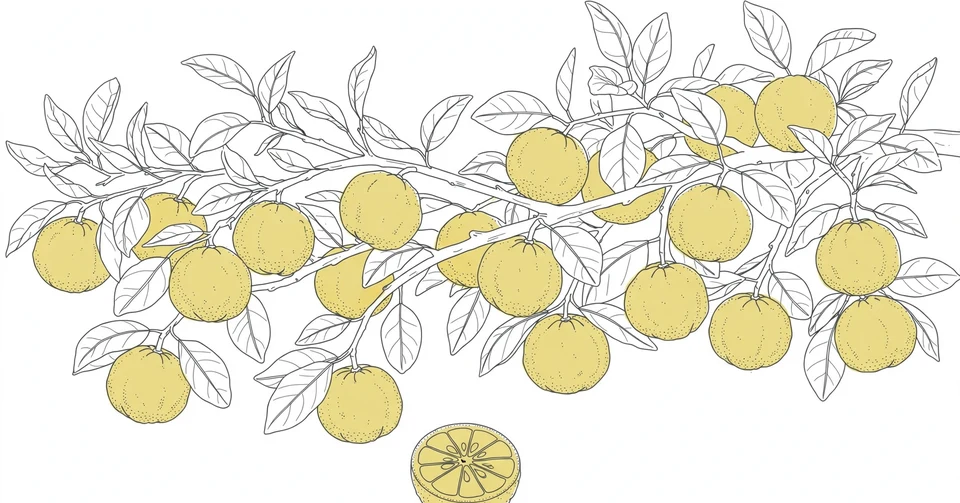
The ripe fruit is only about 5.5 to 7.5 centimetres across, yellow, uneven skinned and very aromatic. As Wikipedia's yuzu profile puts it plainly, yuzu is rarely eaten as a fruit. The flesh is tart, close to grapefruit with overtones of mandarin, and full of seeds. What cooks actually want is the zest, whose oils carry the aroma, and the sharp juice, which Japanese kitchens use much the way other cuisines use lemon.
There is something honest about this arrangement. Yuzu never pretended to be a dessert. A single fruit scents a whole bowl of soup, a sliver of rind finishes a steamed egg custard, and a few drops of juice do the work of a much larger lemon. The fruit is small, but almost nothing about it is wasted, and its flavour goes further per gram than almost any other citrus in the country.
Why Kochi's mountains suit it
Most citrus is a soft plant that sulks in the cold. Yuzu is different. Thanks to its ichang papeda ancestry it is unusually frost hardy for a citrus, tolerating winter temperatures down to about minus 7 degrees Celsius, which opens up hillsides that would kill a mikan grove.
Kochi has hillsides to spare. The prefecture is one of the most mountainous and heavily forested in Japan, cut by deep river valleys, with villages strung along slopes too steep for rice. Citrus that ripens slowly into the cold months, and a tree that shrugs off frost, fits that landscape well. The harvest comes late, from autumn into early winter, when the fruit turns fully yellow and the oil in the skin is at its strongest.
The result is a concentration that surprises people. Kochi grows around half of Japan's yuzu, a share most guides round to roughly 50 percent of the national crop, and Japan itself produces on the order of 27,000 tons a year. The prefecture's nearest rivals grow respectable amounts, but the centre of gravity has sat in Kochi's eastern mountains for decades.
The season there runs in two passes. An early harvest takes the fruit green and unripe, bound for zest and the kosho paste, and then the main harvest follows from around November, when the fruit has turned yellow and heavy with juice. It is close, physical work on steep ground, done tree by tree, and for a few weeks the mountain villages smell of nothing else.
When the timber money faded
Those mountains were not always citrus country. For centuries the villages of eastern Kochi lived from forestry. Yanase cedar, grown around the village of Umaji, was famous enough in the Edo period to be protected by the Tosa domain, and timber paid for everything.
After the war the maths of mountain forestry collapsed. Timber prices fell, imported wood undercut the local cedar, and young people left for the cities. Umaji's population, which peaked at 3,425 in 1960, has since fallen below a thousand. Villages like it needed a crop that suited steep land, stored well as a processed product, and paid better than logs.
Yuzu was the answer they reached for in the 1960s. Umaji turned to the fruit in that decade to lift its economy, and Kitagawa, a neighbouring village now nicknamed the Kingdom of Yuzu, developed its groves from the late 1960s. The key move was not growing the fruit but processing it. Fresh yuzu is fragile and nobody eats it raw, so the villages sold juice, and above all they sold ponzu, the citrus and soy dipping sauce. Ponzu had older loyalties: the bitter daidai had been its traditional base for generations. But daidai juice was a regional habit bottled by small growers, while Kochi's makers turned yuzu ponzu into a commercial product with national reach in the 1960s, just as Japan's supermarkets were expanding. The fragrant fruit that dominates the label today arrived, commercially speaking, on the back of that bottled sauce.
Eighteen years of patience
None of this was quick money. A yuzu tree grows slowly even by orchard standards, generally taking about ten years to fruit, and farmers can shorten the wait only by grafting onto hardy rootstock. The old way is slower still. In Kitagawa, the prized trees are misho yuzu, grown ungrafted from seed, some of them a century old, and a seed grown tree can take up to 18 years before its first real harvest. Growers there accept that wait because the seed grown fruit is considered deeper in aroma.
Planting a tree whose first serious crop may belong to your children is a particular kind of faith. I find it hard not to admire the Kochi farmers who did exactly that in the 1960s, on slopes the timber market had abandoned, for a fruit that cannot be eaten out of hand. The prefecture's dominance today was not a land grab. It was a long position, taken by people with few other options, and held for decades.
The village that put itself on the label
Umaji shows what holding that position looks like. The village is the second smallest in Kochi, with 834 residents in 2022, and about 96 percent of its land is forest. When municipal mergers swept Japan, Umaji refused to merge and kept its own independent farm cooperative, a stance its village profile describes as branding the village itself as a product.
The branding worked. Umaji's yuzu ponzu range and its yuzu drink, Gokkun Umaji-mura, a sweet bottled juice that became a standard souvenir far beyond Shikoku, grew into national products that appeared in television commercials, an unlikely fate for a village with no railway station and no national highway. Yuzu is the official village flower, and the Yuzu Hajimaru festival opens the harvest season on the first Sunday of November. Most Japanese villages of 800 people are quietly negotiating their disappearance. Umaji negotiated shelf space in Tokyo supermarkets instead, and won.
What half a country's yuzu becomes
Very little of the crop ever meets a fruit bowl. Yuzu is pressed for juice, zested for garnishes, and cooked into the products that carry its name around Japan and, increasingly, abroad, where Western chefs adopted it enthusiastically in the early 2000s.
The roll call is long. Yuzu kosho grinds the green or ripe peel with chilli and salt into a fiery paste. Yuzu hachimitsu folds the fruit into honey for a winter tea. The zest perfumes chawanmushi, miso soup and clear broths, the juice sharpens dressings and cocktails like the yuzu sour, and the fruit turns up in marmalade, cakes and an endless line of snacks. In Kochi itself, its vinegar and its juice are kitchen staples rather than novelties, poured the way other regions reach for rice vinegar.
Underneath all of it sits ponzu, still the biggest stage the fruit performs on. Every bottle of yuzu ponzu on a supermarket shelf is a small remittance sent back to those eastern Kochi slopes, which is more or less what the villages of the 1960s were hoping for.
Whole yuzu in the winter bath
The fruit's strangest job comes at the end of the year. On Toji, the winter solstice, households and public baths across Japan float whole yuzu in the hot water, a custom recorded since at least the early 18th century. The bath, called yuzu yu, is said to guard against colds, warm the body and soften the skin, and the fruit is sometimes halved so its juice mingles with the water.
The timing is no accident. The fruit ripens into the coldest weeks of the year, so the solstice bath falls right at the end of its season, when every kitchen in the citrus country has fruit to spare.
It is a fitting end to the harvest. The same fruit that spent autumn being pressed and bottled gets one evening as pure atmosphere, bobbing in steaming water while its oil scents the whole bathhouse. Few ingredients anywhere get to be both an industry and a ritual.
Kochi's achievement, in the end, is not simply that it grows the most yuzu. It is that a prefecture of steep, emptying villages took a sour, seedy, stubbornly slow fruit and built an economy patient enough to match it. The flavour of the Japanese winter now comes bottled from those mountains, and it started with farmers deciding that what they already had was worth waiting 18 years for.
More in Food & Travel
Latest posts
- Hashigo-Nori Is Riding a Ladder Someone Else Holds
- At a Goma, Prayers Are Written to Be Burned
- The Sekaa Teruna Builds the Monsters
- A Lembaga Perkreditan Desa Is a Bank the Village Owns
- Every Melasti Goes to Fetch Tirta Amerta
- Kaburiyu Is How You Talk Your Body Into the Bath
- When the Kulkul Stops Sounding for You
- A Caru Is an Offering for the Ones You Fear
- Tatsuko Wished for Beauty and Became a Statue
- Warangan Is the Wash That Reveals the Pattern
- Ganbanyoku Is Bathing Without Water
- The Obuki Throws Out Nine Thousand Litres a Minute
- Every Village Writes Its Own Awig-Awig
- Sainokawara Is a Bath You Share With a Hundred Strangers
- Rwa Bhineda Keeps Opposites From Going to War