The Pamor Is the Fingerprint of the Blade
· 10 min read
Pamor is the flowing pattern inside a keris blade, built from folded layers of iron and nickel rich metal and revealed by an acid wash. Planned by the empu yet never fully controlled by him, every pamor comes out different, and that is exactly the point.
Hold a keris up to the light and the blade refuses to be plain steel. Pale currents move through the dark metal, curling and breaking like water over stones, and no two stretches of the pattern repeat. That pattern is called pamor, and the first thing to understand about it is that it is not decoration applied to the surface. The pamor is the blade's own structure, made visible.
I have written before about the keris at a pecalang's waist and why that dagger works as an heirloom rather than a weapon. But the pamor deserves a slower look of its own, because in Java the pattern is not a finishing touch. It is read the way a face is read, for character, for origin, and for luck.
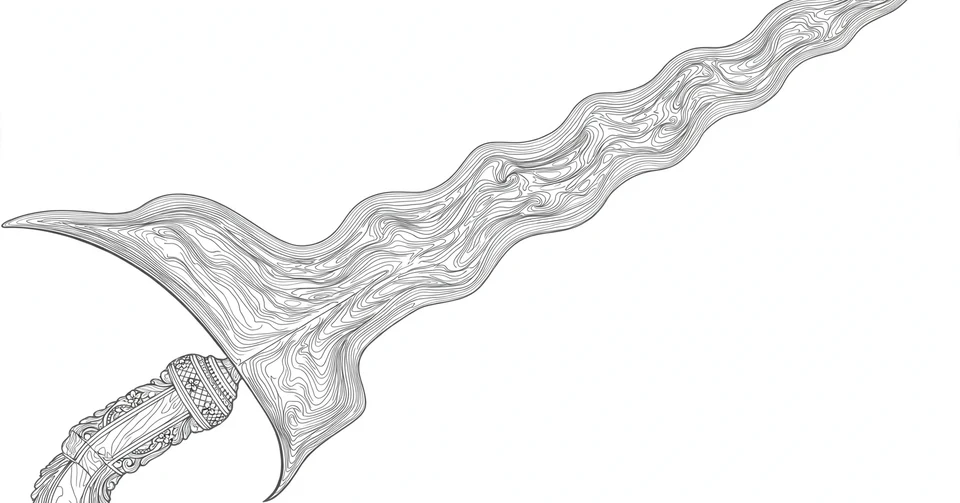
In much English writing the dagger is spelled kris, and reference works describe the pamor as a pattern of metal alloy decoration, one of the three things by which a blade is judged, alongside its form and its age. That dry definition hides something remarkable. It is designed, named, and argued over. Collectors can spend an evening debating a single blade's pamor the way other people debate handwriting, and like handwriting, it identifies its maker and its owner at once.
Two metals, folded into one blade
A pamor begins as a stack. The smith, honoured with the title empu, forge welds layers of iron or steel together with layers of iron rich in nickel, then folds the combined billet back on itself and welds it again. In high quality blades the metal is folded dozens or even hundreds of times, so that a finished blade carries its two metals interleaved in fine strata, like the layers of folded pastry.
Nothing of the pattern can be seen yet. A freshly forged blade is grey and unpromising, and the pattern only appears at the very end, when the blade is washed in an acidic preparation of citrus juice and arsenic bearing minerals. This washing, called warangan, was a process smiths kept secret among themselves. The acid darkens the iron almost to black, while the nickel rich layers resist it and stay bright. Only then does the pamor bloom across the surface, silver on charcoal, exactly where the folds had hidden it all along.
This is why a pamor can never be faked by engraving or printing, at least not convincingly. The pattern does not sit on the keris. It runs through it. Grind the blade thinner, as centuries of the yearly ritual washing called jamasan have done to many old blades, and the pattern is still there underneath, changed by the grinding but never erased, because the two metals continue all the way down.
The pamor an empu plans, and the one the fire allows
An empu does not leave the pattern to luck. By choosing how the layers are stacked, twisted, cut, and restacked, he aims at a specific recognised pattern, the way a weaver aims at a motif. The intention is real, and a master could come close to his target again and again.
Close, but never exact. Every fold shifts slightly under the hammer. Every twist tightens unevenly. When the blade is ground to its final shape, the edge cuts down through the folded strata at depths nobody can fully predict, and the etch reveals whatever the layers happen to be doing at that precise depth. The pamor that emerges is a faithful version of the plan, but it is a version, not a copy. Two blades from the same billet, by the same empu, chasing the same named pamor, will still differ in a hundred small ways.
I find this the most honest feature of the whole tradition. The culture around the keris never pretended the smith was a machine. The pamor records both his intention and his negotiation with hot metal, and the small accidents of the forge are not treated as flaws. They are what make a blade this blade and no other. That is the sense in which the pamor really is a fingerprint. It is not a metaphor about beauty. It is a plain statement about identity: this pattern occurred once, under one pair of hands, and it will not occur again.
Names for the weather inside the steel
Because patterns repeat in families even when they never repeat exactly, Java gave them names. Around sixty variants of pamor are recognised today, and the names are drawn from the everyday world the smiths lived in. Beras wutah means scattered rice, its bright grains strewn across the dark ground of the blade. Udan mas is golden rain. Kembang kacang is the peanut flower, kembang pala the nutmeg flower, and there are many more, each with its own recognised shape and its own reputation.
The names were never only descriptive. In traditional belief, each pattern carried its own properties and its own fortune, and choosing a pattern was closer to choosing a blessing than choosing a wallpaper. Beras wutah, the scattered rice, was believed to grant its possessor an easy life without famine, and blades carrying it were often assigned to government officers who were paid, in whole or in part, with foodstuffs such as rice. A man whose salary arrived as grain carried a blade patterned with grain. The logic is poetic rather than practical, but it was taken seriously for centuries.
It helps explain why the keris sits so naturally inside Javanese storytelling. The heroes of wayang, the shadow puppet theatre, are carved with a keris at the back, because a person of consequence was incomplete without one. In a culture that reads blades this closely, the pamor is part of a character's introduction, as much as his crown or his voice.
The iron that fell from the sky
Nickel bearing iron is what makes a pamor possible, and Java found it in more than one place. Faint pamor already appears on blades from the Majapahit period, made with iron ores carrying a small natural content of nickel, most probably imported from the island of Sulawesi, where the pamor Luwu of the Luwu region was well known in both Sulawesi and Java.
The most prized material of all, though, fell out of the sky. At the end of the eighteenth century an iron meteorite came down near the temple complex of Prambanan in Central Java. The meteorite was excavated and transported to the keraton, the royal court, of Surakarta, and from that time the smiths of the royal territories used small pieces of it in their finest work, cutting the precious metal into kris blades, pikes, and other status weapons. After etching, the small percentage of nickel in the meteoric iron produced silvery patterns that lit up faintly against the darkened steel, and a blade whose pamor contained iron that had arrived from the heavens carried an obvious prestige.
Prestige fed on scarcity. The meteorite was a single stone, and the court guarded it accordingly, so genuinely meteoric pamor was always rare, even in the centuries when the story was freshest. The material became so charged with meaning that it acquired a category of its own among collectors: pamor Prambanan, the pattern named after the place where its iron fell.
What the laboratory found
Modern science has now tested the legend, and the result is a useful lesson in reading old claims carefully. In a 2025 study published in Meteoritics and Planetary Science, researchers examined five nickel rich kris blades held by the Weltmuseum Wien in Vienna, comparing them with newly forged test blades made using known meteorite iron. Their conclusion was restrained. Only one of the five old daggers showed a possible admixture of nickel iron from the Prambanan meteorite. Just as importantly, they showed that a high level of nickel in a blade does not by itself prove that any meteorite was involved, because terrestrial ores and later commercial nickel can produce bright pamor too.
None of this makes the tradition foolish. It makes it precise. The Prambanan story is real, the stone really was dug up and carried to Surakarta, and some court blades really were forged with pieces of it. Those blades are simply far rarer than the number of family stories would suggest, which is exactly what one would expect of a material that arrived once, in one place, in limited quantity. A good pamor does not need a meteorite to be genuine. It needs two metals, folded well, and an etch that lets them speak.
A pamor has to suit the person who carries it
There is one more layer of belief to record, and it should be recorded as belief. Traditional teaching holds that a pamor carries a character of its own, a fortune that may or may not suit the person who owns the blade. Harmony between the weapon and its owner was considered critical. One old test was to sleep with the blade under your pillow: if the owner dreamed well, the pairing was sound, and if the dreams were bad, the blade was unlucky for that person and should be passed on. A pamor that was wrong for one man might be exactly right for another.
Collectors in Java still talk this way, of blades that feel settled with one owner and restless with another, and it would be easy for an outsider to smile at it. I would rather take it as a metaphor that got there early. Anyone who has inherited a family object knows that fit between a person and a thing is real, even if it is made of memory and habit rather than spirits. The pamor tradition simply gave that feeling a vocabulary, centuries ago, and tied it to the most individual feature a blade has.
UNESCO placed the Indonesian kris on its Representative List of the Intangible Cultural Heritage of Humanity in 2008, having first proclaimed it in 2005, and the pamor is a large part of what that listing protects. Not a weapon skill, which the modern world no longer needs, but a way of reading metal.
Lay two old blades side by side and the lesson is plain. The forms may match, the hilts may match, the smiths may even match, but the pamor never does. Fire, folding, and one man's hands conspired to write something unrepeatable into the steel, and the culture that made it had the wit to treat that accident as the most valuable part. A fingerprint is not the part of you that you designed. It is the part that proves the rest is yours.
More in Culture & Society
Latest posts
- Shimekasu Was Herring You Never Ate
- A Hana Donko Wears Its Cracks Like Flowers
- A Lembaga Perkreditan Desa Is a Bank the Village Owns
- Kaburiyu Is How You Talk Your Body Into the Bath
- Kuki Is the Spring the Sea Turned White
- Tatsuko Wished for Beauty and Became a Statue
- Warangan Is the Wash That Reveals the Pattern
- Ganbanyoku Is Bathing Without Water
- The Obuki Throws Out Nine Thousand Litres a Minute
- Every Village Writes Its Own Awig-Awig
- Sainokawara Is a Bath You Share With a Hundred Strangers
- Umaji Refused to Disappear
- Rwa Bhineda Keeps Opposites From Going to War
- Kasepekang Is Exile Without Leaving Home
- Jamasan Washes a Blade Thinner Every Year