A Donko Never Got the Chance to Open
· 9 min read
A donko is a dried shiitake picked before its cap was allowed to open, and that interrupted growth is exactly why it sits at the top of Japan's shiitake grades. Cold weather, oak logs and a grower's timing decide which mushrooms earn the name.
Every shiitake mushroom on a log is on its way to the same ending. Left alone, its cap will thin out, flatten and open, and the mushroom will scatter its spores and be done. A donko is the one that never got there. It is picked while the cap is still thick, rounded and curled tightly shut, and that interrupted childhood is precisely why it sits at the top of Japan's dried shiitake grades.
The odd thing is that a donko and a koshin, the flatter and cheaper mushroom sold beside it, are not different species or even different crops. They can grow on the same log, out of the same fungus, in the same week. The only thing separating a premium donko from an everyday koshin is the morning the grower chose to pick it.
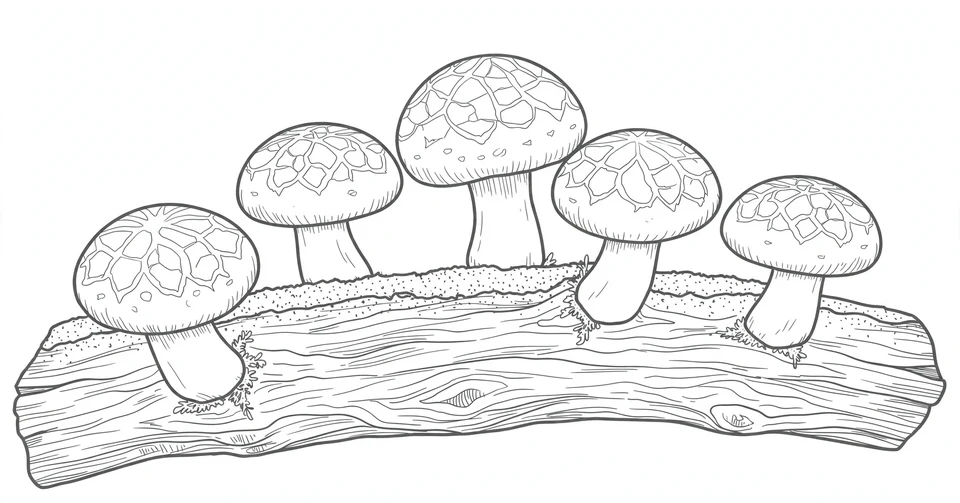
I find that quietly remarkable. The most expensive mushroom in the shop is not expensive because it grew the biggest or the longest. It is expensive because somebody stopped it early, on purpose, and knew exactly when to do it.
What makes a donko a donko
Japan sorts its dried shiitake by one simple question: how far had the cap opened when the mushroom was picked? Under the Shiitake Quality Labeling Standards of the Ministry of Agriculture, Forestry and Fisheries, mushrooms harvested before their caps have fully opened are donko, and those harvested after the cap has opened are koshin, as the Kyushu producer Sugimoto sets out in its dried shiitake FAQ. Within each name, the mushrooms are graded again by cap diameter, into large, medium and small.
At picking time it looks almost like a bun. The cap is domed and thick, its rim still curled inward, and the pale membrane under the cap has not yet torn. Picked in that bud-like state, the mushroom dries down into a dense little dome that feels heavy for its size. The Shizuoka trading company Marusho calls the donko the highest grade of shiitake, known by its small, firmly closed cap, and praises its round shape and rich, meaty flavour.
That density is the whole point. A cap that never opened never spent its substance on spores, and never stretched its flesh thin across a wide umbrella. Everything the mushroom gathered from the log stays packed into a small space, which is why a good donko chews almost like meat and why cooks reach for it when a mushroom has to hold its own in a dish rather than dissolve into it.
Slow winters on an oak log
It starts years before it is picked. Most Japanese dried shiitake are grown the old way, on natural logs outdoors, a method called genboku. Growers inoculate oak or beech logs with shiitake fungus and lay them out in the forest, and the fungus then takes anywhere from half a year to two years to spread through the wood before the first mushroom appears. Sugimoto notes that about 90 percent of Japan's dried shiitake are log grown, and that roughly 70 percent of production comes from three Kyushu prefectures, Oita, Miyazaki and Kumamoto, where the logs are mostly kunugi, the sawtooth oak growers consider the best wood for flavour.
The calendar is patient work. Marusho describes logs cut from oak and beech trees that are already 20 to 25 years old, felled in the cold months, then inoculated and left in the forest while the fungus colonises the wood. The best ground is high ground, where the days can run hot and the nights turn cold, and the mushrooms that survive those swings grow up with a flavour the company compares to wild ones. None of this can be hurried along by a machine indoors, and none of it shows on the label. It only shows later, in the thickness of the cap.
The weather then decides how many donko a log will give. Shiitake fruit when the temperature swings, and in cold weather they grow slowly. Slow growth is what a donko needs. A mushroom that swells slowly in the cold packs its flesh tight and keeps its cap curled, while the same fungus in warm weather rushes to open and ends up a thin koshin instead. Sugimoto says about 80 percent of the log grown harvest comes in spring, when the colder air produces thicker and better donko than the autumn flush.
This is also why so little of any harvest reaches the top grade. The grower cannot order a log to produce donko. He can only walk the rows, read each mushroom, and pick the ones that are ready on the one morning they are ready. Wait a day too long and the cap has opened, the grade has fallen, and the price has fallen with it. Log grown shiitake are perishable enough that producers dry them within half a day of picking, usually in hot air, so the harvest rhythm is relentless while it lasts.
The white cracks are a weather report
The most beautiful donko wear their slow childhood on their skin. When a young shiitake grows in cold, dry air, and rain does not fall directly on it, the surface of the cap cannot stretch as fast as the flesh beneath it swells. The cap splits into a pale network of cracks, white against the dark brown skin, like a flower opening or a pattern etched into the surface. A mushroom with these cracks is called hana donko, flower donko, and traders treat it as the finest form of all.
Marusho lists winter grown types such as tenpaku donko and chabana donko, carefully raised through the cold months, their caps naturally cracked by the low temperature, and says a cracked cap donko is more delicious and more expensive than a plain one. I like that the cracks are valued rather than forgiven. In most food grading, a split surface is a defect. Here it is a certificate, written by the weather, proving the mushroom grew slowly in the cold. You cannot fake it in a hurry, and you cannot produce it on demand.
Underneath, the flavour has its own quiet chemistry. Drying breaks down the cells of the mushroom, and when it is soaked before cooking, enzymes get to work and build up guanylic acid, one of the core savoury compounds of Japanese cooking. I wrote in an earlier piece about why a dried shiitake is louder than a fresh one, and the donko is that effect at its most concentrated, because there is simply more mushroom packed into every bite.
Donko and koshin are one mushroom at two ages
It helps to see the grades as a single life told at different moments. A bud picked early is a donko. Leave it, and as the cap begins to open it passes through a half open stage that Marusho calls koko. Leave it longer and the cap opens wide, the flesh thins out, and it becomes a koshin. Same log, same fungus, three different mushrooms, separated only by days.
None of this makes koshin a failure. Marusho points out that koshin, whose name carries the character for fragrance, has the strongest aroma of any shiitake, and its thin, wide cap is easy to slice and quick to rehydrate. Sugimoto says the same from the kitchen side: koshin suits dishes where the mushroom is cut small and mixed in, like soups and takikomi gohan, seasoned rice cooked with vegetables. A donko, by contrast, is built for simmered and fried dishes where its chew is the main event, and for being served whole, so the person eating it meets the full dome of the cap.
The price gap follows from all of this. A large donko needs a large, fresh, nutrient rich log and a cold season and a grower who picked it on the right morning. A koshin only needs the mushroom to be left alone. Scarcity here is not marketing. It is arithmetic, and the grades are honest about it.
Buying and cooking a donko
Choosing them at a shop is refreshingly physical. Sugimoto advises picking mushrooms that are heavy and full bodied, with thick, hard, dry caps and a bright yellow underside, and suggests judging a bag by how little volume it takes up for its weight. Dense mushrooms in a small bag beat a big bag of light ones. If the caps show the white cracked pattern, so much the better.
At home, patience applies again. A donko is dense, so it rewards a slow soak in cold water rather than a rushed one in hot water, and it comes back at roughly five times its dried weight. Before cooking, it also pays to give dried shiitake a little light. Sugimoto notes that exposure to ultraviolet light raises the mushrooms' natural vitamin D2 content, and that even an hour of strong sun, with the caps spread out gills up, is enough to make a difference. The soaking liquid is not waste. It is a small, deep stock in its own right, the base of many a vegetarian broth, and it belongs to the same family of quiet flavours as dashi, the stock under almost everything Japan cooks. Simmered whole in a sweet soy broth, a rehydrated donko turns glossy and tender at the edges while keeping its chew at the centre, and that contrast is the whole reason the grade exists.
I have come to think the donko is a small lesson in Japanese food culture disguised as a mushroom. It says that the best version of a thing is not always the biggest, the oldest or the most fully realised. Sometimes the best version is the one that was watched closely, judged kindly, and taken at exactly the right moment, before it finished becoming what it was going to be. The cap never opened. It did not need to.
More in Food & Travel
Latest posts
- Edo's Hikeshi Wore Their Dragons Into the Fire
- A Yubatake Cools a Spring With Nothing but Wood and Gravity
- Toji Meant Moving to a Hot Spring Until You Got Better
- Sodoran Treats an Heirloom Like an Honoured Guest
- You Can Read a Pecalang From Across the Street
- Nyuto Onsen Hides Seven Inns at the End of a Snow Road
- Nobody Just Watches a Panigyria, Everybody Dances
- When the Gara-Gara Starts, the Puppets Drop the Plot
- Forty Pounds of Cowbells, and the Mamuthones Say Nothing
- The Oarfish Still Answers to a Name From the Dragon Palace
- Manza Onsen Bathes at 1,800 Metres
- Irezumi Was an Art Before It Was a Warning
- The Oshi Kept Fuji's Pilgrims Fed, Housed, and Devout
- Japan's Population Decline and the Villages It Leaves Behind
- KRL Commuterline and the Trains That Move Jakarta