A Koshin Is a Donko That Was Left Alone Too Long
· 9 min read
A koshin is the same shiitake as a donko, picked a few days later, after its cap has opened wide. It is thinner and cheaper than the premium grade, far easier to use, and its open cap gives it the strongest aroma of any shiitake.
Every donko lives under a deadline. A shiitake whose cap stays thick, rounded and curled shut is worth premium money, but the mushroom is alive and it intends to open. Leave it on the log a few more days and it does exactly that, spreading out into a wide, thin umbrella. On the morning that happens, it stops being a donko and becomes a koshin, and its price falls off a cliff.
Nothing else about it has changed. A koshin grows on the same log, out of the same fungus, quite possibly in the same week as the donko growing beside it. The only difference between the most expensive shiitake in the shop and one of the cheapest is that a grower walked past one of them, on one particular morning, and decided to leave it alone.
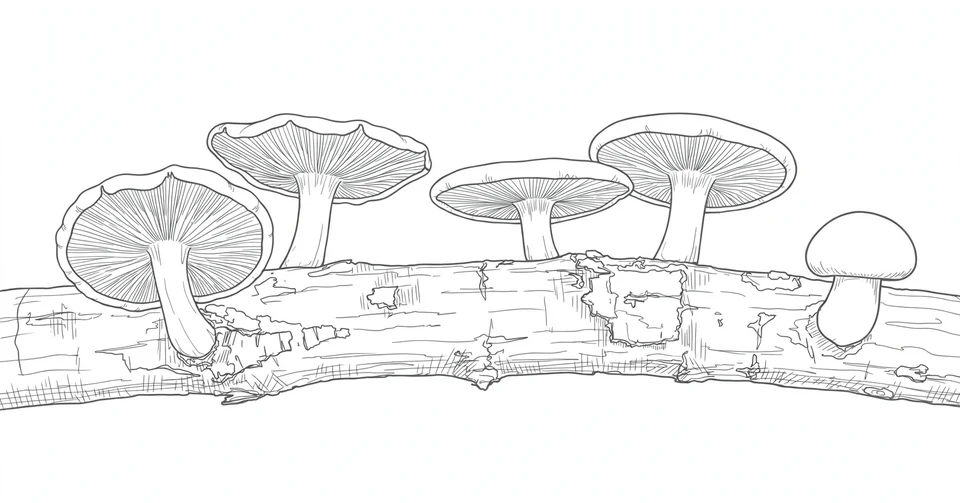
I used to read that as a small story about failure, a mushroom that missed its moment. The more I have cooked with both grades, the less I believe it. A koshin is not a donko that went wrong. It is the same mushroom at a later age, built for different work, and in at least one respect, its aroma, it beats the premium grade outright.
One mushroom, three names
Japan sorts its dried shiitake by asking one question: how far had the cap opened on the day the mushroom was picked? Under the Shiitake Quality Labeling Standards of the Ministry of Agriculture, Forestry and Fisheries, a mushroom harvested before its cap has fully opened is a donko, and one harvested after the cap has opened is a koshin, as the Kyushu producer Sugimoto explains in its dried shiitake FAQ. Within each of the two names, the mushrooms are graded once more by cap diameter, into large, medium and small.
The Shizuoka trading company Marusho fills in the middle step. As a donko grows, its cap begins to open, and at the halfway stage, partly open, partly still curled, the mushroom is called a koko. Left longer, the cap opens wide and flat, and the mushroom arrives at koshin. I wrote earlier about the donko, the premium shiitake that never got the chance to open, and everything in that piece about oak logs, cold springs and patient growers applies to the koshin word for word, because until the moment of picking, they were living the same life.
Seen from underneath, the difference is a small drama of its own. A young donko still wears a pale membrane stretched under its cap, unbroken. A koshin has torn through that membrane, opened its gills to the air and scattered its spores, which is the entire purpose of a mushroom in the first place. The donko is interrupted youth. The koshin is a mushroom that was allowed to finish its one job.
What the extra days do to a koshin
Opening is not free. The flesh a mushroom gathered from its log is a fixed amount, and spreading that flesh across a wide, flat cap stretches it thin. A koshin is broad but light, where a donko is small but dense, and it will never have the donko's meaty chew. That is the honest loss, and the grading system does not pretend otherwise.
The gain is hiding under the cap. The gills of a shiitake are where much of its scent lives, and a koshin is the grade that finally exposes them. Marusho notes that the name koshin is written with the character for fragrance, and says plainly that the koshin has the strongest aroma of any shiitake. Sugimoto, describing the same mushroom from the kitchen side, says the opened cap gives it a large diameter and a thin flesh that is easy to cut to match other ingredients, and that it rehydrates quickly. Thin, wide, fragrant and fast to soak: as a description of a cooking ingredient, that is a list of virtues, not defects.
There is a quieter bonus in the same direction. Sugimoto finishes its dried shiitake under ultraviolet light, which raises their natural vitamin D, and in its own figures the koshin comes out ahead of the donko, listed at 48 micrograms against the donko's 34 per 100 grams. It makes a certain sense. A cap that has opened turns its gills toward the light. A cap that stayed shut keeps them in the dark. The mushroom that was left alone ends up, by this one measure, the more nourished of the two.
Where koshin quietly wins, the weekday kitchen
Watch how each grade is actually used and the hierarchy softens further. A donko is built for dishes where the mushroom appears whole and its chew is the main event: simmered in broth until it turns glossy, or fried. A koshin is almost never served whole. Marusho says it is usually chopped into pieces and used in soups and in takikomi gohan, the seasoned rice cooked together with vegetables and stock. Sugimoto agrees, pointing koshin at dishes where the mushroom is cut small and mixed through. In other words, the cheap grade is the one that dissolves into the food and flavours all of it, while the expensive grade sits on top being admired.
The underlying flavour chemistry does not care about the grade at all. Drying a shiitake breaks down its cells, and soaking it before cooking wakes up enzymes that build guanylic acid, one of the core savoury compounds of Japanese cooking, to roughly ten times its fresh level. I went through that chemistry in a piece on why a dried shiitake is louder than a fresh one, and it applies to a five hundred yen bag of koshin exactly as it applies to a gift box of hana donko. Slice a koshin thin, soak it, and its soaking water becomes the same deep, quiet stock. The donko does not have a better engine. It just has a thicker body around it.
There is also the simple matter of the clock. A dense donko rewards a long, slow soak and some planning. A koshin, being thin, is ready far sooner, and it slices without a fight. For a Tuesday night soup or a pot of mixed rice, I reach for koshin without a flicker of guilt, and I have come to suspect that most Japanese home cooks, whatever the gift catalogues say, do the same.
The log does not care which grade it grows
It is worth remembering what a koshin actually grew on, because it was not anything cheap. Sugimoto says about 90 percent of Japan's dried shiitake are grown the slow way, outdoors on natural logs, and that roughly 70 percent of the crop comes from three Kyushu prefectures, Oita, Miyazaki and Kumamoto, where the logs are mostly kunugi, the sawtooth oak growers regard as the best wood for flavour. Marusho describes the patience involved: logs cut from oak and beech trees already 20 to 25 years old, inoculated with shiitake fungus, then left in the forest while the fungus spreads through the wood for anywhere from half a year to two years before the first mushroom appears. The best ground is high ground, where hot days and cold nights take turns stressing the mushrooms into flavour.
Every koshin on a shop shelf went through all of that. It was not rushed through an indoor bed; Sugimoto points out that it is fresh shiitake, not dried, that mostly comes from indoor sawdust beds, while the dried trade belongs to the logs. The koshin's low price is therefore not a sign that it was produced cheaply. The expensive years all happened before it opened. What the grower could not sell you was the timing, and timing, in the end, is all the donko premium ever was.
Why the price falls, and why that is fair
The price gap is not a conspiracy against the open cap. It is arithmetic. A good donko is scarce because everything has to go right at once: a large, fresh, nutrient rich log, a cold season that slows the mushroom down, and a grower who picks it on the one right morning, because log grown shiitake are perishable and producers dry them within half a day of harvest. Sugimoto notes that about 80 percent of the log grown crop is picked in spring, when the cold air produces the thickest donko. Warm weather pushes mushrooms to open quickly, and a warm flush turns a log's output toward koshin whether the grower wants it or not.
A koshin requires none of that luck. Any shiitake left alone becomes one, so the supply is effectively unlimited, and unlimited things are cheap. The grade measures scarcity, not worth. Once you see that, the price stops looking like a verdict on the mushroom and starts looking like what it is, a weather report and a labour bill, attached to a cap.
Buying well is mostly about freshness rather than grade. Sugimoto advises choosing dried shiitake that feel heavy and full bodied, with a bright yellow underside to the cap, and warns that mushrooms which have absorbed moisture go soft and start to smell fishy. For koshin, that advice narrows to something simple: broad caps, intact rather than shattered, dry enough to feel firm, and a smell that arrives before you even open the bag properly. That smell is the point of the grade. If it is not there, the one advantage a koshin holds over every other mushroom has already been lost to a damp shelf.
I have stopped thinking of the koshin as the mushroom that missed its chance. A koshin is a donko that was allowed to finish, and finishing turns out to have its own rewards: an open cap, a stronger scent, a thinner slice, a kinder price. The donko will always be the mushroom as ceremony, thick and patient and a little solemn. The koshin is the mushroom as everyday life, and everyday life, in my experience, is where most of the flavour actually gets used.
More in Food & Travel
Latest posts
- Hashigo-Nori Is Riding a Ladder Someone Else Holds
- At a Goma, Prayers Are Written to Be Burned
- The Sekaa Teruna Builds the Monsters
- A Lembaga Perkreditan Desa Is a Bank the Village Owns
- Every Melasti Goes to Fetch Tirta Amerta
- Kaburiyu Is How You Talk Your Body Into the Bath
- When the Kulkul Stops Sounding for You
- A Caru Is an Offering for the Ones You Fear
- Tatsuko Wished for Beauty and Became a Statue
- Warangan Is the Wash That Reveals the Pattern
- Ganbanyoku Is Bathing Without Water
- The Obuki Throws Out Nine Thousand Litres a Minute
- Every Village Writes Its Own Awig-Awig
- Sainokawara Is a Bath You Share With a Hundred Strangers
- Rwa Bhineda Keeps Opposites From Going to War