A Haori Is the Jacket That Turns a Kimono Formal
· 13 min read
A haori is the short open jacket worn over a kimono, and the black crested version is what makes a man's formal dress complete. This is its history, its rules, and how to wear one.
A haori is the one garment that can turn an ordinary kimono into formal dress. It is a short, open jacket worn over a kimono, cut like a kimono that stops at the hip or thigh, and it closes loosely with two short cords instead of a sash. Nothing about it wraps, ties, or cinches the body the way a kimono does, and that looseness is the whole point. Put one on and the outfit underneath does not change, yet the occasion does.
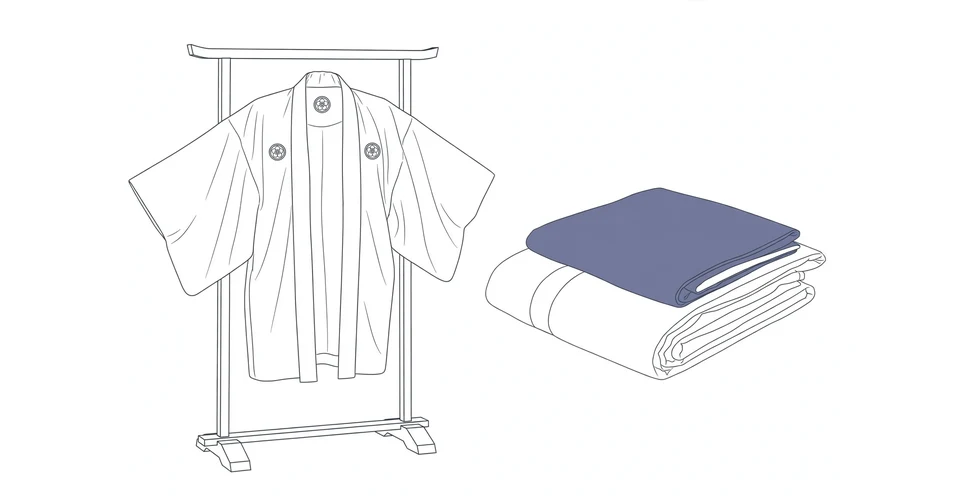
That quiet transformation is why the haori matters far more than its size suggests. In a sumo stable, a wrestler who has reached the salaried ranks may step out in a crested kimono and haori jacket with hakama trousers, and everyone reading the outfit knows his standing without a word being spoken. At a wedding, a groom wears the same black jacket. At a graduation ceremony, a student wears it too. It is a small piece of cloth, but in Japan it works like a badge, a frame, and a finishing touch all at once. I find that economy admirable. A single layer, added or removed, says what a whole speech could not.
What a haori is, and what it is not
A haori looks like a kimono that has been cut short, and in construction that is almost exactly what it is. It has the same straight sleeves and the same T-shaped body, but it has no overlapping front panels, the wide panels called okumi that a kimono wraps across the body. Its collar is noticeably thinner than a kimono collar, and it runs in one flat line all the way to the hem instead of ending at the waist. Two small triangular panels are sewn into the side seams, a detail a kimono does not have, and they give the jacket its easy, straight fall.
The closure is what truly sets the haori apart. A kimono is wrapped shut and held by an obi, the broad sash tied at the back or front. The jacket has no obi at all. Its front panels do not meet, and it is held together only by two short cords called haori himo, which attach to small loops sewn just inside the front edges. The cords are tied loosely at the chest, and they are decorative as much as they are functional. Many wearers leave them untied altogether and simply let the jacket hang open.
That open front is also what separates a haori from the other jackets in the Japanese wardrobe. A hanten is a padded, quilted jacket built for warmth, closer to a winter coat. A happi is a light festival coat, usually worn as a uniform. This jacket sits between them in spirit, lighter than a hanten and far more refined than a happi, closer to a cardigan than to a coat. It protects the kimono underneath from dust and weather, and it adds a layer of dignity without adding weight.
From samurai shoulders to merchant streets
The haori began as practical clothing for men of the sword. Its roots are usually traced to the dobuku, an outer garment worn over armour by samurai during the Sengoku period, the age of warring states that ran through the fifteenth and sixteenth centuries. A sleeveless version of that coat, the jinbaori, was worn over armour on campaign, and the shape of a short, open outer layer survived long after the fighting stopped. Another line of descent is sometimes traced to the kataginu, a short vest of the Muromachi period. The sources disagree on the exact ancestor, so the honest version is that the jacket grew out of the practical outer layers of medieval warriors, not from a single garment with a single birthday.
What is certain is what happened next. In the Edo period, which ran from 1603 to 1868, the jacket moved from the battlefield into the streets of the castle towns. Samurai wore it as daily dress, and wealthy merchants adopted it as the mark of a man of standing. The merchants had money but not rank, and the ruling class answered their spending with sumptuary edicts that limited how loudly a townsman could dress. The merchants answered in turn with a quiet piece of defiance. They wore the garment with plain, sober exteriors and lavishly decorated linings, so that the richness showed only when the jacket moved or opened. That contrast, a quiet outside and a rich inside, is still the signature of a fine one today, and museums such as the British Museum hold formal examples that show it off.
By the late Edo period the haori had become something more than a coat. It was a sign of status and family background, and the formal black version with family crests had settled into the role it still holds. The change is described in detail in the history of the jacket on Wikipedia, which traces the same path from merchant streets to formal dress. When the Meiji era began in 1868 and the old class system came down, the jacket did not fade with it. In 1871 a government decree formalised the black crested jacket as appropriate ceremonial attire, and ordinary men who had once been barred from wearing crests began to adopt them as their own.
The black haori that means business
The most formal haori a man can wear is the kuromontsuki haori, a black silk jacket bearing his family crests. Montsuki means bearing crests, and the crests, called mon or kamon, are white emblems dyed or embroidered onto the black silk. A full formal version carries five of them, one on the back, two on the chest, and two on the sleeves. That five-crest jacket, worn with a matching kimono and striped hakama trousers, is the most formal outfit in traditional Japanese menswear, the montsuki haori hakama.
The number of crests is a scale of formality, and it is worth knowing before you rent or buy. Five crests is the highest grade, worn by grooms at weddings and by men at the most formal ceremonies. Three crests or one crest mark a step down into semi-formal dress, the style called ryaku-reisou, which is common for wedding guests, tea gatherings, and graduation ceremonies. The colour matters too. Black is the most formal colour, and coloured crested jackets, the iro-montsuki, sit a level below it. A man who understands this scale can read a room the way a Westerner reads a dress code, and a man who does not may find himself overdressed for a tea party or underdressed for a wedding.
There is a practical problem hidden in all this formality. Many Japanese families today have a crest in the records but no one in the family remembers it, and some families never had one at all. Rental shops solve this with a standard crest called a tsumon, a generic emblem anyone may wear, and the most common choices are the Gosan-no-kiri, a paulownia flower design, and the Maru-ni-tagai-taka-no-ha, a circle holding crossed hawk feathers. Some shops also offer a sticker type patch crest that can be fixed to a rented jacket. It is a modern, practical answer to an old rule, and it keeps the formal dress within reach of people whose family history is simply lost to time.
The black haori is also worn beyond weddings and graduations. Shinto priests wear a black montsuki jacket as part of their working dress, and it appears at coming-of-age ceremonies and funerals. Its meaning does not change with the occasion. Wherever it appears, it says that the wearer has dressed for the moment with care, and that the moment deserves it.
How women made the haori their own
For most of its history the haori was a garment for men, and women who wore one were making a statement whether they meant to or not. That changed in the early 1800s, when geisha in the Fukagawa district of Edo began wearing the jacket over their kimono. Fukagawa was known for a plainer, more restrained style than the flashier pleasure quarters, and its geisha were famous for setting unconventional trends. Their version was cut shorter than a man's, closer to the hip, and it was worn as a mark of quiet confidence rather than display.
The trend spread slowly, then all at once. By the 1930s, women wearing the jacket had become a common sight in Japan, and the jacket had become a normal part of a woman's wardrobe rather than a borrowed piece of menswear. In the decades that followed, the black crested version became a formal option for married women as well, and the women's version of the formal dress grew to include choices men never had, such as the ehaori, a haori patterned across its whole surface. What began as a small act of borrowing became a full half of the garment's story, and today the jacket is worn by both men and women without anyone thinking twice about it.
I think there is a lesson in that history that goes beyond clothing. The jacket did not change its shape when women adopted it. It changed its meaning, and it did so because a group of women in one district of Edo decided that a good garment was a good garment, whoever wore it. Traditions that survive are often the ones that allow that kind of quiet rewriting.
How to wear a haori without getting it wrong
The rules for wearing a haori are few, and they are mostly about restraint. First, keep it open. The jacket is not wrapped closed the way a kimono is, and pulling it tight defeats its purpose. Let it hang straight so it reads as a clean vertical line, with the kimono underneath doing the work of covering the body. Second, tie the haori himo loosely if you tie them at all. The cords sit at the chest, they are knotted in a simple, even knot, and they are meant to suggest a closure rather than enforce one. Leaving them untied is perfectly acceptable, and in casual settings it is often the better choice.
The layering order is fixed when the haori is worn in the traditional way. The under-kimono called the juban goes on first, then the kimono, then the jacket last as the outer layer. The kimono is secured with its obi, the haori is not, and the two closures should never be confused. It sits over everything, and its hem should fall somewhere between the hip and the thigh, well above the ankle-length kimono beneath it.
The same jacket works in far more relaxed settings. A light cotton one can be worn over a yukata during a stay at a ryokan or after a bath at an onsen, kept loosely tied or left open and kept away from wet areas. Treat it as a light jacket rather than a robe, and it will behave like one. Modern wearers go further still, pairing the jacket with a plain T-shirt, straight trousers or denim, and simple shoes, and the advice from a detailed modern guide to wearing one is to keep the rest of the outfit plain when the jacket itself carries a bold print or a crest, so the haori does the talking.
Fabric and season decide which haori belongs on a given day. Cotton or polyester suits daily wear and is easy to care for. Tsumugi, a textured woven silk, is understated enough for everyday use and for cultural events. Summer versions are made from lighter, more open weaves so the layered look does not overheat the wearer. The formal black silk montsuki is reserved for ceremonies, and wearing it to run errands would be like wearing a morning suit to buy groceries. The choice of fabric is the choice of occasion, and getting it right matters more than getting the knot right.
The haori in modern Japan
The haori has survived the century in which the kimono itself became occasional dress, and it has done so partly by refusing to stay in one role. It is still the formal jacket of weddings, graduations, and coming-of-age ceremonies, still rented by the thousand from kimono shops in tourist districts, and still worn by priests and performers. At the same time it has become a fashion piece in its own right, sold in vintage shops, worn over Western clothes, and printed with patterns that would have startled an Edo merchant. That double life suits it. A garment that once hid its decoration in the lining is well suited to a time when people wear tradition on the outside and make it their own.
There is also a quieter reason for its survival. A kimono demands a full commitment of time, skill, and money, and few people outside formal occasions make that commitment now. The jacket asks for almost nothing. It slips on over what you are already wearing, it needs no sash and no lesson, and it still carries the shape and the history of the kimono with it. That low barrier is why it appears in places the kimono no longer reaches, from street fashion in Harajuku to the wardrobe of a sumo wrestler stepping out for the evening.
When I picture the haori at its best, I do not picture a museum piece behind glass. I picture a man at a wedding, his black jacket catching the light as he bows, and the white crests on his back and sleeves doing the quiet work of naming his family. The jacket does not shout, and it does not need to. It is formal dress reduced to its essentials, a short open layer that says the wearer understands the occasion. That understanding, more than the silk or the crests, is what the haori has always been for.
Why a small jacket carries so much weight
A haori is a short jacket, a few panels of cloth and two cords, and yet it carries the whole grammar of Japanese formal dress on its shoulders. It tells you who is getting married, who has graduated, who has reached the salaried ranks of sumo, and who is simply going out for the evening in good order. It does this without a single word, and without ever closing across the body. The lesson it offers is a modest one, and it travels well beyond Japan. Formality does not have to mean stiffness, and a garment does not have to be large to be serious. Sometimes the smallest layer is the one that makes the outfit, and the occasion, complete.
More in Culture & Society
Latest posts
- Tabi Are the Split Toe Socks Japan Wears Under Everything
- Ukiyo-e Turned Everyday Edo Into Art Anyone Could Own
- Zori Are the Quiet Sandals Japan Wears to Every Formal Occasion
- An Obi Is the Knot That Holds a Kimono Together
- Joya no Kane Rings Out the Old Year One Hundred Eight Times
- Base Genep Seasons Every Balinese Feast From the Mortar Up
- Geta Still Clatter Through Japanese Summer
- Shakyo Copies the Sutra One Stroke at a Time
- Yukata Is the Robe Japan Reaches for After the Bath
- Bonsho Is the Bell That Wakes a Japanese Temple
- Prajnaparamita Is the Wisdom Behind the Heart Sutra
- A Lamak Turns a Coconut Leaf into a Hanging Prayer
- The Heart Sutra Fits the Whole of Buddhism on One Page
- Shinran Turned Chanting Into Gratitude
- Sambal Matah Wakes Up Every Balinese Plate Raw