The Way of the Sword Lives On in Kendo
· 18 min read
Kendo is the Japanese way of the sword, a discipline of bamboo swords, armour and etiquette that grew out of samurai kenjutsu and is now practised in more than sixty countries.
Stand at the edge of a dojo floor in Japan on a weekday evening and the first thing you notice is the sound. Bamboo cracks against bamboo, feet stamp the wooden floor in rhythm, and voices shout short, sharp cries that seem to come from the belly rather than the throat. Two figures in dark armour face each other across a few steps of polished wood, and then they move. In that moment, kendo looks like a fight. Stay a little longer and it starts to look like something else, a conversation held at speed, with rules, respect and a long memory behind every strike.
The word itself gives the game away. Ken means sword and do means way, so the name translates as the way of the sword. It is a modern Japanese martial art descended from kenjutsu, the swordsmanship of the samurai, but it is not a museum piece. Practitioners wear protective armour called bogu and strike each other with a bamboo sword called a shinai, and they do it in school gyms, community halls and dojos all over the world. The armour lets them attack at full speed without injuring each other, which is the clever trick at the heart of kendo. Real swords ended the conversation. Bamboo swords keep it going.
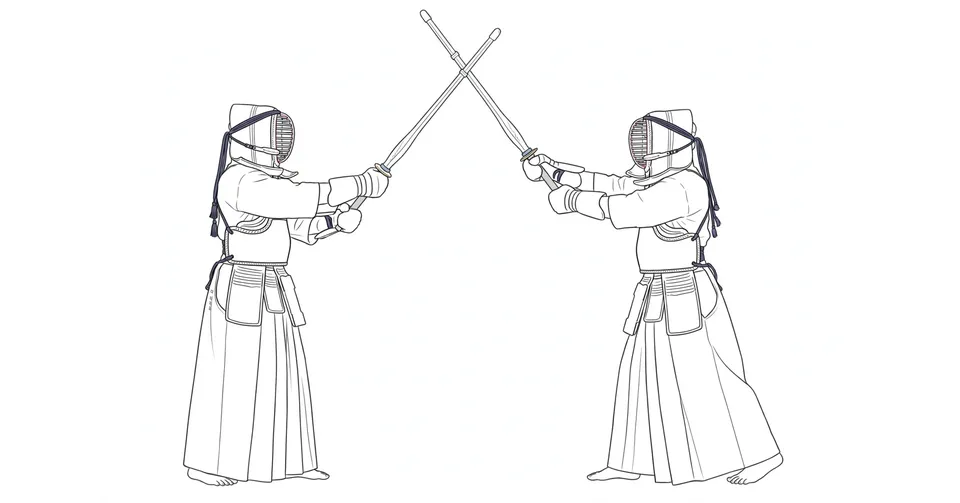
What makes kendo worth a closer look is not the equipment, impressive as it is, but the fact that it survived the end of the world that created it. The samurai class was abolished more than a century and a half ago, swords were banned from public wear, and kendo was even outlawed for a time after the Second World War. Yet today it is practised by millions of people, from schoolchildren in Japan to office workers in Paris and Jakarta, and its world championship draws athletes from sixty countries. This is the story of how a way of killing became a way of living, and why it still matters.
From kenjutsu to kendo: how the sword became a way
The roots of kendo lie in kenjutsu, the practical swordsmanship that samurai studied to survive real combat. After the Onin War threw Japan into a century of civil war in the late fifteenth century, schools of swordsmanship multiplied across the country, each guarding its own techniques. By the end of the Edo period there were said to be around three hundred different styles, a crowded marketplace of ideas about how a sword should move. That variety is the first thing to understand about kendo. It was never one technique handed down unchanged. It was an argument, carried on for centuries, about the best way to use a blade.
The argument changed shape when Japan entered a long peace under the Tokugawa shogunate. With fewer battles to fight, swordsmen began to ask what their art was for when nobody needed killing. Books of sword theory from the early Edo period, including Yagyu Munenori's Heiho Kadensho and Miyamoto Musashi's Book of Five Rings, treated the sword as a discipline for the mind as much as the body. The idea of katsunin-ken, the life giving sword, took hold, the notion that the same weapon could be used to protect and cultivate life rather than take it. That shift, from killing technique to character training, is the seed from which the modern art grew.
The practical breakthrough came in the Shotoku era, from 1711 to 1715, when Naganuma Shirozaemon Kunisato of the Jikishinkage-ryu school developed protective equipment and a training method using the shinai. The International Kendo Federation calls this the direct origin of present day kendo, and the claim is easy to believe. Once a swordsman could strike at full force without hurting his partner, practice could be repeated hundreds of times in a single session, and skill could be built the way a musician builds it, by repetition rather than by luck. Later teachers improved the gear, and by the Horeki era, from 1751 to 1764, iron headgear and bamboo armour were in common use. Inter-school matches became popular in the Kansei era, from 1789 to 1801, and ambitious swordsmen travelled between provinces looking for stronger opponents.
By the early nineteenth century, three great dojo dominated Edo, present day Tokyo. Chiba Shusaku's Genbukan, Saito Yakuro's Renpeikan and Momoi Shunzo's Shigakkan drew students from every class, not only samurai but townspeople and even farmers, and the Genbukan alone is said to have had more than three thousand students. It was here that the modern shape of kendo settled: full contact practice with bamboo swords, named techniques such as oikomi-men and suriage-men that are still taught today, and a competitive spirit that treated the dojo as a place to test oneself rather than a place to hide.
Then the world that had sustained the swordsman collapsed. The Meiji Restoration of 1868 dissolved the samurai class and prohibited the wearing of swords in public, and kenjutsu declined sharply. Many teachers lost their livelihoods overnight. Kendo found new patrons in the Tokyo Metropolitan Police, who kept sword training alive as a practical skill, and in 1895 the Dai-Nippon Butoku Kai was founded to promote the martial arts nationally. In 1912 a common set of formal exercises, the Nippon Kendo Kata, was created to unify the many schools, and according to the All Japan Kendo Federation this was the first time the word kendo itself was used. Kendo now had a single name, a shared curriculum and a place in school physical education. The historian's account of this transformation is told in full in the brief history published by the International Kendo Federation, which traces the line from the sword schools of the civil war era to the modern federation.
War nearly finished the story. After Japan's defeat in 1945, the Allied occupation banned kendo as too militaristic, and the Butoku Kai was disbanded. But the revival came quickly. In 1952, as Japan regained its sovereignty, the All Japan Kendo Federation was founded, and kendo returned to schools as a physical education subject and a sport, stripped of its militaristic trappings. The rules were rewritten for safety and fairness: a marked court, a points system, and strikes limited to the head, the wrists, the body and a thrust to the throat. What returned was not the old swordsmanship. It was something new, built from its pieces.
The shinai and the armour that made practice possible
Everything in kendo depends on two inventions: a sword that does not cut and armour that absorbs a blow. The shinai is made of four slats of bamboo bound together, a design that replaced the earlier bag covered fukuro shinai in the early nineteenth century because it was more elastic and durable. Hold one and the first surprise is how light it feels. The second surprise is how much it stings when it lands properly, a reminder that a practice weapon is still a weapon. The four slat construction spreads the force of impact and lets the bamboo flex, which is why two people can strike each other at full speed, day after day, and walk away unhurt.
The armour, the bogu, has four parts, and each one is a small piece of engineering. The men protects the head and shoulders, with a metal grille across the face and thick padding at the throat. The kote are padded gloves that guard the wrists and forearms. The do is a curved breastplate, often lacquered, that covers the torso. The tare hangs at the waist and protects the hips and groin. Together they cover every legal target, which is no coincidence. The targets and the armour were designed for each other, and kendo only works because the two halves of the system agree.
Under the armour, the uniform is simple and deliberate. A heavy cotton jacket called a keikogi is worn with a hakama, the wide pleated trousers that turn a kimono into formal dress. Kendo practitioners, along with students of iaido, aikido, kyudo, jodo and naginata, all wear the hakama for training, usually the divided umanori type, in black, navy or white. If you want to understand why the garment matters, the story of the hakama is worth reading, because it shows how a piece of clothing can carry ceremony into a place of sweat and effort. The deep pleats hold their crease, the wide legs hide nothing about the feet, and the whole outfit says the same thing before a single strike is thrown: this is a formal occasion, and you are expected to behave accordingly.
There is a quiet wisdom in practising with a weapon that cannot kill. A real sword makes every mistake final, so students of the old schools spent most of their time on forms, rehearsing movements without a partner who fought back. The bamboo sword changed that bargain. It lets a student test a technique against a resisting opponent, fail, adjust and try again, all in the same evening. That is why kendo could become a sport without losing its seriousness. The danger is simulated, but the lessons about timing, distance and nerve are real, and they are learned the only way such lessons can be learned, by doing.
A practice built on etiquette
Step into a dojo and the first lesson has nothing to do with the sword. You bow when you enter, you bow to the teacher, you bow to your partner, and you bow when you leave. The bow, rei, is not decoration. It is the practice, or at least the frame that holds the practice together. Kendo insists that respect comes before technique, and that a person who cannot bow properly cannot be trusted with a weapon, even a bamboo one. There is something bracing about that demand. In a world that treats courtesy as optional, the dojo treats it as the entry fee.
A session usually opens with mokuso, a short period of silent sitting with eyes closed, kneeling in seiza. The purpose is practical as much as spiritual: to leave the noise of the day outside and arrive, mentally, in the room. The stillness has a family resemblance to the quiet of a temple, and it is no accident that the same culture that rings the joya no kane at New Year, the great temple bell whose sound is meant to clear away worldly desire, also begins sword practice in silence. Both acts say the same thing, that a clear mind is the precondition for anything worth doing.
Once practice begins, the sound returns, and with it the kiai, the sharp shout that accompanies a strike. Beginners often think the shout is about intimidation, but its real job is breathing and commitment. A strike thrown without a kiai is usually a strike thrown without conviction, the body holding something back. The shout forces the breath out, commits the whole body to the movement, and tells the partner, honestly, that the attack is real. Teachers listen to the kiai the way a music teacher listens to tone. It reveals everything about a student's state of mind.
Two ideas govern the space between the fighters. Maai is the distance, the constantly shifting gap that is neither too close nor too far, and a good practitioner controls it the way a chess player controls the centre of the board. Zanshin is what remains after the strike, the alertness that continues even after the point is scored, because a fight is not over when the sword lands. Watch a skilled practitioner after a successful strike and you will see it: they do not relax, they do not celebrate, they stay ready, facing the opponent, sword still raised. The lesson is plain enough to carry out of the dojo. Finishing something well includes the moment after the finish.
Grades, matches and the long road to eighth dan
Progress in kendo is measured by grades, and the system is deliberately slow. Students begin at kyu grades and work toward dan grades, which run from first to eighth. Each promotion requires an examination in front of a panel of senior teachers, and the higher the grade, the more the examination tests character and bearing rather than mere technique. The eighth dan examination is famous for its difficulty, and candidates often attempt it many times over many years before passing. There is no shortcut and no way to buy the rank, which is exactly the point. The grade is supposed to describe the person, not the performance on a single day.
Alongside free practice, every student learns the Nippon Kendo Kata, a set of ten formal exercises created in 1912 to preserve the techniques and spirit of the old sword schools. Seven of the forms use the long sword and three use the short sword, and they are practised with wooden swords rather than bamboo ones, in a slow, precise choreography that teaches the angles and timing a free exchange moves too fast to show. The kata are kendo's memory. Long after the schools that invented the techniques have vanished, the forms keep them alive, and a student who knows the kata carries a piece of the nineteenth century in their hands.
A kendo match, or shiai, is a contest of points rather than force. Two fighters compete in a marked court, and a point is awarded for a strike to the head, the wrist, the body or a thrust to the throat, delivered with the correct part of the shinai, in the correct spirit, with the correct posture and a clear kiai. Three referees watch, flags in hand, and a point counts only when at least two of them agree. The first fighter to score two points wins, and a standard adult match usually lasts five minutes. If neither fighter reaches two points, the match can go to extra time, and in the biggest tournaments the extra period is fought until a single decisive strike lands. The format sounds simple, and it is, but that simplicity is deceptive. With only four targets and five minutes, there is nowhere to hide, and the match becomes a pure test of who can read the other person a fraction of a second faster.
The scoring system also explains kendo's most distinctive feature, its insistence on spirit. A strike that lands but is thrown with a sloppy posture or a silent voice does not count, even if it hits the target cleanly. The referees are not judging contact, they are judging a whole action, and that is a deliberate choice. It keeps the sport honest. It says that how you win matters as much as whether you win, and that a point earned without spirit is not a point at all. Anyone who has watched a tournament knows the frustration of seeing a clean hit waved away, and anyone who has practised for a few years comes to see the sense of it.
Kendo beyond Japan
For most of its history kendo belonged to Japan, but its second act has been international. The turning point came at the Tokyo Olympic Games of 1964, when kendo was demonstrated as a national sport before a global audience. The demonstration put the sound of bamboo and the sight of the armour in front of people who had never seen a dojo, and the interest it sparked never really faded. In 1970 the International Kendo Federation was founded, and the first World Kendo Championships were held the same year at the Nippon Budokan in Tokyo, with athletes from seventeen countries and regions. The event has been held every three years since, and the numbers tell the story of the spread. At the sixteenth championships in Tokyo in 2015, fifty six countries and regions took part. At the nineteenth championships in Milan in July 2024, the number had grown to sixty.
The spread has not been even, and the pattern says something about how culture travels. South Korea has the second largest population of practitioners after Japan and has beaten Japan in team competition, a genuine rivalry that pushes both countries to improve. Kendo has also grown steadily in the United States, France, the United Kingdom and Germany, where community dojos often meet in school gyms and church halls, far from the polished wooden floors of Japan. Around two million people have taken grading examinations and registered with the All Japan Kendo Federation, and the true number of practitioners is higher, since many train in local clubs without ever registering. The full account of that expansion, including interviews with the federation's leaders, is told in this report from Tokyo Updates, which follows kendo from a Tokyo dojo to a world championship in Milan.
Popular culture has done as much as any federation to spread the word. The anime Musashi no Ken inspired a generation of young practitioners in the 1980s, and more recently Demon Slayer brought sword fighting to an audience that had never heard of a dojo. Hollywood played its part too, and the All Japan Kendo Federation has recorded a rise in enquiries at schools after the release of The Last Samurai. It would be easy to be sniffy about people who arrive because of a cartoon, but the dojo does not care why you walk in. It cares whether you stay, and whether you learn to bow. Many of the most dedicated practitioners alive today first picked up a bamboo sword because of something they saw on a screen, and that is not a weakness in kendo. It is a sign that its appeal is wider than its traditions.
The next milestone is already on the calendar. The twentieth World Kendo Championships will be held in Tokyo in 2027, the first time in twelve years that the event returns to the city where it began. For the federation, the homecoming is a chance to show how far kendo has travelled. For the rest of us, it is a reminder that a discipline born in the sword schools of feudal Japan now belongs, in a real sense, to the world.
Why the way of the sword still matters
So what is all of this for? The All Japan Kendo Federation answered that question in 1975, when it published its formal statement of purpose: the concept of kendo is to discipline the human character through the application of the principles of the katana, the sword. The purpose of practice, it added, is to mould the mind and body, to cultivate a vigorous spirit, and through correct and rigid training to strive for improvement, to hold in esteem human courtesy and honour, to associate with others with sincerity, and to forever pursue the cultivation of oneself. It is a demanding list, and it is worth reading slowly, because it makes no mention of winning. Winning is the test, not the goal.
That distinction is the heart of the matter, and it is what separates kendo from the many sports that look like it from the outside. A sport asks who is better today. A way asks who you are becoming. The two questions overlap, since you cannot improve without competing, but they are not the same question, and kendo has always been clear about which one matters more. The grading system, the etiquette, the insistence on spirit in scoring, the kata preserved from the nineteenth century, all of it points in the same direction. The sword is the tool. The person is the project.
I find that idea quietly reassuring, in a time when most things we do are measured by output. Here is a discipline that measures you by input, by how you show up, how you bow, how you treat a partner who is weaker than you, and whether you keep your guard up after the point is scored. None of that appears on a scoreboard, and all of it is the point. It is also, I think, why kendo has survived every attempt to kill it, from the abolition of the samurai to the postwar ban. Institutions can be banned. A practice that makes people better at living cannot be, because the people who need it will always find a way to keep doing it.
There is a practical lesson in that survival, too. The teachers who rebuilt kendo after the war did not pretend the past had never happened. They kept the techniques, rewrote the rules, and let kendo become something its founders would not have recognised, a school subject, a sport, a global pastime. Traditions that refuse to change die. Traditions that change while keeping their centre intact get to live, and the centre of this one was never the sword. It was the discipline of the person holding it.
If you ever get the chance to watch a practice session, take it, and stay past the noise to the quiet at the end, when the armour comes off and the practitioners sit together, tired and companionable, folding their hakama with care. What you will see is not a relic of feudal Japan and not a sport looking for an audience. You will see ordinary people, of all ages and from many countries, doing something difficult together and doing it with courtesy. The way of the sword lives on, not because the sword matters, but because the way does.
More in Culture & Society
Latest posts
- The Taiko Musubi Turned a Kimono Sash Into a Drum
- Hiroshige Walked the Tokaido and Japan Followed
- Hokusai Spent a Lifetime Chasing One Mountain
- Tabi Are the Split Toe Socks Japan Wears Under Everything
- Ukiyo-e Turned Everyday Edo Into Art Anyone Could Own
- Zori Are the Quiet Sandals Japan Wears to Every Formal Occasion
- An Obi Is the Knot That Holds a Kimono Together
- Joya no Kane Rings Out the Old Year One Hundred Eight Times
- Base Genep Seasons Every Balinese Feast From the Mortar Up
- Geta Still Clatter Through Japanese Summer
- Shakyo Copies the Sutra One Stroke at a Time
- Yukata Is the Robe Japan Reaches for After the Bath
- Bonsho Is the Bell That Wakes a Japanese Temple
- Prajnaparamita Is the Wisdom Behind the Heart Sutra
- A Lamak Turns a Coconut Leaf into a Hanging Prayer