An Obi Is the Knot That Holds a Kimono Together
· 12 min read
An obi is the wide sash that holds a kimono together and sets the tone of the whole outfit, from a soft yukata bow to a formal drum knot.
An obi is the knot that holds a kimono together. It is a wide sash wrapped around the waist and tied at the back, and it does far more than keep the robe closed. It sets the formality of the outfit, balances its colours, and tells anyone who knows how to read it exactly what kind of occasion the wearer is dressed for.
The sash began as something far humbler. In the Heian period, from 794 to 1185, the sash was a narrow cord about eight centimetres wide, a practical tie and little more. Over the centuries it grew wider, stiffer and more decorated, until it became the broad band we recognise today, sometimes more than four metres long and thirty centimetres wide, folded, padded and knotted into a shape that sits like a small piece of architecture on the wearer's back.
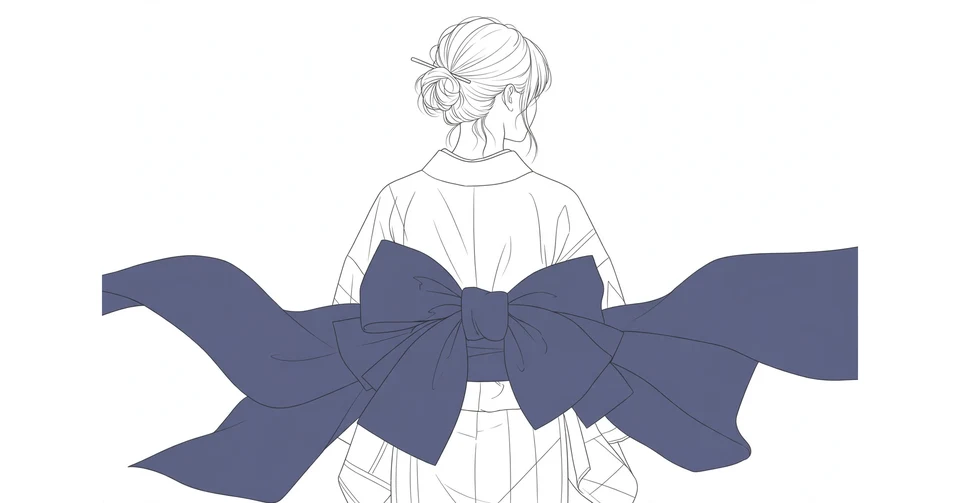
Most people first meet the sash through its softest form. The sash of a yukata, the obi, is softer and narrower, tied in a simple bow at the back, and that sentence from our piece on the summer robe is where this story starts. A yukata is wrapped right side first, then left over it, the collar sitting just below the nape, and the whole outfit is finished with wooden geta and a small drawstring kinchaku bag. Men tie the sash lower, around the hips, while women tie it at the waist. If that evening scene sounds familiar, read our guide to the yukata, the robe Japan reaches for after the bath.
What an obi actually does
Here is the first surprise. A modern formal obi is usually too wide and too stiff to hold a kimono closed on its own. The robe is really kept shut by a series of thin ties worn underneath, called koshihimo, and the obi sits on top of them as the visible seal. The sash looks like the fastening, and in a sense it still is, but its real work has moved from holding cloth to holding meaning.
That meaning is mostly about formality. The same kimono can be dressed up or down by changing the obi, and experienced wearers read the combination the way others read a dress code. A heavy brocade sash says ceremony. A soft cotton one says summer evening. The choice is never random, and getting it wrong is the kind of mistake that other guests notice even if they are too polite to mention it.
The obi also does the visual work of the outfit. A kimono is a large, flat expanse of cloth, and without the sash it can look unfinished. The band breaks the vertical fall of the robe, gives the eye somewhere to rest, and lets the wearer play colour against colour. A plain indigo robe wakes up under a gold sash, and a busy floral robe calms down under a solid one.
From a cord to a canvas
The history of the sash is the history of a practical object becoming a luxury. In its early days it was a cord, and men and women wore much the same thing. At the beginning of the 17th century both sexes still wore a thin, ribbon like sash. Then the widths began to diverge. By the 1680s the women's sash had already doubled from its original size. By the 1730s it was about 25 centimetres wide, and by the turn of the 19th century it had reached 30 centimetres, the width that still defines a formal sash today.
Two things pushed it wider. The sleeves of the kosode, the ancestor of the kimono, were growing longer and broader at the start of the Edo period, and a wider sash was needed to keep the outfit in balance. Married women in the 1770s were also wearing long sleeved robes, and the open underarm of those sleeves made room for a broader band.
The knot moved as the sash grew. Originally every sash was tied in the front. As the knots grew bigger they became awkward to wear at the waist, and by the end of the 17th century most women were tying the sash at the back, though the custom was not firmly established until the beginning of the 20th century. The front of the outfit became a clean, flat surface, and the display moved to the back, where it could be admired as the wearer walked away.
The Edo period also turned the sash into a status object. The merchant class grew rich and dressed their wives in silk brocade sashes woven with gold thread, and the shogunate answered with sumptuary laws restricting gold thread and expensive dyes, which only made the forbidden fabrics more desirable.
The main types of obi
Not every sash is the same, and the differences are a language of their own. The types below run from the most formal to the most casual, and each one belongs to a particular kind of occasion.
| Type | Width | Length | Occasion |
|---|---|---|---|
| Maru obi | 30 to 35 cm | 360 to 450 cm | Weddings and ceremony |
| Fukuro obi | 30 cm | 360 to 450 cm | Formal parties and visits |
| Nagoya obi | 30 cm | 315 to 345 cm | Semi formal and everyday |
| Hanhaba obi | 15 cm | 300 to 400 cm | Yukata and casual kimono |
| Heko obi | 20 to 30 cm | About 300 cm | Children, men, very informal |
The maru obi sits at the top and is now almost a museum piece. Fully patterned on both sides, thick and heavy, often embroidered with metal coated yarn, it was at its most popular during the Meiji and Taisho periods. Today it is worn only by some brides and by maiko. Its lighter successor, the fukuro obi, is the most formal sash actually in regular use, patterned fully on the outer side and plainer inside.
The nagoya obi is the workhorse. It was developed by a seamstress living in Nagoya at the end of the 1920s, and it spread through Tokyo's geisha before fashionable city women adopted it for everyday wear. One end is folded and sewn in half, which makes it easier to tie, and it is normally worn in the drum knot described below. A nagoya obi made from heavy brocade can even pass as semi ceremonial wear.
At the casual end sits the hanhaba obi, the half width sash. At 15 centimetres wide it is easy to tie, cheap to buy and often reversible, so it can be folded and twisted to show a contrasting colour. It is the sash of the yukata and the summer festival. The heko obi is softer still, a loose sash of thin cloth, often dyed with shibori tie dyeing, worn by children, by men at home, and by young women with modern informal kimono. Two special types deserve a mention: the darari obi, a very long maru obi of roughly six metres worn only by maiko, and the tsuke obi, a pre tied sash in two pieces that looks no different from a regular obi when worn.
The knots that finish the outfit
The word for a knot is musubi, and the knot is where the sash stops being cloth and becomes sculpture. There are many ways to tie a sash, and different knots suit different occasions, but three dominate everyday life.
The taiko musubi, the drum knot, is the one most people picture. It is a neat, flat rectangle worn at the back, shaped with a small pillow called an obimakura and held by a decorative cord, the obijime. The style is said to have become popular at the opening celebrations of the Tomioka Hachiman Shrine in Edo in 1817, when women attending the festival began tying the back knot in the structured square form that gave it its name. Today most women tie their sash in the taiko style, and it is the default for formal dress.
The bunko musubi, the library knot, is the friendly bow of the summer festival. It looks like a large ribbon, it suits the hanhaba obi and the yukata, and it is the knot beginners learn first. Wrap the sash twice around the waist, fold one end into a loop, cross the other end over and tie it into a bow, then adjust the loops until they sit evenly. It is charming precisely because it is simple, and it suits an evening that is meant to be enjoyed rather than endured.
The kai no kuchi, the clam's mouth knot, belongs to men. It is a flat, sturdy square knot worn with the stiff kaku obi, and it matches the plain, practical character of men's dress. Men's sashes are at most about ten centimetres wide, they need no cords or pillows to hold their shape, and the whole business is finished in a minute or two. Women's dress in Japan carries the decoration, and men's dress carries the restraint, and the sash shows the split more clearly than almost any other garment.
Men wear the sash differently
A men's obi is a different object from a women's one. Where a woman's formal sash can be 30 centimetres wide and more than four metres long, a man's is narrow, subdued and tied low, around the hips rather than the waist. The standard men's sash is the kaku obi, a stiff band about ten centimetres wide and four metres long, most often woven in hakata ori, the tight weave of Fukuoka.
Men also hang things from the sash. In the Edo period, small lacquered boxes called inro hung from the kaku obi on a toggle called a netsuke, carrying seals, medicines and writing tools. What began as a practical pocket became an art object in its own right, and wealthy men competed to collect finely decorated inro. The sash was not only a fastening but a belt for carrying the small tools of daily life.
The wooden sandals complete the picture for both sexes. Geta clatter on stone paths in summer, and they are the natural partner of the soft sash and the cotton robe. Our piece on the geta that still clatter through Japanese summer follows those sandals from the workshop to the festival street, and it is worth reading alongside this one, because the sash, the robe and the sandals are one outfit, not three separate objects.
The small pieces around the sash
A formal obi never works alone. The obiage is a scarf like length of cloth worn above the sash, often dyed with shibori, which covers the obimakura pillow and keeps the upper part of the knot in place. The obijime is the decorative braided cord tied around the sash, and the obidome is a small brooch fastened onto it, which for maiko can be the most expensive item of the whole outfit. The obi ita is a stiffener slipped between the folds at the front, giving the sash its smooth, flat appearance. None of these pieces is strictly necessary for a casual yukata, and that is part of the yukata's appeal, but at a wedding or a tea ceremony the accessories appear one by one, and the outfit gains weight and ceremony with each addition.
The sash in modern Japan
The obi has survived the arrival of Western dress, which is more than most traditional garments can say. It survived because it adapted. The nagoya obi was itself an adaptation, a sash redesigned in the 1920s to be easier to tie. The tsuke obi is a newer one, a pre tied sash for people who love the look but not the labour. And today designers pair obi belts with Western dresses, jumpsuits and streetwear, using the wide sash as a waist cincher far from any kimono. A good overview of the types, the knots and the modern styling of the sash is given in the guide to the kimono obi belt, which walks through each style with clear photographs.
The economics are part of the story too. A good sash often costs more than the kimono it is worn with, especially when bought new, and the most prized weaving, nishijin ori from the Nishijin district of Kyoto, can reach prices around one million yen for a single sash. A second hand sash is far cheaper, and the second hand market is where most beginners sensibly start. The fullest reference on the subject, from the cord of the Heian period to the pre tied sashes of today, is the article on the obi sash, which documents the types, the measurements and the knots in careful detail.
The sash is no longer everyday clothing for most Japanese people, but it is not a museum piece either. It lives in weddings, graduations, coming of age ceremonies and festivals, and each wearing keeps the knowledge alive for one more generation.
Why the knot still matters
I keep coming back to a simple thought. The sash is the one part of the outfit that the wearer ties for herself, or has tied for her, and that act is the moment the robe stops being cloth on a hanger and becomes something worn. The knot is small, it sits at the back where the wearer cannot see it, and it is finished for other people to admire. There is something generous in that, a piece of beauty made to be seen by everyone except the person wearing it. That is a good rule for more than clothing: the best things we make are often the ones we cannot see ourselves, the kindness that lands behind our back, the preparation nobody notices, the knot tied neatly out of sight. It began as a cord eight centimetres wide, it grew into a canvas four metres long, and it carries a thousand years of Japanese craft in a single knot. The robe may be the garment, but the sash is the sentence that finishes it.
More in Culture & Society
- Ukiyo-e Turned Everyday Edo Into Art Anyone Could Own
- Zori Are the Quiet Sandals Japan Wears to Every Formal Occasion
- Joya no Kane Rings Out the Old Year One Hundred Eight Times
- Geta Still Clatter Through Japanese Summer
- Shakyo Copies the Sutra One Stroke at a Time
- Yukata Is the Robe Japan Reaches for After the Bath
Latest posts
- Base Genep Seasons Every Balinese Feast From the Mortar Up
- Bonsho Is the Bell That Wakes a Japanese Temple
- Prajnaparamita Is the Wisdom Behind the Heart Sutra
- A Lamak Turns a Coconut Leaf into a Hanging Prayer
- The Heart Sutra Fits the Whole of Buddhism on One Page
- Shinran Turned Chanting Into Gratitude
- Sambal Matah Wakes Up Every Balinese Plate Raw
- The Javanese of Suriname and the Language They Kept Alive
- Nembutsu Is the Name Japan Calls Out to Amida
- Sate Lilit Wraps Bali's Feast Around a Lemongrass Stick
- Babi Guling Turns a Whole Pig Into a Balinese Feast
- Konpon Daito Towers Over Koyasan in Vermilion and Gold
- Lawar Is the Dish Bali Serves When the Whole Village Eats
- Goma Dofu Is the Forty Minute Tofu Ground by Hand
- Garuda Wisnu Kencana Rises Above Bali's Southern Cliffs