Tabi Are the Split Toe Socks Japan Wears Under Everything
· 13 min read
Tabi are Japan's split toe socks, worn with kimono, zori and geta for centuries, and this guide explains their history, the kohaze clasps, the colours, and how to wear and care for them.
Tabi are the quietest part of a kimono outfit, and also one of the most telling. They are socks with a split between the big toe and the rest of the foot, made to fit the thong of a sandal. You rarely notice them at first glance, yet without them the whole outfit looks unfinished.
The split looks odd until you understand the job it does. A normal sock would bunch and slip under a thong sandal, and the thong would rub the skin raw. The split solves that by giving the big toe its own pocket, so the thong sits in the gap and the foot stays steady. It is a small piece of engineering that has survived for centuries because it simply works.
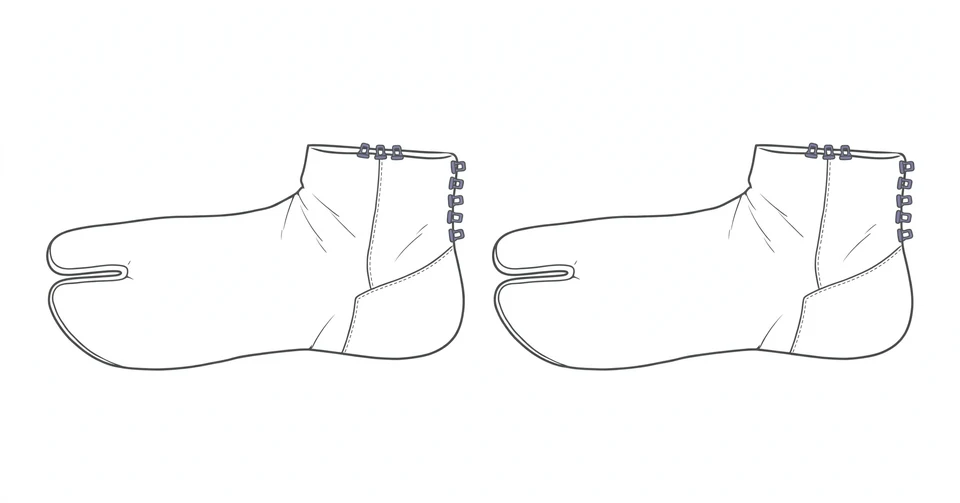
There is also something quietly honest about these socks. They do not show off. They sit at the ankle, white and neat, and let the kimono and the sandals do the talking. In a culture that often values restraint, that modesty is the point, and it is why tabi still matter long after most traditional clothing has become occasional wear.
What tabi are, exactly
They are traditional Japanese socks with a divided toe, usually made from cotton, although silk, hemp, and modern polyester versions exist. They are sewn from cloth cut to shape, open at the back so the foot slips in, and fastened along the ankle with small metal clasps called kohaze. Some modern pairs use elastic instead, but the classic design still closes with hooks, one by one, from the bottom up.
The split is the whole idea. It lets the wearer step into zori or geta, slide the thong between the toes, and walk without the sock twisting out of place. The fit is snug by design. A loose pair would defeat the purpose, so tabi are sized closely to the foot, with reinforced stitching around the toes and the heel where wear is heaviest.
It helps to think of them as underwear for the feet rather than as socks in the Western sense. They are part of the formal dress code, not an afterthought, and arriving at a formal occasion in kimono without them would be like wearing a suit without a shirt. The comparison sounds extreme until you see how much attention Japanese dressers pay to the neat white line at the ankle.
How tabi grew out of leather and into cotton
The roots of these socks reach back a long way, and the honest answer is that nobody knows the exact beginning. One theory traces them to a type of footwear called shitozu that came from China to Japan around the 5th century. Another points to the leather foot coverings hunters wore in the Heian period, which already had a split at the toes. Both stories agree on the same arc: a practical foot covering, worn by the wealthy first, that slowly became ordinary.
Early pairs were made of leather and served more as protective covers than as socks. As sandals spread during the Muromachi period, leather versions gained popularity among samurai, and by the late 1500s white leather tabi for men and purple dyed ones for women had become customary. Leather was durable and protected the toes, and for a warrior on the move that mattered more than comfort.
The big change came in the Edo period, when cotton became widely available. A great fire in 1657, in the Meireki era, made leather scarce and expensive, because leather was suddenly in demand for fire protection clothing. Cotton versions emerged as the affordable alternative, and people liked them so much that cotton became the dominant material, a position it still holds today. What began as a substitute turned out to be an improvement: cotton breathed better, washed more easily, and felt softer against the skin.
Fasteners changed along with the fabric. Early pairs were tied at the ankle with a string. Around the Genroku era, from 1688 to 1704, makers began fitting them with kohaze, small metal hooks inspired by Chinese purse clasps, and these became the prototype of the modern design. The hooks spread widely from the second half of the Edo period into the first half of the Meiji period. Early versions had two clasps; modern pairs usually have four, though three to six are common, and the number is a matter of maker and style rather than a strict rule. A detailed guide from Japan Objects traces the same story, from Chinese origins through the samurai era to the cotton boom.
White for formal wear, colour for everyday life
If you remember one rule about these socks, make it this one: white is formal, colour is casual. White pairs are worn with formal kimono at weddings, tea ceremonies, and shrine visits, where they signal cleanliness and respect for the occasion. A stained or grey pair at a formal event would be noticed, and not kindly.
Coloured pairs belong to daily life and to play. Indigo and black were the everyday choices of Edo townsfolk, who matched them proudly with kimono and wooden sandals. Today you can find them in navy, grey, patterned prints, and seasonal colours, and younger wearers treat them as a small, safe place to show personality inside an otherwise strict outfit. The rule has softened, but it has not disappeared: the more formal the event, the whiter the sock.
| Occasion | Colour of the socks | What it signals |
|---|---|---|
| Wedding or tea ceremony | White | Formality and respect |
| Shrine visit | White | Cleanliness before the gods |
| Everyday kimono | Indigo, black, grey | Practical daily wear |
| Festival or casual outing | Coloured or patterned | Personality and play |
The table is a guide, not a law, and local custom and the host of an event can override it. When in doubt, white is the safe choice, which is itself a useful lesson: in Japanese dress, the conservative option is rarely the wrong one. I find that reassuring rather than restrictive, because it means a visitor who learns one rule can already avoid the most common mistake.
How to put tabi on and look after them
Putting them on takes a little practice, and the first attempt usually feels fiddly. Slip the foot in, settle the big toe into its pocket, and smooth the fabric over the heel. Then fasten the kohaze from the bottom hook upward, pulling each small loop of thread over its hook. The fit should feel snug but not tight; if the fabric wrinkles across the top of the foot, the size is wrong, not the technique.
The socks are worn with the thong of the sandal sitting in the split, so the sandal and the sock work as a pair. With zori, the formal sandal, the combination is neat and quiet under a kimono hem. With geta, the wooden sandal of summer, the same split keeps the foot steady on a raised, clattering sole. The zori article on this site describes the pairing well, noting that zori are almost always worn with tabi socks, the split toe socks that make the thong comfortable, and that white tabi socks sit neat at the ankle.
Care is simple but not careless. Cotton pairs are washed like other cotton socks, turned inside out, in cool or lukewarm water, and dried out of direct sun so the white stays white. The kohaze clasps are the weak point: fasten them before washing so they do not snag other laundry, and check them now and then, because a bent hook will not hold. A pair that is looked after lasts a long time, and the softening of the cotton with wear is part of the pleasure, like a good shirt that improves with age.
Sizing deserves a word of warning. Sizes run in centimetres of foot length, and a pair that is even slightly short will pull at the toes, while a long pair will wrinkle. If you are buying your first pair, measure your foot in the evening, when it is at its largest, and ask the shop staff rather than guessing. Good shops expect the question.
Jika-tabi, the working cousin
Not all of them stay indoors. Jika-tabi are the sturdy outdoor cousins: the same split toe shape, but built as shoes with thick rubber soles, worn by construction workers, gardeners, rickshaw drivers, and festival participants. They grip well, flex with the foot, and let the wearer feel the ground, which is why people who work on their feet have trusted them for generations.
There are two broad kinds. Work versions are tough, sometimes with steel toe guards and heavy soles, made for building sites and gardens. Festival pairs are softer, made for festivals, with rubber soles but no hardened guards, and they fasten with kohaze at the ankle like indoor tabi. The festival kind is what you will see on dancers and on the men carrying portable shrines through summer streets, their white tabi flashing under happi coats.
The split toe is not decoration here; it is the reason the shoe works. It lets the big toe grip and balance independently, which matters on a ladder, on wet stone, or on a festival route. Modern makers have noticed this too, and the same logic now appears in running shoes and work boots that borrow the divided toe. Tradition, in this case, turned out to be biomechanics ahead of its time.
Tabi against ordinary socks
Put a pair of these socks next to a pair of ordinary Western socks and the differences are obvious, but the interesting ones are not visual. An ordinary sock is a tube: it stretches, it slips, and it treats all five toes as one unit. These socks are cut and sewn to the shape of the foot, with a seam down the middle of the sole and a separate pocket for the big toe. They do not stretch into shape; they are made in the shape.
That construction changes how they feel. The snug fit holds the foot without elastic squeezing the ankle, and the separated big toe can move and grip on its own. Wearers often describe a feeling of steadiness, of the foot being held rather than wrapped, and there is a plausible reason for it: the big toe does real work in balance, and giving it room lets it do that work. Whether that translates into measurable health benefits is a claim best treated with care, but the comfort is easy to feel on a first wearing.
There is also a difference in attitude. Ordinary socks are disposable in practice, bought in packs and replaced without thought. These socks are bought singly, in a size, in a colour chosen for an occasion, and kept for years. That alone says something about how Japan treats the small parts of dress: nothing worn in public is too small to deserve attention.
The modern afterlife of tabi
Tabi could have faded into a museum piece, worn only at weddings and tea ceremonies. Instead, the split toe escaped into the wider world. The most famous moment came in 1951, when Shigeki Tanaka won the Boston Marathon wearing tabi shoes, showing a global audience that the design could compete at the highest level of sport. It was an early sign that the old sock had something to teach modern footwear.
Fashion noticed next. Maison Margiela turned the split toe into a heeled leather boot that became one of the most talked about designs in modern fashion, and sportswear makers followed with their own versions. Nike built the Air Rift, a split toe sandal sneaker, and Asics has explored tabi inspired elements in athletic shoes. Split toe Mary Janes, rain boots, hiking boots, and work shoes have all followed, each borrowing the same idea: let the big toe work alone.
Back in Japan, tabi themselves have not stood still. Contemporary makers produce them in stretch fabrics, in bright patterns, and in ankle and calf lengths, and some pairs now close with elastic for people who find kohaze fiddly. The classic white cotton pair remains the standard for formal wear, but the casual market has become playful, which seems right for an item that began as a practical solution and only later became a rule.
I think the modern afterlife of tabi carries a gentle warning for anyone who loves old crafts. The designs that survive are not the ones preserved untouched; they are the ones that keep finding new work to do. Tabi survived because the split toe kept proving useful, first under a sandal, then on a building site, then on a running track, then on a runway. Usefulness is the best preservation society.
Why a split toe still matters
It would be easy to treat tabi as a curiosity, a footnote to the kimono, and move on. That would miss what they represent. They are a reminder that good design is often invisible, that a small change in shape can solve a problem for centuries, and that formality need not mean discomfort. The white sock at the ankle is doing quiet work: keeping the foot steady, keeping the outfit correct, and keeping a thread of history alive in everyday life.
For a visitor to Japan, tabi are also a low stakes way to take the culture seriously. Learning to wear them properly, choosing white for a formal occasion, fastening the kohaze without rushing, these are small acts of respect that cost little and are noticed. You do not need to master the tea ceremony to show you care; sometimes a neat pair of socks is enough.
Nippon.com describes tabi as combining elegance and practicality when wearing traditional Japanese clothing, and that short summary is hard to improve on. The elegance is visible in the white line at the ankle. The practicality is hidden in the split, in the clasps, and in the cotton that has carried feet through four centuries of Japanese life. Both halves matter, and neither works without the other. That balance, practical and beautiful at once, is what tabi have always been about, and it is why a simple pair of socks deserves a whole article of its own.
More in Culture & Society
Latest posts
- Zori Are the Quiet Sandals Japan Wears to Every Formal Occasion
- An Obi Is the Knot That Holds a Kimono Together
- Joya no Kane Rings Out the Old Year One Hundred Eight Times
- Base Genep Seasons Every Balinese Feast From the Mortar Up
- Geta Still Clatter Through Japanese Summer
- Shakyo Copies the Sutra One Stroke at a Time
- Yukata Is the Robe Japan Reaches for After the Bath
- Bonsho Is the Bell That Wakes a Japanese Temple
- Prajnaparamita Is the Wisdom Behind the Heart Sutra
- A Lamak Turns a Coconut Leaf into a Hanging Prayer
- The Heart Sutra Fits the Whole of Buddhism on One Page
- Shinran Turned Chanting Into Gratitude
- Sambal Matah Wakes Up Every Balinese Plate Raw
- The Javanese of Suriname and the Language They Kept Alive
- Nembutsu Is the Name Japan Calls Out to Amida