Hokusai Spent a Lifetime Chasing One Mountain
· 14 min read
Hokusai spent more than seventy years learning to draw, and his most famous work came when he was past seventy. This is the story of the man behind the Great Wave and his lifelong chase after Mount Fuji.
The most famous Japanese picture in the world shows a wave about to swallow three small boats, while a snowcapped mountain sits small and calm in the distance. It hangs on tote bags, posters, and phone cases from Tokyo to Paris. The man who drew it was Katsushika Hokusai, and he was in his early seventies when the print was published, after more than sixty years of drawing.
Hokusai lived to the age of 88, changed his name more than thirty times, and left behind more than 30,000 drawings, prints, and paintings. Yet the work the world knows best came from a short stretch of his seventies, when he gave himself a single subject and refused to let it go: Mount Fuji, drawn again and again from thirty-six angles, then ten more.
This article follows that long chase, from a boy in Edo who began drawing at six to an old man who believed he would only truly understand drawing after one hundred. It is a story about patience, and about what one subject can teach a person who stays with it for a lifetime.
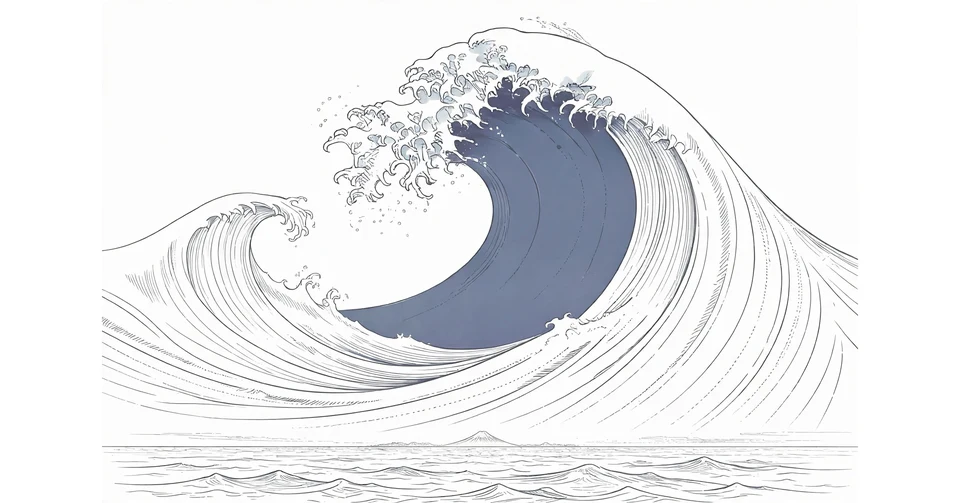
Before the mountain, there was the city. Hokusai was born in Edo, the city we now call Tokyo, in a Japan at peace under the Tokugawa shogunate. He grew up among merchants, actors, and craftsmen, and the art of his youth was made for them, not for temples or courts. That beginning shaped everything that followed.
A boy from Edo who never stopped drawing
Hokusai was born in the Katsushika district of Edo, and his birth date is usually given as 31 October 1760, though the exact day is uncertain. His childhood name was Tokitaro, and his father is believed to have been Nakajima Ise, a maker of mirrors for the shogun. The boy began painting at around the age of six, perhaps learning from his father, whose work included painting designs around mirrors.
At twelve, his father sent him to work in a bookshop and lending library, where books made from woodcut blocks were popular reading. At fourteen he became an apprentice to a woodcarver, and at eighteen he entered the studio of Katsukawa Shunsho, a master of ukiyo-e and head of the Katsukawa school. Ukiyo-e at the time meant pictures of courtesans and kabuki actors, and Hokusai learned the craft by drawing them.
After a year his master gave him a new name, Shunro, and under it he published his first prints, a series of kabuki actor portraits, in 1779. He married during his years in the studio, and his first wife died in the early 1790s. When Shunsho died in 1793, Hokusai began studying other styles, including European art he saw in French and Dutch copper engravings. The chief disciple of his old master expelled him from the school, possibly for studying with the rival Kano school, and Hokusai later said the embarrassment was what truly pushed his style forward. Being thrown out of the only artistic home he knew could have ended his career. Instead it set him free.
He also knew how to be seen. At an Edo festival in 1804 he painted an enormous portrait of the Buddhist prelate Daruma with a broom and buckets of ink, and in 1817 he painted another Daruma, 18 metres tall and 10.8 metres wide, outside a temple in Nagoya before a huge crowd. Invited to the court of the shogun Tokugawa Ienari, he is said to have painted a blue curve, then chased a chicken with red paint on its feet across the paper, and called the result the Tatsuta River with red maple leaves. The stories may be polished by retelling, but they agree on one point: Hokusai understood that an artist must also know how to be seen.
Hokusai and his thirty names
Hokusai was known by at least thirty names in his lifetime. Changing names was common among Japanese artists of the time, but no other major artist did it so often, and his changes came so regularly, and matched his shifts in style so closely, that historians use them to divide his life into periods. Each new name was a fresh start, and a quiet announcement that the old work was finished.
He was Shunro under his first master, then Sori after leaving the school, then Taito from 1811, when he began the sketchbooks that became the Hokusai Manga. In 1820 he took the name Iitsu, a clean slate at sixty, and it was under that name that he produced the Thirty-six Views of Mount Fuji. From 1834 he signed himself Gakyo Rojin Manji, the old man mad about painting, and he kept that name until his death.
The name he is known by came from Hokushinsai, meaning North Star Studio, shortened to Hokusai, meaning north studio, in honour of the North Star, a deity in his Nichiren Buddhist faith. Katsushika was the district of Edo where he was born. Put together, the name says where he came from and what guided him, which seems fitting for a man who spent his life looking up at the same mountain.
Four hands made every print
A ukiyo-e print was never the work of one person. The publisher commissioned the design and paid for the blocks. Hokusai drew the design in ink. The carver pasted the drawing face down onto a block of cherry wood and cut away everything except the lines, destroying the original drawing in the process. The printer brushed pigment onto a separate block for each colour, laid dampened paper over it, and rubbed the back with a baren, a flat hand pad, until the image transferred. Every colour needed its own block, and a print could use up to twenty of them.
The system is described in detail in our story about how ukiyo-e turned everyday Edo into art anyone could own, and it explains why the prints were cheap enough for ordinary people to buy. Around two hundred impressions could be made in a day, and the sheets were sold through print and book shops across the city.
Hokusai paid unusually close attention to the people who cut and printed his work. In letters about an edition of Chinese poetry, he complained to the publisher that the blockcutter Egawa Tomekichi, a man he respected, had strayed from his style in cutting certain heads, and he wrote directly to another cutter, Sugita Kinsuke, with drawings showing how eyes and noses should look. Hokusai treated the carvers and printers as partners, not servants, and he believed the drawing only became art when their hands were faithful to it.
He also seized on new materials. Prussian blue, known in Japan as berro, had reached Japan through trade in the 1700s, but it only became affordable in the late 1820s, when a Chinese entrepreneur made it cheaper. Hokusai used it boldly in the Fuji series, layering it with indigo to make deep seas and dusky skies, and the blue became part of the identity of the work.
Thirty-six views of one mountain
The series that made Hokusai famous began in the late 1820s and was published around 1830 to 1832, when he was in his early seventies. Its full title is Thirty-six Views of Mount Fuji, and although the title promises thirty-six designs, the series grew to forty-six, because the first prints sold so well that ten more were added. The first design was the Great Wave off Kanagawa, also called Under the Wave off Kanagawa, and it remains the most famous Japanese print ever made. A review of the complete series at the Dulwich Picture Gallery shows all forty-six prints together, and the variety is startling: the same mountain, drawn forty-six different ways, never repeating itself.
The subject was not new. Fuji had been painted for centuries, and the mountain was sacred in Shinto tradition, a place of pilgrimage and a symbol of permanence. What was new was the way Hokusai treated it. In most of the forty-six prints, Fuji sits in the background while ordinary people fill the foreground: fishermen, carpenters, travellers, pilgrims, and merchants at work. Only three of the forty-six prints contain no human figures at all.
On a clear day in the time of Hokusai, Fuji was visible from almost every neighbourhood in Edo, about one hundred kilometres away. The mountain rises 3,776 metres above the plain, and its near perfect cone made it a landmark that anyone could recognise at a glance. Hokusai understood that it was part of the rhythm of daily life, not a distant postcard, and that is why the series feels less like a set of landscapes and more like a diary of a city living under one mountain.
The series was also a response to a domestic travel boom. Roads were safer, townspeople had money to travel, and prints of famous places sold well. Fuji was the most famous place of all, and climbing it was a pilgrimage as much as a walk. Readers who want the climb itself can find it in our story about climbing Mount Fuji, Japan's sacred peak, but the prints offer a different kind of ascent: forty-six ways of looking at the same mountain without ever leaving Edo.
I keep returning to the idea that the mountain is the least interesting part of each print, and that is the point. Hokusai gives us a wave, a storm, a bridge, a barrel maker, and then hides Fuji in a corner, small and patient. The mountain does not need to shout. That patience is the real subject of the series.
The sketchbooks that taught Japan to draw
Long before the Fuji series, Hokusai had begun a project that may have mattered even more to other artists. In 1811, at the age of fifty-one, he changed his name to Taito and began producing the Hokusai Manga, a set of sketchbooks and drawing manuals that eventually ran to fifteen volumes. The first volume was published in 1814 and was an immediate success, and twelve volumes appeared in his lifetime, with three more published after his death.
The books contain thousands of drawings: people bathing, working, dancing, and fighting; animals, birds, insects, and fish; plants, landscapes, and religious figures, often with a humorous touch. They were meant partly to make money and attract students, and Hokusai eventually taught about fifty pupils, but they became something larger: a visual dictionary that other artists copied for generations.
The manuals also show how he learned. Earlier, in 1812, he had published Quick Lessons in Simplified Drawing, and the Fuji prints carry the results of the perspective studies he worked out in the Manga. The Great Wave uses a Western style of perspective to give depth and volume to the water, and Hokusai had practised it for years on paper before he risked it in a print.
How Hokusai reached Europe
Hokusai died before most Europeans had heard his name, yet his work crossed the sea quickly. Around 1856, the French printmaker Felix Bracquemond came across a copy of a Hokusai sketchbook at the workshop of his printer, Auguste Delatre, in Paris. Bracquemond used the drawings as the model for a dinner service for a Paris ceramics dealer, and the service was exhibited at the Universal Exposition in Paris in 1867, where it was a critical and commercial success.
From there the influence spread through the artists who collected Japanese prints: Degas, Manet, Gauguin, Klimt, and van Gogh, among others. Degas is reported to have said of him, "Hokusai is not just one artist among others in the Floating World. He is an island, a continent, a whole world in himself." The composer Claude Debussy kept an impression of the Great Wave in his living room, asked for it to appear on the cover of his tone poem La Mer when it was published in 1905, and the music itself carried Japanese inflected harmonies. His full life story, from his birth in Edo to his death at eighty-eight, is told in detail in the biography of Hokusai on Wikipedia.
The wave of interest was called Japonisme, and it changed European art: flat planes of colour, cropped compositions, and high horizons all entered Western painting partly through prints like his. What strikes me is the direction of the journey. Hokusai learned Western perspective from Dutch and French engravings that reached Edo, and fifty years later European artists learned composition from his prints.
The old man mad about painting
In 1834, at the age of seventy-four, Hokusai took the name Gakyo Rojin Manji, the old man mad about painting, and began his last great period. He produced One Hundred Views of Mount Fuji, a book of landscape designs that many consider the masterpiece among his landscape picture books, and he wrote a colophon for it that reads like a promise to himself.
From the age of six, I had a passion for copying the form of things and since the age of fifty I have published many drawings, yet of all I drew by my seventieth year there is nothing worth taking into account. At seventy-three years I partly understood the structure of animals, birds, insects and fishes, and the life of grasses and plants. And so, at eighty-six I shall progress further; at ninety I shall even further penetrate their secret meaning, and by one hundred I shall perhaps truly have reached the level of the marvellous and divine. When I am one hundred and ten, each dot, each line will possess a life of its own.
The words are startling because of who wrote them. A man of seventy-four, already the most famous printmaker in Japan, was telling his readers that nothing he had drawn before seventy was worth taking into account. He genuinely believed that understanding came late, and that the work of a lifetime was only preparation for the work to come.
Hardship followed. In 1839 a fire destroyed his studio and much of his work, and younger artists such as Ando Hiroshige were becoming more popular. At eighty-three Hokusai travelled to Obuse, in what is now Nagano Prefecture, at the invitation of a wealthy farmer named Takai Kozan, and stayed for several years, painting the Masculine Wave and the Feminine Wave there. Between 1842 and 1843 he painted Chinese lions in ink every morning, calling the practice daily exorcisms, a talisman against misfortune.
Hokusai kept working almost to the end, painting The Dragon of Smoke Escaping from Mount Fuji and Tiger in the Snow in early 1849. On his deathbed he is said to have exclaimed, "If only Heaven will give me just another ten years. Just another five more years, then I could become a real painter." He died on 10 May 1849, aged eighty-eight, and a haiku composed shortly before his death reads, "Though as a ghost, I shall lightly tread, the summer fields."
What one mountain teaches about mastery
The life of Hokusai argues against the idea that great work belongs to the young. His most famous image came at seventy-two, his most personal book at seventy-four, and his best paintings in his eighties, in a mountain town far from Edo. He did not peak and fade. He kept changing his name, kept learning, kept drawing the same mountain until the mountain taught him something new.
There is also a quieter lesson in the choice of subject. Hokusai did not chase novelty. He chose one mountain and looked at it from forty-six directions, in sun, storm, and snow, from the sea and from the street. The restriction was the freedom: with the subject fixed, all his energy went into seeing.
The mountain is still there, 3,776 metres high, visible from Tokyo on a clear winter morning. Hokusai never climbed it in the prints, or not that we know, but he spent a lifetime walking around it with his eyes. Mastery is not a moment. It is a mountain you keep drawing, one view at a time, until the drawing starts to draw you.
More in Culture & Society
Latest posts
- Zori Are the Quiet Sandals Japan Wears to Every Formal Occasion
- An Obi Is the Knot That Holds a Kimono Together
- Joya no Kane Rings Out the Old Year One Hundred Eight Times
- Base Genep Seasons Every Balinese Feast From the Mortar Up
- Geta Still Clatter Through Japanese Summer
- Shakyo Copies the Sutra One Stroke at a Time
- Yukata Is the Robe Japan Reaches for After the Bath
- Bonsho Is the Bell That Wakes a Japanese Temple
- Prajnaparamita Is the Wisdom Behind the Heart Sutra
- A Lamak Turns a Coconut Leaf into a Hanging Prayer
- The Heart Sutra Fits the Whole of Buddhism on One Page
- Shinran Turned Chanting Into Gratitude
- Sambal Matah Wakes Up Every Balinese Plate Raw
- The Javanese of Suriname and the Language They Kept Alive
- Nembutsu Is the Name Japan Calls Out to Amida