The Taiko Musubi Turned a Kimono Sash Into a Drum
· 18 min read
The taiko musubi turned a kimono sash into a drum, and this is the story of the square knot that became the default formal knot for women in Japan.
The taiko musubi is the square knot you see on the back of almost every woman in a formal kimono in Japan. It looks like a small drum strapped to the wearer's back, neat, flat and quietly confident, and it is the knot most people picture when they think of a kimono at all.
The taiko musubi is also a knot with a small mystery at its heart. Two different stories explain where the taiko musubi came from, and they disagree by six years and by one festival. The disagreement is worth keeping, because it shows how a piece of clothing can outgrow its own history and become something larger than the day it was invented.
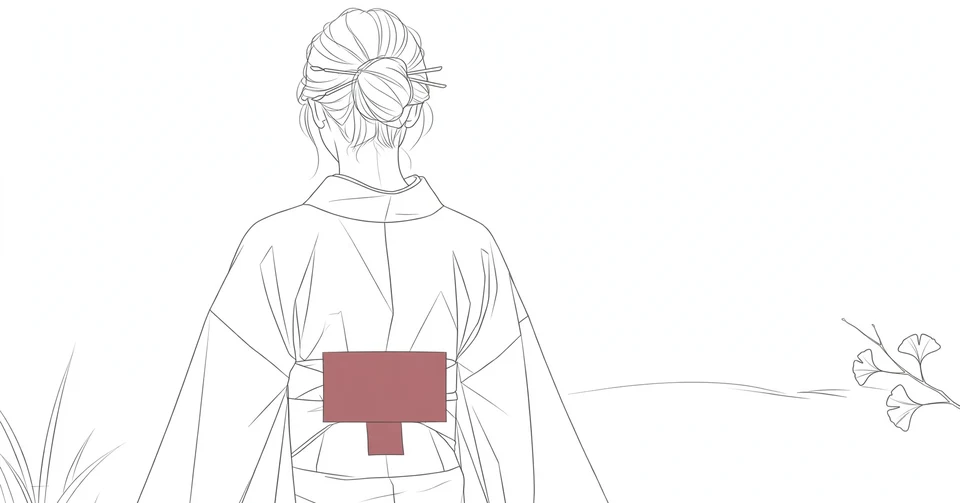
This article grows out of a single sentence in our guide to the obi, the wide sash that holds a kimono together. That guide said the taiko musubi, the drum knot, is the one most people picture, and that sentence deserves a whole story of its own. What follows is that story: what the knot is, how it is built, where it came from, and why it quietly became the default.
What the taiko musubi looks like
Picture a woman in a formal kimono walking away from you down a temple path. The robe falls straight, the sleeves hang still, and at the small of her back sits a flat rectangle of brocade, as neat as a small box. Underneath the rectangle, a short tail of folded cloth peeks out. That is the taiko musubi, and once you have noticed it, you will see it everywhere: at weddings, at graduations, at tea ceremonies, in every formal photograph in the family album.
The name explains the shape. Taiko is the great drum of Japanese festival music, a barrel of wood and hide with a flat, taut face. The knot borrows the drum's silhouette, a wide, flat rectangle with clean edges, and nothing else. It has no loops, no wings, no trailing ribbons. It is the plainest of the formal knots, and its plainness is the point. A knot that shouts would compete with the kimono, and the taiko musubi is too polite to compete.
The rectangle of the taiko musubi is not a real knot in the everyday sense. Nobody ties it the way you would tie a shoelace. The sash is wrapped twice around the waist, and the remaining length is folded into the flat panel, shaped over a hidden support, and pinned in place with cords. The structure is more like a small piece of architecture than a knot, and it only holds its shape because of the helpers tucked inside it.
The most important helper is the obimakura, a small pillow that sits behind the folded panel and gives the taiko musubi its gentle puff and its straight top edge. Without the pillow, the taiko musubi would collapse into a soft fold. With it, the knot stands proud of the back, a firm rectangle that keeps its corners through a whole day of sitting, standing and bowing. The pillow is completely hidden in the finished outfit, covered by a scarf-like length of cloth called the obiage, which is often dyed with shibori tie dyeing and shows just a little at the top of the knot.
The second helper is the obijime, a decorative braided cord roughly 150 centimetres long, tied around the sash to hold the knot in place. Most obijime are woven silk, and they come in many varieties: rounded cords for the furisode, open weave cords for summer, and cords threaded with gold and silver for formal occasions. Most have tassels at each end. A small brooch called an obidome is sometimes fastened onto the cord at the front, and for a maiko that brooch can be the most expensive item in the whole outfit. The cord is the one part of the hidden machinery that shows, and it is chosen as carefully as the sash itself.
There is something I admire about this arrangement. The taiko musubi is finished for other people to admire, since the wearer cannot see her own back, and the hardest working parts of it are the parts nobody sees. The pillow, the cords, the stiffener slipped between the folds at the front, all of them do their work in the dark. It is a small lesson in craft: the visible result is only as good as the invisible support, and the knot is honest about that in a way that louder decorations are not.
A knot with two birthdays
Every guide to the knot tells an origin story, and the stories do not agree. The version most often repeated in Japan says the taiko musubi became popular at the opening celebrations of the Tomioka Hachiman Shrine in Edo in 1817, when women attending the festival began tying their sashes in the structured square form that gave the knot its name. It is a good story, and it fits the knot's character: a festival crowd, a new fashion, a shape borrowed from the drums beating in the shrine yard.
But the best-known English language history of the kimono tells it differently. Liza Dalby, in her book Kimono: Fashioning Culture, writes that the knot was created to celebrate the opening of the Taikobashi bridge in Tokyo in 1823, when some geisha tied their sashes in the new square style and the fashion soon caught on. The fullest reference on the subject, the article on the obi sash, repeats Dalby's account, and it is the version most English readers will meet first.
So which birthday is right, 1817 or 1823, a shrine or a bridge? The honest answer is that nobody can be certain, and the knot itself may be older than either story. What the two accounts agree on is more important than what they dispute: the taiko musubi appeared in Edo in the early nineteenth century, it was a fashion of festival-going women and geisha rather than a rule handed down by the court, and it spread quickly because people liked how it looked. I have kept both stories here rather than choosing one, because the taiko musubi has been worn for two hundred years and can afford two birthdays, and pretending to a certainty the sources do not support would be worse than admitting the doubt.
There is a third strand to the story, from a different kind of source. Niponica, the magazine of Japanese culture published by the Ministry of Foreign Affairs, traces the knot to an earlier, puffier style called the tsunodashi musubi, a soft and feminine knot worn by townsfolk. According to its account, the tsunodashi was simplified, and a cord was used to secure it, and that change transformed it into the taiko musubi, which then spread widely through the population. Read that way, the taiko musubi was not invented in a single afternoon at a shrine or a bridge. It was refined, step by step, out of an older knot, until the soft puff became a firm rectangle. The Niponica feature on sash knots tells that longer story well, and it is worth reading alongside the shorter origin tales.
How the knot is built
Tying a taiko musubi is a small piece of engineering, and it is worth understanding even if you never tie one yourself, because the steps explain the shape. First the obi is wrapped twice around the waist, snug but not tight, with the patterned side out. The remaining length, the tare, is folded into a rectangle about the width of the sash itself, and that rectangle becomes the drum face you see from behind.
Then the obimakura goes in. The small pillow is placed behind the folded panel, tied in place with its own cords, and the panel is shaped over it until the top edge is straight and the corners are square. The obijime is wrapped around the whole assembly and knotted, locking the pillow and the panel together. Finally the obiage is draped over the top of the pillow and tucked down, covering the machinery and adding a soft line of colour above the knot. The short tail of the folded sash hangs below the rectangle, and the taiko musubi is done.
Two versions of the knot exist, and the difference is in the sash. The single layer version, ichiju-daiko, is tied with the nagoya obi, the everyday formal sash whose one end is folded and sewn in half to make it easier to handle. The double layer version, nijudaiko, is tied with the longer fukuro obi, which must be folded in two to make the knot, and its name carries an auspicious double meaning of double joy. The double layer is the more formal of the two, worn with the fukuro obi to the most ceremonial occasions, while the single layer is the everyday formal standard.
Most women can tie the taiko musubi themselves, which is part of its appeal, but the formal versions can be difficult to finish neatly without help. The panel must sit level, the corners must match, and the cord must be tight enough to hold through a long day without wrinkling the sash. Kimono dressing schools teach the knot as a core skill, and a student will practise it many times before it looks effortless. That effort is invisible in the finished taiko musubi, which is exactly how it should be. A good taiko musubi looks as though it simply arrived there, and the hours of practice behind it are nobody's business but the wearer's.
The drum knot against the bow
The taiko musubi is the default, but it is not the only knot, and it is easier to understand by comparison with its neighbours. The most familiar contrast is the bunko musubi, the library knot, which is the friendly bow of the summer festival. Where the drum knot is a flat rectangle, the bunko is a large ribbon bow, tied with the soft, narrow hanhaba obi of the yukata. It is the knot beginners learn first, and it suits an evening that is meant to be enjoyed rather than endured. Niponica notes that the bunko can be tied tightly and does not unravel easily, and that its modest yet dignified look was meant to signify the vitality of a samurai family woman, which is a reminder that even the simplest bow once carried a social message.
The men's knot is a different world again. The kai-no-kuchi, the clam's mouth knot, is a flat, sturdy square tied with the stiff, narrow kaku obi, and it needs no pillow, no cord and no scarf to hold its shape. Men's sashes are at most about ten centimetres wide, they are tied low around the hips, and the whole business is finished in a minute or two. Women's dress in Japan carries the decoration, and men's dress carries the restraint, and the sash shows the split more clearly than almost any other garment.
Other knots fill the occasions the drum knot leaves open. The fukura-suzume, the puffed sparrow knot, is a decorative knot that resembles a sparrow with its wings spread, worn only by young women and typically only with the furisode. The darari musubi, the dangling knot, belongs to maiko alone, with long tails that need an obi of up to six metres to achieve. The table below sets the main knots side by side, and the pattern in it is the real lesson: each knot is a choice about who is wearing it, and what the day is for.
| Knot | Shape | Worn by | Occasion |
|---|---|---|---|
| Taiko musubi | Flat rectangle, short tail | Women, almost all ages | Formal, nearly every occasion |
| Nijudaiko | Double layer rectangle | Women | Most formal, with fukuro obi |
| Bunko musubi | Large bow | Women, all ages | Yukata, summer festivals |
| Fukura-suzume | Puffed sparrow | Young women | Furisode, formal celebrations |
| Darari musubi | Long dangling tails | Maiko only | Performance and ceremony |
| Kai-no-kuchi | Flat square | Men | Everyday and formal |
What strikes me about that table is how much of a woman's life the taiko musubi covers. The other knots are specialists, each tied to one age or one occasion, but the drum knot is the generalist, the one knot that serves almost every formal day from a wedding to a graduation. It earned that place not by being the prettiest knot, because the sparrow and the dangling tails are prettier, but by being the most reliable. A taiko musubi that suits almost every age, almost every kimono and almost every occasion is a knot that never embarrasses its wearer, and in a culture that reads clothing as carefully as Japan does, that reliability is a form of elegance.
When the drum knot does not belong
Almost every occasion is not every occasion, and the exceptions are instructive. The first is the furisode, the long sleeved formal kimono worn by young unmarried women. The drum knot is considered too plain and subdued for those sweeping sleeves, and young women wear the fukura-suzume or the standing arrow knot, the tateya musubi, instead. The sleeves demand a knot with height and drama, and the flat rectangle would be lost beside them.
The second exception is the yukata, the light cotton robe of summer evenings. Most yukata are considered unsuitable to be worn with the taiko musubi, and the reason is practical as much as visual. The yukata is tied with a soft, narrow hanhaba obi, and a flat drum panel needs a stiff, wide sash and a pillow to hold its shape. A taiko musubi on a yukata would be like a ball gown at a picnic: not wrong in a moral sense, simply out of place. The bow of the bunko musubi is the yukata's natural partner, and the two belong together the way the robe belongs to warm evenings. If that evening scene sounds familiar, read our guide to the yukata, the robe Japan reaches for after the bath, which follows the soft sash from the bathhouse to the festival street.
Young girls are the third exception. The taiko musubi has become the standard knot for women of all ages, but very young girls wear simpler knots, and the rectangle waits for them until they are older. The rule is gentle rather than strict, but it shows the same logic as the other exceptions: the knot is a marker of a certain stage of life, and it is worn when the wearer has grown into it.
Why the taiko musubi became the default
A knot does not become the default by accident. In the Edo period, when the taiko musubi appeared, there were already many ways to tie a sash, and the number has only grown since. It is said that there are now over a hundred ways to tie an obi, but most are variants of knot styles born in the Edo period, and the culture of those knots has been passed down through the generations. In a field that crowded, a new knot had to earn its place, and the drum knot earned it by being useful.
Part of the answer is the social history. In Edo, the knot a woman tied could identify her social class and occupation, and within those rules people expressed their own sense of style with a diversity of knots. The taiko musubi sat in the middle of that system: plain enough to be respectable for almost anyone, structured enough to look formal, and simple enough to be tied without a specialist. It was a knot that a merchant's wife and a geisha could both wear, and that is a rare thing in a society that usually marks such differences carefully.
Part of the answer is the shape itself. A rectangle is the most forgiving shape in the wardrobe. It does not favour one age over another, it does not clash with a patterned sash the way a big bow can, and it does not wilt in the course of a long day. The obimakura holds it up, the obijime holds it together, and the whole assembly can survive hours of sitting on tatami and standing for photographs. A bow can droop. A dangling tail can catch. The taiko musubi simply stays where it was put.
And part of the answer is older than fashion altogether. In earlier days, knots were believed to banish malicious spirits, and many knots carry a name with an auspicious double meaning, like the double joy of the nijudaiko. The taiko musubi borrows its name from the taiko drum, the instrument that opens festivals and drives away bad luck with its sound, and wearing a drum on your back is a small, quiet piece of protection. Whether anyone still believes that literally, the association gives the knot a warmth that a purely decorative shape would not have.
Our guide to the obi, the wide sash that holds a kimono together tells the longer story of the sash itself, from a narrow cord in the Heian period to the broad brocade band of today, and the drum knot is the natural end of that story. The sash grew wider, stiffer and more decorated over the centuries, and the knot grew with it, from a simple tie into a piece of sculpture. The taiko musubi is where that long evolution settled, and it has stayed settled for two hundred years.
The knot in modern Japan
The taiko musubi is no longer everyday clothing for most Japanese people, but it is not a museum piece either. It lives in weddings, graduations, coming of age ceremonies and festivals, and each wearing keeps the knowledge alive for one more generation. Rental kimono shops in Kyoto and Asakusa tie the taiko musubi dozens of times a day for visitors, and kimono dressing schools still teach it as the first formal knot a student must master.
It has also adapted, as the sash has always adapted. The tsuke obi, a pre tied sash in two pieces, lets people wear the look of a hand tied taiko musubi without the labour of tying it, and it is indistinguishable from a regular obi when worn. Some traditionalists look down on it, and some busy mothers are grateful for it, and both reactions are understandable. A tradition that cannot bend a little will eventually break, and the pre tied knot is a small bend that keeps the shape alive for people who love it but have no time to practise it.
The knot also appears far from the kimono now. Designers pair obi belts with Western dresses, jumpsuits and streetwear, using the wide sash as a waist cincher, and the taiko musubi sometimes follows the sash into those new outfits. It is a strange sight at first, a drum knot on a denim jacket, but it is the same impulse that has always driven the sash: take a beautiful, useful shape and let it find a new home.
Why the knot still matters
I keep coming back to a simple thought. The taiko musubi is a square of cloth, a hidden pillow and a braided cord, and that is all it is, yet it has carried two hundred years of Japanese craft on a woman's back. It asks for patience to tie, it hides its own machinery, and it is finished for other people to admire, since the wearer cannot see it herself. There is something generous in that, a piece of beauty made to be seen by everyone except the person wearing it, and a reminder that the best things we make are often the ones we cannot see ourselves.
The next time you see a woman in a formal kimono walking away from you, look at the rectangle on her back and think of what it took to put it there: a sash four metres long, a pillow no bigger than a hand, a cord of braided silk, and two centuries of women deciding, one festival at a time, that this square was the right shape. The drum knot does not shout, and it does not need to. It has been quietly right for two hundred years, and it will still be right the next time it is tied.
More in Culture & Society
Latest posts
- Tabi Are the Split Toe Socks Japan Wears Under Everything
- Ukiyo-e Turned Everyday Edo Into Art Anyone Could Own
- Zori Are the Quiet Sandals Japan Wears to Every Formal Occasion
- An Obi Is the Knot That Holds a Kimono Together
- Joya no Kane Rings Out the Old Year One Hundred Eight Times
- Base Genep Seasons Every Balinese Feast From the Mortar Up
- Geta Still Clatter Through Japanese Summer
- Shakyo Copies the Sutra One Stroke at a Time
- Yukata Is the Robe Japan Reaches for After the Bath
- Bonsho Is the Bell That Wakes a Japanese Temple
- Prajnaparamita Is the Wisdom Behind the Heart Sutra
- A Lamak Turns a Coconut Leaf into a Hanging Prayer
- The Heart Sutra Fits the Whole of Buddhism on One Page
- Shinran Turned Chanting Into Gratitude
- Sambal Matah Wakes Up Every Balinese Plate Raw