Japan Meets the New Year at Hatsumode
· 15 min read
Hatsumode is the first shrine or temple visit of the new year in Japan, a quiet prayer at the start of January that millions of people make in the cold, in a crowd, and in good spirits.
At midnight on the first morning of January, Japan is already walking. Families in warm coats step out into the cold, follow the lanterns down familiar streets, and join a slow queue outside a shrine or temple. That first visit of the year is hatsumode, and for millions of people it is the real beginning of the new year.
Hatsumode is simply the first visit to a shrine or a temple after the year turns. People go to give thanks for the year that has passed and to pray for health, safety, and good fortune in the year ahead. There is no ticket, no ceremony to book, and no special skill involved. You walk in, you wait your turn, you pray, and you walk out with a small charm or a paper fortune in your pocket.
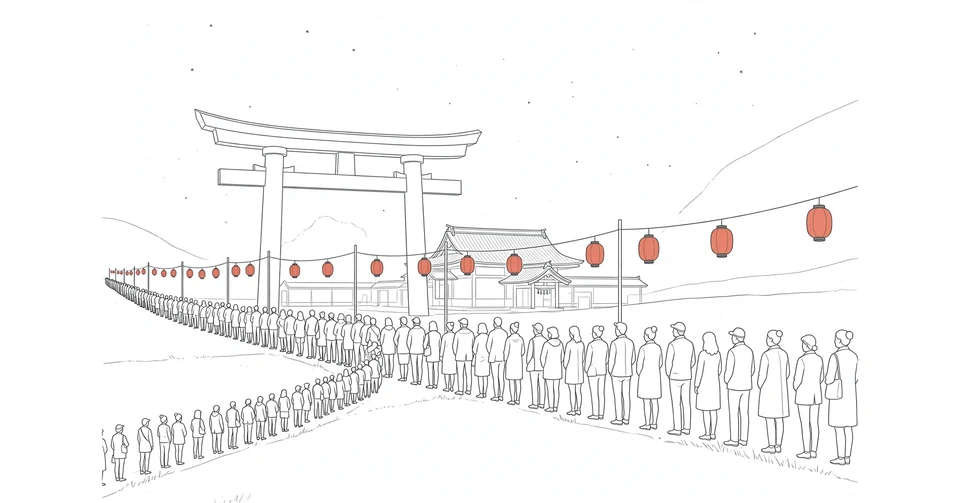
What makes hatsumode remarkable is not any single ritual. It is the scale and the mood. The same streets that are empty on an ordinary winter night fill with people, food stalls steam in the cold air, and strangers stand shoulder to shoulder in a line that moves at the pace of a prayer. Nobody is in a hurry, and nobody seems to mind the wait.
What hatsumode means
The word itself is plain. Hatsu means first, and mode means a visit to pray, so hatsumode is the first prayer visit of the year. Before the year gets busy, before work and school and ordinary life resume, you go and stand in front of something larger than yourself and say thank you.
Hatsumode can be made at either a Shinto shrine or a Buddhist temple, and nobody in Japan finds that strange. The two traditions have shared sacred ground for most of Japanese history. A family might visit a shrine one year and a temple the next, and the visit counts either way. What matters is that it is the first, and that it is made with a clear mind.
The custom grew out of an older practice called toshigomori, in which people stayed overnight at a shrine or temple on New Year's Eve to greet the year in a sacred place. Over time the overnight stay shortened into a visit, and the visit became the tradition we know today. Its roots reach back to the Heian period, more than a thousand years ago, which makes hatsumode one of the oldest customs still practiced by ordinary people in Japan. A guide to the season describes hatsumode as the year's first visit to a shrine or temple, held at practically every shrine and temple across Japan during the first few days of the year, as explained on the Japan Guide page on visiting Japan during New Year.
I think the endurance of hatsumode says something hopeful about Japan. A country that reinvents itself every decade still keeps a morning in early January for a walk to the local shrine. It is short, it is free, and it asks only for a little patience and a little sincerity.
When hatsumode happens
The heart of hatsumode is the first three days of January, known as sanganichi. January 1 is the busiest day by far, with the thickest crowds just after midnight and again in the late morning. January 2 and 3 are still busy at the famous sites, but the queues move faster.
Strictly speaking, there is no official deadline. The first shrine or temple visit of the new year counts as hatsumode whenever it happens, even if you put it off for weeks. In practice, most people go within the first three days, and the great shrines keep their New Year arrangements, stalls, and extended hours, up through about January 7. After that the decorations come down and the grounds return to their ordinary quiet. A detailed guide to the custom notes that hatsumode is typically performed between midnight on New Year's Eve and the third day of January, and that the first visit still counts as hatsumode even if it is made later, as described in the Tsunagu Japan guide to hatsumode, how to celebrate the Japanese New Year.
That flexibility is part of the charm of hatsumode. If you cannot face the midnight crowd, you can go on the afternoon of January 2, or on January 5, and nobody will tell you that you missed it. The only thing you lose by waiting is the festival feeling of the first three days, and for many people that is a fair trade for a shorter queue and a quieter prayer.
From the last bell to the first prayer
For many people, hatsumode begins before midnight, while the old year is still ending. At temples across Japan, the bell rings 108 times in the ceremony called joya no kane, one strike for each of the worldly desires that Buddhism says cloud the mind. The last strikes fall just after midnight, and the people who have stood listening in the cold then step forward to make the first prayer of the new year. The bell and the visit belong to the same night, and it is hard to say where one ends and the other begins. At a temple on the night of hatsumode, the grounds often stay open and crowded well past midnight, with food stalls, lanterns, and families drifting between the bell tower and the main hall.
There is something wise in joining the two customs together. The bell clears the mind, and the prayer fills it again with hope. A new year that starts with both a letting go and a wish seems better balanced than one that starts with only a party. The season of parties has its place too, and workplaces across Japan hold shinnenkai, the New Year parties that open the working year, as described in the article on shinnenkai, Japan's New Year parties that start the year over. But the bell and the first prayer come first, and they set a tone that a party cannot.
The full story of that bell, why it rings 108 times, and how radio carried it across the country is told in the article on joya no kane, the bell that rings out the old year. What matters here is the feeling of the handover. The old year ends with a sound that asks you to let go, and the new year begins with a prayer that asks you to begin again. Between the two, there is a moment of quiet that belongs to neither year, and hatsumode is the walk you take through it.
The ritual, step by step
The ritual of hatsumode is short, and it is mostly the same as an ordinary shrine or temple visit. At a shrine, you bow once before passing under the torii gate, then stop at the temizuya, the purification fountain, to rinse your hands and mouth. At a temple, you may light incense first. These small acts of cleaning are a way of leaving the noise of the street outside.
At the main hall, you toss a small coin into the offering box, called saisen, as a gesture of thanks. At a Shinto shrine, you then bow twice, clap twice, make your silent prayer, and bow once more. At a Buddhist temple, there is no clapping. You simply press your palms together and pray in silence. The difference is small, but it is worth knowing, because it is the one place where visitors most often hesitate. Nobody will correct you if you get it wrong, but the ten seconds it takes to learn the order makes the moment feel like yours. First timers who copy the people ahead of them will get hatsumode right without thinking about it.
What you pray for is your own business. Some people pray for health, some for work, some for a family member, and some for nothing in particular. One thoughtful piece of advice is to skip the list of requests altogether and simply give thanks. I like that advice. A prayer that is only a list of wants can start to feel like a shopping list, while a prayer of thanks leaves room for the year to surprise you.
The walk itself matters as much as the prayer. You do not walk down the middle of the approach, which is reserved for the kami, but to one side. You keep your voice low. You do not rush past people who are praying. These are not strict rules enforced by anyone. They are courtesies, and keeping them is part of what makes hatsumode feel different from a day out.
Omamori, omikuji, and hamaya
The prayer itself takes only a minute, but the visit usually lasts much longer, because of what comes after. The stalls and counters around the main hall sell the small objects that make the New Year feel real, and most visitors leave with at least one of them in a pocket or a bag.
Omamori are small cloth amulets, believed to carry a little divine protection with them. They come in many designs, for health, safe travel, success at school, love, and childbirth, and they make popular gifts for friends and family. An omamori is said to last about a year, and the custom is to bring last year's charm back to the shrine and have it burned with respect, then buy a new one. That yearly exchange is one of the quiet engines of hatsumode. It gives people a reason to return, and it gives the shrine a way to mark the passing of the year.
Omikuji are paper fortune slips, drawn at random, that tell you what the coming year may hold for health, love, work, and money. At many shrines you shake a wooden box until a numbered stick slips out, then take the fortune with the matching number from a drawer. If the fortune is good, you keep it. If it is bad, you tie it to a rack or a tree at the shrine and leave it behind, so the bad luck stays there instead of following you home. It is a gentle piece of psychology, and it works. A bad fortune tied to a rack feels dealt with, and a good fortune folded into a wallet feels like a small promise to carry.
Hamaya, the demon breaker arrow, is the third classic purchase. Traditionally given to celebrate a baby boy's first New Year, it is now bought more widely as a charm against bad luck and a symbol of aiming high in the year ahead. Many people buy a hamaya at hatsumode and display it in the living room or near the entrance of the home. Alongside these three, many shrines sell ema, wooden plaques on which you write a wish and hang it up for the kami to receive. At New Year the ema often carry the design of the year's zodiac animal, and rows of fresh wishes appear on the racks within hours of midnight.
The stalls stay busy all morning, because for many visitors the shopping is half of hatsumode. None of these objects is expensive, and none of them is required. They are souvenirs of a state of mind, and their real value is the few minutes of attention they ask of you.
The busiest shrines and temples in Japan
Almost every shrine and temple in Japan holds hatsumode, from the smallest neighborhood shrine to the great national sites. The numbers below vary a little from year to year and from source to source, so treat them as rough guides rather than exact counts. These figures count hatsumode visits, and they rise and fall a little with the weather and the day of the week.
Meiji Jingu in Tokyo is the most visited of all, with around 3 million people over the first three days of January. The shrine stands in a quiet forest beside Harajuku, and the walk from the gate to the main hall, ten minutes on an ordinary day, can take hours at the peak of hatsumode. Senso-ji in Asakusa, Tokyo's oldest temple, draws around 2.9 million, and its Thunder Gate and the Nakamise shopping street fill with a festival crowd. Fushimi Inari Taisha in Kyoto, famous for its thousands of vermilion torii gates, draws around 2.8 million. Naritasan Shinsho-ji near Narita Airport draws a little over 3 million, and Kawasaki Daishi in Kanagawa draws around 3 million as well.
| Site | City | Visitors over the New Year |
|---|---|---|
| Meiji Jingu | Tokyo | Around 3 million |
| Naritasan Shinsho-ji | Chiba | Around 3 million |
| Kawasaki Daishi | Kanagawa | Around 3 million |
| Senso-ji | Tokyo | Around 2.9 million |
| Fushimi Inari Taisha | Kyoto | Around 2.8 million |
| Tsurugaoka Hachimangu | Kamakura | More than 1 million |
Tsurugaoka Hachimangu in Kamakura, the shrine at the heart of the old samurai capital, draws more than a million visitors over the first few days, as do Sumiyoshi Taisha in Osaka and Ise Jingu in Mie. Japan Guide notes that Meiji Shrine, Fushimi Inari Taisha, Sumiyoshi Taisha, and Tsurugaoka Hachimangu each attract more than a million visitors over the first few days of the new year, and that visitors should expect to queue for more than an hour at the popular sites.
The numbers are impressive, but they hide the real point. For every person at Meiji Jingu, there are hundreds at small shrines across the country, making the same prayer.
Hatsumode at your local shrine
If you are in Japan in early January, the best hatsumode may be the nearest one. A local shrine has everything the famous sites have, in a smaller and friendlier form: the lanterns, the stalls, and the queue of neighbors you half recognize. You can arrive in the afternoon, pray without waiting an hour, and be home for dinner.
The local visit also shows you something the great shrines cannot. At a neighborhood shrine, hatsumode is a community event. Children in kimono pose for photographs, old friends greet each other after months apart, and the shrine volunteers hand out sweet sake to visitors with cold hands. The prayer is the same, but the feeling is closer to a village festival than a pilgrimage.
There is also a practical argument for going local. The famous sites are wonderful, but a small shrine lets you learn the ritual at your own pace, and the great shrines will still be there next year. I would rather see someone pray calmly at a small shrine than rush through a famous one, because the calm is the point.
Etiquette and practical tips for visitors
Hatsumode is open to everyone, whatever your beliefs. A few simple habits will make the visit smoother, for you and for the people around you.
Go early or go late. The worst crowds are around midnight and late morning on January 1. Dawn on January 2, or any time after January 4, is far quieter, and the stalls and charms are still there. Dress warmly, because almost all of the waiting happens outdoors, and the queue at a popular site can last more than an hour. A thermos of hot tea is a common sight in a hatsumode queue, and nobody will think it strange. Wear comfortable shoes, because the approach to a great shrine can be a long walk on gravel and stone steps.
Bring small coins for the offering box and a little cash for charms and fortunes, since many stalls do not take cards. Keep your voice low, and never photograph people at prayer. If you draw a bad omikuji, tie it to the rack provided. If you have last year's omamori, bring it to be burned and buy a fresh one.
Check transport before you go. Many urban train lines run late into the night or through the night from December 31 to January 1 to carry hatsumode visitors, although some companies have reduced these services since the pandemic. At the biggest sites, follow the signs and the flow of the crowd rather than trying to cut across it.
Why hatsumode still matters
Japan has no shortage of ways to mark the new year, and most of them are louder, brighter, and faster than a walk to a shrine. None of them are wrong, and hatsumode does not compete with them. It simply does something different. It asks a person to stand still for a minute, in the cold, in a crowd, and to think about the year ahead with a clear head.
That minute is the reason the custom has lasted for more than a thousand years. Hatsumode gives that moment a place to happen, a short walk, a small prayer, and a charm to carry home. It does not promise that the year will be easy. It only promises a good beginning, and that is an honest promise.
The best hatsumode is the one you actually make, at whatever shrine is nearest, at whatever hour you can manage. So if you are in Japan in early January, go. Go to the great shrine if you want the spectacle, or to the small one at the end of your street if you want the quiet. Stand in the queue, toss in a coin, bow twice, clap twice, and bow once more. Then buy a charm, draw a fortune, and walk home with the year still new in front of you. That is hatsumode, and it is one of the simplest and kindest ways any country has found to begin again.
More in Culture & Society
Latest posts
- The Taiko Musubi Turned a Kimono Sash Into a Drum
- Hiroshige Walked the Tokaido and Japan Followed
- Hokusai Spent a Lifetime Chasing One Mountain
- Tabi Are the Split Toe Socks Japan Wears Under Everything
- Ukiyo-e Turned Everyday Edo Into Art Anyone Could Own
- Zori Are the Quiet Sandals Japan Wears to Every Formal Occasion
- An Obi Is the Knot That Holds a Kimono Together
- Joya no Kane Rings Out the Old Year One Hundred Eight Times
- Base Genep Seasons Every Balinese Feast From the Mortar Up
- Geta Still Clatter Through Japanese Summer
- Shakyo Copies the Sutra One Stroke at a Time
- Yukata Is the Robe Japan Reaches for After the Bath
- Bonsho Is the Bell That Wakes a Japanese Temple
- Prajnaparamita Is the Wisdom Behind the Heart Sutra
- A Lamak Turns a Coconut Leaf into a Hanging Prayer