Hiroshige Walked the Tokaido and Japan Followed
· 13 min read
Hiroshige walked the Tokaido road in 1832 and turned the journey into fifty-five prints that taught Japan to see its own country. This is the story of the fire warden who became the poet of the road.
In 1832, Hiroshige joined an official procession travelling from Edo to Kyoto, and he walked the Tokaido road the whole way, sketching as he went. The road ran 514 kilometres along the Pacific coast, through fifty-three post stations, from the Nihonbashi bridge in Edo to the Sanjo Ohashi bridge in Kyoto. When he returned home, he turned his sketches into a series of prints called The Fifty-three Stations of the Tokaido, and the series made his name. Japan had seen travel pictures before, but it had never seen its most famous road drawn with such patience and such feeling for weather.
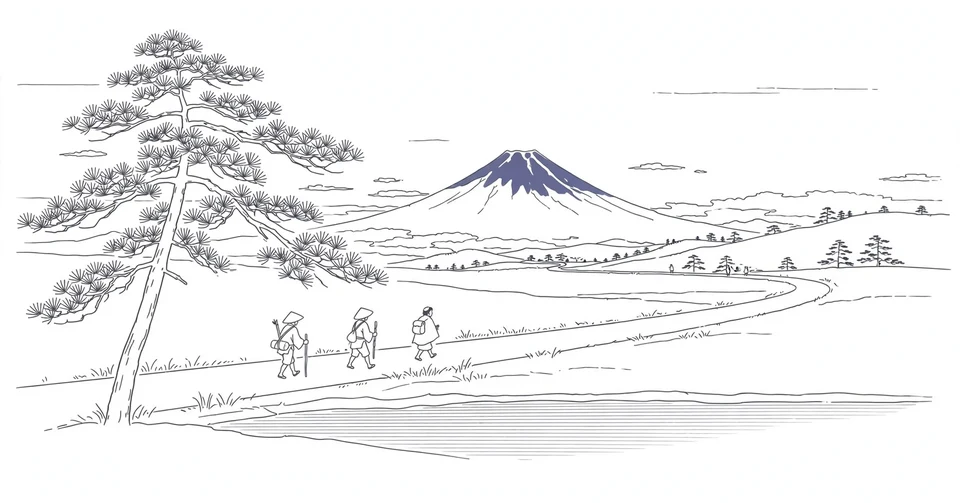
The prints sold because they showed the road as travellers actually knew it. Rain fell on porters at Shono. Snow covered the village of Kanbara. Boats waited at the river crossings, and Mount Fuji appeared and disappeared between the stations. Hiroshige was not the first artist to draw the Tokaido, but he was the first to make the journey itself the subject, and the road has been associated with his name ever since.
The fire warden who became an artist
Utagawa Hiroshige was born Ando Tokutaro in 1797, in the Yayosu Quay section of Edo, the city we now call Tokyo. He came from a samurai family. His father, Genemon, was a fire warden for the Yayosu Quay area, a post he had inherited by adoption into the Ando family, and his grandfather had been an archery instructor. The boy grew up in the fire warden barracks, among men whose work was to watch the city and wait for the alarm.
His mother died in early 1809, and his father followed later the same year, but not before handing his fire warden duties to his twelve-year-old son. The boy was charged with the prevention of fires at Edo Castle, a duty that left him much leisure time, and he filled it with drawing. At around ten he had already studied Kano style painting under Okajima Rinsai, who also lived in the barracks. In his early teens he began painting in earnest, and he sought the tutelage of Toyokuni of the Utagawa school, only to find that the master had too many pupils. A librarian introduced him instead to Toyohiro, of the same school, and by 1812 he was permitted to sign his works, under the art name Hiroshige.
He kept the fire warden post for years, passing it to his son in 1823 while still acting as an alternate. When Toyohiro died in 1828, he declined the offer to succeed his master. The decision tells us something about the man. Hiroshige did not want to run a school. He wanted to draw, and the road was about to give him the subject that would define his life.
There is a quiet logic to the fact that a fire warden became the great painter of the road. A fire warden watches. He waits through long, uneventful hours, and then he must notice everything at once. Hiroshige's prints have that same quality of attention. Nothing in them hurries, yet nothing is missed.
Hiroshige learned from Hokusai, then found his own weather
The landscapes that made Hiroshige famous began to appear around 1829 and 1830, first in a series called Eight Views of Omi, and then, about 1831, in Ten Famous Places in the Eastern Capital. Both show the influence of another artist, and the influence is easy to name. Hokusai's Thirty-six Views of Mount Fuji had recently been published, and the whole of Edo was looking at landscape prints in a new way. Our story about Hokusai's lifelong chase after Mount Fuji follows the older master through those same years, and the two careers run side by side like travellers on the same road.
The two men saw the same country differently. Hokusai was bolder and more formal, building his pictures around strong shapes and dramatic contrasts. Hiroshige was more poetic and more interested in atmosphere. His colours are subtler, often printed with several impressions in the same area, and he made extensive use of bokashi, the technique of colour gradation that lets a sky fade from deep blue to pale grey. Where Hokusai gives you the mountain, Hiroshige gives you the morning the mountain happened to be standing in.
The difference is not a matter of talent but of temperament. Hokusai drew the world as a place to be mastered. Hiroshige drew it as a place to pass through, slowly, in weather that would not wait for you. That is why his prints feel like memories rather than monuments. They do not show you a famous place. They show you what it felt like to arrive there.
By the end of the 1830s, the balance between the two men had shifted. Hokusai's studio burned in 1839, and younger artists such as Ando Hiroshige were becoming more popular than the ageing master. The older man kept working, but the public had found a new favourite, and the new favourite was the poet of the road.
A road of 514 kilometres and 53 stations
The Tokaido was the most important of the Five Routes of the Edo period, the road that joined Kyoto, the old imperial capital, to Edo, the seat of the shogun. It ran along the sea coast of eastern Honshu, which is what its name means, the eastern sea route. Its length was 514 kilometres, and between its two ends stood fifty-three post stations, places where travellers could rest, eat, change horses, and hire porters. The number fifty-three was not an accident. It was taken from the fifty-three Buddhist saints whom the acolyte Sudhana visited in his quest for enlightenment, and every traveller on the road was, in a small way, making a pilgrimage of his own. The history of the Tokaido road gives the full account of its stations, its checkpoints, and its travellers.
Most of the travel was on foot. Wheeled carts were almost nonexistent, and heavy cargo usually went by boat. People of higher rank travelled by kago, a palanquin carried by porters, and the great lords travelled in norimono, roomy litters borne by teams of men. Women were forbidden from travelling alone and had to be accompanied by men. At the checkpoints along the road, travellers had to present permits to pass onward, and the rules were severe, even if they were not always enforced.
The road was not an easy one. There were almost no bridges over the larger, fast flowing rivers, so travellers were ferried across by boat or carried on the shoulders of watermen. At one point near Nagoya, the road was barred by several rivers at once, and voyagers had to take a boat across the sea for 27 kilometres to reach Kuwana station. In ideal weather, the whole journey on foot could be made in about a week. In bad weather, it might take up to a month.
It is worth remembering what the road meant to the people who used it. For a merchant, it was business. For a pilgrim, it was devotion. For a daimyo travelling to Edo under the alternate attendance system, it was duty. But for everyone, it was also the longest stretch of open country most of them would ever walk, and the prints understood that. They show the road not as a line on a map but as a place where people got wet, got tired, and kept going.
Fifty-five prints from one walk
The invitation to join the official procession in 1832 gave Hiroshige his chance. As a fire warden, he held a rank that carried small privileges reserved for low ranking samurai, and one of them was a place in the procession. He sketched the scenery along the way, and when he returned to Edo he produced the series that would define his career. The first edition, issued by the Hoeido publishing house in the early 1830s, contained fifty-five prints, one for each of the fifty-three stations, plus the departure from the Nihonbashi bridge in Edo and the arrival in Kyoto.
Three of the prints have become famous enough to stand for the whole series. At Hakone, the eleventh station, travellers cross a mountain pass under a huge sky. At Kanbara, the sixteenth, snow falls on a village that seems to have stopped moving altogether. And at Shono, the forty-sixth, a sudden shower catches travellers on the road, and they hurry forward with their straw capes flapping and their legs splashing through the wet. The rain at Shono is the print people remember, and it is easy to see why. It is not a picture of a famous place. It is a picture of being caught in the rain.
The prints were made the way all ukiyo-e was made, by four hands rather than one. The publisher commissioned the design and paid for the blocks. Hiroshige drew the design in ink. The carver pasted the drawing face down onto a block of cherry wood and cut away everything except the lines, destroying the original in the process. The printer brushed pigment onto a separate block for each colour and rubbed the paper with a baren, a flat hand pad, until the image transferred. Our story about how ukiyo-e turned everyday Edo into art anyone could own describes this system in detail, and it explains why the prints were cheap enough for ordinary people to buy.
The work was not done in comfort. Hiroshige's first wife helped to finance his sketching trips, in one instance selling some of her clothing and ornamental combs to pay for the journey. She died in October 1838, and he remarried to Oyasu, a farmer's daughter sixteen years his junior, from Totomi Province, the western part of what is now Shizuoka Prefecture. The detail is a small one, but it matters. The road that looks so effortless in the prints was paid for, in part, by a woman selling her combs.
Hiroshige kept walking after the Tokaido
The success of the Tokaido series gave Hiroshige a lifetime of work. He followed it with more travel pictures, including Illustrated Places of Naniwa in 1834 and Famous Places of Kyoto in 1835, though he had never been west of Kyoto and based those views on pictures in books and paintings. Between about 1835 and 1842 he produced The Sixty-nine Stations of the Kiso Kaido, a joint work with Keisai Eisen, in which his share was forty-six of the seventy prints. The Kiso road ran inland, through mountains, and it gave him a second great highway to draw.
His last great series was One Hundred Famous Views of Edo, a hundred and eighteen sheets produced over the last decade of his life, many of them showing the city he had lived in all his days. In these prints he often placed a large object, a person, or an animal in the foreground, a device borrowed from Western art to add depth to the picture. A plum branch fills the frame at Kameido. A bridge crosses the top of the view at Suidobashi. The city is still there, behind the branch and under the bridge, but you see it the way a person walking through it would see it, in pieces, close up, and all at once.
In 1856, Hiroshige retired from the world and became a Buddhist monk. Two years later, he died in Edo, on 12 October 1858, during the great cholera epidemic of that year. He was in his early sixties. The sources differ on his exact age, some saying sixty and some sixty-two, and the uncertainty seems fitting for a man who was always more interested in the journey than in the record of it. Just before his death, he left a farewell poem, which can be translated as follows: "I leave my brush in the East, and set forth on my journey. I shall see the famous places in the Western Land." The Western Land was both the road between Edo and Kyoto and the paradise of the Amida Buddha. He was still, at the end, a traveller.
His name did not die with him. A young print artist named Chinpei Suzuki married his daughter Otatsu, and after the master's death he took the name Hiroshige II. Another former pupil, Shigemasa, later took the name Hiroshige III. Neither reached the level of the master, but the fact that the name was worth inheriting says how far the fire warden's son had travelled.
Why Hiroshige still walks with us
Hiroshige is often called the last great master of ukiyo-e, and for scholars and collectors his death marked the beginning of a rapid decline in the genre, hastened by the westernisation that followed the Meiji Restoration of 1868. But his work did not decline with the genre. It travelled. Western European artists collected his prints and studied his compositions closely, and Vincent van Gogh painted copies of some of them. Manet and Monet owned them. The flat planes of colour, the cropped compositions, and the high horizons of his prints entered Western painting through the fashion for Japanese art that came to be called Japonisme.
The full life of Hiroshige, from his birth in the fire warden barracks to his death as a Buddhist monk, is told in detail in the biography of Hiroshige on Wikipedia, and it is worth reading whole. What stays with me is a smaller fact. Despite his productivity and his popularity, Hiroshige was never wealthy. His commissions paid him about twice the wages of a day labourer, and his will left instructions for the payment of his debts. He walked one of the most famous roads in Japan, drew it so well that the whole country followed him, and died owing money.
That is the part of the story I keep coming back to. Hiroshige did not become famous by chasing fame. He became famous by paying attention to a road that everyone else was simply trying to get to the end of. He noticed the rain at Shono, the snow at Kanbara, and the mountain that appeared between the stations, and he drew them as if they mattered, because to the people walking past them, they did.
The road is still there, in a sense. The corridor the Tokaido followed is now the most heavily travelled route in Japan, carried by the JR Tokaido Main Line, the Tokaido Shinkansen, and the Tomei and Meishin expressways, and a few portions of the original road can still be found. At least one modern traveller has managed to walk much of it. The walkers change. The road stays, and so do the prints. Hiroshige walked the Tokaido once, in 1832, and Japan has been following him ever since.
More in Culture & Society
Latest posts
- Tabi Are the Split Toe Socks Japan Wears Under Everything
- Ukiyo-e Turned Everyday Edo Into Art Anyone Could Own
- Zori Are the Quiet Sandals Japan Wears to Every Formal Occasion
- An Obi Is the Knot That Holds a Kimono Together
- Joya no Kane Rings Out the Old Year One Hundred Eight Times
- Base Genep Seasons Every Balinese Feast From the Mortar Up
- Geta Still Clatter Through Japanese Summer
- Shakyo Copies the Sutra One Stroke at a Time
- Yukata Is the Robe Japan Reaches for After the Bath
- Bonsho Is the Bell That Wakes a Japanese Temple
- Prajnaparamita Is the Wisdom Behind the Heart Sutra
- A Lamak Turns a Coconut Leaf into a Hanging Prayer
- The Heart Sutra Fits the Whole of Buddhism on One Page
- Shinran Turned Chanting Into Gratitude
- Sambal Matah Wakes Up Every Balinese Plate Raw