Base Genep Seasons Every Balinese Feast From the Mortar Up
· 14 min read
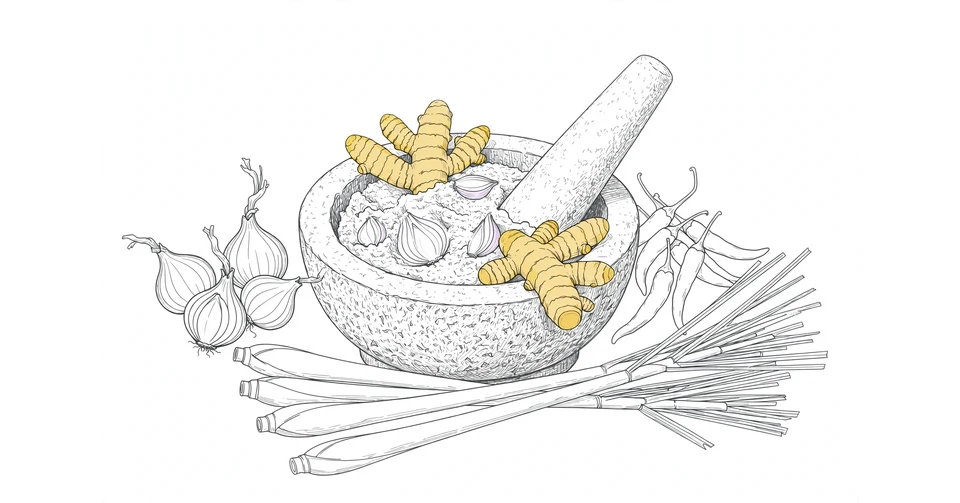
Base genep is the complete Balinese spice paste, ground from shallots, garlic, turmeric, galangal, kencur, ginger, chillies, candlenuts and shrimp paste, and it seasons lawar, sate lilit, babi guling and ayam betutu from the mortar up.
If you have eaten your way across Bali and wondered why so many different dishes taste like they belong to one family, the answer is sitting in a stone mortar. Base genep is the complete Balinese spice paste, ground from more than a dozen roots, chillies, nuts and leaves, and it is the flavour underneath almost every feast on the island.
It seasons the lawar at a temple anniversary, the sate lilit on a warung grill, the babi guling at a wedding and the ayam betutu steamed in banana leaves. Learn this one paste and you have learned the grammar of Balinese cooking.
The name gives the game away. In Balinese, base means spice paste and genep means complete, so base genep is the paste that leaves nothing out. It is savoury, spicy, a little sour and a little bitter all at once, and its job is balance rather than heat.
The first time I understood what base genep really does, I was not looking at a recipe at all. I was looking at a plate. Rice, pork, lawar, sate lilit and sambal sat side by side, and every one of them carried the same warm yellow colour and the same deep flavour. The dishes were different, but the seasoning was one.
What base genep actually is
Base genep is the foundation paste of Balinese cooking, the mixture a cook prepares before the real cooking begins. In Bali every cooking process starts with the grinding of various spices, and the resulting paste is known as bumbu or base genep, which translates literally to complete spice paste. That description comes from chef Heinz von Holzen, writing for NOW! Bali, and it matches what Balinese cooks will tell you in their own kitchens. The paste comes first, and the dish follows.
The paste is built from two groups. The fresh group is the roots and aromatics: shallots, garlic, galangal, lesser galangal, ginger, turmeric, chilli and lemongrass. The dry group is the seeds and nuts: candlenuts, coriander, peppercorns and sometimes nutmeg, cloves and cumin. Shrimp paste, salt, palm sugar and salam leaves join them, and coconut oil carries the whole mixture. Most versions of base genep run to around fifteen ingredients, though no two cooks agree on the exact list, and that disagreement is part of the tradition.
What matters is not the number but the shape of the flavour. A good base genep is savoury from the shrimp paste, warm from the turmeric and ginger, citrus bright from the lemongrass, and hot from the chillies, all held together by the creamy richness of candlenut. No single flavour is meant to win.
That is why the paste is ground rather than simply chopped. Grinding crushes the fibres and forces the oils to merge, so the flavours stop being a pile of ingredients and become one thing. A food processor will get you most of the way there, and many modern Balinese cooks use one without apology, but the stone mortar still sets the standard. The slow circular work of the pestle releases aromas that a blade chops past.
The ingredients in the mortar
Every ingredient in base genep earns its place. Shallots give sweetness and body, and they make up the largest share of most recipes. Garlic gives depth and a savoury edge. Turmeric gives the golden colour that marks Balinese food at a glance, and it stains everything it touches, including the cook's hands.
Galangal and kencur, the lesser galangal, are the two roots that give base genep its unmistakably Balinese character. Galangal is citrusy and piney, kencur is camphorous and cooling, and together they lift the paste out of the ordinary. Ginger adds warmth without the heat of chilli. Lemongrass adds a clean, lemony brightness that keeps the rich paste from feeling heavy. Candlenuts, also called kemiri, add body and a mild nuttiness, and they help the paste bind into something smooth.
The chillies set the heat, and here the cook makes the first real decision. Large red chillies give colour and a moderate warmth, while bird's eye chillies give a sharper, faster burn. Coriander seed adds a warm, earthy note. Shrimp paste, or terasi, adds the deep savoury bass note that makes base genep taste like itself. Without it, the paste is pleasant but flat. Salam leaves, palm sugar and salt finish the work: the sugar rounds off the bitter edges, and the salt sharpens everything else.
There is a useful honesty in a paste that asks for fifteen ingredients. It refuses shortcuts. You cannot buy the real thing in a jar and expect the same result, because the flavour of base genep depends on fresh roots ground the same day, and a jarred paste has already lost the bright top notes that make the fresh one sing.
How base genep is made, from chopping to frying
Making base genep is a process with a rhythm. The roots are peeled and sliced, the chillies are seeded or left whole according to taste, the dry spices are toasted briefly until fragrant, and then everything goes into the mortar in stages. The hard, dry ingredients are ground first, then the fibrous roots, then the soft shallots and garlic, until the whole mass turns into a smooth, golden paste.
The order matters because the mortar is not a blender. A blade chops everything at once, but a pestle works one layer at a time, and the cook adds ingredients as each one gives up its oils. The paste is finished when it holds together and smells warm and complete, with no single ingredient shouting above the rest.
Most cooks then fry the paste gently in a little coconut oil until it is fragrant and the oil begins to separate at the edges. This step cooks off the raw edge of the garlic and chilli and deepens the whole mixture. The fried paste is left to cool before it is folded into meat or vegetables. In sate lilit, for instance, the fried paste is mixed into minced meat with grated coconut, and the cook can tell the spices are evenly spread when the whole mixture turns an even yellow.
At home, a cook will often make a large batch and keep it for the week. The paste keeps well in the refrigerator for several days, and it freezes beautifully. One practical method, shared by chef Heinz von Holzen, is to refrigerate the paste overnight, spoon it into an ice cube tray, freeze it, and store the frozen cubes in an airtight container to use as needed.
Base genep at work in lawar, sate lilit and babi guling
The best way to understand base genep is to watch it work in the dishes it seasons. Each one uses the same paste, and each one tastes completely different, which is the point. The paste is the constant, and the dish is the variable.
Lawar is the dish Bali makes when the whole village eats together, and base genep is what makes it taste the way it does. The dish is a mix of finely minced meat, vegetables and grated coconut, bound together with the paste, and it appears wherever people gather to cook for a ceremony. The site's own guide to lawar is the dish Bali serves when the whole village eats puts it plainly: the paste is ground from shallots, garlic, red chilli and bird's eye chilli, galangal, kencur, turmeric, ginger, candlenuts, coriander, lemongrass and shrimp paste, and the point of that long list is balance rather than heat. In lawar, the paste holds the sweet coconut and the bitter vegetables together so that no single flavour wins. Without it, lawar would be a salad. With it, lawar is a ceremony you can eat.
Sate lilit shows a different side of the paste. The dish is minced meat mixed with grated coconut and base genep, pressed around a lemongrass stalk or a flat bamboo skewer, and grilled over hot coals. The guide to sate lilit wraps Bali's feast around a lemongrass stick states the relationship directly: no account of sate lilit makes sense without base genep, the complete spice paste that gives Balinese cooking its character. Here the paste is not a seasoning added at the end. It is mixed through the meat before the skewer is even formed, so the flavour runs through every bite.
Babi guling, the spit roasted pig that is Bali's most famous feast dish, depends on base genep even more heavily. The heart of babi guling is base genep, the complete Balinese spice paste, and it is worth knowing what is in it, because the same paste shows up across Balinese cooking. The paste is rubbed into the skin and packed inside the body cavity, where the slow heat melts the fat and carries the spices through the meat. The result is a flavour that builds in layers: first the warmth of turmeric and ginger, then the citrus lift of lemongrass, then the slow burn of chilli, then the deep savoury note of shrimp paste underneath it all.
Ayam betutu, chicken steamed or roasted in banana leaves, shows the paste in its most patient form. The chicken is rubbed with base genep and wrapped tight, then cooked slowly until the meat falls from the bone and the spices have soaked through to the centre. Bebek betutu, the duck version, works the same way. In both, the paste is not a sauce served alongside. It is the cooking medium itself.
Base genep and base gede, cousins not twins
Anyone reading about Balinese cooking will quickly meet a second name, base gede, and the two names cause honest confusion. Some writers use base genep and base gede as synonyms. Others treat them as different pastes. The truth, as far as the sources I read allow me to say it, is that the two overlap heavily and the distinction depends on who is cooking.
The word gede means large, and base gede is often described as the fuller, darker blend, used for strong flavoured meats such as pork, duck and lamb. At the Bumbu Bali restaurant, chef Heinz von Holzen prepares five different spice blends, and base gede is the one reserved for those strong meats, while lighter blends are made for seafood, vegetables, chicken and beef. Each blend contains similar ingredients, but they are mixed in very different proportions.
The older literature draws the line more sharply. Writing about traditional Balinese spicing, Suryatini N. Ganie describes basa gede as containing a vast array of spices, including black pepper, white pepper, coriander, cumin, cloves, nutmeg, sesame seeds, cinnamon and a root called lempuyang, along with purut lime leaves and even a type of incense called menyan. Her full account of traditional Balinese spicing is worth reading for anyone who wants to see how the two pastes sit side by side. For a visitor, the practical advice is simple: do not worry about the boundary between the two names. What matters is that the paste is ground fresh and balanced rather than hot.
The six flavours behind base genep
Base genep is not just a list of ingredients. It is built on an idea about flavour. In Balinese cooking, six flavours called sad rasa are considered very important, and they form a unity. The six are pakeh or salty, lalah or pungent and hot, masem or sour, manis or sweet, pahit or bitter, and sapek, an overall flavour felt through the other senses. That account comes from Suryatini N. Ganie, and it explains why base genep tastes the way it does.
Base genep is the paste that brings all six flavours together. Salt gives the salty note, chillies and shallots give the pungent note, lime gives the sour note, palm sugar gives the sweet note, turmeric and kencur give the bitter note, and the shrimp paste gives the deep, overall savouriness that ties the rest together. Ganie calls basa genep the perfect flavour according to this system, and notes that it is used in all cooking, and that the resulting dishes can be eaten by everyone from children to adults. That last detail matters. A paste that balanced all six flavours would be too hot for a child if heat were the point, but heat is not the point. Balance is.
The philosophy shows up on the plate as well. In lawar, the colours of the dish carry meaning: the white of the grated coconut, the red of the blood, the yellow of base genep and the black of the shrimp paste stand for four directions and four deities. I am cautious about reading too much into a side dish, and a plate of food will not teach you Balinese philosophy on its own. But there is something honest about a dish that refuses to let one flavour win, and the paste is the reason it can refuse.
The home kitchen, the ceremony and the freezer
Base genep lives two lives, and both are worth knowing. In the home kitchen, it is an everyday tool. A cook grinds a batch in the morning, fries it in oil, and uses it through the week for vegetables, chicken, fish and rice. The proportions shift with the household. A family that likes heat adds more bird's eye chilli. A family with small children adds less. The paste bends to the people eating it, and nobody apologises for the adjustment.
In the ceremonial kitchen, the same paste becomes a communal event. Large scale ceremonies in Bali almost always mean big feasts, and the preparation begins the evening before, when helpers gather at the bale banjar, the village meeting hall, to chop the spices. The process is called ngeracik basa, meaning to mix the spices, and it lasts about two hours, with a break for coffee and snacks in between. The men sit cross legged in two long rows with their chopping boards between them, each with his own knife, and the rhythmic sound of the knives carries a long way through the village. The women cook the rice, which must be ready by dawn.
The scale is hard to picture until you see the numbers. During a typical village ceremony, food is prepared for approximately 700 people, including the helpers and their families, and for that purpose at least 55 kg of spices would be used. Those figures come from chef Heinz von Holzen's account of ceremonial cooking, and they give a sense of what base genep means when it leaves the home kitchen. It stops being a recipe and becomes logistics, and the paste is ground by hand, in bulk, by people who have done it many times over and for many generations.
I have come to think of base genep as the most honest argument Bali makes for taking cooking seriously. In much of the world, a spice paste is a shortcut, something to add flavour quickly to a dish that would otherwise be plain. In Bali, the paste is the cooking, and the dish is the vehicle. The pig, the chicken, the minced meat and the coconut are all important, but they are not the idea. The idea is the paste, ground fresh, balanced by hand, and carried through the whole feast from the mortar up. That is a small thing to learn and a large thing to understand, and it is the reason a plate of Balinese food can taste, all at once, like a village, a ceremony and a home.
More in Food & Travel
- Sambal Matah Wakes Up Every Balinese Plate Raw
- Sate Lilit Wraps Bali's Feast Around a Lemongrass Stick
- Babi Guling Turns a Whole Pig Into a Balinese Feast
- Lawar Is the Dish Bali Serves When the Whole Village Eats
- Goma Dofu Is the Forty Minute Tofu Ground by Hand
- Garuda Wisnu Kencana Rises Above Bali's Southern Cliffs
Latest posts
- An Obi Is the Knot That Holds a Kimono Together
- Joya no Kane Rings Out the Old Year One Hundred Eight Times
- Geta Still Clatter Through Japanese Summer
- Shakyo Copies the Sutra One Stroke at a Time
- Yukata Is the Robe Japan Reaches for After the Bath
- Bonsho Is the Bell That Wakes a Japanese Temple
- Prajnaparamita Is the Wisdom Behind the Heart Sutra
- A Lamak Turns a Coconut Leaf into a Hanging Prayer
- The Heart Sutra Fits the Whole of Buddhism on One Page
- Shinran Turned Chanting Into Gratitude
- The Javanese of Suriname and the Language They Kept Alive
- Nembutsu Is the Name Japan Calls Out to Amida
- Konpon Daito Towers Over Koyasan in Vermilion and Gold
- Wuku Gives Every Week in Bali a Name
- A Penjor Turns a Whole Street Into an Offering