Zori Are the Quiet Sandals Japan Wears to Every Formal Occasion
· 12 min read
Zori are the flat, quiet sandals Japan pairs with formal kimono, from weddings to tea ceremonies. This article explains what they are made of, how formality is read from the sole, and how to wear them well.
At a Japanese wedding, the loudest thing in the room is usually the silence between the vows. The guests arrive in formal kimono, white tabi socks neat at the ankle, and on their feet sit the quietest shoes in the country. Zori make almost no sound at all.
That silence is the point. Where geta announce their wearer with a wooden clack down a summer lane, zori are built to disappear into the occasion. They are flat sandals with a thong between the toes, woven from straw in their oldest form and finished today in cloth, leather, vinyl or brocade, and they are the standard footwear for a formal kimono. The higher and richer the sole, the more formal the moment it belongs to.
The rule is easy to remember once you have seen it in practice. A summer festival in a light yukata calls for geta, while a wedding, a tea ceremony or a shrine ritual calls for zori and white tabi. Get the pairing wrong and nothing terrible happens, but everyone in the room will notice, the way they would notice a necktie worn with a bathing suit.
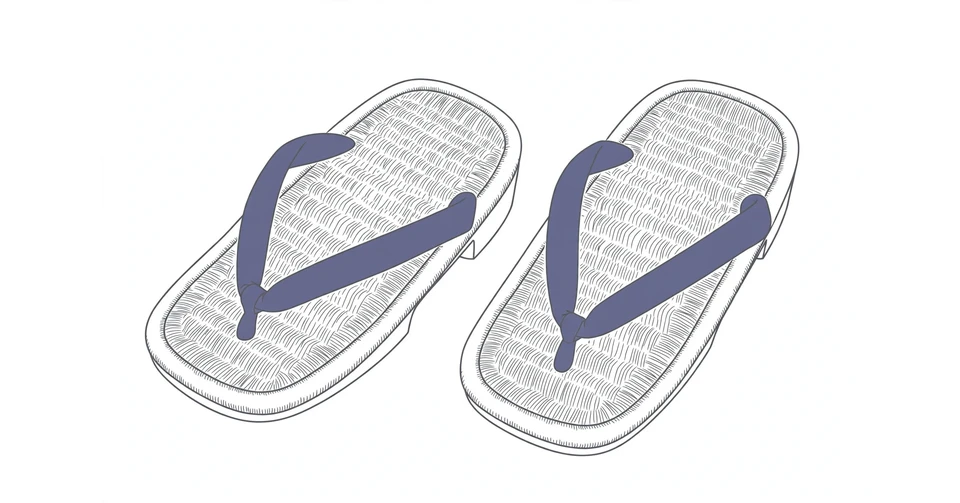
I first paid attention to zori not at a ceremony but in a kimono rental shop in Kyoto, watching a dresser match footwear to outfits the way a sommelier matches wine to a meal. She held up two pairs that looked almost identical to my untrained eye, then explained that one belonged with a visiting kimono and the other with a wedding kimono, and that the difference lived in the height of the sole and the weave of the covering. That is the whole subject of this article. These sandals look simple because their job is to be simple, and the simplicity is doing a lot of quiet work.
What a pair of zori actually is
A pair of zori is a flat platform held to the foot by a thong called hanao, which passes between the big toe and the second toe. The oldest pairs were woven from rice straw, and the name itself comes from the word for straw, wara. In time the materials widened to rush, bamboo sheath, cloth, lacquered wood, leather and rubber, and today synthetic materials are the most common choice for everyday pairs. The shape stayed the same through all of it, a low platform, a V shaped thong, no left or right shoe.
The thong has its own anatomy. The part that sits loosely between the toes is the maetsubo, and the side straps are the yoko-o. Traditionally the hanao is tied through three holes in the sole and adjusted to the wearer, and on some pairs small flaps in the sole hide the knots so the straps can be replaced when they stretch. That adjustability matters, because a thong that is too tight will hurt within minutes, and a thong that is too loose will not hold the sandal on the foot at all. A good pair feels like it is barely there, and that is the test.
The sole tells you more than the strap. Women's pairs are seldom flat, with soles in different thicknesses and angles, often covered in vinyl or fabric, while men's pairs almost always have a flat sole. The thickness is not decoration. It is the clearest signal of formality the sandal carries, and once you know how to read it you can judge an outfit at a glance. The plain straw pair that a farmer once wove at home and the brocade pair worn at a wedding are the same object at opposite ends of one long scale.
The fullest reference on the sandal, from its straw origins to its modern synthetic forms, is this encyclopaedia entry on zori, which also explains how the modern flip-flop spread around the world when soldiers returning from the Second World War brought pairs home to the United States, Australia and New Zealand.
From straw field sandals to formal footwear
Zori began as a slip-on improvement on the waraji, the tied-on straw sandal that travellers and workers wore on the road. A waraji had to be laced around the ankle, which made it slow to put on and take off, and in a country where shoes come off at every doorway that was a real cost. The zori kept the straw and dropped the laces, and that small change turned a work sandal into something you could slip out of at the entrance without breaking stride.
For a long time the sandal was made at home, woven by hand like the waraji before it, and the quality of the weave was the quality of the shoe. The change came in the Edo period, which ran from 1603 to 1868, when production became professionalised and workshops began turning out fancier types in fancier materials. Straw stayed the everyday choice, but rush, bamboo sheath and woven wicker coverings appeared, and an extra outsole was often sewn on when the material was anything better than plain rice straw. Coiled hemp rope, wisteria stems and wood in lateral strips all served as outsoles, and leather soles marked out the setta, the sturdier leather-soled cousin that still carries its own name today.
That Edo period shift is the moment zori stopped being only a practical object and became a marker of taste. The sandal had always been humble, and suddenly it could also be luxurious, and the two versions lived side by side in the same shops. Ordinary people still wore the plain straw pair, while wealthier buyers chose covered soles and patterned thongs. The quiet sandal had learned to speak, softly, about who was wearing it, and it has been speaking that way ever since.
How formal a pair of zori can be
Formality in zori is read from the sole upward, and the scale has three clear rungs. At the top sit ceremonial pairs in gold, silver or brocade, with platforms of five centimetres or more, worn at weddings, receptions and highly formal tea ceremonies. The higher the platform, the more formal the pair is considered, and particularly high pairs are matched with furisode, the long sleeved kimono worn by unmarried women on formal occasions. The thongs on these pairs are often woven with gold or silver thread or decorated with beads, because at this level the sandal is jewellery as much as footwear.
The middle rung is the formal pair in enamel or calf leather, matched with visiting kimono, solid colour kimono and other semi-formal dress, with platforms of about three to five centimetres and designs more modest than the ceremonial kind. Below that sit everyday pairs for small pattern kimono, pongee and cotton, made from cloth, synthetic leather or tatami matting, with low platforms and an emphasis on easy walking. The thong colour adds a final note. White thongs are worn with formal pairs, while black thongs are considered informal, though the thong may also simply match the colour of the garment.
| Pair | Platform | Worn with |
|---|---|---|
| Ceremonial, brocade or gold | 5 cm or more | Wedding, formal tea ceremony, furisode |
| Formal, enamel or leather | About 3 to 5 cm | Visiting kimono, solid colour kimono |
| Everyday, cloth or tatami | Low | Small pattern kimono, cotton kimono |
The scale works because everyone in the room knows it. A guest who arrives at a wedding in low cloth sandals has made the same kind of mistake as a guest who arrives in a lounge suit at a black tie dinner, and the mistake is visible before a word is spoken. That is also why the advice for visitors is so simple. Match the sandal to the kimono, ask the rental shop or the dresser when in doubt, and remember that a taller and richer sole means a more formal occasion. The rule has survived centuries because it is easy to follow and hard to fake.
A clear guide to the whole ladder, from ceremonial pairs down to everyday ones, with matching advice for tabi, is this guide to tabi and zori and how to choose them.
Zori and geta, side by side
Visitors often confuse zori with geta, and the confusion is fair. Both have a thong between the toes, both leave the toe open, and both fit either foot. Our earlier piece on geta, the wooden sandals that clatter through Japanese summer lays out the wooden side of the family, and it notes the line that started this article, that what ordinary people switched to instead was plain straw zori. The two sandals grew up in the same house and then took different jobs.
The difference is the sole and the setting. Geta stand on a wooden platform raised on teeth, which keeps the foot clear of mud and makes the famous karan-koron clack on hard ground. Zori sit close to the ground on a flat or gently angled sole, and they are quiet by design. Geta belong with the informal yukata at festivals and fireworks, while zori belong with kimono, including the most formal outfits in the wardrobe. As a beginner rule, formal kimono means zori, yukata means geta, and a casual kimono can take either, chosen by preference. Rain is the one case where geta win, because the higher platform keeps the feet drier, though zori can be worn in rain with toe covers called shigure zori.
The sock question follows the same logic. Zori are almost always worn with tabi socks, the split toe socks that make the thong comfortable, while geta are usually worn barefoot with a yukata. White tabi are the formal choice, basic for weddings, tea ceremonies and official occasions, and the clean white line at the ankle is part of the outfit, not an afterthought. Coloured tabi suit casual kimono, and the modern stretch versions without metal clasps are easier for beginners, though traditional tabi with their small kohaze clasps are still preferred for formal occasions.
How to wear zori well
Fitting is the first skill, and it surprises first time wearers. The heel should protrude slightly beyond the back of the sole, about one to two centimetres, which follows the Japanese aesthetic of showing the heel. Too small and the pair becomes difficult to walk in, and too large and the foot slides around and the sandal looks careless. Try the pair on, walk a few steps, and check that the thong is snug without pinching. A stiff thong will hurt within minutes, and a good shop will adjust it for you.
Walking is the second skill, and it is the opposite of walking in geta. Take small steps, keep your stride short, and aim to walk quietly. If the sandals make a karan-koron clatter, that is evidence of incorrect walking, and the fix is to slow down rather than stamp harder. The quiet is the point. A person in formal dress who clatters across a tatami room has missed the whole idea, and the room will hear it.
Removing them is the third skill, and it is a small piece of etiquette that guests remember. Step up into the room first, then turn around and arrange the pair facing backward at the entrance, ready for the next wearing and as a courtesy to the host. After use, wipe the soles with a dry cloth and store the pair somewhere ventilated, because moisture is the enemy and causes mould. For long term storage, keep them in a box with mothballs, and if the thongs loosen, a specialist shop can adjust them. Care is simple, and a good pair lasts for years when it gets it.
Where zori still turn up
Zori are no longer everyday footwear for most people in Japan, but they remain the default wherever a kimono is worn properly. Weddings, coming of age ceremonies, tea gatherings, shrine visits and formal dinners all call for them, and kimono rental shops in Kyoto and Tokyo hand over a matched pair with every formal outfit. The same logic holds in the hot spring towns, where the evening outfit is a light robe after the bath. Our piece on the yukata, the robe Japan reaches for after the bath describes that slow evening walk between baths, and on the more formal evenings of a long stay, when dinner calls for a kimono rather than a robe, it is zori that go on the feet.
Modern life has also given the sandal a second career. Casual pairs are worn with Western clothes in summer, and the thong sandal the rest of the world calls a flip-flop owes its spread to the pairs that soldiers brought home after the Second World War. Fashion designers have picked up the split toe sock, athletes have tried tabi style running shoes, and colourful tabi and patterned thongs now turn up with denim kimono and modern styling. The formal sandal has not stayed frozen in the Edo period. It has kept its shape and let the world come to it.
The lesson of the sandal is a modest one, and I think it is worth carrying beyond Japan. Formality does not have to be loud. A flat straw platform, a thong and a white sock can say more about respect for an occasion than any amount of height or noise, and the person who chooses the quiet pair has understood something about the room they are walking into. Get it right, and nobody notices the footwear at all, which is exactly the compliment it was designed to receive.
More in Culture & Society
- Hokusai Spent a Lifetime Chasing One Mountain
- Tabi Are the Split Toe Socks Japan Wears Under Everything
- Ukiyo-e Turned Everyday Edo Into Art Anyone Could Own
- An Obi Is the Knot That Holds a Kimono Together
- Joya no Kane Rings Out the Old Year One Hundred Eight Times
- Geta Still Clatter Through Japanese Summer
Latest posts
- Base Genep Seasons Every Balinese Feast From the Mortar Up
- Shakyo Copies the Sutra One Stroke at a Time
- Yukata Is the Robe Japan Reaches for After the Bath
- Bonsho Is the Bell That Wakes a Japanese Temple
- Prajnaparamita Is the Wisdom Behind the Heart Sutra
- A Lamak Turns a Coconut Leaf into a Hanging Prayer
- The Heart Sutra Fits the Whole of Buddhism on One Page
- Shinran Turned Chanting Into Gratitude
- Sambal Matah Wakes Up Every Balinese Plate Raw
- The Javanese of Suriname and the Language They Kept Alive
- Nembutsu Is the Name Japan Calls Out to Amida
- Sate Lilit Wraps Bali's Feast Around a Lemongrass Stick
- Babi Guling Turns a Whole Pig Into a Balinese Feast
- Konpon Daito Towers Over Koyasan in Vermilion and Gold
- Lawar Is the Dish Bali Serves When the Whole Village Eats