Joya no Kane Rings Out the Old Year One Hundred Eight Times
· 15 min read
Joya no Kane is the ceremony of ringing a temple bell 108 times on New Year's Eve, a slow and solemn way for Japan to let go of the old year and enter the new one with a clear mind.
On the last night of the year, Japan does something quieter than almost any other country. There is no great burst of fireworks over the cities, no loud countdown in the squares. Instead, in the dark, a deep note rolls out from a temple tower, fades, and rolls out again. That sound is joya no kane, the New Year bell, and it is how millions of people say goodbye to the old year.
Joya no kane is the ringing of a temple bell 108 times on New Year's Eve, beginning late on December 31 and carrying on past midnight into January 1. Each strike is meant to clear away one of the 108 earthly desires and attachments that Buddhism says cloud the human mind, so that by the final peal the listener starts the new year with a clean slate.
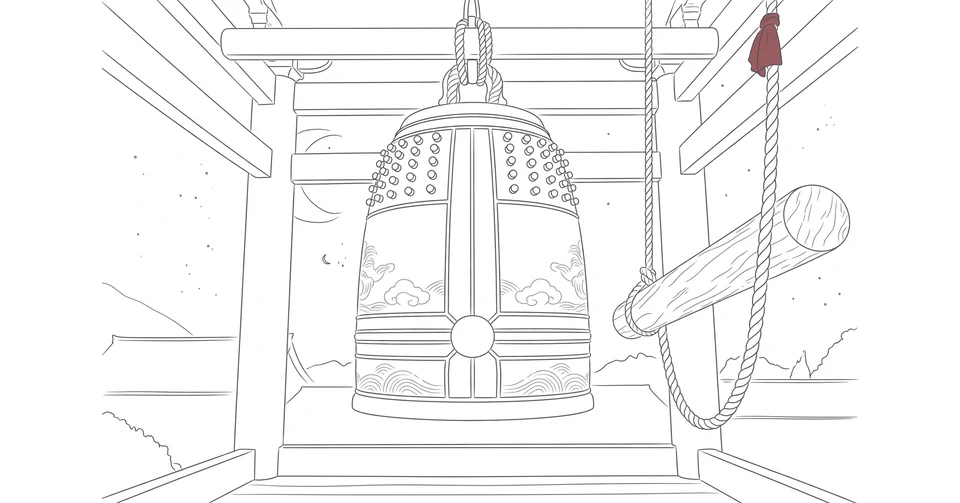
I find it moving that a whole country marks its biggest turning point with a sound that asks for nothing. A bell does not argue, advertise, or entertain. It simply marks the passing of time, and it leaves each listener alone with their own thoughts. In a season full of noise and shopping and hurry, joya no kane is the one tradition that slows everything down on purpose.
What joya no kane means
The name is plain once it is taken apart. Joya means the night when the old year is removed, and kane means bell. Put together, joya no kane is the bell of the night that removes the old year. The bell itself is a bonsho, the great bronze bell that hangs in a tower of its own on temple grounds, struck from outside with a heavy wooden beam hung on ropes.
Joya no kane belongs to Omisoka, the last day of the year, and it is part of the same season as hatsumode, the first temple or shrine visit of the new year. Many people who hear the bell at midnight stay on to make their first prayer of the year, so the last sound of the old year and the first prayer of the new one happen in the same visit. A guide to the season notes that visiting a temple around midnight is one of the most atmospheric things to do in Japan at New Year, when the temple bell is rung repeatedly through the dark hours, as described in the Japan Guide page on visiting Japan during New Year.
Joya no kane is not a concert and it is not a performance for tourists. At most temples, monks strike the first rounds, and then ordinary visitors take their turn at the rope. At some temples the queue is long and the wait is cold, and people stand in line for an hour or more for a single strike. That willingness to wait, in the cold, for one note, says a great deal about what the ceremony means to the people who keep it.
Why the bell rings 108 times
The number 108 is the heart of joya no kane, and it comes from Buddhist teaching about the afflictions of the mind. In Japanese they are called bonno, the worldly desires and attachments, such as greed, anger, jealousy, and pride, that cause human suffering. The tradition holds that there are 108 of them, and each peal of the bell is meant to purge one. This is the same figure given in the bonsho article, which says the 108 peals are meant to purge humanity of the 108 earthly temptations, and it is why the ceremony is counted so carefully, strike by strike, all the way to the end.
There is no single agreed explanation for why the count is 108, and the honest answer is that several explanations exist side by side. One counts the six senses of sight, hearing, smell, taste, body, and mind, each with three variations of pleasant, unpleasant, and even, each of those pure or impure, spread across the past, present, and next life, which multiplies out to 108. Another adds the twelve months, the twenty four solar terms, and the seventy two microseasons of the old calendar, which also sum to 108. A third explanation builds the number from the four and eight kinds of suffering described in Buddhist teaching.
I like that the number has more than one explanation, because it shows that joya no kane was never a piece of arithmetic. It was a feeling first, a sense that a human life carries more troubles than can be counted on two hands, and that the year deserves a proper clearing out. The exact maths matters less than the act itself, and the act is slow, deliberate, and shared. A full account of the ceremony, its history, and the competing explanations for the number can be found in the detailed article on Joya no Kane at Wikipedia.
How the night unfolds
The timing of joya no kane is not the same at every temple, and that is part of the charm. Many temples begin before midnight, often at around eleven in the evening, and ring 107 times in the old year, saving the final strike for the moment the new year begins. Others wait until after midnight and ring all 108 in the new year. Temples that start only after midnight include Zojoji in Tokyo, Sensō-ji in Asakusa, and Narita-san Shinsho-ji, so the exact hour depends on where you stand.
Before taking a turn at the bell, participants place their hands together in gassho, palms pressed, facing the bell. It is a small gesture, and it is easy to overlook, but it changes the act from pulling a rope into making a wish. You bow to the bell, you strike it once, and you step aside for the next person. There is no applause. The next note is already on its way.
The queue for joya no kane is part of the experience. Families, friends, and strangers stand together in the cold, watching the rope move and listening to the notes roll out over the rooftops. The bell of a great temple can be heard for a long way, and people who never leave their homes still hear it through their windows. That is how joya no kane reaches people who never set foot in a temple. It does not need them to come to it. It comes to them.
The great bells of New Year's Eve
No bell in Japan is more famous on this night than the one at Chion-in in Kyoto. It is the largest bonsho in Japan, cast in 1636, weighing 70 metric tons, and it takes a team of 17 people to sound it. On New Year's Eve the monks of Chion-in ring it 108 times for joya no kane, and the ceremony is broadcast across the country. The bell is so large that it is not so much rung as worked, with the monks pulling together on ropes in rhythm, swinging the great striking beam back and forth.
The instrument itself deserves a closer look. A bonsho is a huge bronze bell with no clapper inside, hung in a tower called a shoro, and struck from outside with a wooden beam. The full story of the bell, its casting, and its history is told in the article on the bonsho, the bell that wakes a Japanese temple, and joya no kane is the night when that quiet daily instrument becomes the voice of the whole country.
Sensō-ji in Asakusa holds a different kind of fame. Its bell was the first to be broadcast live, and the temple's bell tower is where many Tokyo people picture the ceremony when they think of it. Zojoji, beside Tokyo Tower in Shiba Park, is another of the great stages, and its bell rings out over one of the most modern skylines in Japan. The contrast is part of the beauty. A centuries old sound, rolling over neon and glass, and nobody in the crowd finds that strange.
| Temple | Where | Why it matters on this night |
|---|---|---|
| Chion-in | Kyoto | Largest bonsho in Japan, cast in 1636, 70 metric tons, rung by a team of 17 monks, broadcast across the country |
| Sensō-ji | Asakusa, Tokyo | First temple to broadcast the bell live, in 1929 |
| Zojoji | Shiba Park, Tokyo | Rings after midnight, beside Tokyo Tower |
| Narita-san Shinsho-ji | Narita | One of the great temples that begins ringing only after midnight |
The table above holds only the most famous names, and it is worth remembering that joya no kane does not belong to them alone. Thousands of smaller temples ring their own bells on the same night, many of them with no audience beyond the neighborhood. A small temple bell, heard by fifty people on a quiet street, does the same work as the great bell of Chion-in. The scale is different. The meaning is not.
How radio carried the bell across Japan
One of the most surprising facts about joya no kane is how recently it became a national custom. The ringing of the temple bell 108 times began in the Zen temples of Song dynasty China, and it was introduced to Japanese Zen temples during the Kamakura period, from 1185 to 1333. In the Muromachi period, from 1333 to 1573, it became an event held only on New Year's Eve. But for centuries after that, joya no kane remained mostly a Zen temple practice, and by the Meiji era it had been largely forgotten outside those temples.
Radio brought it back. In 1927, two years after the first radio station opened in Japan, JOAK, the predecessor of NHK, began broadcasting a radio program called Joya no Kane. For the first two years a bell set up in the studio rang in the new year, but in 1929 the program was broadcast live from a temple, and the first live broadcast came from Sensō-ji. The program spread joya no kane beyond Zen temples to temples of many Buddhist sects across the country, and in 1955 it was renamed Yuku Toshi Kuru Toshi, meaning Going Year, Coming Year, and began to be broadcast on television, where it continues to this day.
The war interrupted the story. In 1941, instead of broadcasting the bells, NHK played a recording of a cannon fired during an attack, and as the war went on, many temples were ordered to hand over their bells to be scrapped for metal, leaving them unable to hold the ceremony at all. Some replaced their bell with a taiko drum. The bells came back after the war, and joya no kane came back with them, and so did the broadcast, but the episode is a reminder that even a tradition that feels timeless can be fragile. A bell that took months to cast can be melted down in a day.
It is worth pausing on what the radio story means for joya no kane. A ceremony that had nearly faded was saved, not by a temple or a priest, but by a new technology that carried its sound into living rooms across the country. People heard the bell on the radio, wanted to hear it in person, and went to their local temples to do so. Technology is often blamed for pulling people away from tradition, and sometimes it does, but here it did the opposite. It gave an old sound a new audience, and the audience kept it alive.
A ceremony that not every temple keeps
Not every Buddhist temple in Japan rings the bell on New Year's Eve, and the exceptions are instructive. Some temples in the Jodo Shinshu sect do not practice joya no kane. According to Higashi Hongan-ji, the head temple of one branch, the founder Shinran did not think that sins were something to be paid off by ringing a bell, so the temple does not hold the ceremony. Nishi Hongan-ji, the head temple of another branch, rings bells before services and to pray for peace, but it does not conduct joya no kane either.
There is a quiet dignity in that refusal. A tradition kept out of habit, without belief behind it, is only noise, and a temple that declines to ring because its teaching says otherwise is being honest about what it believes. I respect that honesty, and it makes the temples that do ring all the more meaningful. They ring joya no kane because they believe the act matters, not because the calendar tells them to.
The same honesty shows in the changes of recent years. Since the late 2010s, some temples have stopped ringing at midnight, because the monks are growing older and fewer, and because neighbors have complained about the noise. Ryukoku-ji in Namerikawa moved joya no kane to two in the afternoon in 2021, taking into account the aging population and the danger of snow and ice on the steps to the bell tower. It is easy to mourn that as a loss, and in a sense it is one, but it is also a temple choosing to keep the ceremony alive in a form it can sustain, rather than letting it die out of stubbornness. A bell rung at two in the afternoon still clears the year. The hour matters less than the intention.
Taking part in joya no kane
For a visitor who wants to take part in joya no kane, the practical rules are simple, and they reward patience more than planning. Arrive early, because popular temples hand out numbered tickets or limit the number of people who can ring, and the queue forms hours before midnight. Dress warmly, because the wait is outdoors and the night is cold. Expect to stand in line, to bow, to strike once, and to step aside. One strike is all anyone gets, and that is the point. The ceremony is shared by giving everyone a single note, not by letting a few people ring many times.
If you cannot reach a temple, the broadcast of joya no kane is a fine way to listen. The television program that began as a radio broadcast in 1927 still carries the bells into homes across Japan, and many people listen to it with the lights low, the year behind them, and the new one just ahead. There is no shame in listening from home. The bell was always meant to be heard at a distance, rolling over rooftops to people who never left their houses.
It is also worth knowing that the night does not end with the bell. Many people stay for hatsumode, the first visit of the year, and the temple grounds stay open and crowded well past midnight. Food stalls, prayers, and the slow drift of the crowd give the night a festival feeling, but the bell is the still center of it. Everything else moves around that slow, deep note.
There is a connection here to another quiet practice of Japanese Buddhism, the calling of the name of Amida Buddha, which is also a sound repeated with the hope of clearing the mind. The article on nembutsu, the name Japan calls out to Amida describes a practice built on a single repeated phrase, and joya no kane works the same way, with a single repeated note. Both trust repetition to do what argument cannot, which is to wear down the noise in the mind until something quieter is left behind.
Why the bell still matters
The modern world has no shortage of ways to mark the new year, and most of them are louder, brighter, and faster than a temple bell. There are countdowns, fireworks, parties, and screens full of light. None of them are wrong, and I would not take them away from anyone. But none of them do what joya no kane does, which is to ask a person to stand still and listen, and to let go of something, one note at a time.
A year is a long time to carry. It holds work and worry, arguments and losses, plans that failed, and hopes that did not arrive. The bell does not pretend that any of that can be erased by a sound. It only offers a way to set it down for a moment, to hear the note fade, and to step into the new year a little lighter. That is a modest promise, and it is exactly why it works. A ceremony that promised to fix everything would be a lie. A ceremony that promises one quiet moment of release is telling the truth.
So when the bell of joya no kane sounds on the last night of the year, whether you hear it in a temple courtyard, on the television, or faintly through a window, it is worth stopping for. Stand still for the minute it takes to fade. Let the old year go, one note at a time, and let the new one begin in the silence that follows.
More in Culture & Society
- Ukiyo-e Turned Everyday Edo Into Art Anyone Could Own
- Zori Are the Quiet Sandals Japan Wears to Every Formal Occasion
- An Obi Is the Knot That Holds a Kimono Together
- Geta Still Clatter Through Japanese Summer
- Shakyo Copies the Sutra One Stroke at a Time
- Yukata Is the Robe Japan Reaches for After the Bath
Latest posts
- Base Genep Seasons Every Balinese Feast From the Mortar Up
- Bonsho Is the Bell That Wakes a Japanese Temple
- Prajnaparamita Is the Wisdom Behind the Heart Sutra
- A Lamak Turns a Coconut Leaf into a Hanging Prayer
- The Heart Sutra Fits the Whole of Buddhism on One Page
- Shinran Turned Chanting Into Gratitude
- Sambal Matah Wakes Up Every Balinese Plate Raw
- The Javanese of Suriname and the Language They Kept Alive
- Nembutsu Is the Name Japan Calls Out to Amida
- Sate Lilit Wraps Bali's Feast Around a Lemongrass Stick
- Babi Guling Turns a Whole Pig Into a Balinese Feast
- Konpon Daito Towers Over Koyasan in Vermilion and Gold
- Lawar Is the Dish Bali Serves When the Whole Village Eats
- Goma Dofu Is the Forty Minute Tofu Ground by Hand
- Garuda Wisnu Kencana Rises Above Bali's Southern Cliffs