Geta Still Clatter Through Japanese Summer
· 17 min read
Geta are the wooden sandals that turn a summer evening in Japan into a small parade of sound. This article explains what a pair is made of, where the design came from, and how to walk in one without wobbling.
On a summer evening in Japan, you hear the geta before you see them. The sound comes down a stone lane in pairs, a light wooden clack, then an answering clack, and a moment later a group in yukata rounds the corner, drifting toward the festival ground or the next public bath. Nothing about the sound is loud enough to startle, yet it carries further than any other part of the outfit. It is the sound of summer itself, at least in the old towns where the evening still belongs to pedestrians.
A pair of geta is simple enough to describe in one breath. It is a flat wooden board for the foot, held on by a cloth thong between the toes, and lifted off the ground by wooden teeth underneath. That raised sole is the whole idea. It keeps the foot and the hem of a robe clear of mud, puddles and dust, and it turns every step into a small wooden note. The word covers a wide family of shoes rather than one single design, from the plain low pair rented with a summer yukata to the tall lacquered platforms worn in old entertainment districts, yet all of them share the same three parts and the same logic.
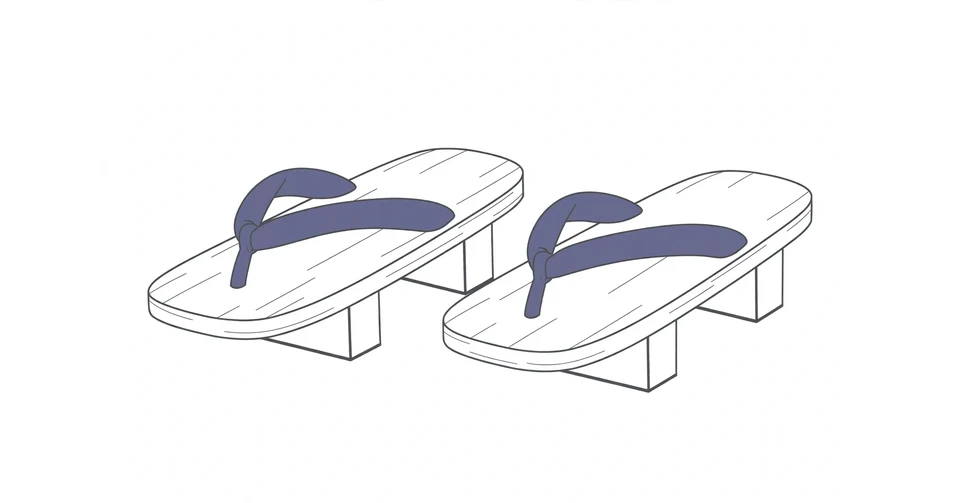
The charm of geta is that they ask so little of the wearer and give so much back in return. They have no laces, no buckles and no left or right shoe. You step into them, you slip out of them at the door, and in between they keep you a few centimetres above the ground. That ease is part of why they lasted so long in a country where shoes come off at the entrance and where the street was often wet. A board, a thong and two teeth are all it takes, and the result has outlived centuries of fashion. It began as farm footwear, became a fashion object in the Edo period, and still turns up wherever Japan dresses for summer.
What a pair of geta actually is
Every pair of geta is built from three named parts. The board the foot rests on is the dai, the platform. The blocks beneath it are the ha, which means teeth. Running between the big toe and the second toe is the hanao, a V shaped cloth thong. The teeth are usually carved from the same block of wood as the base rather than glued on, and harder wood is sometimes set into the bottom of the teeth so they do not split. Some pairs get a metal plate or a glued rubber sole on the contact surface to stretch their life.
The wood matters more than it looks. Paulownia, known in Japanese as kiri, is prized because it is very light, and a pair cut from it costs accordingly. Cedar is the other common choice, and cypress appears in some styles as well. The base shape carries a quiet gender code, with oval bases read as feminine and squarer ones as masculine, and finishes range from bare wood to lacquer and wood stain. Straps vary just as much, from wide and padded to narrow and hard, in printed cotton with traditional motifs or in vinyl and leather. Inside the hanao runs a cord, hemp traditionally and synthetic now, knotted through the three holes in the dai. Straps are replaceable, but breaking one is considered very unlucky.
There is no left and right shoe in a pair, much like a Western wooden clog. The thong sits in the middle of the base rather than off to one side, because on a rectangular base any other position would make the inner back corners collide as you walk. The height of a pair is the whole point of the design. Two toothed pairs run from about 5 cm to about 18 cm tall, and that extra height is what keeps the wearer clear of the ground. When there are two teeth, the front one sits under the ball of the foot and the sandal pivots on it as you walk, while the rear one sits under the standing centre of gravity. That pivot is what produces the sound, and it is also what makes the walk feel different from walking in a flat shoe.
The sound that gives the sandal away
Japanese calls the sound karan-koron, the wooden clack that follows a wearer down a street. The word is onomatopoeia, and the alternating rhythm is what matters. One wooden contact sounds karan, the next answers koron, left and right, step after step, and a shorter version of the same word, karakoro, describes a lighter and quicker clatter. In English the sound is usually rendered as clip-clop, clack-clack or a wooden clatter, but none of those quite catches the music of it.
The exact sound changes with the footwear, the surface and the walker. The wood and the construction set the tone, the shape of the underside shapes it further, and rubber protectors on the bottom soften it. Weight and walking rhythm play their part, and so does the ground itself, whether stone, tile, asphalt, wood or soil. A useful guide to the word and its sound explains that karan-koron is a conventional sound word rather than a scientific transcription, and that no two pairs clatter in exactly the same way. You can read that full explanation in this guide to geta and the karan-koron sound.
For many people the clack evokes summer festivals, old streets, ryokan and traditional townscapes, and fiction uses it as a shorthand for atmosphere. A short clip-clop can tell an audience that a character is walking through a festival, an inn or an old district before the footwear is even shown. That is a lot of work for two small blocks of wood, and it explains why the sound has survived as a cultural signal long after the sandal stopped being everyday footwear. It is worth remembering, though, that a charming cultural sound can still be loud in a quiet hotel corridor or a late night street. The sound should never be forced by stamping harder. Walk naturally, and let the structure of the footwear create its own rhythm.
From rice fields to festival streets
The wooden footwear itself is ancient, though the name geta became common only later. Archaeological remains include large board like ta-geta used in wet rice fields, helping workers avoid sinking into mud. Those early farm versions had no teeth and straw thongs, and they were a tool before they were fashion. Before the word geta became established, earlier Japanese names included ashida and bokuri, and dictionary sources record the word geta from around the late medieval to early modern period. The exact origin of the name is not explained with complete certainty, and it is safer to learn the word as it stands than to invent a story from its kanji.
Japanese examples of geta style footwear from the latter part of the Heian period, which ran from 794 to 1185, were found in Aomori in 2004 during an excavation on the right bank of the Shinjo river. By the Heian period the raised sole was already doing its familiar job of holding a hem a few centimetres above the mud and snow, which is also why sushi chefs favoured tall pairs, since the height kept their feet away from the scraps on the kitchen floor. A detailed history of the sandal, from its farm roots to its Edo period fashion peak, is laid out in this guide to geta sandals and their history.
What ordinary people switched to instead was plain straw zori, which left geta a rare and expensive thing for a long stretch of history. In the Edo era, which ran from 1603 to 1868, geta returned as fashion. They stopped being only wet weather footwear and started being worn on dry days too from the middle of the period, and workshops multiplied until dozens of named varieties were being made. Ukiyo-e, the woodblock prints of the Edo period, caught the sandal in everyday street scenes, and painted pairs still carry ukiyo-e style scenes on the board itself. That is the moment when geta stopped being only a practical object and became a piece of culture, a thing people chose for how it looked and sounded as much as for what it did.
A family of geta, not one sandal
Geta types are named for their teeth, how many there are, how tall they are, and who wore them. The plain low pair with two teeth is the one most people picture, and it is the standard summer sandal, worn with a yukata at festivals and fireworks shows. The koma-geta is close to this familiar shape, a rectangular platform with two teeth, sometimes carved from a single piece of wood.
The hiyori-geta is the classic everyday pair, also called masa-geta. It usually has a rectangular base and two wooden teeth that run across the base, and it was traditionally worn in good weather. The name sets it against the rain footwear, and the distinction matters, because the Japanese summer brings both. Some modern everyday pairs do not have any teeth at all, just a wooden base, which shows how the design keeps loosening its own rules.
For wet weather there is the ama-geta, the rain sandal. Some were lacquered, and removable toe covers could help protect the feet and clothing from rain and mud. Its taller cousin is the taka-ashida, with two teeth that are very tall and thin, built to keep the wearer above deep puddles. With paved roads and street drains keeping mud and puddles to a minimum today, there is little need for the tallest rain pairs, but they survive in the vocabulary and in a few specialist shops.
Then there is the single tooth. The ippon-ba geta, also called tengu geta, has one central support instead of the familiar pair of teeth. Tengu, the long nosed mountain creatures of Japanese folklore, are usually depicted wearing them, and mountain ascetics used them for balance training. They take practice to walk in and are mostly reserved for actors, traditional dances, festivals and costumes. A single tooth stands about 14 to 20 cm tall, and the same design had a much less mystical use too. Fish merchants wore it to stay above the scraps on their shop floors.
The pokkuri geta, also called okobo, go the other way entirely. They have a large base cut from a single piece of wood, the inside is hollow and may contain a small bell so the wearer makes sounds when they walk, and pokkuri is onomatopoeia for the sound these shoes make. They are womens geta and rarely worn except by maiko, the apprentice geisha of Kyoto, whose okobo are usually worn with tabi. Very young girls wear a version with a small bell set into a cavity in the sole, usually in red, with a bright formal kimono for the Shichi-Go-San festival. At the far end of the scale sit the koma-geta with three tall lacquered teeth, worn by oiran, the high ranking courtesans of the old pleasure quarters, in procession. Height, in that world, was a statement of rank.
Geta, zori, and the question of formality
Visitors often confuse geta with zori, and the mistake is understandable. Both have a thong between the toes, both leave the toe open, and both fit either foot. What separates them is the sole and the setting each one belongs in, and the difference is worth learning before buying a pair.
| Feature | Geta | Zori |
|---|---|---|
| Sole | Wooden platform, often raised on teeth | Flatter sandal like sole without teeth |
| Sound | Often clacks or clip-clops on hard ground | Usually quieter |
| Common pairing | Yukata and casual traditional styling | Kimono, including dressier and formal outfits |
| Feet | Often bare with yukata, other combinations exist | Often worn with tabi in conventional kimono dressing |
As a beginners rule, zori are the standard choice for many conventional kimono outfits, including formal ones, while geta are strongly associated with casual yukata and informal wear. There are historical and specialised exceptions, so no single modern rule covers every surviving or theatrical form. The safe approach is to match the footwear to the outfit and the occasion. A summer festival with a yukata calls for geta. A formal ceremony with a formal kimono generally calls for appropriate zori and tabi. Ask a specialist when the occasion is a wedding, a tea ceremony or a formal celebration, because the wrong pair is the kind of mistake that is easy to avoid and hard to forget.
The question of socks follows the same logic. The familiar festival style is yukata, geta and bare feet, and that is the simplest answer for a beginner. Yet geta and tabi have also been combined in some historical, occupational, seasonal, theatrical and modern contexts, so the claim that geta are never worn with socks is too absolute. White tabi with geta is still a common festival pairing, and okobo are normally worn with tabi. Ordinary closed toe socks do not work well, because the hanao passes between the toes, while split toe tabi are designed for exactly that.
How to walk in geta without wobbling
Walking in geta feels different from walking in flexible sneakers, and the first ten minutes are the awkward ones. Then, for most people, it is not. The trick is to take shorter, controlled steps, keep the centre of gravity stable, and avoid dragging the footwear loosely behind you. Do not stamp to make a louder sound, and slow down on stairs, wet stone, metal covers and uneven ground. If the yukata hem needs lifting on steps, lift it slightly.
Fitting surprises first time wearers. Geta are worn deliberately a little too small. The heel should overhang the back of the dai, with about a fingers width between the strap and the webbing of the toes. The toes then pinch the thong to lift the front at each step, and that position puts the teeth under the wearers centre of gravity, which is what stops the wobble. A small amount of heel extending beyond the back edge can be normal in traditional fitting, so a slight overhang does not automatically mean the pair is too small. What matters is whether the pair is stable and comfortable, and a rental shop dresser can check the size and adjust the hanao. Stop if the thong causes serious pain or skin damage, and do not imitate an exaggerated animation walk. Small, stable steps are the whole technique.
Rain is fine, snow less so. The extra height and the impermeable wood keep feet dry, and because a geta sole does not flex it will not flick water and grit up the backs of your legs the way a soft sandal does. Snow is the problem. It packs into the teeth and makes walking awkward, so geta are not usually a snow shoe now, even though they were historically. Wood can also be slippery on wet tile, polished floors, metal plates and smooth stone. Some modern pairs include rubber on the underside for grip and quieter wear, but even with rubber, take extra care in rain and on stairs. Care is simple. Keep the wood dry after rain, wipe off mud before it dries into the grain, and store the pair somewhere ventilated rather than sealed in plastic. A lacquered pair wants a soft cloth rather than a scrubbing brush, and a good pair is worth repairing rather than replacing.
Where geta still turn up
Geta are no longer normal everyday footwear for most people, but they remain visible with yukata, at festivals, in ryokan and hot spring towns, in traditional performance, and in modern fashion. The hot spring town is their natural home. The whole outfit is completed with geta, wooden sandals that clatter pleasantly on stone paths, and a small drawstring bag, a kinchaku, for carrying a phone and a little cash. That line comes from our earlier piece on the yukata, the robe Japan reaches for after the bath, and it describes Kinosaki Onsen, a hot spring town in Hyogo Prefecture where wearing a yukata is part of everyday life rather than a special occasion. Visitors walk the willow lined streets in robe and geta, moving from one public bath to the next under paper lanterns, and the sandal fits the town because the town still runs at walking pace.
The same logic holds wherever the bath is the centre of the evening. In our piece on gensen-kakenagashi, the onsen water that never circles back, the water itself is the attraction, and the walk to the bath is part of the ritual. Geta suit that walk. They slip off at the entrance, they keep the robe hem off the wet stone, and they make the short journey between bath and inn feel like a small event rather than a chore. It is a small detail, and small details are what a hot spring town is made of.
Sumo keeps the sandal in daily use too. Footwear marks rank in the sumo stable, and new recruits wear geta, wrestlers who have proved themselves move up to setta, and only the highest ranked get tabi. Summer festivals and Kyoto kimono rental shops keep them in circulation as well, and a session with a kimono, geta and often a traditional hairstyle runs 3,000 to 6,000 yen. The height also had a second life in fashion. By the late 1990s designers were competing over how tall a sole they could get away with, and the result was the thick platform shoe popular with young women, a trend that ran straight back to geta. The Metropolitan Museum of Art holds a pair of womens geta dated to the late 19th or early 20th century, built from wood, raffia and natural fibres, which is a quiet sign of how far a farm sandal travelled.
Why a wooden sandal still matters
There is a temptation to treat geta as a costume, something to rent for an afternoon and photograph. That misses what the sandal actually is. It is a piece of design that solved a real problem, keeping feet and clothing clear of a wet and muddy world, and it solved it with so little material that the solution itself became beautiful. The sound is a bonus, not the point, and the point was never fashion. Fashion arrived later, and it arrived because the object already worked.
I think the sandal also teaches something about pace. You cannot hurry in geta, not safely and not comfortably. The teeth demand short steps, attention to the ground, and a willingness to arrive a little later than you planned. In a country that runs some of the fastest trains on earth, that slowness is not a flaw. It is a small, deliberate pause built into the evening, and it is the reason the sandal still fits the festival and the hot spring town better than any sneaker. The places where geta survive are the places where slowness is still part of the pleasure.
So if you find yourself in Japan on a summer evening, with a yukata on and a festival somewhere ahead, take the wooden pair the inn offers. Let the heel hang a little past the edge, take short steps, and listen for the karan-koron under your feet. The sound has been following Japanese summers for centuries, and it is still there, waiting under the next stone lane, ready to carry you the last few hundred metres to the bath.
More in Culture & Society
- An Obi Is the Knot That Holds a Kimono Together
- Joya no Kane Rings Out the Old Year One Hundred Eight Times
- Shakyo Copies the Sutra One Stroke at a Time
- Yukata Is the Robe Japan Reaches for After the Bath
- Bonsho Is the Bell That Wakes a Japanese Temple
- Prajnaparamita Is the Wisdom Behind the Heart Sutra
Latest posts
- Base Genep Seasons Every Balinese Feast From the Mortar Up
- A Lamak Turns a Coconut Leaf into a Hanging Prayer
- The Heart Sutra Fits the Whole of Buddhism on One Page
- Shinran Turned Chanting Into Gratitude
- Sambal Matah Wakes Up Every Balinese Plate Raw
- The Javanese of Suriname and the Language They Kept Alive
- Nembutsu Is the Name Japan Calls Out to Amida
- Sate Lilit Wraps Bali's Feast Around a Lemongrass Stick
- Babi Guling Turns a Whole Pig Into a Balinese Feast
- Konpon Daito Towers Over Koyasan in Vermilion and Gold
- Lawar Is the Dish Bali Serves When the Whole Village Eats
- Goma Dofu Is the Forty Minute Tofu Ground by Hand
- Garuda Wisnu Kencana Rises Above Bali's Southern Cliffs
- Wuku Gives Every Week in Bali a Name
- A Penjor Turns a Whole Street Into an Offering