Yukata Is the Robe Japan Reaches for After the Bath
· 10 min read
A yukata is Japan's light cotton robe for after the bath, worn at hot springs, summer festivals and fireworks shows. It began as a simple bathing cloth and became the uniform of Japanese summer.
A yukata is the robe Japan reaches for after the bath. It is light, unlined and made of cotton, and its name says exactly what it is for. The word breaks down into yu, meaning bath, and katabira, an old word for a single layer robe. It is, quite literally, a bathing cloth.
It is not a kimono, though visitors often mistake one for the other. A kimono is formal, usually silk, worn in layers for weddings and tea ceremonies and other occasions that call for ceremony. A yukata is the casual cousin. It is worn in summer, after a soak, at festivals and fireworks shows, and for an evening walk through a hot spring town. Where a kimono demands help and preparation, the robe asks for a sash and a pair of wooden sandals.
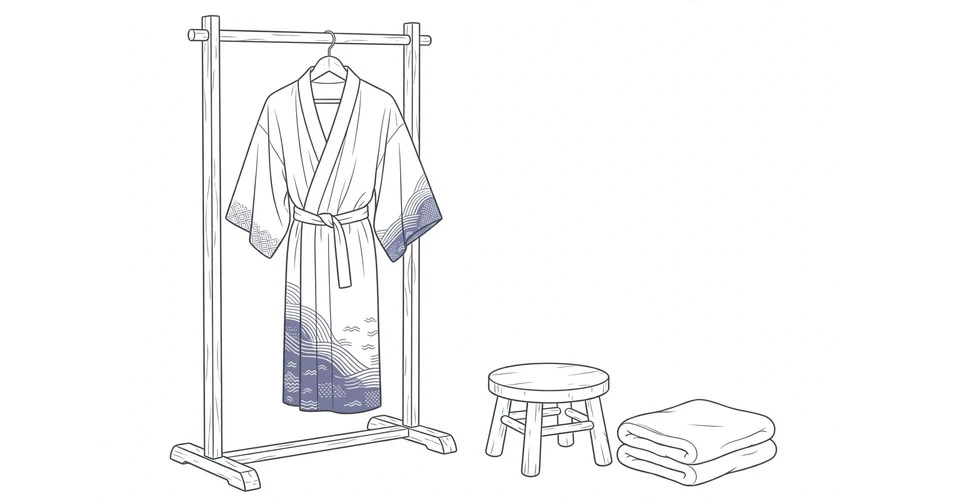
The robe usually waits on a hook in the room of a traditional inn, folded neatly beside the futon, and that placement is the whole story. Guests change into it after dinner, step out into the evening air, and drift toward the bath in something that feels closer to loungewear than to dress. The image is familiar to anyone who has stayed at a ryokan. In one of our earlier pieces about open air bathing, we described how guests drift out after dinner in their yukata toward a modest garden bath, and that small scene, a robe and a quiet evening, is where the garment still belongs most naturally. If you want the full picture of that bath, read about the rotenburo, the bath with weather.
The name gives the job away
The ancestor of the robe was the yukatabira, a thin linen robe worn by court nobles in the Heian period, which ran from 794 to 1185. Bathing in those days meant sitting in a steam bath rather than sinking into a tub, and the robe protected the skin from the hot steam while it absorbed sweat. It was practical clothing for the elite, reserved for people who could afford a private bath and the leisure to linger in it.
The garment changed when bathing changed. During the Edo period, from 1603 to 1868, public bathhouses spread through the growing cities, and ordinary townspeople began to bathe every day. Cotton was becoming more widely available, and the linen robe gave way to a cotton one that was cheaper, softer and easier to wash. Indigo dye gave the early cotton robe its deep blue colour, and the robe moved out of the bathhouse and into the street.
That move is the interesting part. A piece of clothing designed for the moments after a bath became the standard dress for a summer evening. People wore the robe to stroll the neighbourhood, to watch the fireworks, to dance at the Bon festival. The robe kept its loose cut and its absorbent cotton, but its job expanded. It stopped being only something you changed into and became something you went out in, and that is still how it works today.
A yukata is not a kimono
The difference is easy to see once you know what to look for. The robe is unlined, made from a single layer of cotton or a modern synthetic blend, and it is worn without the underlayers that a kimono requires. A kimono is usually silk, often lined, and it is dressed with help, with cords and clips and a wide stiff sash that takes practice to tie. The robe is dressed by its wearer, usually alone, in a couple of minutes.
The sleeves tell the story too. A kimono has long sleeves and a formal weight to it, while a yukata has shorter sleeves and a lighter drape. The sash of a yukata, the obi, is softer and narrower, tied in a simple bow at the back. The whole outfit is completed with geta, wooden sandals that clatter pleasantly on stone paths, and a small drawstring bag, a kinchaku, for carrying a phone and a little cash.
There is a temptation to treat the robe as a lesser kimono, a simplified version for people who cannot manage the real thing. That reading misses the point. The yukata is not a kimono that failed. It is a different answer to a different question, the question of what to wear when the air is hot and humid and the evening is meant to be enjoyed rather than endured. Japan kept both garments because each one does a job the other cannot.
How to wear a yukata without getting it wrong
Putting one on is simple, but one detail matters more than all the rest. Slide your arms in, wrap the right side of the fabric across your body first, and then overlap it with the left side, so the left side ends up on top. Secure it with an inner tie, then wrap the obi around your waist and tie it in a bow at the back. The collar should sit just below the nape of the neck, with a small neat gap.
The order of the wrap is not a matter of taste. Right over left is how the dead are dressed in Japanese funerary custom, and wearing a yukata that way is a mistake people notice. Left over right is the rule for the living, and it applies to a yukata just as it applies to a kimono. It is the kind of small detail that separates a guest who has done a little homework from one who has not, and it costs nothing to get right.
The rest is comfort. If the yukata is too long, fold the extra fabric up at the waist into neat pleats before tying the obi. Men usually tie the obi lower, around the hips, while women tie it at the waist. A fuller guide to the dressing, the accessories and the rental shops of Tokyo, Kyoto and Osaka is kept by the Arigato Japan travel team in their guide to the yukata, which walks through each step with the patience of people who have dressed many first timers.
Where a yukata belongs
The robe has three natural homes, and each one shows a different side of it. The first is the summer festival, the matsuri, where crowds in bright cotton move between food stalls and game booths, and where the patterns of the robe, goldfish, fireworks, morning glory flowers, become part of the scenery. The second is the fireworks show, the hanabi taikai, held on hot evenings in parks and along riverbanks, where the light fabric keeps the wearer cool through hours outdoors. The third is the hot spring town, where the robe returns to its original job.
Nowhere is that third home clearer than in Kinosaki Onsen, a hot spring town in Hyogo Prefecture where wearing a yukata is part of everyday life rather than a special occasion. Every ryokan in the town provides guests with a yukata, and visitors walk the willow lined streets in robe and geta, moving from one public bath to the next under paper lanterns. The town has kept this custom for generations, and it works because the robe is exactly what a person wants after stepping out of hot water into a cool evening. A good account of Kinosaki and its yukata culture, including the Himeji Yukata Festival held every late June near Osakabe Shrine, is given in this guide to the yukata in Japan, which traces the garment from the bathhouse to the festival ground.
The Himeji festival deserves a mention of its own. It is counted among the oldest yukata festivals in Japan, with a history reaching back to the early 18th century and the era of Sakakibara Masamine, the lord of Himeji. Thousands of people gather in yukata, and the festival is less a costume event than a town remembering, together, that the robe belongs to everyone.
Hot spring towns beyond Kinosaki run on the same logic. In Kusatsu, the spring water arrives too hot to bathe in, and the town cools it by stirring, never by diluting it, a method described in our piece about the yubatake, the wooden field that cools a spring. The bather steps out of that water, dries off, and reaches for the robe on the hook. The bath and the garment are two halves of the same evening, and neither one makes full sense without the other.
The patterns say something
The robe is rarely plain. The cotton is printed or dyed with motifs that change with the season and the wearer, and the choice of pattern is part of the pleasure. Goldfish swim across indigo cloth, fireworks burst in white and red, morning glories climb the hem, and waves roll in stylised bands. The patterns are cheerful by design, because the occasions are cheerful, and a bright robe in a festival crowd is a small act of participation.
Men's yukata tend toward quieter colours, deep indigo, charcoal, grey, with restrained geometric patterns, while women's yukata run brighter, with flowers and flowing designs. Children's yukata are the brightest of all, made with playful colours and patterns that suit a summer evening, and often sewn with hidden shoulder folds that can be let out as the child grows. None of this is written down as law. It is custom, absorbed by watching, and that is part of its charm.
The fabric itself has changed with the times. Traditional yukata are cotton, sometimes linen, and the best of them are still made that way. Modern versions often use synthetic blends that resist wrinkles and dry faster, and they are cheaper to buy. Purists prefer cotton for the way it breathes and the way it softens with washing, and they have a point. A cotton yukata feels better against skin that has just come out of hot water, and it ages the way good everyday things age, by getting more comfortable rather than less.
Why the robe still matters
Japan could have let the robe fade. Western clothing is easier to buy, easier to wear and easier to wash, and for most of the year most Japanese people wear it. The robe survives because it does something Western clothing does not do, which is to mark a change of state. Putting one on is a small ritual of slowing down. The day clothes come off, the sash is tied, the sandals are slipped on, and the evening begins on different terms.
There is a lesson in that, and it is not really about clothing. A culture keeps what it uses, and it uses what fits the moment. The yukata fits the moment after the bath, the evening of a festival, the slow walk between one hot spring and the next. It asks little of its wearer and gives back comfort, and that modest exchange has kept it alive for a thousand years, from a linen robe in a Heian steam bath to a cotton one on a crowded street in July.
So the robe on the hook in the ryokan room is not a costume waiting for a tourist. It is an invitation, and a practical one. Put it on, tie the sash, mind the left over right, and step out into the evening. The bath has already done its work. The yukata finishes it.
More in Culture & Society
Latest posts
- Base Genep Seasons Every Balinese Feast From the Mortar Up
- A Lamak Turns a Coconut Leaf into a Hanging Prayer
- The Heart Sutra Fits the Whole of Buddhism on One Page
- Shinran Turned Chanting Into Gratitude
- Sambal Matah Wakes Up Every Balinese Plate Raw
- The Javanese of Suriname and the Language They Kept Alive
- Nembutsu Is the Name Japan Calls Out to Amida
- Sate Lilit Wraps Bali's Feast Around a Lemongrass Stick
- Babi Guling Turns a Whole Pig Into a Balinese Feast
- Konpon Daito Towers Over Koyasan in Vermilion and Gold
- Lawar Is the Dish Bali Serves When the Whole Village Eats
- Goma Dofu Is the Forty Minute Tofu Ground by Hand
- Garuda Wisnu Kencana Rises Above Bali's Southern Cliffs
- Wuku Gives Every Week in Bali a Name
- A Penjor Turns a Whole Street Into an Offering