Shakyo Copies the Sutra One Stroke at a Time
· 10 min read
Shakyo is the Japanese practice of copying a Buddhist sutra by hand, one character at a time, and the slow work itself is the meditation.
A brush, a sheet of thin paper, and 260 characters that must each be written by hand. That is shakyo in its simplest form, the Japanese Buddhist practice of copying a sutra character by character until the whole text exists again in your own handwriting. Nothing about it is fast, and that is the point.
Shakyo is not calligraphy for display, and it is not a test of beautiful handwriting. It is a devotional practice, a form of meditation, and a way of earning merit, all carried out with a brush. The word itself is plain. Written with the characters for copy and sutra, shakyo means exactly what it says, and the practice has been part of Japanese Buddhism for more than thirteen centuries.
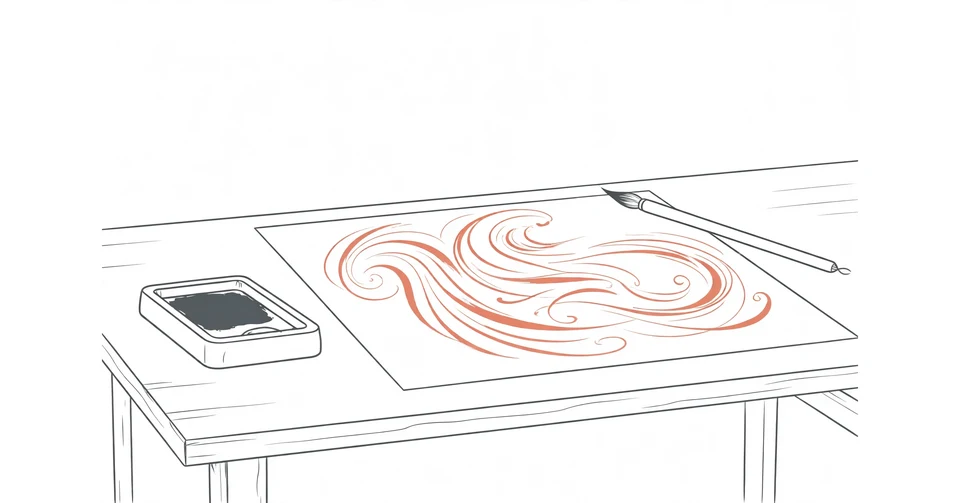
What surprises most first timers is how little the result matters. A shaky character is not a failure. What matters is the attention given to each stroke, and that is why shakyo still draws people into temple halls today.
What shakyo actually is
Shakyo is the hand copying of a Buddhist sutra, done slowly and deliberately as an act of devotion, study, meditation, and merit making. That description comes from the history of sutra copying, which traces the practice across East Asia, where copying a sacred text was understood as a way to preserve the teaching and to generate merit for the copyist and for others. In Japan today, shakyo usually means copying the Heart Sutra, because its 260 characters fit into a single sitting while still carrying a complete teaching.
The practice begins before the brush touches paper. The copyist washes the hands, tidies the desk, and arranges the materials in neat order. Ink is ground, paper is laid flat, and the text to be copied is placed underneath a translucent sheet, so the characters show through faintly. The copyist then traces each character from top to bottom and from right to left. Sincerity matters more than skill, and the Japan Tourism Agency, which describes the practice for visitors, puts it plainly. The copyist's sincerity outweighs the quality of the handwriting.
A mistake is handled with the same calm. The wrong character is crossed out, and the correct one is written beside it in the margin. There is no starting over and no apology. The correction stays visible on the page, which seems right for a practice built on honesty.
At the end of a shakyo session, the copyist writes the date, the name of the person who should receive the merit, and their own name at the foot of the text, then traditionally reads the finished copy aloud after the priest. The copy can be taken home or dedicated to the temple, where it is placed on the altar and later ritually burned, a form of offering rather than destruction.
How shakyo reached Japan
Shakyo came to Japan in the sixth century with the introduction of Buddhism itself, and by the Nara period, which ran from 710 to 794, copying sutras had become a popular activity among the aristocracy. In the days before mechanical printing, hand copying was the only way a religious text could travel, so the propagation of Buddhism depended on the slow labor of copyists. A long text could take months or even years to copy in full.
The earliest recorded instance in Japan dates to 673, in the second year of Emperor Tenmu's reign, when the copying of the entire Buddhist canon was carried out at Kawaradera, also known as Kawahara Temple. In the Nara period, court sponsored projects to copy the entire corpus of sutras took place every three and a half years, engaging the efforts of around 10,000 people for a year at a time. Copying was not a quiet hobby for a few monks. It was a national undertaking, organized by the court and carried out by thousands of hands.
Professional copyists, known as shakyo sei, were employed for this work, and sutra copying became a state sponsored enterprise under Emperor Shomu in the Tenpyo era. The work was organized, paid, and checked, and the finished copies were stored in temple libraries and dedicated as offerings. For the scribes, it was a livelihood as well as a devotion.
By the Heian period, which ran from 794 to 1185, shakyo had changed in an important way. It was no longer only a public project for spreading the faith. It had also become a private practice, carried out by individuals as a spiritual discipline, often to pray for health, for peace, or for the benefit of someone who had died. The court workshops are gone, but the private act of sitting down with a brush and a sutra remains.
The heart sutra is the usual text
In Japan, the most frequently copied sutra is the Heart Sutra, known in Japanese as the Hannya Shingyo. At 260 characters in the Chinese translation by Xuanzang, it is short enough to finish in one sitting, yet it carries a teaching that monks spend lifetimes studying. A beginner can complete it and still feel they have done something whole, which is exactly the experience the Heart Sutra article on this site describes. The Heart Sutra fits the whole of Buddhism on one page, and shakyo is how many people first meet it up close, character by character rather than all at once.
Other sutras are also copied in shakyo. The Kannon Sutra, the Diamond Sutra, the Amida Sutra, and the Lotus Sutra are all common choices. The Lotus Sutra in full is a project for months or years rather than an afternoon, and that length is part of the appeal.
What happens in a shakyo session today
Today, many temples across Japan offer shakyo sessions to visitors. Two temples along the Chichibu 34 Kannon Pilgrimage, Saikoji and Hoshoji, offer visitors the chance to try it, and Hoshoji gives instruction in English and Mandarin as well as Japanese. No reservation is required there, and the requested donation is 1,000 yen per participant.
Hoshoji offers three sutras for copying. The Heart Sutra is one, the Kannon Sutra is another, and the third is the Life Extending Ten Phrase Kannon Sutra, a shorter form of the Kannon Sutra that has only 42 characters. That short text is ideal for beginners, and completing a shakyo copy usually takes between 30 and 60 minutes.
The session itself is simple. Visitors are led to a tatami room with the desk and materials already prepared. The chosen text lies underneath a translucent sheet of copying paper, and the copyist traces the characters beneath, working from top to bottom and from right to left. There is no music, no talking, and no phone. That quiet connects shakyo to the wider rhythm of temple life. In the dawn service called gongyo, the chanting is kept on pace by a wooden drum while the whole hall breathes together. In shakyo there is no drum and no hall full of voices, only one person, one brush, and one character at a time.
Why copying beats reading
Reading a sutra is fast. Copying it is slow, and the slowness changes what happens in the mind. When you read, the eye skips ahead and the text becomes an idea. When you copy, the eye must stay on one character, and the hand must form it stroke by stroke. The text stops being an idea and becomes an action, and that shift is the heart of shakyo.
The Chinese Buddhist monk Sheng Yen described two main benefits of sutra copying. It improves the memory of the teachings, and it gives rise to a mind of respect and faith, because seeing the sutra is like seeing the Dharma, and seeing the Dharma is like seeing the Buddha. A character you have written by hand is not the same as a character you have glanced at. It has passed through your body, and the body remembers what the eye forgets. That slowness feels like a quiet correction to the way most days are measured, in messages answered and pages scrolled, and I think shakyo survives because that correction still matters.
There is also the question of merit, which is central to the tradition and easily misunderstood from outside it. In Buddhist teaching, copying a sutra generates merit, a kind of spiritual goodness that grows with each positive act, and the merit can be transferred to others. As shakyo became popular, it became common to commission copies for the benefit of a deceased loved one. Whether or not a reader accepts that doctrine, the impulse behind it is easy to recognize. It is the wish to do something good for someone you love, with your own hands, over a long afternoon.
The tools of shakyo
The tools of shakyo are few, a brush made from animal hair, an inkstone for grinding an ink stick, a ruler or template to keep the lines straight, and paper. That is the whole kit, and it has barely changed in a thousand years. The ink is ground by hand before the session begins, and the grinding itself is part of the preparation, a slow circular motion that settles the mind before the first character is written. Ordinary copies use plain paper, but the tradition also includes indigo dyed paper with gold or silver ink, reserved for high status manuscripts.
A practice that survived printing
Printing should have ended shakyo. Once a sutra could be printed by the thousand, copying it by hand became unnecessary for spreading the text, and the court workshops faded away. The practice survived anyway, because it was never only about making copies. It was about what copying does to the person doing it, and printing cannot do that work for anyone. The distinction has a name in Japanese. The printing of sutras is called kangyo, while copying them out by hand is shakyo, and the two have lived side by side for centuries. A printed sutra spreads the teaching. A copied sutra lets a single person meet it, one character at a time.
One stroke at a time
Shakyo asks for very little and gives back something hard to name. A brush, a sheet of paper, a text, and an hour of attention. The finished page is not the reward. The reward is the hour itself, spent inside a single task, with the mind held gently to one character and then the next.
The practice does not promise enlightenment, and it does not promise a beautiful page. It promises only that if you sit down, pick up the brush, and copy one character at a time, the noise will quiet for a while, and the text will become yours in a way that reading alone never quite manages. That is a modest promise, and it is one that shakyo has kept for more than thirteen centuries.
More in Culture & Society
- An Obi Is the Knot That Holds a Kimono Together
- Joya no Kane Rings Out the Old Year One Hundred Eight Times
- Geta Still Clatter Through Japanese Summer
- Yukata Is the Robe Japan Reaches for After the Bath
- Bonsho Is the Bell That Wakes a Japanese Temple
- Prajnaparamita Is the Wisdom Behind the Heart Sutra
Latest posts
- Base Genep Seasons Every Balinese Feast From the Mortar Up
- A Lamak Turns a Coconut Leaf into a Hanging Prayer
- The Heart Sutra Fits the Whole of Buddhism on One Page
- Shinran Turned Chanting Into Gratitude
- Sambal Matah Wakes Up Every Balinese Plate Raw
- The Javanese of Suriname and the Language They Kept Alive
- Nembutsu Is the Name Japan Calls Out to Amida
- Sate Lilit Wraps Bali's Feast Around a Lemongrass Stick
- Babi Guling Turns a Whole Pig Into a Balinese Feast
- Konpon Daito Towers Over Koyasan in Vermilion and Gold
- Lawar Is the Dish Bali Serves When the Whole Village Eats
- Goma Dofu Is the Forty Minute Tofu Ground by Hand
- Garuda Wisnu Kencana Rises Above Bali's Southern Cliffs
- Wuku Gives Every Week in Bali a Name
- A Penjor Turns a Whole Street Into an Offering