Hakama Turn a Kimono Into Ceremony
· 17 min read
A hakama is the wide pleated trouser worn over a kimono at weddings, graduations, tea ceremonies and martial arts, and it turns everyday dress into formal dress.
A kimono by itself is a comfortable robe. Men wear one at home, at festivals and at hot spring inns, and nobody looks twice. Add one more garment, though, and the same robe turns into formal dress. That garment is the hakama, a pair of wide pleated trousers tied high over the kimono, and in Japan it works the way a tie works in the West, only more so. It is the difference between dressed and dressed up.
It is simple to describe and hard to mistake. It falls from the waist to the ankles, it is held by four long straps called himo, and its deep pleats give it a flowing line that looks almost like a skirt from a distance. There are two kinds: the divided umanori hakama, cut like very wide trousers for riding a horse, and the undivided andon bakama, which hangs like a lantern skirt. Both are worn over a kimono, never instead of one, and both announce the same thing. The wearer has dressed for an occasion that matters.
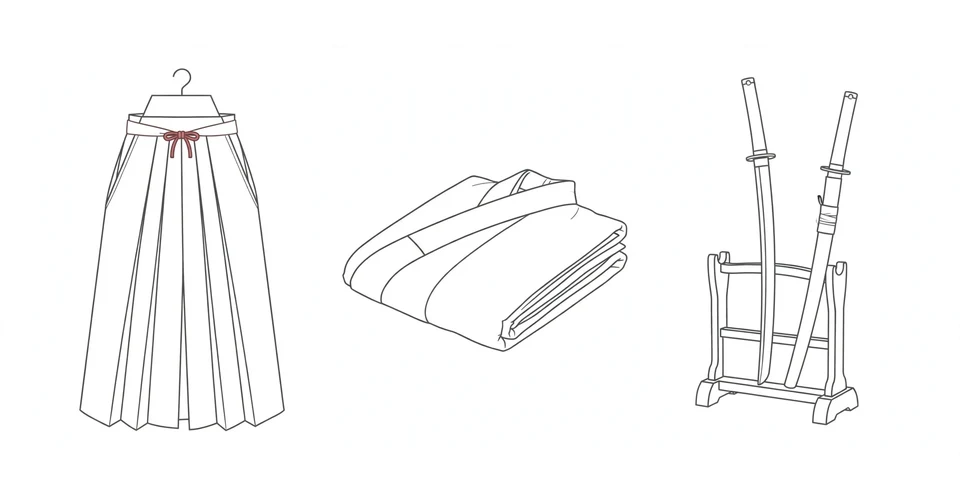
I first understood the power of the garment at a wedding in Japan, watching the groom walk in wearing a black crested kimono, a haori jacket and a striped hakama. Nothing else about him had changed since the rehearsal the day before, yet he looked like a different person, taller, slower and suddenly serious. That is what this article is about: how a pair of pleated trousers came to carry the weight of ceremony in Japan, from the imperial court to the graduation stage, and why the hakama still does.
What a hakama actually is
Strip away the ceremony and the hakama is a practical garment with a clever construction. It is tied at the waist and falls to about the ankles, worn over a kimono, sometimes over a special under kimono called a hakamashita. The front and the back are held by four straps, the himo. Two longer straps are attached to the front and two shorter ones to the rear, and the way they are crossed and knotted is part of the dress itself, not an afterthought.
The back of the garment may have a rigid trapezoidal section called the koshi-ita, which sits flat against the lower back and keeps the whole shape upright. Tucked inside, below it, there may be a small spoon shaped piece called the hakama-dome, which slides behind the obi and helps hold everything in place. The obi itself is tied first in a special knot at the rear, and the straps of the hakama are then crossed over it in a sequence that ends, in the most formal method, in a knot that looks like two bow ties set in a cross. It sounds complicated, and it is, which is part of the point. A garment that takes this much care to put on cannot be casual.
The pleats are the most recognisable feature. One made for martial arts usually has seven deep pleats, five in the front and two at the back, and the front pleats are arranged asymmetrically, which is a deliberate nod to the Japanese taste for imperfect balance. The pleats do more than decorate. They give the wide legs their fall, they let the wearer walk, kneel and sit without the cloth bunching, and they hold a crease that must be protected every time the garment is folded and stored. Silk versions in particular lose their shape if they are folded badly, and in some martial arts schools the folding itself is treated as a piece of etiquette, with the most senior student given the honour of folding the teacher's hakama after practice.
From the Heian court to the samurai saddle
The hakama is old, and its story starts at the top of society rather than the bottom. Scholars trace its origins to the Heian era, from 794 to 1185, when women of the imperial court wore culotte like garments as a base layer under their kimono, tied in a way very similar to the modern hakama. Men of the court followed, wearing skirt like trousers as part of the kariginu and suikan outfits of the same period. By the start of the Kamakura period, from 1185 to 1332, men on horseback from the warrior class were commonly wearing the divided type, and the garment had found the job it would keep for centuries: clothing for men who rode, fought and governed.
From the warriors the hakama spread outward. Foot soldiers wore narrower versions, scholars wore it, merchants wore it, and field workers wore a still narrower form called the nobakama, the field hakama. As Japan became more westernised, everyday use faded away, and the garment retreated to the places where it still lives today: formal occasions, Shinto shrines and the martial arts. That retreat is the key to understanding it. The hakama did not disappear, it specialised, and specialisation made it more formal, not less.
The Edo period, from 1603 to 1868, gave the garment its most imposing form. Samurai and courtiers wore the kamishimo, a complete outfit of a formal kimono, a hakama and a sleeveless jacket with exaggerated shoulders called a kataginu. Samurai visiting the shogun or a high ranking daimyo at court were sometimes required to wear very long hakama called naga-bakama, whose train ran one or two feet behind the wearer and made normal walking almost impossible. The length was deliberate. A man who cannot walk quickly cannot launch a surprise attack, so the garment itself kept the peace in the audience hall. Today the naga-bakama survives mainly on the stage, in Noh and kyogen plays, in kabuki and in Shinto ritual.
Other historical forms show how widely the idea was adapted. Court nobles of the Heian period wore sashinuki hakama, gathered at the ankle with a cord so the cloth bloused over the leg. Armour makers sewed small plates or mail into yoroi hakama for battle. During the Sengoku period some hakama borrowed the ballooning cut of Portuguese trousers, a style that continued into the Edo period as the karusan-bakama. The basic idea never changed, a pleated lower garment over a kimono, but the cut, the cloth and the length could say almost anything about the wearer.
The seven pleats and the virtues they are said to carry
Ask a martial artist what the pleats mean and you will hear a story that has been told in dojos for generations. The seven pleats of the hakama, five in the front and two at the back, are said to stand for the seven virtues of the warrior: jin, benevolence; gi, honour or justice; rei, courtesy and etiquette; chi, wisdom; shin, sincerity; chu, loyalty; and koh, piety. It is a beautiful idea, and it turns an item of clothing into a daily reminder of how to behave. Every time you tie the garment you are, in theory, wrapping yourself in a code of conduct.
The honest version of the story is a little more complicated, and it is worth telling. The five Confucian values at the heart of the list, jin, gi, rei, chi and shin, certainly reached the Japanese warrior class, and the swordsman Miyamoto Musashi wrote about them in his Book of Five Rings. What is far less certain is when anyone first tied those values to the pleats of a pair of trousers. Some scholars argue the link may be as recent as the Meiji era, and different schools give different lists. A kendo tradition recorded by Masataka Inoue lists only five values, chu, ko, jin, gi and rei, while an aikido source lists yuki, jin, gi, rei, makoto, chugi and meiyo, courage, benevolence, justice, etiquette, sincerity, loyalty and honour. The details shift from school to school, and the historian Guillaume Erard, who studied the question for his own promotion in Daito-ryu Aiki-jujutsu, warns that we must be cautious about treating any one version as ancient fact.
I find that uncertainty makes the garment more interesting, not less. The pleats may not have carried those meanings for a thousand years, but generations of practitioners have chosen to believe they do, and a belief held that widely becomes a kind of truth of its own. A garment that reminds its wearer to be loyal, courteous and sincere is doing useful work, whatever the date on the idea. The lesson is not to repeat the list as history, but to notice what it reveals: in Japan, even trousers can be asked to carry a moral.
The most formal outfit a Japanese man can wear
For a man today, the hakama reaches its highest form in the montsuki haori hakama, the outfit worn by grooms at weddings, by young men at coming of age ceremonies, and by mourners at funerals. It is a black kimono bearing the family crest, the kamon, in five places, worn with a black haori jacket and a striped hakama. The number of crests is itself a signal. Five crests is the most formal, three is a step down, and one is the most relaxed, though relaxed is a relative word here. There is no version of this outfit that could be mistaken for everyday clothes.
The most formal type in this outfit is the sendaihira hakama, made of stiff striped silk, usually black and white or black and navy blue. It is worn with a black montsuki kimono, white tabi socks, a white under kimono and formal footwear, with a montsuki haori over the top in cooler weather. The silk is woven in a particular way, with a dense warp and an untwisted weft treated with lye, which gives the cloth its gloss and makes the fine stripes precise. You can see the expense in it before anyone tells you the price. The whole ensemble is a uniform of occasion, and the hakama is the part that does the most work, since it is the part that turns the kimono from a robe into a suit.
That is why the garment appears wherever a man must look his most serious. A groom wears it to marry. A father wears it to see his son come of age. A mourner wears it to bury the dead. Sumo wrestlers, who are required to wear traditional Japanese dress whenever they appear in public, are often seen in a hakama at formal functions, a crested kimono and haori jacket over the same pleated trousers. In an earlier article on this site I described how a sekitori, one of the seventy salaried wrestlers at the top of sumo, may wear exactly that combination away from the ring, and the point was the same: the hakama tells everyone in the room that the occasion is not ordinary. You can read about that world in White Silk Means You Made It as a Sekitori.
How women wear the hakama
Women wear the hakama differently, and more rarely, which is part of what makes it striking when they do. A woman's hakama is usually a solid colour or dyed in graduating hues, sometimes sparsely embroidered with flowers such as cherry blossom, where a formal man's hakama is striped. Women tie it just below the bust line, while men wear it at the waist, and the knot is simpler, often a bow at the left hip. The effect is a long, clean line from the shoulders to the ankles, and it is one of the most recognisable silhouettes in Japan.
The most familiar sight is the graduation ceremony. Young women all over Japan receive their degrees wearing a furisode, the formal kimono with long sleeves, under a hakama in a deep red, navy or purple, often with embroidered flowers. The pairing is so established that a photograph of a graduation in Japan is almost a photograph of a hakama. The tradition goes back to the Meiji and Taisho periods, when the educator and dress reformer Utako Shimoda adapted the clothing worn by ladies in waiting at the imperial court into a school uniform for her Jissen Women's School. Shimoda, who had served as a lady in waiting to Empress Shoken from 1871 to 1879, believed both the traditional kimono and the Western corset restricted women too much for study and physical activity. Her solution spread to other women's schools, became standard wear for high schools, and survives today in the graduation outfit. It began as a reform and ended as a ritual.
The other place to see a woman in a hakama is a Shinto shrine. A miko, the shrine maiden who assists the priests, wears a plain white kimono with a bright red hakama, a look that descends from the dress of high ranking aristocratic women of the Heian era and court performers such as the shirabyoshi. Female school teachers are also strongly associated with the garment, attending graduation ceremonies in kimono and hakama in much the way Western professors wear academic gowns. Women do not wear a hakama at tea ceremony, and they rarely wear one outside graduation, shrine duty and traditional sports such as kyudo, some branches of aikido and kendo. The rarity is the point. When a woman puts on a hakama, something formal is happening.
Hakama in the dojo and the tea room
If the wedding is where most people meet the hakama, the dojo is where it works hardest. Practitioners of kendo, iaido, aikido, kyudo, jodo and naginata all wear it for training, usually the divided umanori type, in black, navy or white. In many traditional schools it has always been worn from the first day of practice, and since practitioners in those arts often wear no trousers underneath, arriving without one is not really an option. The wide legs hide nothing about the feet, whatever the popular myth says. Samurai in a fight would tie the garment up or tuck it into their belt so it would not hinder them, and in a muddy field they wore armour instead. The hakama was never a trick for concealing footwork. It was a uniform, and uniforms are about belonging.
The idea that the hakama marks rank is newer than most people think. Before the Second World War, wearing one was compulsory for all students in Daito-ryu and aikido, whatever their grade. After the war, some schools relieved penniless students of the cost of buying one during their first years, and over time that kindness hardened into a rule: the hakama was worn only from the first dan grade, shodan, onward. Some schools pushed the line further, and in the Yoshinkan style of aikido it is worn only from the fourth dan. The dan grades themselves are a modern invention, created in 1883 by Kano Jigoro, the founder of judo, so the link between the garment and rank can hardly be older than that. What the association gets right is the feeling behind it. Shodan means beginning degree, not mastery, and putting on the hakama at that point says that the student has finally been accepted into the school and is ready to start learning in earnest.
Men also wear it at tea ceremony, which is one of the few places where the formal and the everyday meet. The tea room is quiet, slow and governed by small exact movements, and the wide pleated cloth suits it. It does not rustle, it does not catch on the tatami, and it makes the simple act of kneeling look composed. In the dojo, the tying of the straps at the start of practice and the careful folding at the end are treated as part of the training itself, a few minutes of attention before and after the noise. There is a word for moving well in the garment, hakama sabaki, and instructors have been known to say that if a student's hakama comes untied during practice, the student's movements were not correct. Whether or not that is fair, it shows how seriously the garment is taken. A tidy hakama is read as a tidy mind.
How to wear one, and how to read one
Wearing one well is mostly a matter of knowing what not to pair it with. It is worn with almost any kimono except the yukata, the light cotton summer robe worn for relaxing, sleeping and festivals. A yukata with a hakama would be like a dinner jacket with beach sandals, and nobody who knows the rules would try it. With a formal kimono the choice is the striped sendaihira hakama. With less formal wear, stripes in other colours, solid colours and graduated dyes are all acceptable, and in recent years some young men have even worn the garment as casual day wear with a T-shirt, a use that would have surprised their grandfathers and probably delights their grandmothers.
The details are the language. A black and white striped hakama with a crested black kimono and haori says wedding or funeral. A solid coloured hakama over a furisode says graduation. A bright red hakama with a white kimono says shrine maiden on duty. An indigo hakama in a dojo says martial artist at practice, and the colour itself has a history: indigo dye was once far more common than black, which was expensive and only became widespread with synthetic dyes and fabrics. White hakama have their own stories too. Nakayama Hakudo, the founder of the Muso Shinden school of sword drawing, is said to have required his students to wear white so that dirt would show on anyone who neglected to wash. The garment does not hide its wearer. It reports on them.
Fitting matters as much as colour. The hakama should fall to the ankles, the pleats should hang straight, and the rigid koshi-ita should sit flat against the back. A hakama that is too long trips its wearer, and one that is too short looks borrowed. First time wearers are usually surprised by how much fabric there is to manage when sitting down, since the wide legs must be gathered and folded under the knees. The surprise passes quickly. After a few wearings the body learns the garment, and the garment, in its way, teaches the body to move more slowly and deliberately. That is the real lesson of the hakama. It does not just dress the body for ceremony. It asks the body to behave ceremonially.
Why the hakama still matters
Japan has no shortage of old garments that survive only in museums, and the hakama could easily have joined them. It did not, because it kept finding new work to do. It dressed the court, then the samurai, then the schoolgirl, then the graduate, then the martial artist, and at each step it kept the same basic shape and the same message: this moment is set apart. A society that still needs ways to mark weddings, graduations, funerals and the start of a student's real training will keep needing a garment that says, without a word, that something serious is happening.
There is something quietly reassuring about that. Modern life is very good at making every occasion look the same. We wear the same clothes to a wedding and to a supermarket, and we wonder why the wedding does not feel different. The hakama refuses that flattening. It is impractical, it is hard to fold, it takes time to tie, and it cannot be worn with the most comfortable robe in the house. All of those are features, not faults. A garment that demands effort makes the wearer slow down and notice the day, and the people around the wearer notice too. I think that is why it has lasted for more than a thousand years, from Heian court women to university graduates, while so many other fashions have come and gone. It does not follow the occasion. It creates it.
More in Culture & Society
Latest posts
- Tabi Are the Split Toe Socks Japan Wears Under Everything
- Ukiyo-e Turned Everyday Edo Into Art Anyone Could Own
- Zori Are the Quiet Sandals Japan Wears to Every Formal Occasion
- An Obi Is the Knot That Holds a Kimono Together
- Joya no Kane Rings Out the Old Year One Hundred Eight Times
- Base Genep Seasons Every Balinese Feast From the Mortar Up
- Geta Still Clatter Through Japanese Summer
- Shakyo Copies the Sutra One Stroke at a Time
- Yukata Is the Robe Japan Reaches for After the Bath
- Bonsho Is the Bell That Wakes a Japanese Temple
- Prajnaparamita Is the Wisdom Behind the Heart Sutra
- A Lamak Turns a Coconut Leaf into a Hanging Prayer
- The Heart Sutra Fits the Whole of Buddhism on One Page
- Shinran Turned Chanting Into Gratitude
- Sambal Matah Wakes Up Every Balinese Plate Raw