Ukiyo-e Turned Everyday Edo Into Art Anyone Could Own
· 9 min read
Ukiyo-e turned the floating world of Edo into affordable art, and this is how four craftsmen, twenty woodblocks, and one famous wave made it happen.
Ukiyo-e began as cheap entertainment for the merchants of Edo, and it ended up changing how the whole world sees Japan. The prints showed actors, courtesans, teahouses, and later the landscapes ordinary people travelled to see, all pressed from cherry wood blocks onto paper strong enough to survive hundreds of rubbings. Those ukiyo-e prints were not made for palaces. They were made for the street, and the street bought them by the thousand.
What still surprises me is how democratic the whole thing was. A single design could be printed thousands of times, and a publisher only needed to sell about two thousand impressions to make a profit, according to research published by the British Museum. That is the story of ukiyo-e in one number: art made to be owned, not admired from a distance.
A recent piece here about geta, the wooden sandals that still clatter through Japanese summer caught the same spirit in a single line, noting that ukiyo-e prints caught the sandal in everyday street scenes, and that painted pairs still carry ukiyo-e style scenes on the board itself. The sandal and the print belong to the same world, a world where beauty sat on the street, not behind a rope. That is where this story starts.
What ukiyo-e actually means
The words translate as pictures of the floating world. Ukiyo began as a Buddhist word for a sorrowful, passing world, and by the Edo period a different way of writing it had turned it into the floating world of theatres, teahouses, and fashion. The final e simply means picture, so ukiyo-e is literally a picture of the floating world.
Edo, the city we now call Tokyo, was at peace for more than two centuries under the Tokugawa shogunate. Society was divided into four classes, warriors, farmers, artisans, and merchants, and the merchants sat at the bottom of the ladder. Yet trade made them rich, and with wealth but no rank, they spent their money in the pleasure districts, above all the Yoshiwara quarter. Artists followed the money, and ukiyo-e followed the artists.
That origin matters, because it explains the tone of the whole genre. Ukiyo-e was never court art. It was art about the city, for the city, and it treated actors and courtesans as seriously as earlier painters had treated gods and generals. I find that shift quietly radical: the subject of great art became the evening out, not the temple.
Four hands made every sheet
A single ukiyo-e print was the work of four specialists, and none of them could do it alone. The publisher commissioned the design, paid for the blocks, and sold the finished sheets. The artist drew the design in ink on thin paper. The carver pasted that drawing face down onto a block of cherry wood and cut away everything except the lines, destroying the original drawing in the process. The printer brushed pigment onto each block, laid dampened paper over it, and rubbed the back with a baren, a flat hand pad, to transfer the image.
Every colour needed its own block, and a print could use up to twenty of them. To keep every colour in the right place, each block carried the same registration marks, called kento: a right-angled notch in one corner and a straight guide along one edge, against which the printer lined up each sheet. The paper itself was made from the inner bark of mulberry trees, strong enough to withstand numerous rubbings and absorbent enough to take the ink. Reproductions, sometimes numbering in the thousands, could be made from one set of ukiyo-e blocks until the carving wore down.
The publisher was the one who chose the theme and set the quality, often working as a bookseller as well. That commercial spine is easy to miss when you look at a print in a museum, but it is the reason ukiyo-e looks the way it does. The prints had to sell, so they showed what people wanted to see, and they showed it clearly, boldly, and fast.
Colour arrived in 1765, and ukiyo-e changed
The first single-sheet ukiyo-e prints appeared in the 1670s, when the book illustrator Hishikawa Moronobu began issuing designs in black ink, with colour brushed on by hand afterwards. Early colour came in orange-red, pink, or a glossy lacquer mix, and one writer in 1913 called these hand-coloured prints cheap paintings. In the 1740s printers began adding colour from extra woodblocks, at first just pink and green.
The breakthrough came in 1765, when Suzuki Harunobu designed elaborate calendar prints for wealthy Edo poetry circles, using a separate block for each of many colours. These full-colour prints became known as nishiki-e, or brocade pictures, because their colours seemed woven together like fine silk. Harunobu led the market until his death in 1770, and the full-colour print he popularised became the standard for the masters who followed. A clear history of the craft, from Moronobu's ink sheets to Harunobu's colour, is set out in this guide to ukiyo-e, which traces the same turning point to 1765.
The masters who defined ukiyo-e
Kitagawa Utamaro, born around 1753, turned to portraits of women in the early 1790s and made his name with tall, slender figures, long necks, and slit-like eyes. In 1804 he designed prints of the sixteenth-century ruler Toyotomi Hideyoshi with his wife and concubines, and depicting real warlords was forbidden, so the shogunate had him manacled for fifty days. He died two years later, and the episode is still quoted as a warning about where the floating world ended and the law began.
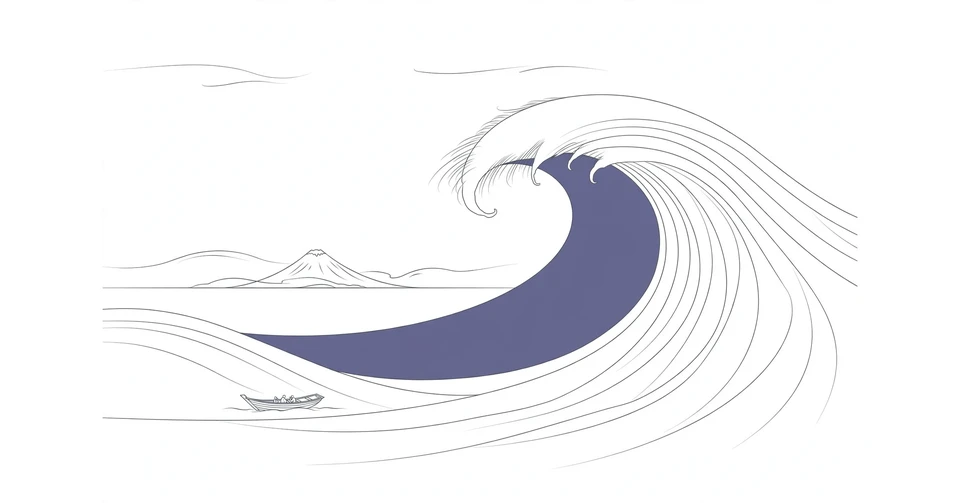
Katsushika Hokusai, born in 1760, is the name most people outside Japan know first. His Thirty-six Views of Mount Fuji, published around 1830 to 1832 when he was in his early seventies, turned the landscape print into the heart of ukiyo-e, and its most famous sheet, the Great Wave off Kanagawa, shows Mount Fuji small in the distance behind a towering wave. Hokusai worked under many names and in many styles, and he is said to have left about 30,000 prints behind him.
Utagawa Hiroshige, born in 1797, carried the ukiyo-e landscape forward. His Fifty-three Stations of the Tokaido, issued in 1833 and 1834, followed the great highway between Edo and Kyoto one stop at a time, and his One Hundred Famous Views of Edo recorded the everyday experience of the capital. Where Hokusai composed with drama, Hiroshige painted nature more loosely, as it was.
One wave, eight thousand impressions
The Great Wave off Kanagawa was produced in the early 1830s, and it was very popular in Japan from the start. Experts now believe up to 8,000 impressions were made from its blocks, and a publisher generally had to sell at least 2,000 impressions from a design to make a profit. Some designs by Kunisada were printed between 3,000 and 4,000 times, while Hiroshige's Fifty-three Stations of the Tokaido is thought to have been printed between 12,000 and 15,000 times. Those numbers, gathered in a British Museum study of 111 surviving impressions of the Great Wave, turn the most famous Japanese image in the world into a piece of mass media.
Looking at the numbers changed how I see the ukiyo-e print. The Wave was not a unique masterpiece locked in a temple. It was a bestseller, printed again and again until the wood itself began to fail. Scholars can even track the life of the blocks: the researcher Roger Keyes listed 21 states of the Great Wave, each defined by a small break or a re-carved line, and later study confirmed that the blocks wore, cracked, and were patched as the edition grew. A print bought early and a print bought late are not quite the same picture.
The prints faded, and hands repaired them
Ukiyo-e prints were made with light-sensitive colourants, and many surviving impressions have faded. The pink clouds and the yellow boats of the Great Wave are the parts that suffered most, and in 26 of the 111 impressions studied by the British Museum, no clouds were discernible at all, most probably because the ink had completely faded. In one impression, clouds invisible in normal light appeared again under ultraviolet light.
Some prints were also retouched, with breaks filled in and faded areas recoloured, and signs of retouching were found on 16 of the 111 impressions. That habit of repair has a familiar ring to it. The Japanese art of kintsugi, the repair of broken things with gold, treats damage as part of the story, and the retouched print works the same way, even if its repairer meant only to raise the price. The history of an old ukiyo-e sheet is written in its fading and its fixes as much as in its lines.
How ukiyo-e crossed the sea
After Japan opened to Western trade in the mid 1800s, prints poured into Europe, and by the 1860s artists such as Degas, Van Gogh, and Manet were looking hard at them. Van Gogh copied Japanese prints in oil paint to learn their secrets, and Monet collected them. The sudden popularity, called Japonism, fed into Impressionism and Art Nouveau, and its flat colour and bold lines still show up in posters, comics, and screen design today.
Back home, ukiyo-e prints had a humbler reputation for a long time. They were cheap, popular entertainment, and many Japanese connoisseurs ranked them far below painting. Writing in 1913, Frederick Gookin noted that the finest impressions had largely passed into European and American collections, which is why the British Museum and the Museum of Fine Arts in Boston hold some of the largest collections in the world, while the V&A in London holds more than 30,000 Edo-period ukiyo-e prints, paintings, drawings, and albums.
What stays with me is not the wave, famous as it is, but the ukiyo-e system behind it. Four craftsmen, a publisher with a shop to keep, and a public that wanted pictures of its own life made ukiyo-e the first art of the modern city: repeatable, affordable, and alive to the moment. The blocks wore out, the colours faded, and the prints scattered across the world, yet the idea survived intact, that everyday life is worth picturing well.
More in Culture & Society
- Hokusai Spent a Lifetime Chasing One Mountain
- Tabi Are the Split Toe Socks Japan Wears Under Everything
- Zori Are the Quiet Sandals Japan Wears to Every Formal Occasion
- An Obi Is the Knot That Holds a Kimono Together
- Joya no Kane Rings Out the Old Year One Hundred Eight Times
- Geta Still Clatter Through Japanese Summer
Latest posts
- Base Genep Seasons Every Balinese Feast From the Mortar Up
- Shakyo Copies the Sutra One Stroke at a Time
- Yukata Is the Robe Japan Reaches for After the Bath
- Bonsho Is the Bell That Wakes a Japanese Temple
- Prajnaparamita Is the Wisdom Behind the Heart Sutra
- A Lamak Turns a Coconut Leaf into a Hanging Prayer
- The Heart Sutra Fits the Whole of Buddhism on One Page
- Shinran Turned Chanting Into Gratitude
- Sambal Matah Wakes Up Every Balinese Plate Raw
- The Javanese of Suriname and the Language They Kept Alive
- Nembutsu Is the Name Japan Calls Out to Amida
- Sate Lilit Wraps Bali's Feast Around a Lemongrass Stick
- Babi Guling Turns a Whole Pig Into a Balinese Feast
- Konpon Daito Towers Over Koyasan in Vermilion and Gold
- Lawar Is the Dish Bali Serves When the Whole Village Eats