Yakitori and the Smoky Alleys Where Tokyo Learned to Love Chicken Skewers
· 12 min read
Yakitori turned cheap chicken and charcoal smoke into one of Japan's great foods, and the best place to understand it is still a cramped alley in Shinjuku.
Yakitori is chicken on a stick, and that description is both completely accurate and completely unfair. A skewer of chicken grilled over charcoal sounds simple, almost too simple to write about, yet yakitori has its own vocabulary, its own etiquette, its own temples of smoke, and a history that runs from Edo period street vendors to a Michelin star in Ginza. The dish is small. The world around it is not.
The best way to understand yakitori is not to read about it but to stand in one of Tokyo's narrow yokocho alleys at seven in the evening, when the lanterns are on, the charcoal is glowing, and the smoke from a dozen tiny grills hangs in the air like weather. The counters seat six people. The chef is two feet from your face. The skewers cost a few hundred yen each. Nobody is in a hurry, and everybody is hungry.
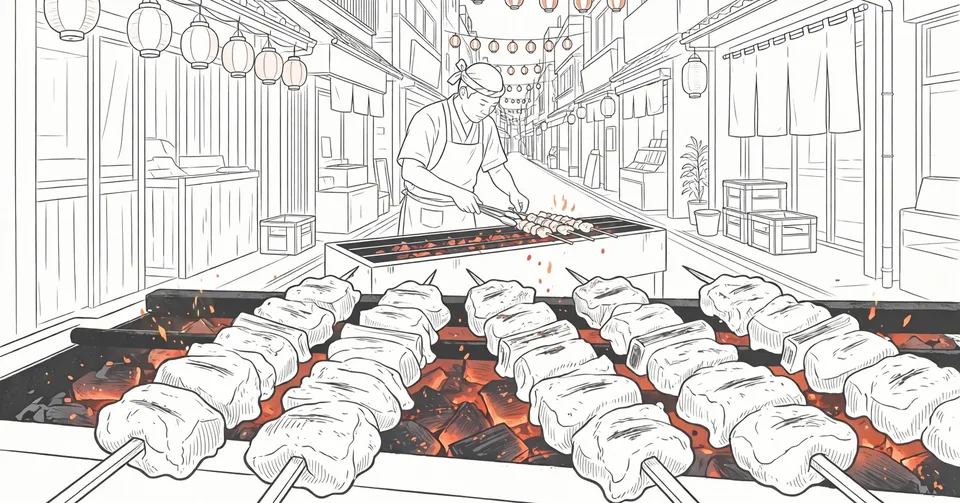
I think it is the most honest food in Japan. There is nowhere to hide on a skewer. The chicken is either cooked right or it is not, the charcoal is either real or it is not, and the sauce is either balanced or it is too sweet. A restaurant can dress up many dishes with presentation and price. Yakitori refuses. That refusal is the whole point, and it is why a food that began as cheap postwar fuel for tired workers now has counters where dinner costs as much as a hotel room.
What yakitori actually is
The word yakitori means grilled bird. In practice it means pieces of chicken threaded on a bamboo skewer, called a kushi, and cooked over charcoal on a long, narrow grill called a konro. The grill is built to the exact length of the skewer, and the bed of charcoal underneath is only ten or twelve centimetres deep. Everything about the setup is precise because the cooking is fast and the margin for error is small.
The charcoal matters more than most first timers expect. The real thing is grilled over binchotan, a dense white charcoal made from ubame oak that burns hot and almost smokeless. The lack of smoke from the charcoal itself is the point. What you smell is not burning wood but vaporized chicken fat and caramelized sauce, which is why the smoke in a good yakitori shop smells like dinner rather than a campfire. Kishu binchotan from Wakayama became the first regional charcoal brand certified under Japan's Regional Collective Trademark system in 2006, which tells you how seriously Japan takes its charcoal.
Every skewer comes in one of two styles. Shio means salt, just a pinch, so the flavour of the chicken and the smoke does the work. Tare means the skewer is brushed with a sweet soy based sauce, a mixture built on soy sauce, mirin, sake, and sugar that each shop guards like a family recipe. Some tare sauces have been kept going for decades, topped up rather than replaced, so the sauce you taste tonight contains a little of the sauce from years ago. There is no right answer between shio and tare. Regulars have a preference and defend it fiercely, which is part of the fun.
A short history, from sparrows to broilers
The dish is older than it looks and younger than it claims. An early form appears in Tsurezuregusa, a book from the Kamakura period, which describes a dish of roasted pheasant. By the middle of the Edo period, street vendors were grilling small game birds, sparrows, quail, and sometimes duck, on skewers. Chicken was too expensive for everyday food, so the yakitori of the Edo period was mostly not chicken at all.
That changed after the war. Broiler chickens were introduced from the United States in the late 1950s, chicken became cheap, and yakitori became a popular food almost overnight. The single counter, all chicken specialist is essentially a postwar phenomenon. The stalls that appeared in the black markets after 1945 sold chicken offal because it was cheap, quick to skewer, and fast to grill, exactly what exhausted workers wanted with a beer at the end of the day. It went from a food of necessity to a food of choice in about a decade, and it never really left the alley.
The fine dining version is much newer. Birdland in Ginza became the first yakitori shop in the world to earn a Michelin star in 2008. The whole idea of yakitori as fine dining is younger than the iPhone, which is a useful reminder that tradition and novelty are not opposites in Japan. They are neighbours, and sometimes they share a grill.
Shio or tare, and the cuts worth knowing
A yakitori menu reads like a butcher's chart, and that is a compliment. The chicken is broken down into parts that most Western cooking throws away or hides, and each part gets its own skewer, its own cooking time, and its own following. Learning the cuts is the fastest way to go from tourist to regular, and the list below is the short version worth memorizing.
- Negima: thigh meat with green onion, the classic first order and the safest introduction.
- Momo: thigh meat alone, juicy and forgiving, good with either shio or tare.
- Tsukune: a minced chicken meatball, often served with a raw egg yolk for dipping.
- Kawa: chicken skin, grilled until crisp, almost entirely texture and smoke.
- Tebasaki: chicken wing, crisp outside and rich inside, usually with tare.
- Bonjiri: tail meat, small, fatty, and beloved by regulars.
- Sunagimo: gizzard, firm and chewy, a test of whether you are ready for the deeper menu.
- Reba: liver, rich and soft, best ordered shio so nothing hides the flavour.
Vegetables and other items share the grill too. Shishito peppers, mushrooms, and asparagus wrapped in pork are common, and some shops grill quail eggs or even beef tongue alongside the chicken. The rule is simple. If it fits on a skewer and benefits from charcoal, someone has tried it.
Ordering has its own rhythm. Most shops serve two skewers per order, and a good meal is somewhere between five and eight skewers per person, eaten slowly with beer or sake. You order a few, eat them, order a few more. Nobody orders everything at once. The pace is the point, and the chef sets it. At a counter, you eat what comes off the grill while it is still hot, because yakitori waits for no one.
Omoide Yokocho, the alley that kept the smoke alive
If yakitori has a home address, it is Omoide Yokocho in Shinjuku, literally Memory Lane. The alley sits on the west side of Shinjuku Station, wedged between the train tracks and Yasukuni-dori, about a hundred metres long, with around sixty tiny stalls packed into five narrow lanes. Roughly half of them are yakitori counters. Most seat five or six people. The menus are handwritten. The smoke is constant.
The alley began as a black market on the burnt ground beside Shinjuku Station in the years right after the war, when traders worked from pitches divided by salvaged door boards and almost every kind of supply was short. Yakitori stalls appeared because chicken offal was cheap and fast, and the stalls became permanent shops as Tokyo recovered. A fire in 1999 burned through part of the block, and the operators rebuilt it in the same low rise wood and tin style on purpose, because they did not want it to look modernized. The current buildings are reconstructions, but the plan, the scale, and the smell are the original.
The oldest stall is Dai-ichi Horai-ya, founded in 1947 by Masami Kaneko and widely credited as the birthplace of the postwar yakitori trade in western Tokyo. It still serves charcoal grilled skewers and broiled offal over high grade oak charcoal, basted with a sauce developed over more than seven decades. Sitting at a counter like that is not nostalgia. It is continuity, the same smoke, the same small room, the same transaction between a tired person and a hot skewer, repeated for almost eighty years.
Other alleys carry the same spirit. The Yurakucho gado-shita stalls under the train tracks offer a similar evening for roughly 1,500 to 3,000 yen per person, standing or sitting shoulder to shoulder with office workers. You do not need a reservation, a guidebook, or a plan. You need an empty stomach and a willingness to point at what looks good.
How to order like a regular
The etiquette of yakitori is light, which is part of its charm. There are no white tablecloths to fear and no courses to track. A few habits will make the evening smoother, though, and they are worth knowing before you sit down.
First, order a drink when you sit. Beer is the default, and many counters also serve sake, shochu, and highballs. Second, start with negima and momo, then branch out. The chef will notice what you liked. Third, eat each skewer as it arrives, sliding the meat off with your chopsticks or eating it straight from the skewer. Yakitori is cooked to order and served hot for a reason. Fourth, do not be shy about asking the chef what is good tonight. At a six seat counter, the chef is your waiter, your cook, and your conversation, and a question is a compliment.
A practical note on price. A single skewer usually costs between 150 and 350 yen, and a satisfying evening runs about 1,500 to 3,000 yen per person at a casual alley counter. The high end counters in Ginza charge far more, and the difference is real, better chicken, better charcoal, better technique, but the pleasure is not proportional to the price. Some of the best yakitori I have ever eaten cost less than a coffee back home, and I mean that as praise, not as a bargain hunt.
Yakitori also travels well beyond the alley. Convenience stores sell it, supermarkets sell it, and festival stalls grill it over open flames in summer. The festival version is a different animal, often sweeter and smokier, eaten standing up with a paper cup of beer. It is not better or worse than the counter version. It is the same idea in a different setting, which is exactly how a great street food behaves.
Yakitori beyond the alley
The rise of this skewer from postwar necessity to Michelin starred craft mirrors a larger pattern in Japanese food, and it is worth naming. Dishes like takoyaki and okonomiyaki followed the same road, cheap food for working people, refined slowly over decades without losing the setting that made it good. The counter did not disappear when the star arrived. Both exist, and both are honest.
That is also what separates yakitori from the other great Japanese export on the world stage. Sushi conquered the world by becoming elegant and expensive, and it is wonderful for it. Yakitori conquered the alley by staying cheap and smoky, and it is wonderful for that. Japan contains both impulses at once, and a visitor who only experiences one of them has missed half the country.
The comparison with Japanese curry is instructive too. Curry arrived from abroad and became Japanese through long, slow adaptation. Yakitori was Japanese from the start, then became democratic when chicken became cheap, then became artisanal when chefs decided the skewer deserved the same attention as the knife. Three different histories, one shared result, food that ordinary people eat every day and chefs spend a lifetime perfecting.
For a deeper guide to the cuts, the charcoal, and the counters worth booking, the Yakitori Guide covers the full vocabulary and the etiquette that separates a regular from a tourist. The history, from Kamakura period pheasant to postwar broilers, is told well in What is Yakitori?, which is also a useful starting point if you want to understand why the dish spread so fast in the late 1950s.
My own opinion, for what it is worth, is that yakitori is the best first food for anyone visiting Japan who thinks they already know Japanese food. Sushi and ramen are the ambassadors, and they deserve the fame. But yakitori is the food that shows you how Japan actually eats after work, in a room the size of a garage, with strangers on both sides and a chef who remembers your order. You learn more about a country from its weeknight dinner than from its ceremony, and yakitori is weeknight dinner at its best.
So go to the alley. Sit at the counter. Order negima and a beer. Watch the chef work the konro, turning each skewer at exactly the right moment, brushing tare with a practiced hand. Eat it hot, order two more, and stay a little longer than you planned. The smoke will follow you home on your clothes, and you will not mind at all.
More in Food & Travel
- Okonomiyaki and the Savory Pancake Japan Cooks at the Table
- Takoyaki and the Ninety-Year-Old Shop That Still Serves the Original
- Japanese Whisky and How a Scottish Spirit Became Japan's Own
- Japanese Curry and How a British Stew Became Japan's Comfort Food
- Sushi, the Japanese Dish That Conquered the World
- Kakiage and the Tempura Bowl That Towers Over Rice
Latest posts
- Omamori, Japan's Pocket-Sized Amulets of Protection
- Japanese Festivals, From Snow Sculptures to Summer Fireworks
- The Daruma Doll, Japan's Round Symbol of Perseverance
- Kotatsu, Japan's Heated Table That Warms Winter
- The History of the Bicycle From Wooden Wheels to Japanese City Bikes
- the-javanese-of-suriname-and-the-language-they-kept-alive
- Kanban and the Japanese System That Organized Work
- Shichi-Go-San and the Day Japan Dresses Its Children in Kimono
- Desa Pakraman Is the Name the Law Gave the Old Village
- A Primbon Reads Your Life From the Day You Were Born
- Pasaran Is the Five-Day Week Java Never Gave Up
- A Ceper Folds a Coconut Leaf Into a Crescent Moon
- Your Neptu Is the Number Hidden Inside Your Birthday
- Tilem Is the Dark Moon Bali Counts Its Year By
- The Saka Calendar Sets Nyepi on a Different Date Every Year