Akajiso Gives Umeboshi Its Deep Red Blush
· 23 min read
Akajiso is the red perilla leaf that dyes umeboshi deep red, colours pickled ginger, and becomes a summer drink and a rice seasoning in Japanese kitchens.
Open a bento box anywhere in Japan and you will probably find a small red plum resting on the white rice. That deep red blush does not come from the plum itself. It comes from a leaf, and the leaf has a name worth learning: akajiso.
Akajiso is the red form of shiso, the Japanese perilla herb, and it is a dyer and a pickler before it is ever a seasoning. Its job in the Japanese kitchen is almost entirely about colour and preservation, and it does that job so well that a handful of leaves can turn a whole barrel of pale fruit a rich purple red.
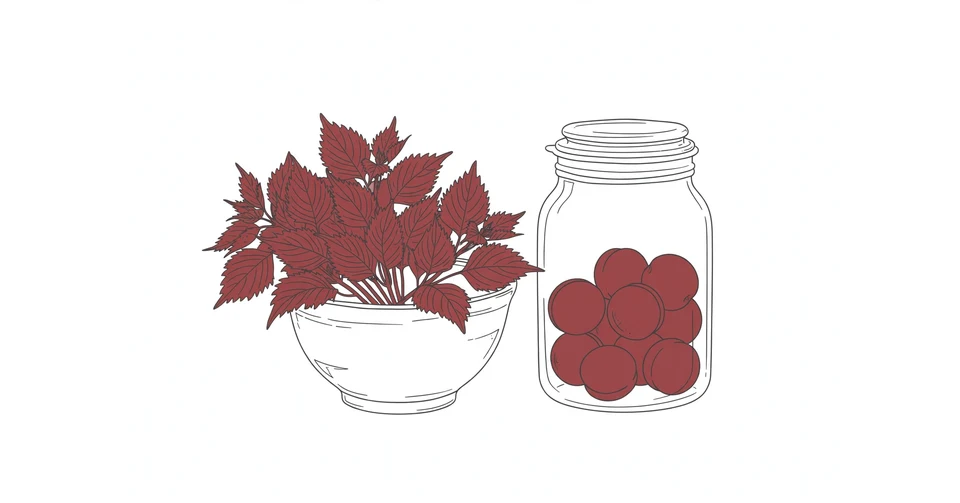
This article follows akajiso from the garden to the pickle jar and beyond. It explains what the leaf is, how it differs from its green sibling, how it paints umeboshi red step by step, what it becomes when the pickling is done, and why such a small leaf holds such a large place in Japanese cooking. Our article on shiso, the leaf that paints umeboshi red tells the wider story of the plant, and this one zooms in on its red half.
What akajiso actually is
Akajiso is the red form of Perilla frutescens var. crispa, a herb in the mint family Lamiaceae. The Japanese name breaks down simply: aka means red, and shiso comes from the Chinese zisu, meaning purple perilla. Botanists call the flat red form f. purpurea, to separate it from the ruffled red form, chirimen-jiso, whose leaves are red on both sides with a wavy surface. For a cook, the distinction matters less than the colour. If the leaf is red, it is akajiso, and its work is colouring and pickling.
The plant behind the name akajiso is a cultigen of Perilla frutescens, native to the mountainous regions of China and India and now found worldwide. It was cultivated in ancient China, and one early mention comes from the Supplementary Records of Renowned Physicians, written around 500 AD, where it is listed as su with some of its uses described. It was introduced into Japan around the eighth to ninth centuries, and akajiso has been part of Japanese cooking ever since. That is more than a thousand years of continuous use, which is a long apprenticeship for a leaf.
An akajiso plant grows 40 to 100 centimetres tall, with broad ovate leaves that have pointy ends and serrated margins, arranged in opposite pairs on long leafstalks. Its seeds are tiny, about 1 millimetre across, and the plant is not frost hardy. The red colour that makes akajiso famous comes from shisonin, an anthocyanin pigment found in perilla. Anthocyanins are the same family of pigments that colour red cabbage, blueberries, and red wine, and in akajiso the pigment sits in the leaf waiting for acid to wake it up.
Akajiso travelled west long before sushi did. It became available to gardening enthusiasts in England around 1855, and it was introduced later in the United States, perhaps in the 1860s. Today it is considered a weed or invasive species in parts of the United States, a reminder that a plant can be a treasured kitchen herb in one country and a garden nuisance in another. In English it is sometimes called the beefsteak plant, because purple leaf varieties resemble the blood red colour of meat, though most English speakers who know the leaf at all know it by its Japanese name.
One warning is worth keeping. Wild, weedy forms of the plant are not suitable for eating, as they do not have the characteristic fragrance, and they are high in perilla ketone, which is potentially toxic. Grow the cultivated forms from seed bought from a reputable supplier, and do not forage for the plant in the wild. The cultivated red form that Japanese cooks use is the one worth growing, and it is the one this article is about.
I think the first thing to understand about akajiso is that it is not really a flavouring in the usual sense. Most herbs earn their place by taste, and this one earns it by colour. A cook reaches for it the way a painter reaches for a pigment, and the flavour it brings is almost a bonus. That reversal, a herb valued first for what it does to the eye, is what makes it interesting.
Akajiso and aojiso, two leaves with two jobs
Shiso comes in two main forms that behave like two different ingredients in the kitchen, and akajiso is one half of that pair. The green kind, called aojiso or oba, meaning big leaf, is eaten fresh and raw. The red kind, akajiso, is a dyer and a pickler before it is ever a seasoning. Japanese cooks treat them as different tools, and confusing the two is the most common mistake a newcomer makes.
The green form is the common one, used all year round in Japanese cooking, much as basil and mint are used in Western cooking. It garnishes sashimi, frames cold noodles, and tops rice, and it is eaten in the same bite as the food it accompanies. Akajiso almost never appears on the plate that way. It goes into the jar, into the brine, and into the pot, and what reaches the table is the colour and flavour it left behind rather than the leaf itself.
Several forms of shiso exist, defined by the colour and shape of their leaves, though colouring also appears on the stalk and flower buds. The table below gives the forms a Japanese cook is most likely to meet, and it shows where akajiso sits among them.
| Form | Japanese name | Main use |
|---|---|---|
| Red, flat leaves | Akajiso | Pickling and colouring |
| Red, ruffled leaves | Chirimen-jiso | Pickling and colouring |
| Green, flat leaves | Aojiso, oba | Eating fresh, garnish |
| Green, ruffled leaves | Chirimen-aojiso | Eating fresh, garnish |
| Green on top, red below | Katamen-jiso | Garnish, pickling |
| Mixed green and red | Madara-jiso | Garnish |
There is a second perilla in Japan that is worth keeping separate. Perilla frutescens var. frutescens is called egoma in Japan and deulkkae in Korea, and its leaves are the Korean kkaennip used to wrap grilled meat. The leaves are giant and thick textured, with an intense, peppery, and earthy flavour, and they are used for side dishes and kimchi, with the seed oil used in cooking. Japanese cooks do not advise substituting it for Japanese shiso, because the two have different characteristics and different culinary uses. They are cousins, not twins, and akajiso belongs firmly on the shiso side of the family.
What I like about this division of labour is how practical it is. A kitchen that keeps both forms has a fresh herb and a natural dye in the same plant, and neither one tries to do the other's job. Western cooking tends to ask one herb to do everything, and this plant refuses. The green leaf is for eating, the red leaf is for colouring, and the cook who respects that split gets the best of both.
How akajiso turns umeboshi red
The most famous job of akajiso is the one that gave this article its title, and the process is worth following step by step. Our article on umeboshi, the sour plum Japan puts in every bento follows the fruit from the orchard to the lunchbox, and the leaf enters that story right in the middle of the pickling.
Umeboshi begins as ume fruit packed in barrels with salt equal to about 20 percent of the fruit's weight. The salt draws juice out of the fruit, and the ume soak in that salty, sour liquid for about two weeks. The liquid is called umezu, often translated as ume vinegar, although it is not a true vinegar. The fruit at this stage is still pale, and without akajiso it would stay that way.
Akajiso enters the process during the pickling stage. The leaves are salted and kneaded first to remove their bitterness, then packed in with the ume. Their pigments react with the acidic brine and dye the fruit that familiar deep red. The kneading matters, because raw red leaves are bitter and astringent, and the salt and squeezing tame them before they meet the fruit. A cook who skips the kneading gets a harsher pickle and a duller colour, so the extra work is not optional.
After the akajiso has done its dyeing, the fruit is laid out in the sun for several days, traditionally during the hot spell of late July and early August, and turned regularly so it dries evenly. Only then is it packed away for storage. The red colour survives the drying, and it deepens as the fruit wrinkles, so a finished red umeboshi looks almost purple in the shade and bright red in the sun.
The pale kind of umeboshi, called shiraboshi, is made with salt alone and no akajiso at all, and under Japan's agricultural standard it is just as authentic as the red kind. The difference is purely a matter of style and flavour. The red kind carries a fresh scent from the leaves, and it is the type most people picture when they think of umeboshi. The label term shiso-zuke on a pack means pickled with red shiso, and it is one of the most useful words to know when you are choosing a pack in a shop.
The red style also has a home region. It was mainly in the Kishu Domain, as Wakayama was called during the Edo period, that umeboshi pickled with akajiso came into being, and those reddish brown to bright purple red fruits became what most people picture when they hear the word. The same prefecture still grows most of Japan's ume, and the town of Minabe in particular grows more ume and produces more of it than any other town in Japan.
Modern home recipes often use less salt, around 13 percent, with a little sugar added, and the pickling takes about a month before three days of drying. The trade off is real. Salt is what preserves the fruit, so a lower salt version has a shorter shelf life and usually needs refrigeration, while a traditional high salt one can keep for years. Akajiso does its work either way, but a lower salt brine is gentler on the colour, so home picklers who want the deepest red often keep the salt closer to the old level.
I admire how little the method has changed. The ingredients are ume, salt, sunshine, patience, and akajiso if you want colour. No factory trick replaces the weeks of waiting, and no shortcut produces the same result. In a food culture full of careful technique, this is almost stubbornly simple, and that simplicity is part of its charm. The leaf does not dominate the recipe. It lends its colour and steps aside.
The colour science behind the blush
The reason akajiso works as a dye is chemistry, and the chemistry is simple enough to watch happen in a pot. The red colour comes from shisonin, an anthocyanin pigment found in perilla. Anthocyanins are sensitive to acid, and they turn redder and brighter as the liquid around them grows more acidic. That is why the leaf's colour blooms in the sour brine of the pickle jar and in a splash of vinegar, and why it stays muted in plain water.
You can see the same reaction without any plums at all. When akajiso leaves are boiled, the cooking liquid turns darker purple while the leaves themselves turn green, because the pigment has moved out of the leaf and into the water. Add a little vinegar to that liquid and the darker purple changes to a beautiful brighter purple, almost as if a light had been switched on. The colour was always there, and the acid simply revealed it.
The Wikipedia entry on the plant puts it plainly: the akajiso leaves turn bright red when steeped in umezu, the vinegary brine that results as a byproduct of pickling plums. That single sentence explains both the plum and the drink that follows in this article, because the same brine that dyes the fruit can dye a glass of juice. The Wikipedia entry on shiso covers the varieties, the history, and the culinary uses across East Asia, and it is the best single reference for telling the forms apart and for understanding why the red form behaves the way it does.
There is a useful lesson in this for any cook. Natural colour is not paint, and it does not sit on the surface of food. It reacts with what is around it, and a cook who understands the reaction can control the result. A little more acid gives a brighter red, a longer soak gives a deeper one, and a leaf that has given up its pigment has done its job and can be put to a second use. Akajiso teaches that lesson in a single jar, and it is a lesson that carries into the rest of the kitchen.
Akajiso juice, the summer drink
The same akajiso leaf that dyes the plum also makes one of Japan's most refreshing summer drinks. In the summer, the Japanese enjoy making a drink called aka shiso juice, or red perilla juice, using akajiso leaves. It stimulates the appetite on hot days, and it is said to help with recovery from exhaustion and digestion. With a vivid rose colour, it looks like something poured from a bottle of wine, and it tastes nothing like wine at all.
The method is disarmingly simple, and the Just One Cookbook guide to red shiso juice gives the fullest practical account of it. The syrup is made with four ingredients: red perilla leaves, water, sugar, and apple cider vinegar, with rice vinegar or lemon juice as alternatives. The akajiso leaves are rinsed, then boiled in water for about five minutes, and the cooking liquid is reserved. Sugar is added to the hot liquid and dissolved completely, then vinegar is added, and the syrup is left to cool before it goes into a sterilized jar.
The vinegar is the moment of magic. The purpose of the vinegar is to impart the syrup with a bright purple colour, and you see the change as soon as you add it: the darker purple turns to a beautiful brighter purple. The sugar is not only for sweetness. It helps preserve the syrup, so the guide warns against reducing it too much if you plan to keep the syrup for a long time. Stored in the refrigerator or freezer, the syrup keeps for six to twelve months, which means a summer harvest can last until the next one.
To drink it, the syrup is mixed with cold water or sparkling water, roughly one part syrup to one or two parts water, or to taste. The result is mildly minty, fruity, refreshing, and sparkling all at once, and it is served over ice on the hottest days. Some people use alcohol to dilute the syrup and make a cocktail with it, but the plain version with sparkling water is the one most families reach for.
The health claims around the leaf deserve the same caution as any food claim. Just One Cookbook lists the leaves as anti-inflammatory, antioxidant, antiviral, and antibacterial, high in iron, and a source of calcium and carotene, and notes them as good for the respiratory tract, for the immune function, and for stomach aches and digestive upset. Those are traditional attributions rather than proven medical effects, and no single drink should be treated as medicine. What is certain is that the juice is refreshing, that it carries the leaf's colour and some of its flavour, and that it is a pleasant way to use a summer glut of leaves.
I think the juice is the most forgiving introduction to akajiso for a newcomer. Umeboshi asks for weeks of patience and a tolerance for sourness, but the juice asks for twenty minutes and a pot of water, and it rewards you with a glass that looks extraordinary. It is the leaf showing off, and after a thousand years in the kitchen, it has earned the right.
Yukari, the seasoning made from leftovers
Nothing in the akajiso story goes to waste, and the proof is yukari. Akajiso leaves are dried and pulverized into flakes, then mixed with salt to make a seasoning called yukari. The word yukari is an ancient term for the colour purple, and it was first used by Mishima Foods Co. to describe their product, though the word is now used to refer to the seasoning in general. Red leaf flakes are a common ingredient in furikake seasonings, meant to be sprinkled over rice or mixed into onigiri.
The most elegant version of yukari starts with the very leaves left over from making the juice. After the leaves have been boiled and squeezed for their syrup, they are not thrown away. A little vinegar or umezu is added to loosen them, they are spread out and dried, then processed into a powder and mixed with salt to taste. Dried in a dehydrator or a low oven at about 60 degrees Celsius for two hours, or dried in the breezy air outside, they become a seasoning that keeps in an airtight container in a cool dark place for up to a year.
A spoonful turns plain white rice pink, and children in Japan grow up with that colour on their lunch. It is a small thing, a pinch of purple red flakes on white rice, but it changes the whole look of the meal, and it carries a faint echo of the leaf's flavour with it. The fresh green leaf cannot do this job, and the dried red leaf cannot do the green leaf's job either. Each form has its place, and yukari is the red form's quietest one.
What I like about yukari is the thrift behind it. The akajiso leaves have already given their colour to the syrup, and instead of being discarded they are dried and ground and given a second life on rice. Japanese cooking is full of this kind of second use, and it comes from a time when nothing was wasted because nothing could be wasted. A seasoning made from leftovers sounds humble, and it is, but it is also the most practical kind of cooking there is.
Beyond the plum jar
Umeboshi is the most famous job of akajiso, but the leaf has a life beyond the plum jar, and it is a busy one. In Kyoto, red leaves and their seeds are used to make shibazuke, a type of fermented eggplant pickle. The leaves are also used to colour pickled ginger, the red beni shoga served with noodles and rice dishes, and to colour Kyoto style vegetable pickles. Wherever a pickle needs a red blush, the leaf is the traditional answer.
Akajiso also finds its way into sushi. It can be combined with umezu to make certain types of sushi, carrying the same sour red brine that dyes the plum into the rice itself. The colour is gentler there, a pink tint rather than a deep red, but the logic is the same: the leaf's pigment, woken by acid, doing its quiet work in the background.
There is a pattern here that runs through the whole story of akajiso. Akajiso is rarely the star of a dish. It colours the plum, flavours the rice, tints the ginger, and refreshes the summer drink, all from the same plant. Cooks in the West tend to sort ingredients into strict boxes, and this herb ignores the boxes. It is a dye, a pickle, a seasoning, and a drink, and it does each job without fuss. That versatility is rare, and it explains why the plant has stayed in Japanese kitchens for more than a thousand years.
I find that versatility reassuring rather than confusing. A kitchen ingredient that does one thing well is useful, but an ingredient that does four things well earns a permanent place on the shelf. The leaf does not ask for much, and it gives back in more ways than a cook can use in a single summer.
What akajiso tastes like
Describing the flavour of akajiso is harder than describing its colour, because the leaf does not taste like any single Western herb. Akajiso leaves have a unique taste, mildly minty with an earthy aroma, and if you like umeboshi or green shiso you are already familiar with it. It could be an acquired taste for many non-Asian palates, and that is an honest warning rather than a flaw.
The flavour is quieter than the colour suggests. A leaf that looks so dramatic might be expected to taste dramatic too, but the taste is restrained, herbal, and slightly astringent, with a warmth underneath it. The bitterness that the pickling process kneads away is real, and it is why the leaf is almost never eaten raw the way its green sibling is. Salt, acid, and heat tame it, and what is left is a clean herbal note that sits behind the sourness of the pickle rather than in front of it.
That restraint is the point. Akajiso is not there to be tasted on its own. It is there to make the plum red, the rice pink, and the drink rose coloured, and to leave a faint herbal trace behind. A cook who expects a bold flavour from it will be disappointed, and a cook who expects a colour will be delighted. The leaf rewards the right expectation, and it punishes the wrong one, which is true of many good ingredients.
My own view is that the taste is worth acquiring slowly. The first time I tried red shiso in a drink, I found the flavour odd, almost medicinal, and I understood why some people leave the leaf untouched. The second time, I noticed the minty note. The third time, I missed it when it was absent. A flavour that grows on you like that earns its place in a kitchen more honestly than a flavour that impresses at once and bores by the fifth taste.
Growing and buying akajiso
The good news for cooks outside Japan is that the plant is famously easy to grow, and akajiso is no exception. It is good for container growing and suitable for apartment or small space gardening, and a single pot on a balcony can supply a household through the summer. Perilla seeds are tough, so they must be softened in water overnight before sowing. Seedlings should be moved out to the garden when the nighttime temperatures are warmer than 7 degrees Celsius and all possible danger of frost has passed. If your spring is relatively cool, you may need to plant the seeds indoors for 4 to 6 weeks in mid spring.
The seeds should be planted about 6 millimetres below the surface and watered daily, since covering them with too much soil will delay germination. The ideal temperature for the plant to grow is above 20 degrees Celsius, so the timing depends on your climate. Seeds planted in May sprout about two weeks later and grow well, and leaves can be harvested as soon as they are a good size, about 3 to 4 inches long. Harvesting the leaves encourages the plant to produce more, so a few plants can keep a kitchen supplied for months.
Buying the fresh leaf is harder, because akajiso is a summer ingredient with a short season. Japanese grocery stores usually carry green leaves all year round in their produce section, but akajiso leaves are only available in the summer months, typically from the end of June to early July, so if you want them for pickling, call the local Japanese grocery store ahead of time to see if they carry them. There is nothing quite like the taste and texture of the fresh leaf, and unfortunately it is hard to find outside Japanese grocery stores, which is one reason growing your own is so often recommended.
Storage is simple. The best way to store fresh leaves is to cover them with a damp cloth or paper towel and put them in an airtight container or plastic bag, then place the container in the refrigerator in the crisper drawer. Use them as soon as possible, since the flavour fades with time. A leaf bought on Saturday and used on Saturday tastes noticeably brighter than one that has waited a week, and the difference is worth planning around.
If you cannot find the leaf fresh, the dried red seasoning yukari is easier to buy online and keeps well in a jar. It is not a substitute for the fresh leaf, since it does a different job, but it brings the colour and some of the flavour to rice and noodles, and it is a good way to start. The fresh leaf is the goal, and the dried seasoning is a useful bridge until you find it.
I have never grown it myself, but the advice from cooks who do is consistent: it is one of the easiest herbs to keep alive, and it rewards a little neglect more than a lot of attention. That suits me. A herb that needs constant care is a herb I will eventually kill, but a herb that grows in a pot with daily water and a sunny spot is a herb I can keep. If you have a balcony and a taste for Japanese food, it is a good place to start.
Why a small red leaf matters
A thousand years is a long time for a leaf to stay in fashion, and akajiso has done it by being useful in more ways than one. It colours the plum, seasons the rice, tints the ginger, and refreshes the summer drink. It asks for little, a pot, some water, and a sunny spot, and it gives back all summer. It is a herb that works as hard as a spice and as quietly as a dye, and that combination is rare.
The next time you open a bento box and see the small red plum on the rice, you will know the akajiso behind it. The next time you see pink rice in a lunchbox, or a glass of rose coloured juice on a hot day, you will know it is not a decoration. It is a small piece of Japanese cooking history, still fresh, still fragrant, and still doing its work one leaf at a time.
More in Food & Travel
Latest posts
- Hello Kitty and the Cat Who Conquered the World
- Baikasai Serves Tea Under the Plum Blossom at Kitano Tenmangu
- Plum Blossom Opens Japan's Year Before the Cherry Trees Wake
- Tenjin Engi Emaki Paints a Storm God Into a Saint of Learning
- The Flying Plum Tree That Followed a Scholar Into Exile
- Kitano Tenmangu Turns Plum Blossom Into a Prayer for Exams
- Japanese Geisha and the World Behind the Painted Face
- Tenjin Is the Storm God Who Became Japan's Patron of Learning
- Queen Is the Crown Japan Gives Its Best Woman Karuta Player
- Japanese Pottery and the Six Kilns That Turned Clay into Culture
- Meijin Is the Title Every Karuta Player Dreams of Wearing
- Dazaifu Tenmangu Is Where Japan Still Prays to a Scholar God
- Sugawara No Michizane Became the God Students Still Pray To
- Wakamizu Is the First Water Japan Draws for Good Luck
- Japanese Kabuki and the Theatre That Paints Its Actors