Tenjin Engi Emaki Paints a Storm God Into a Saint of Learning
· 17 min read
The tenjin engi emaki is a thirteenth century painted scroll that turned the disgraced scholar Sugawara no Michizane into Tenjin, god of learning, and its pictures still shape how Japan remembers him.
Somewhere in the treasure hall of Kitano Tenmangu in Kyoto, kept away from light and unrolled only on rare occasions, lies a set of painted scrolls that did more than record a life. The tenjin engi emaki tells the story of Sugawara no Michizane, a scholar who was falsely accused of treason, died in exile in 903, and returned, in the telling of the scroll, as a god of thunder. It is a biography, a ghost story, and a founding document for a shrine, all painted in bright color on paper more than eight hundred years ago.
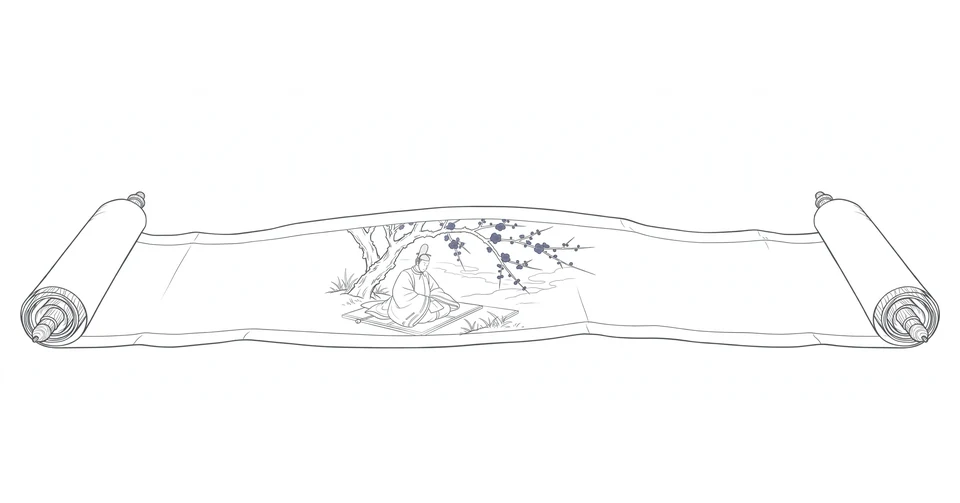
What makes the tenjin engi emaki remarkable is not only its age. It is the way it changed its subject. Michizane the man was a courtier and a poet. Michizane the god became Tenjin, the patron of learning, and today more than 12,000 shrines across Japan are dedicated to him. The tenjin engi emaki did not invent that change, but it gave the change pictures, and pictures travel further than arguments. Students who pray at Kitano Tenmangu before an exam are praying to a god whose face they first met in a painting.
What the tenjin engi emaki actually is
An emaki is a painted narrative handscroll, a story told in alternating passages of calligraphy and painting on a long roll of paper. You read it by unrolling it with one hand and rewinding it with the other, moving from right to left, so that only about 60 centimeters of text or image is visible at a time. The story arrives in scenes, the way a film arrives in shots, and the painter controls the pace by deciding where each scene begins and ends.
The most famous version of the tenjin engi emaki is the Jokyu version, named for the Jokyu era, and dated to about 1219. In its original form it consists of eight scrolls, each about 52 centimeters high and between 8.45 and 12.05 meters long. It is classified as a National Treasure of Japan and it is held at Kitano Tenmangu, the shrine whose founding it narrates. The text it illustrates was written shortly before 1194, about thirty years before the paintings were made, and the story was revised again in the years just before the scroll was painted, to fit the standard shape of a temple founding legend.
Nobody knows who painted the Jokyu version. An old theory credited the court painter Fujiwara no Nobuzane, but that attribution has been abandoned, and no other name has survived. The text in the first six scrolls may have been written in part by Kujo Michiie, the powerful courtier who donated the scrolls to the shrine, probably to strengthen the political position of his family in an unstable period. That detail matters, because it reminds us that the tenjin engi emaki was never only art. It was also a gift with a purpose, offered to a shrine by a family that wanted to be seen standing close to a god.
The ending of the Jokyu version is unfinished. The text runs out before the story does, and the final scroll closes with wordless paintings of the six realms of existence. Scholars have studied underdrawings that may belong to a ninth scroll, which suggests the work was planned to go further and was never completed, or was completed and partly lost. Either way, the tenjin engi emaki stops before it finishes, and that incompleteness has become part of its character. A story about a man who was cut off in mid life ends, fittingly, in mid sentence.
A scholar, a conspiracy, and a storm
The life the scroll tells begins in the ninth century. Sugawara no Michizane was born in 845 into a family of scholars, and he rose at the imperial court on the strength of his learning. He was a noted poet of Chinese verse, a prominent statesman under the Emperors Uda and Daigo, and eventually Minister of the Right, one of the highest offices in the land. Then, in 901, his rival Fujiwara no Tokihira accused him of plotting against the throne. The charge was almost certainly false, but it was enough. Michizane was stripped of his rank, sent into exile at Dazaifu in Kyushu, and died there two years later, in 903.
The full arc of that fall, and of the god who grew out of it, is told in Tenjin Is the Storm God Who Became Japan's Patron of Learning, and the scroll follows the same arc in pictures. Within twenty years of Michizane's death, the capital began to suffer. Princes died young. Plagues and droughts struck. Then, on July 21, 930, a violent storm broke over Kyoto, lightning struck the imperial palace, and several leading Fujiwara died while fires and floods destroyed their residences. To the court, the message was clear. Michizane had not gone quietly.
The court's answer was a shrine. Kitano Tenmangu was built in 947 to calm the angry spirit of the dead scholar, and in 986 the title of Tenjin was formally conferred on him there. The name means sky deity, and it tells you exactly what the court thought it was dealing with. You can walk the grounds of that shrine today and see how the story settled into stone and wood, in Kitano Tenmangu Turns Plum Blossom Into a Prayer for Exams, which describes the plum garden, the great hall, and the exam season crowds that now fill a place built to quiet a storm.
What the tenjin engi emaki adds to that history is the middle of the story, the part the shrine's stones cannot show. It paints the accusation, the exile, the lonely death, and then the return, scene by scene, so that a viewer who could not read the court chronicles could still follow the whole tragedy. That is the tenjin engi emaki's first achievement. It took a political scandal and made it legible to anyone who could look at a picture.
I find something sobering in that sequence. The court that destroyed Michizane did not apologize because it changed its mind about the evidence. It apologized because lightning killed its leaders and it needed the storms to stop. The tenjin engi emaki does not hide that motive. It paints the disasters plainly, with fire and flood and dead courtiers, and then it paints the shrine rising as the answer. Honesty like that is rare in official art, and it is one reason the scroll still feels alive.
How to read a scroll that unrolls right to left
The tenjin engi emaki is painted in the yamato-e style, the Japanese style of painting that favored bright color, free lines, and scenes of court and landscape. The faces follow the hikime kagibana convention, slit eyes and a hooked nose, familiar from the illustrated Tale of Genji scrolls of the early twelfth century. The style is not realistic in the modern sense, but it is expressive, and the painter uses scale the way a film director uses a close up. In one famous scene, Michizane prays atop a mountain and is shown far larger than the landscape around him, not because the painter misunderstood perspective, but because the man's strength of character is the point of the picture.
The tenjin engi emaki also uses a technique called boneless painting, in which outlines are sometimes left out entirely and color alone carries the form. The result is a scroll that can feel both delicate and forceful, with nervous, energetic lines in some scenes and soft washes of color in others. Buddhist iconography runs through it, in the creatures, the hells, and the six realms, but the style is also deeply Shinto in its attention to landscape, to trees and water and weather, and to the small details of ordinary life.
Reading the tenjin engi emaki was originally a communal act, not a private one. In the Kamakura period, religious paintings were often explained aloud in sessions called e-toki, in which a priest or storyteller unrolled the scroll before an audience and narrated the scenes. That may explain the unusual height of the Jokyu scrolls. At 52 centimeters tall, they are large enough for a small group to see, and large enough for the paintings to carry a sermon. The tenjin engi emaki was a teaching tool, a piece of scripture you could watch, and its size was part of its message.
There is a lesson in that for anyone who makes things today. We tend to assume that a story needs to be short to be understood, and that pictures are decoration for words. The tenjin engi emaki assumes the opposite. It assumes that a story told slowly, in pictures, to people sitting together, will sink deeper than a story read alone in a hurry. Eight centuries later, the tenjin engi emaki is still proving that assumption right, because we are still talking about it.
The revenge scenes and the six realms
The narrative of the tenjin engi emaki falls into four unequal parts, and the second part is the most dramatic. After Michizane's death, his vengeful ghost returns to earth as a god of thunder, and a series of disasters is laid at his door. Fires break out in the capital. His enemies fall ill and die. A priest named Nichizo describes meeting Michizane's spirit while crossing the six realms of existence, the rokudo, including the underworld, and the scroll paints that journey in fantastic detail, a medieval tour of the afterlife that reads like a vision.
One scene shows the minister who slandered Michizane falling ill, and a Buddhist monk chanting mantras to cure him. As the monk chants, two blue dragons emerge from the minister's ears and announce Michizane's intent to avenge his wrongful exile and death. Shortly afterward, the minister dies. It is a grotesque image, and the painter does not soften it. The dragons are bright blue, the minister is helpless, and the point is unmistakable. Slander has consequences, and in this story the consequences arrive from inside the slanderer's own head.
The third part of the tenjin engi emaki turns toward the shrine. The court decides to build Kitano Tenmangu in 947 to calm Michizane's spirit, and he is worshipped there under the name of Tenjin, a protective god of arts and letters. The final part relates various miracles connected to the temple, small stories of answered prayers and signs of the god's favor. The arc is complete. A man is wronged, a ghost takes revenge, a shrine is built, and the revenge softens into blessing.
I think the six realms section is the heart of the scroll, and the part modern readers are most likely to skip. It is easy to treat it as fantasy, a medieval detour into hell. But for the people who first watched the scroll unroll, it was the moral center of the story. It said that what you do in this life follows you into the next, and that a wronged man does not stop existing because a court has erased his name. A culture that believes that will think twice before destroying a rival. A culture that forgets it will not.
Why the scroll was painted three centuries late
There is a gap in the tenjin engi emaki that is easy to miss and important to notice. Michizane lived from 845 to 903. The text was written around 1194, and the paintings were made around 1219. That is a gap of more than three hundred years between the events and the pictures, which means the tenjin engi emaki does not show the ninth century at all. It shows the thirteenth century dressed up as the ninth.
The evidence is everywhere in the paintings. The clothes, the houses, the wooden bridges, the boats, the birth ceremonies, the outfits of young monks, the pets and the children who appear so often, all belong to the world of the painter, not the world of Michizane. One scene shows a boat propelled by six rowers, a model of a medieval Japanese ship of which no real example survives. The tenjin engi emaki has become an accidental archive of everyday life in Kamakura Japan, and scholars at Kanagawa University have studied it scene by scene for exactly that reason. The tenjin engi emaki is a window into two centuries at once, the one it tells about and the one it was painted in.
The gap also has a political explanation. The early thirteenth century was unstable, the warrior class was rising, and the court families were competing for position. A scroll that told the story of a wronged scholar turned god, donated to a major shrine by a powerful family, was a statement about who that family was and whose side the gods were on. The tenjin engi emaki was painted three centuries late because the thirteenth century needed it, not because the ninth century did.
That is how memory usually works, and it is worth saying plainly. We do not preserve the past because the past asks us to. We preserve the version of the past that helps us live in the present. The tenjin engi emaki is honest about this in a way that a chronicle rarely is, because its pictures betray its true date on every page. It tells the story of Michizane, and it also tells the story of the people who needed Michizane three hundred years after his death.
More than thirty copies and a god who travelled
The Jokyu version was not the end of the tenjin engi emaki. It was the beginning. More than thirty later versions can be identified, made between the fourteenth and nineteenth centuries by amateurs and by famous painters, because the cult of Tenjin kept growing and every new shrine wanted its own copy of the story. Among the best known are the Koan version, whose exact date scholars still dispute, and the Matsuzaki version of 1311, a six scroll set that ends with the founding of the Matsuzaki shrine and is divided into thirty three sections, a number that symbolizes the forms the bodhisattva Kannon may take.
The Metropolitan Museum of Art in New York holds a late thirteenth century set of five scrolls that is considered second in age and quality only to the Jokyu treasure in Kyoto. Its scenes include the blue dragons, the miraculous child appearing in a garden, and the young Michizane composing a poem before the emperor. That a copy of a Japanese shrine legend ended up in New York is a reminder of how far the story travelled, and how the tenjin engi emaki became one of the most copied works in Japanese art.
The copies of the tenjin engi emaki were not decoration. The Matsuzaki version was used at monthly gatherings of Tenjin devotees, held on the eighteenth day of each month among farming communities, where the scrolls were unrolled and the story retold. Each copy carried the cult to a new place, and each new shrine that received one became a small Kitano, a local home for a god who had started in Kyoto. That is how a local ghost became a national presence. Not by decree, but by painters copying a scroll, again and again, for five hundred years.
There is something quietly democratic about that process. The original was a treasure, locked away in a shrine and shown rarely. The copies were working objects, unrolled at village gatherings, handled by ordinary people, worn by use. The tenjin engi emaki survived because it was copied, and it was copied because ordinary people wanted to hear the story. Great art often survives that way, not in a vault, but in the hands of people who refuse to let it go.
What the pictures remember that the chronicles forget
A court chronicle records who was promoted and who was exiled. It does not record what a boat looked like, or how a birth ceremony was arranged, or what children wore to a temple festival. The tenjin engi emaki records all of those things, because a painter cannot paint a scene without deciding what is in it. Every roof, every robe, every bridge and grave in the scroll is a decision about the world, and those decisions add up to a portrait of medieval Japan that no chronicle provides.
The scroll also remembers feelings that the chronicles leave out. In the scene of Michizane in exile, the people around him are painted with a deep melancholy, their postures slumped, their faces turned away. The caption in the modern description of the scene notes exactly that, the attitude of the people conveys a deep melancholy. A chronicle would say that Michizane was demoted and died. The tenjin engi emaki says that people grieved, and it shows you what grief looked like.
That is the tenjin engi emaki's lasting value, and it is also a warning about how we write history now. We keep records of decisions and ignore the texture of the days those decisions were made in. We save the press release and delete the photograph. The tenjin engi emaki did the opposite. It saved the photograph, in paint, and let the decisions speak for themselves inside it. A thousand years from now, if anyone wants to know how we lived, they will learn more from our pictures than from our minutes.
For a fuller account of the scroll's history, its versions, and its place among Japanese National Treasures, the Wikipedia article on the Kitano Tenjin Engi Emaki is a careful and well sourced starting point. For the Japanese terminology, the dating of the versions, and the family tree of the later copies, the JAANUS entry on the Kitano tenjin engi sets out the scholarly consensus in compact form. Both are worth reading before you look at the scrolls themselves, because they teach you what to look for.
Why a painted scroll still matters
The tenjin engi emaki matters because it is the reason we remember Michizane at all. Without it, he would be a name in a chronicle, a minister who lost a court struggle and died far from home. With it, he is a person we can see, a child appearing in a garden, a young man writing a poem, an exile praying on a mountain, a ghost riding the thunder, and finally a god receiving prayers from students. The pictures gave the story a face, and a face is harder to forget than a name.
It also matters because it shows how a society repairs itself. The court could not bring Michizane back, and it could not undo the exile. What it could do was build a shrine, paint a scroll, and tell the story honestly enough that later generations would know a wrong had been done. That is not justice, exactly, but it is the beginning of it, and it is more than most wronged people ever receive. A culture that paints its mistakes is a culture that has decided to remember them, and remembering is the first step toward not repeating them.
The tenjin engi emaki is still in Kyoto, still a National Treasure, still unrolled only on rare occasions, and still too fragile to be handled casually. Most of us will never see the Jokyu version with our own eyes. We will see reproductions, or a later copy in a museum, or a photograph in a book. That is enough, because the scroll was always meant to be copied, and every copy carries the same story. Unroll it, in whatever form you find it, and you will meet a scholar who was wronged, a storm that answered, and a god who learned to be kind. The pictures have been telling that story for eight hundred years, and they have not finished yet.
More in Culture & Society
- Baikasai Serves Tea Under the Plum Blossom at Kitano Tenmangu
- Plum Blossom Opens Japan's Year Before the Cherry Trees Wake
- The Flying Plum Tree That Followed a Scholar Into Exile
- Kitano Tenmangu Turns Plum Blossom Into a Prayer for Exams
- Japanese Geisha and the World Behind the Painted Face
- Tenjin Is the Storm God Who Became Japan's Patron of Learning
Latest posts
- Hello Kitty and the Cat Who Conquered the World
- Umeboshi Is the Sour Plum Japan Puts in Every Bento
- Queen Is the Crown Japan Gives Its Best Woman Karuta Player
- Japanese Pottery and the Six Kilns That Turned Clay into Culture
- Meijin Is the Title Every Karuta Player Dreams of Wearing
- Dazaifu Tenmangu Is Where Japan Still Prays to a Scholar God
- Sugawara No Michizane Became the God Students Still Pray To
- Wakamizu Is the First Water Japan Draws for Good Luck
- Japanese Kabuki and the Theatre That Paints Its Actors
- Kakizome Turns the First Brushstroke of the Year Into a Wish
- Ujigami Is the Guardian God Who Watches Over One Neighbourhood
- Omi Jingu Is Where Karuta Crowns Its Champions
- Hagoita-ichi Turns Asakusa Into a Forest of Paddles
- The Two Lives of Japanese Coffee
- Chihayafuru Made a Card Game Feel Like a Sport